NZ PR Guide — Indian Students 2026
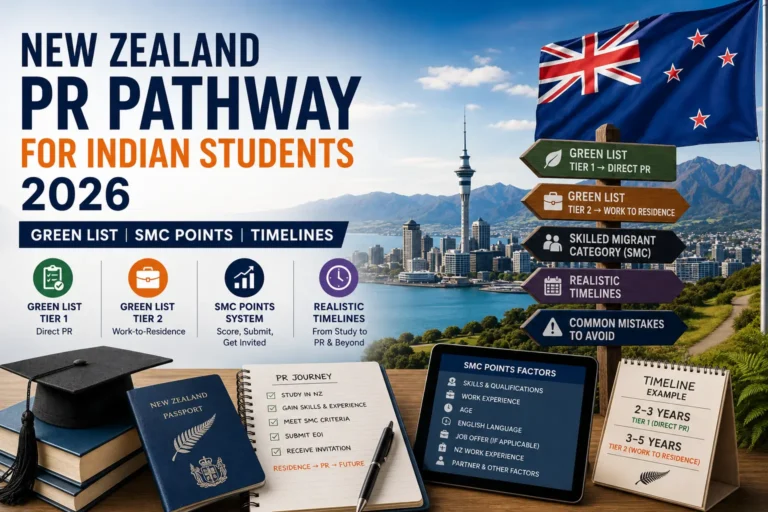
New Zealand PR Pathway for Indian Students 2026 — Green List, SMC, and Realistic Timelines
Written by Sameer Jadhav, Content Strategist and International Education Research Specialist | Reviewed by Reshma Bokaria, IMFS | Updated: July 2026
New Zealand's Green List is why NZ PR is consistently the fastest and most predictable settlement pathway available to Indian graduates in qualifying occupations. This guide covers every route — Green List Tier 1 (direct PR), Tier 2 (work to residence), and the Skilled Migrant Category — with realistic timelines, occupation-level eligibility, and the five mistakes that derail most plans.
🆕 India–NZ FTA Impact on PR Planning (Signed April 2026)
The India-NZ FTA (pending ratification) extends PSWV from 3 to 4 years for Indian PhD graduates. This gives doctoral candidates one additional year to find Green List employment or accumulate SMC points before applying for PR. The FTA does not change Green List or SMC requirements themselves — those remain Immigration NZ policy. Source: MFAT NZ 🟢
📋 Key Takeaways — NZ PR Pathway 2026
- Fastest route: Green List Tier 1 — job offer in listed occupation at/above median wage (~NZD $31.61/hr) → direct Resident Visa. No points competition. 🟡 verify median wage at stats.govt.nz
- Tier 2 route: Work in listed occupation for 24 months → apply for residence. Requires an Accredited Employer Work Visa first
- SMC route: Points-based; pass mark 160. For occupations not on Green List 🟢 Immigration NZ
- Realistic timeline — Green List Tier 1: 4–6 years from arrival (study + PSWV + PR application)
- PR processing time: approximately 3–6 months after application lodgement 🟡
- Plan from Day 1: Choose your NZ program based on target Green List occupation — not after graduation
- NZ PR leads to citizenship: 5 years PR + 1,350 days physical presence → NZ passport eligible
- Dual citizenship: NZ allows it — check Indian citizenship rules separately (India generally does not permit dual citizenship)
Quick Answer — How to Get PR in NZ as an Indian Student
Study in NZ (2 years) → PSWV (up to 3 years) → find Green List occupation employment at or above NZ median wage → apply for Resident Visa (Green List Tier 1). This is the most direct route. For occupations not on the Green List, the Skilled Migrant Category (SMC) requires 160 points from age, employment, and qualifications. Plan from your program selection — not after graduation.
Two Main PR Routes for Indian Graduates in NZ
| Route | Who It's For | How It Works | Typical Timeline | Evidence |
|---|---|---|---|---|
| Green List Tier 1 (Straight to Residence) | Graduates in listed shortage occupations | Job offer in Tier 1 occupation at or above NZ median wage (~NZD $31.61/hr) → apply directly for Resident Visa | 4–6 years from NZ arrival | 🟢 Immigration NZ |
| Green List Tier 2 (Work to Residence) | Graduates in Tier 2 listed occupations | Accredited Employer Work Visa → work 24 months in Tier 2 occupation → apply for Resident Visa | 5–7 years from NZ arrival | 🟢 Immigration NZ |
| Skilled Migrant Category (SMC) | Skilled workers in any occupation (not just Green List); minimum 160 points | File Expression of Interest (EOI) → selected if 160+ points → invited to apply → submit Resident Visa application | 5–9 years from NZ arrival | 🟢 Immigration NZ |
Green List Tier 1 — Direct PR for Indian Graduates
Green List Tier 1 is the most powerful feature of NZ's immigration system for Indian students in 2026. If your occupation is on the list, you can move from PSWV directly to Resident Visa as soon as you find qualifying employment — no points, no queue, no lottery. 🟢 Immigration NZ
Current Tier 1 Roles (Key for Indian Graduates)
💡 Salary requirement: Green List Tier 1 requires employment at or above NZ's median wage (approximately NZD $31.61/hour as of 2026). 🟡 Verify current median wage at stats.govt.nz. A job offer in a Tier 1 occupation below the median wage does NOT qualify. Discuss salary negotiation strategy with IMFS before accepting an offer.
✅ For software engineers: Software Engineer / Developer is Tier 1. This covers the largest single occupational group among Indian IT graduates choosing NZ. Starting salaries for software engineers in Auckland typically range NZD $70,000–$100,000/year — well above the median wage threshold. Green List PR is genuinely achievable for this profile. 🟡
Green List Tier 2 — Work to Residence
Tier 2 requires 24 months of employment in the listed occupation under an Accredited Employer Work Visa before applying for residence. You still need a job offer, but the salary requirement is lower and the PR application comes after 24 months of NZ employment rather than immediately. 🟢 Immigration NZ
Current Tier 2 Roles (Key for Indian Graduates)
Employer Accreditation — AEWV and JobCheck Explained
Before a New Zealand employer can hire someone on a Green List Tier 2 visa or certain Tier 1 pathways, they must complete two processes: become an Accredited Employer and pass a JobCheck. Understanding this protects you from job offers that will not lead to a valid visa. 🟢 Immigration NZ
What Is the Accredited Employer Work Visa (AEWV)?
The AEWV is the main work visa type through which employers hire skilled migrants in New Zealand. For you as a student or PSWV holder, this matters because Green List Tier 2 requires your employer to be accredited. Tier 1 (Straight to Residence) does not require AEWV — but verifying accreditation status before accepting any offer is good practice.
| Accreditation Type | Who It Covers | What It Means for You |
|---|---|---|
| Standard Accreditation | Employers hiring 1–5 migrants/year | Most SMEs and mid-size companies. Valid 12 months, renewable. Sufficient for Tier 2 hiring. |
| High Volume Accreditation | Employers hiring 6+ migrants/year | Large employers, hospitals, construction firms. More rigorous requirements but more hiring capacity. |
What Is JobCheck?
Before hiring a migrant on AEWV, the employer must post the role through Immigration NZ's JobCheck system, which verifies: (1) the role is genuinely needed, (2) the employer has tried to hire locally first (labour market test), and (3) the pay meets minimum thresholds. Only after JobCheck approval can they make you a formal visa-eligible offer. 🟢 Immigration NZ
💡 How to check if an employer is accredited: Use Immigration NZ's EmployerCheck tool at immigration.govt.nz/employercheck — search by employer name or NZBN. Always verify before investing time in an interview process. An employer who is not accredited cannot legally sponsor your Tier 2 visa, regardless of what the job offer says.
⚠️ What happens if your employer loses accreditation while you are employed on an AEWV: your visa does not automatically cancel, but you are at risk. Immigration NZ requires you to find a new accredited employer or apply to change visa status. Maintain awareness of your employer's accreditation renewal dates — ask HR annually.
📌 For Indian students still in NZ on PSWV: You can work for any employer on PSWV — no accreditation required. Accreditation only becomes relevant when you apply to convert your PSWV to an AEWV for Green List Tier 2, or when your PR application requires evidence of Tier 2 employment. Plan the employer conversation before you need the visa change, not after.
Skilled Migrant Category (SMC) — Points Guide
For occupations not on the Green List, SMC is the primary PR route. Pass mark: 160 points (as of 2024-26). 🟢 Immigration NZ
📌 SMC EOI process: Submit Expression of Interest (EOI) → if 160+ points, EOI is selected → receive Invitation to Apply → lodge Resident Visa application. Selections happen in batches. Source: Immigration NZ. 🟢
| Factor | Condition | Points |
|---|---|---|
| Age | 20–25 years | 30 |
| Age | 26–35 years | 20 |
| Age | 36–45 years | 10 |
| Age | 46–55 years | 5 |
| Skilled employment (NZ) | Current skilled job in NZ | 50 |
| Skilled employment bonus | Job offer or employed <3 months in NZ | +10 |
| NZ qualification | Level 7+ (bachelor's or higher) from NZ institution | 50 |
| Overseas qualification | Recognised overseas degree (may need NZQA assessment) | 40 |
| NZ work experience | 2+ years skilled work in NZ | +10 |
| Partner points | Partner with skilled employment or NZ qualification | 20 |
| PASS MARK | 160 |
💡 Typical Indian graduate profile: Age 26–30 (20 pts) + skilled NZ employment (60 pts) + NZ master's degree (50 pts) + 2 years NZ work (10 pts) + employed partner (20 pts) = 160 points. Many Indian students can reach 160 with a combination of NZ qualification + NZ skilled employment + age points — without needing a partner's contribution. Verify current points schedule at immigration.govt.nz. 🟡
Salary Threshold Mechanics — How the Median Wage Works
The NZ median wage is the single most consequential number in NZ PR planning. It determines Green List Tier 1 eligibility and affects SMC points. Most students know the figure but few understand how it is calculated, what counts toward it, and how to protect their PR eligibility when negotiating an offer. 🟡 Stats NZ · verify current rate at stats.govt.nz
How Stats NZ Calculates the Median Wage
The NZ median wage is derived from the Household Labour Force Survey (HLFS), published quarterly by Stats NZ. The figure Immigration NZ uses for Green List Tier 1 is updated periodically — it is not fixed annually. As of 2026, the approximate rate is NZD $31.61/hour, but this will change. Before accepting any job offer with PR eligibility in mind, verify the current rate at stats.govt.nz. 🟡
| Component | Counts Toward Median Wage? | Notes |
|---|---|---|
| Base hourly / salary rate | ✅ Yes — this is the measure | The calculation is based on your base pay rate, converted to an hourly equivalent |
| Overtime pay | ❌ Not counted | Regular overtime earnings do not inflate your base rate for the threshold check |
| Performance bonuses | ❌ Not counted | One-off or variable bonuses are not part of the base rate calculation |
| Allowances (travel, meals) | ❌ Not counted | Expense allowances and non-salary benefits are excluded |
| Employer KiwiSaver contributions | ❌ Not counted | Employer contributions are outside the wage calculation |
| Annual salary ÷ 2,080 hrs | ✅ Standard conversion | Full-time annual salary divided by 2,080 gives the hourly equivalent INZ uses |
Occupation-Specific Salary Reality Check
| Green List Tier 1 Occupation | Typical NZ Starting Salary | Hourly Equivalent | Clears Threshold? |
|---|---|---|---|
| Software Engineer | NZD $70,000–$100,000/yr | NZD $33.65–$48.08/hr | ✅ Comfortably above |
| Registered Nurse (public hospital) | NZD $57,000–$70,000/yr | NZD $27.40–$33.65/hr | ⚠️ Borderline — verify |
| Civil Engineer | NZD $65,000–$90,000/yr | NZD $31.25–$43.27/hr | ✅ At or above |
| Construction Project Manager | NZD $80,000–$120,000/yr | NZD $38.46–$57.69/hr | ✅ Above |
| Physiotherapist | NZD $60,000–$80,000/yr | NZD $28.85–$38.46/hr | ⚠️ Lower end — negotiate |
| Pharmacist | NZD $65,000–$90,000/yr | NZD $31.25–$43.27/hr | ✅ At or above |
Salary ranges are indicative estimates based on NZ market data, July 2026. Verify current median wage at stats.govt.nz and specific offer at time of negotiation. 🟡
💡 Before accepting any offer: (1) Get the base hourly rate in writing in your employment agreement. (2) Verify it meets or exceeds the current median wage at stats.govt.nz. (3) If borderline — as nurses and physiotherapists often are — negotiate explicitly. Framing: "I need the base hourly rate to be at or above the NZ median wage for my residence visa application." Most healthcare employers understand this and can accommodate it. Do not accept a role that puts PR eligibility at risk for a marginal salary difference. Talk to IMFS before accepting.
⚠️ If your salary drops below median wage after you start: For example, if you move to part-time, take unpaid leave, or accept a role change with lower pay — your Green List Tier 1 eligibility may be affected. Consult a licensed immigration adviser immediately. Do not assume the existing application is unaffected. 🔴 Verify with Immigration NZ or licensed adviser
NZQA Assessment for Indian Degrees — SMC Points Implications
If your target PR route is the Skilled Migrant Category (SMC) and you hold an overseas qualification, Immigration NZ requires a New Zealand Qualifications Authority (NZQA) assessment to confirm your degree is equivalent to a New Zealand Level 7 or above. Without this, you receive 0 overseas qualification points in your SMC Expression of Interest — a 40-point gap that is very hard to compensate for elsewhere. 🟢 NZQA · Immigration NZ
When You Need a NZQA Assessment
📌 NZQA assessment is required for SMC if: You are claiming 40 points for an overseas qualification in your EOI. It is NOT required if you completed a NZ qualification (which automatically receives 50 points with no assessment needed). If your only PR route is Green List Tier 1 or Tier 2 (not SMC), NZQA assessment is also not required for the PR application — though it may be required separately for professional registration (e.g., Engineering NZ, Nursing Council).
| Detail | Information |
|---|---|
| Assessment body | New Zealand Qualifications Authority (NZQA) — nzqa.govt.nz |
| What NZQA assesses | Institution recognition, qualification level (NZ equivalent), and field of study |
| Cost | Approximately NZD $565 for a standard international qualification assessment 🟡 verify current fee at nzqa.govt.nz |
| Processing time | Approximately 8–12 weeks from complete application submission 🟡 |
| Can apply from India? | Yes — NZQA assessments can be done offshore. You do not need to be in NZ. |
| Documents required | Certified copies of degree certificate and transcripts, proof of institution recognition |
| Result | NZQA issues a formal Statement of Comparability — submit this with your SMC EOI |
Indian Degrees — What Typically Qualifies
Indian bachelor's degrees (3 or 4 years) from UGC-recognised universities typically assess as NZ Level 7 equivalents. Master's degrees typically assess as NZ Level 8 or 9. NAAC-accredited institutions and those on NZQA's recognised institution list go through more smoothly. Degrees from deemed universities or private institutions with limited UGC recognition may require additional documentation. 🟡 NZQA assessment outcomes vary by institution
💡 Do not confuse NZQA assessment with professional registration. They are separate processes: NZQA assessment is for SMC immigration points only. Professional registration (Engineering NZ / IPENZ for engineers, Nursing Council NZ for nurses, Pharmacy Council NZ for pharmacists) is required to practise your profession in NZ — and is a separate application with separate fees and requirements. Both may be needed, but through different channels on different timelines.
SMC Points Impact — Before vs After NZQA
| Scenario | Overseas Qual Points | Example Total | Reaches 160? |
|---|---|---|---|
| Indian degree, no NZQA assessment filed | 0 pts | Age 28 (20) + NZ employment (60) + 0 = 80 pts | ❌ No |
| Indian degree, NZQA assessment = NZ Level 7+ | 40 pts | Age 28 (20) + NZ employment (60) + 40 = 120 pts | ⚠️ Still needs more |
| Indian degree (NZQA 40) + 2 yrs NZ work + partner | 40 pts | 20 + 60 + 40 + 10 + 20 = 150 pts | ⚠️ Close — needs 10 more |
| NZ master's degree instead (no NZQA needed) | 50 pts | 20 + 60 + 50 + 10 = 140 pts | ⚠️ Add partner for 160 |
This table illustrates how NZQA assessment affects SMC points. Verify current points schedule at immigration.govt.nz before filing EOI. 🟡
✅ IMFS counsellors assess your NZQA eligibility and SMC points profile as part of PR planning — including whether your Indian degree is likely to receive a Level 7+ assessment, and whether completing a NZ qualification would give you a better points outcome. This assessment happens at program selection stage, not after arrival. Free session: imfs.co.in/contact-us →
Realistic PR Timelines — What to Expect
Green List Tier 1 — Fastest Route
Total Tier 1 timeline: 3.5–5 years from NZ arrival for most Indian graduates. 🟡
SMC Route — Less Direct But Available for All Occupations
Total SMC timeline: 5–9 years from NZ arrival. 🟡
5 Mistakes That Derail NZ PR Plans
Choosing a program in a non-Green-List occupation without an SMC strategy
Map your target occupation to the Green List before choosing your NZ program. If not listed: calculate your SMC points profile. IMFS counsellors do this assessment at the program selection stage — before you apply.
Assuming the PSWV is a PR pathway
PSWV is work authorisation only — not residence. It gives you up to 3 years to find Green List employment or accumulate SMC points. Many students mistake PSWV for PR and don't plan the next step until they're close to expiry.
Accepting a Green List job offer below median wage
Green List Tier 1 requires at or above median wage (~NZD $31.61/hr). A job offer in a Tier 1 occupation below this threshold does not qualify. Verify the current median wage at stats.govt.nz before accepting. Don't trade PR eligibility for a slightly higher title or a more interesting role.
Employment gaps reducing SMC points
SMC skilled employment points require continuous skilled NZ employment. Returning to India for extended periods, taking unskilled gap work, or changing to a lower-skill role can reduce your points or reset your work experience calculation. Maintain your NZ employment record carefully during the PSWV period.
If I Were You — PR Strategy by Student Profile
| Your Profile | Best Route | First Step |
|---|---|---|
| Software engineer / developer | Green List Tier 1 | Choose any NZ CS / SE program → build NZ portfolio during PSWV → target NZD $75K+ role |
| Registered nurse | Green List Tier 1 | Otago or AUT nursing program → Nursing Council NZ registration → hospital or clinic employment |
| Civil or structural engineer | Green List Tier 1 | Canterbury or Auckland engineering degree → NZ engineering firms actively hire; IPENZ registration helps |
| Accountant (general) | Green List Tier 2 | Waikato / AUT accounting program → Tier 2 AEWV → 24 months → PR application |
| Data scientist / IT analyst | Green List Tier 2 or SMC | CS/IT postgrad → verify role classification → plan 24-month Tier 2 or accumulate SMC points |
| MBA / management graduate | SMC | Auckland MBA → management role → target 160+ SMC points (NZ qual 50 + skilled employment 60 + age 20+) |
| Doctor / medical officer | Green List Tier 1 | NZMC registration → medical role at or above median → direct PR |
| Physiotherapist | Green List Tier 1 | Otago physiotherapy → Physiotherapy Board NZ registration → hospital or clinic → direct PR |
📊 IMFS Annual Outlook — NZ PR Pathway, 2026–27
Immigration NZ reviews the Green List periodically. IMFS expects 2026-27 to include additions in data science, specific construction roles, and possibly some digital health roles. Indian students in adjacent fields should monitor immigration.govt.nz.
The 160-point pass mark has been consistent through 2024-26. IMFS does not anticipate a significant change in 2026-27. Students approaching 160 points should file EOIs promptly — batch selection timing is unpredictable.
Once the India-NZ FTA is ratified (expected late 2026), Indian PhD students gain a 4-year PSWV — one additional year to find Tier 1 employment or accumulate SMC points. Meaningful additional planning time for doctoral graduates.
IMFS Expert View — Reviewed July 2026
The NZ Green List, introduced in July 2022 and expanded since, represents the most significant change in NZ immigration in a decade for Indian students specifically. For graduates in software engineering, nursing, civil and electrical engineering, and healthcare — NZ's PR pathway is genuinely unmatched globally in terms of directness and predictability.
The key insight we give every family: PR planning starts at program selection, not after graduation. A student who chooses an NZ program in a Tier 1 occupation, studies for 2 years, finds a qualifying role in Year 3, and applies in Year 4 can hold NZ PR by Year 4–5. That is faster than any equivalent pathway in Australia, Canada, UK, or USA for Indian nationals in the current policy environment.
The most common planning failure we see: students who chose programs without mapping their occupation to the Green List, and arrive at PSWV stage without a clear pathway. Our guidance is to do this mapping before applying, not after arriving.
— IMFS Counselling Team, reviewed July 2026. Not immigration legal advice — verify all requirements at immigration.govt.nz before making decisions.
Map Your NZ PR Pathway — Free IMFS Session
We assess your degree, target occupation, and Green List eligibility — and build your specific PR timeline. At all 10 IMFS branches and online.
NZ PR Pathway — All FAQs
How can Indian students get PR in New Zealand?
Three main routes: (1) Green List Tier 1 — job in listed occupation at/above NZ median wage → direct Resident Visa. (2) Green List Tier 2 — 24 months employment in Tier 2 occupation → Resident Visa. (3) SMC — 160+ points from age, NZ employment, NZ qualification. Green List Tier 1 is the fastest for qualifying occupations. Source: Immigration NZ. 🟢
What is the NZ Green List and which Indian graduates qualify?
The Green List is NZ's shortage occupation list for direct or work-to-residence PR. Tier 1 (direct): software engineers, nurses, civil/electrical/mechanical engineers, doctors, physiotherapists, pharmacists, construction project managers, midwives. Tier 2: accountants, IT architects, data scientists, secondary teachers. Always verify at immigration.govt.nz. 🟢
How long does it take to get PR in NZ as an Indian student?
Green List Tier 1: approximately 4–6 years from NZ arrival (2 years study + PSWV job search + application processing). Tier 2: 5–7 years. SMC: 5–9 years. These are ranges — faster is possible for students who find qualifying employment quickly. 🟡
What is the salary requirement for Green List Tier 1?
Employment at or above NZ median wage — approximately NZD $31.61/hour as of 2026. Verify current rate at stats.govt.nz before applying. Below-median salary = not eligible for Tier 1 regardless of occupation. 🟡 verify at stats.govt.nz
What is the SMC points pass mark?
160 points (as of 2024-26). Key contributors: age 26-35 = 20 pts; NZ skilled employment = 50-60 pts; NZ master's degree = 50 pts; 2 years NZ experience = +10 pts; partner in skilled NZ role = 20 pts. Many Indian graduates with NZ qualification + NZ employment can reach 160. Source: Immigration NZ. 🟢
Does the India-NZ FTA improve the PR pathway?
Indirectly. The India-NZ FTA (pending ratification) extends PSWV to 4 years for Indian PhD graduates — one additional year to find Tier 1 employment or accumulate SMC points. The FTA does not change Green List requirements or SMC pass mark. Source: MFAT NZ. 🟢
Can I get NZ PR directly after graduation?
Not immediately — you need the PSWV to legally work post-graduation. But the sequence is: graduation → PSWV → Tier 1 employment → PR application → Resident Visa. Some graduates secure Tier 1 employment within months of graduation and can lodge PR applications in Year 3 from arrival. 🟡
Which NZ universities lead to Green List occupations?
Engineering (Tier 1): Auckland, Canterbury, Massey. Software engineering: all 8 NZ universities. Nursing/health: Otago (premier), AUT. Construction management: Massey, AUT. Physiotherapy, pharmacy, midwifery: Otago, AUT. Map your target Green List occupation to program before applying. See NZ university IELTS requirements guide.
What are the most common PR planning mistakes?
(1) Choosing a non-Green-List occupation without SMC planning. (2) Treating PSWV as PR. (3) Accepting a Tier 1 job below median wage. (4) Employment gaps reducing SMC points. (5) Not checking if overseas qualification needs NZQA assessment for SMC. See the mistakes section above for solutions. 🟡 IMFS counselling data
How does NZ PR compare to Australia and Canada?
Green List Tier 1 (4-6 years) is faster and more certain than Australia SkillSelect (7-10+ years for competitive occupations), Canada Express Entry (8-12 years for many Indians), UK ILR (9+ years employer-dependent), and USA EB-2 India (~50-year backlog). For Indian graduates in Green List occupations: NZ has the best settlement probability of any major English-speaking destination in 2026. NZ vs Australia comparison.
Does NZ PR lead to citizenship?
Yes. After 5 years on NZ Resident Visa with at least 1,350 days physical presence in NZ, you can apply for NZ citizenship. NZ citizenship = NZ passport (visa-free/on-arrival to ~185 countries). NZ allows dual citizenship — but check Indian citizenship rules: India generally does not permit dual citizenship (Indian Citizenship Act). 🟢 Immigration NZ / Indian Citizenship Act
Does IMFS help with NZ PR planning?
Yes — at all 10 IMFS branches. We do occupation-level Green List mapping, SMC points calculation, program selection aligned to PR goals, and timeline planning. This assessment is done at the stage before you apply for your NZ program — not after you arrive. Free session: imfs.co.in/contact-us or WhatsApp: wa.me/919322509674
About This Guide
Written by Sameer Jadhav, Content Strategist and International Education Research Specialist, IMFS. Reviewed by Reshma Bokaria, IMFS.
Data sources: Immigration NZ (immigration.govt.nz), Stats NZ (stats.govt.nz), MFAT NZ (India-NZ FTA, April 2026). Last reviewed: July 2026. Immigration requirements change — always verify at immigration.govt.nz before making decisions. 🔴 Not immigration legal advice