
SAT Prep Guide for Indian Students
SAT vs ACT for Indian Students: Which Test Should You Take?
Reviewed by Sarita Sinha, Senior Counselor - Undergraduate, MBA, PhD and Ivy League Admissions | Written by Sameer Jadhav, Content Strategist and International Education Research Specialist | Updated: July 2026
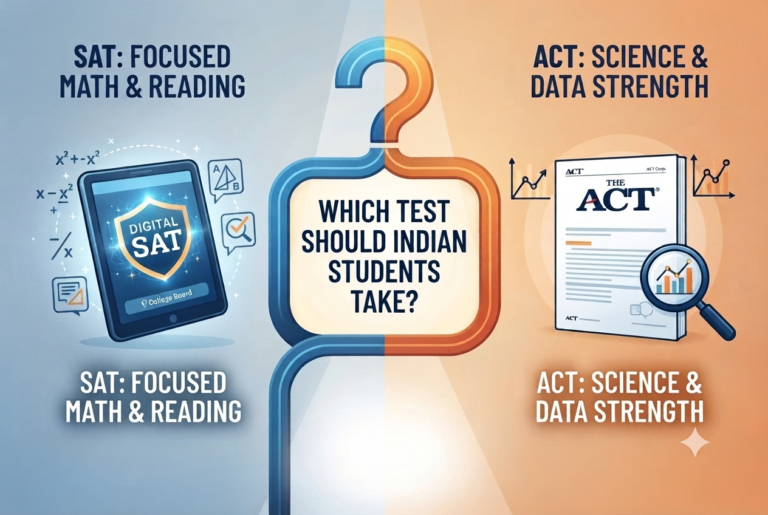
For most Indian students applying to U.S. undergraduate programs, the SAT is the safer first choice. It has no Science section, gives more breathing room per question, and its Math aligns well with CBSE, ICSE, state board, and JEE foundation preparation. Choose the ACT only if you read fast, handle data-heavy science passages well, and perform better on an ACT diagnostic mock.
Every year, Indian students preparing for U.S. undergraduate admissions ask one common question: should I take the SAT or the ACT? Both exams are accepted by U.S. universities, but choosing the wrong test can cost valuable preparation time, retake fees, scholarship timing, and application focus. This guide explains the difference from an Indian student's perspective and helps you make a decision you can act on.
Summary: SAT vs ACT in 60 Seconds
- If you are an Indian student choosing for U.S. admissions, start with the SAT unless an ACT diagnostic clearly suits you better.
- The digital SAT has Reading and Writing plus Math, takes 2 hours 14 minutes, and has no Science section.
- The ACT has English, Math, Reading, optional Science, and optional Writing. Its core Composite score is based on English, Math, and Reading.
- If your board Math is strong but Reading speed is average, the SAT is usually more comfortable.
- If you enjoy fast-paced tests and can interpret charts, experiments, and data quickly, the ACT may fit you.
- Parents should budget about USD 111, approximately INR 9,400 using an approximate conversion for illustration. Exchange rates, bank charges, card fees, and taxes vary.
- You should take one SAT diagnostic and one ACT diagnostic after Class 10 boards or early in Class 11, then commit to one test.
- U.S. colleges generally accept both. Your stronger score matters more than whether the score is SAT or ACT.
Short Answer: SAT or ACT, Which Is Better?
For most Indian students, the SAT is better because College Board's current SAT structure has no separate Science section, and its Math usually matches Indian school preparation more naturally. The ACT is better if you are a fast reader, like a predictable non-adaptive test, and can manage Science-style data questions without extra stress.
In One Minute: What Should You Do?
| Your situation | Recommended action | Why IMFS recommends it |
|---|---|---|
| You are in Class 10 and boards just ended | Take one SAT and one ACT diagnostic in April-June | You still have time to choose calmly before Class 11 starts. |
| You are strong in Math but average in reading speed | Start with SAT | Indian students in this profile usually lose fewer marks to pacing on the SAT. |
| You read fast and enjoy graphs or experiments | Try an ACT diagnostic seriously | ACT Science can become an advantage if data interpretation is already natural. |
| You are in Class 12 and applying soon | Choose the stronger diagnostic, not the popular test | You may not have enough time to recover from choosing the wrong exam. |
| Your goal is U.S. top-50 or scholarship-sensitive universities | Start with SAT unless ACT diagnostics are clearly stronger | A strong score can support admissions or scholarship review where universities consider testing. |
| Your shortlist is fully test-blind | Focus on profile, grades, essays, and requirements | Do not spend test-prep time where scores will not be considered. |
SAT vs ACT: Quick Comparison for India
| Factor | SAT | ACT | What it means for you |
|---|---|---|---|
| Best fit | Strong Math, steady reading, prefers fewer sections | Fast reader, comfortable with Science data | Choose the format that gives your higher diagnostic score. |
| Sections | Reading and Writing; Math | English; Math; Reading; optional Science; optional Writing | SAT is simpler if your schedule is packed with boards or JEE. |
| Time | 2 hours 14 minutes | 2 hours 5 minutes for Composite score; optional sections add time | ACT is shorter for the core score but usually feels faster question by question. |
| Scoring | 400-1600 | 1-36 Composite | Use official concordance tables when comparing scores. |
| Science | No Science section | Optional Science section | ACT Science is data reasoning, not CBSE Biology/Chemistry/Physics theory. |
| Format | Digital and adaptive | Linear | SAT rewards accuracy in early modules; ACT rewards pace across a fixed test. |
Sources: College Board SAT structure, ACT test overview, and ACT/SAT concordance.
Quick Decision Matrix
| You are... | Choose | Reason |
|---|---|---|
| CBSE PCM or state board Science student | SAT first | Math familiarity usually makes SAT the cleaner starting point. |
| IB or Cambridge student | Diagnostic first | Your reading style and curriculum may fit either test. |
| Fast reader with strong data interpretation | ACT diagnostic | ACT pacing and Science data may become an advantage. |
| Strong Math but average English confidence | SAT first | SAT gives a more focused route, but Reading and Writing still need training. |
| Engineering applicant | SAT usually fits | SAT Math often aligns better with Indian STEM preparation. |
| Liberal arts applicant | Diagnostic first | Reading strength, writing skill, and college policy matter more than stream. |
| Unsure | Take both diagnostics | One timed comparison is better than months of guessing. |
Decision Tree: Which Test Should You Take?
Strong Math and moderate reading speed? Choose SAT first.
Fast reader and calm with charts or experiments? Take an ACT diagnostic.
Unsure after school advice or peer pressure? Take both diagnostics.
One diagnostic clearly higher? Prepare only for that exam.
Both diagnostics close? Choose the test that fits your Class 11 or Class 12 calendar better.
Why the SAT Usually Fits Indian Students Better
The SAT usually feels more natural if you are studying in CBSE, ICSE, IB, Cambridge, or a state board and want one clear testing route for U.S. undergraduate admissions. You prepare for Reading and Writing, then Math. There is no extra Science reasoning section to learn.
For many Indian students, SAT Math also feels closer to school and entrance-test preparation. Algebra, functions, data analysis, and problem solving overlap with the way you already practise for board exams and, in some cases, JEE foundation.
The Reading and Writing section still needs training. It is not a vocabulary test you can solve by memorising word lists. You need grammar, inference, punctuation, and the habit of reading short passages carefully.
Based on IMFS counselling conversations, students often underestimate Reading and Writing because the passages look short. Our faculty usually recommends a full diagnostic before choosing prep material, because careless grammar errors can hide inside a "good at English" profile.
When the ACT Can Be the Better Choice
The ACT can be better if you are quick, calm, and accurate under time pressure. It suits students who do not like adaptive testing and prefer knowing that every student sees the same linear structure.
ACT Science is often misunderstood in India. It is not a test of whether you remember Class 11 Chemistry reactions or Biology definitions. It measures how quickly you can read experiments, tables, graphs, and scientific arguments.
If you enjoy data interpretation in school, Olympiad-style reasoning, or JEE Main graph questions, you may like ACT Science. But if Reading already feels rushed, ACT Science can add avoidable stress.
IMFS counsellors usually recommend ACT only when the diagnostic proves it. A student who likes Science as a subject is not automatically an ACT student.
What IMFS Has Observed from Indian Student Diagnostics and Counselling
Many CBSE and state board students adapt faster to SAT Math than to ACT pacing. The SAT is not easy, but its Math section often feels closer to familiar school and JEE-foundation problem solving.
JEE-focused students often underestimate SAT Reading and Writing. They may solve Math quickly, then lose score because they treat grammar, inference, punctuation, and short passages as "English, so manageable."
The biggest waste IMFS sees is repeated switching. Families sometimes spend 2-3 months asking whether SAT or ACT is better, instead of taking both diagnostics once and committing to the stronger route.
A second SAT attempt can produce meaningful improvement when it follows structured error analysis. A retake helps only when you know whether mistakes came from concept gaps, pacing, careless reading, weak grammar, or test strategy.
ACT Science is also misunderstood by many Indian families. It is not school science. It is graph, table, experiment, and data reasoning under time pressure.
Real Counselling Patterns IMFS Sees
| Student pattern | What usually happens | IMFS counselling response |
|---|---|---|
| JEE Advanced + SAT applicant | Strong quantitative ability, but Reading and Writing errors reduce the total SAT score. | Keep SAT Math sharp, but build a structured grammar and passage-review routine early. |
| CBSE PCM student with average reading speed | SAT Math improves faster than ACT Reading or Science pacing. | Choose SAT first unless the ACT diagnostic is clearly stronger. |
| IB or Cambridge student with strong reading habits | ACT can sometimes fit because longer reading sets and data passages feel less intimidating. | Use diagnostics, not board type alone, to choose between SAT and ACT. |
| Class 12 student starting late | There is limited room for experimentation and retakes. | Pick the stronger diagnostic immediately and align it with the application calendar. |
What Happens If You Choose the Wrong Test?
The biggest cost is time. If you spend two or three months preparing for the wrong exam, you may lose the clean window for diagnostics, school exams, application essays, and retakes.
The second cost is money. Wrong-test prep can mean extra coaching, extra mocks, extra registration fees, and more travel to test centres. Parents often notice this only after the first score disappoints.
The third cost is opportunity. A delayed or weaker score can affect whether you submit a test score, whether you meet priority deadlines, and whether you are ready for scholarship-sensitive review.
The fix is simple: take both diagnostics early, compare results honestly, choose one test, and review errors before booking a retake.
University Strategy: Where Scores Help
U.S. universities generally accept both SAT and ACT. The bigger strategy is whether your score should be submitted, required, ignored, or used for scholarships.
| University type | Typical testing strategy | Example policy signal |
|---|---|---|
| Ivy League / highly selective | A strong SAT or ACT may be required or may strengthen the file if submitted. | Harvard announced standardized testing is required again for fall 2025 admission. Source: AP News. |
| Large public universities | SAT/ACT can support admission review and sometimes scholarship timing. | Purdue says it accepts both, has no preference, and advises spring testing before the Early Action scholarship deadline. Source: Purdue Undergraduate Admissions. |
| Liberal arts colleges | Holistic review is common; test policies vary widely. | Check each college's official admissions page before deciding to submit or skip. |
| Test-blind universities | Do not spend prep time for that university alone. | If a university states it is test-blind, verify that policy on the official admissions page before building your test plan. |
If your shortlist includes highly selective colleges, connect your test plan with U.S. university applications, profile building, essays, and course rigor. For top-choice planning, also read the IMFS guide on which Ivy League university is right for you.
Parent Checklist Before Paying for Coaching
- Budget for two attempts, but do not assume two attempts are always needed.
- Do not delay diagnostics until Class 12 if your child is targeting U.S. undergraduate admissions.
- Focus on one exam after diagnostics. Preparing for both can waste time and money.
- Avoid comparing your child with classmates. Test fit depends on pacing, reading style, Math strength, and target universities.
- Build the university shortlist alongside test prep, not after the score arrives.
- Check whether each university is test-required, test-optional, test-flexible, or test-blind.
For parents, the decision is not only SAT versus ACT. It is score potential, application timing, scholarship possibility, and stress management. IMFS counsellors assess your child's realistic target range before recommending a prep route.
How IMFS Conducts SAT vs ACT Diagnostics
IMFS starts with a timed SAT-style diagnostic and a timed ACT-style diagnostic. The goal is not to declare one test "easy"; it is to compare how your score behaves under real pacing.
Faculty review the score pattern section by section. For SAT, we look at Reading and Writing accuracy, Math concept gaps, module behaviour, and careless errors. For ACT, we look at English, Math, Reading pace, and Science data handling.
Then the counsellor connects the test result with your school board, stream, Class 11 or Class 12 calendar, target universities, scholarship goals, and likely application timeline.
The recommendation is personal: SAT, ACT, retest diagnostics, or skip testing if your shortlist makes scores irrelevant. This prevents families from spending months on the wrong exam.
Should You Change from SAT to ACT Midway?
Do not switch from SAT to ACT only because one mock score was disappointing. First check whether the issue was content knowledge, pacing, careless reading, weak grammar, or test anxiety.
Switching makes sense if your ACT diagnostic converts clearly higher than your SAT score, your SAT improvement has been flat after structured review, and your application timeline still allows ACT preparation and one official attempt.
Switching usually does not make sense if you are already close to your SAT target, if your deadline is near, or if ACT Reading and Science feel rushed. In those cases, deeper SAT error analysis is often better than starting a new test.
IMFS counsellors usually ask for three data points before recommending a switch: your latest SAT mock, one timed ACT diagnostic, and your university deadline calendar.
Cost and Scholarship Strategy
For one international SAT attempt, College Board lists a USD 68 registration fee plus a USD 43 international fee. That is USD 111 before extra charges, which is approximately INR 9,400 using an approximate conversion for illustration. Exchange rates, card fees, bank charges, and taxes vary.
Parents should budget for at least two possible attempts. Not every student needs a retake, but planning for one prevents last-minute stress if the first score is slightly below target.
Scholarships are never guaranteed by SAT or ACT scores alone. Universities may consider grades, curriculum strength, essays, leadership, activities, financial need, and institutional priorities. A strong score can help at some universities, but it is one part of a larger merit review.
At IMFS, we usually connect test prep with scholarship shortlisting early. If your goal is to reduce total cost, read the IMFS guide to scholarships for Indian students in the USA before finalising your target score.
Timeline: When Should You Decide?
If you are in Class 10, wait until board exams are over, then take one SAT diagnostic and one ACT diagnostic. April to June is a clean decision window because Class 11 usually begins around June.
If you are in Class 11, decide within the first term. You can prepare for 3-6 months, take a first official attempt, and still have time for a retake before application deadlines.
If you are in Class 12, choose the test that needs the least new learning. This is usually the SAT for Indian students, unless your ACT diagnostic is already clearly higher.
College Board lists SAT dates from August 2026 through June 2027, including August, September, October, November, December, March, May, and June dates. Check SAT exam registration steps and SAT test centres in India early because seats in major cities can fill quickly.
Common Mistakes Indian Students Make
| Mistake | Why it hurts | Better move |
|---|---|---|
| Preparing for SAT and ACT simultaneously | Your practice gets diluted and scores rise slowly. | Compare once, then commit to one exam. |
| Ignoring Reading and Writing | Strong Math alone cannot carry a top SAT score. | Track grammar, inference, and punctuation errors from the first mock. |
| Taking the first attempt too late | You lose retake flexibility before deadlines. | Plan the first attempt in Class 11 or early Class 12 where possible. |
| Retaking without analysing mistakes | The second score may stay flat. | Use an error log before booking the next test date. |
| Using only unofficial practice tests | The difficulty and scoring may mislead you. | Use official-style diagnostics and review them with a faculty plan. |
Who Should Skip the SAT or ACT?
You should skip SAT or ACT prep if every university on your shortlist is genuinely test-blind. In that case, your time is better spent on grades, essays, activities, portfolio, or course-specific requirements.
You may also skip these tests if you are applying only to countries or pathways where SAT/ACT has little value. Some U.K., Europe, Canada, or India-based routes may care more about board marks, subject prerequisites, IELTS/TOEFL, portfolios, or entrance tests.
Students targeting Germany, Ireland, or many European undergraduate programmes generally do not need SAT or ACT unless a specific university, scholarship, or English-taught programme asks for it. Always verify the exact programme page before deciding.
Do not skip only because the exam feels difficult. A diagnostic is a low-risk way to find out whether you have score potential. Many students discover that SAT Math is more manageable than expected once the format becomes familiar.
If English proficiency tests are also part of your plan, compare IELTS vs TOEFL separately. SAT and ACT are admissions tests; IELTS and TOEFL are English proficiency tests.
Final IMFS Recommendation
If you are an Indian student targeting U.S. undergraduate admissions, begin with a diagnostic-first plan. For most students, SAT is the practical starting point because it is shorter, has no Science section, and fits Indian Math preparation well.
Choose ACT only when your diagnostic proves that your reading speed and data interpretation are stronger than your SAT fit. Once you choose, prepare for one exam with a clear target score, official-style mocks, and a university shortlist.
The right choice is rarely SAT versus ACT. The right choice is selecting the test that maximises your admission and scholarship potential while fitting your academic strengths.
Test policies change frequently. Always verify current university requirements before applying. If your larger goal is the U.S., also read Why Study in USA, the guide to a bachelor's degree in the USA, and the SAT scoring guide.
Find Out Which Test Suits You
Take a diagnostic before you spend months preparing. IMFS will help you compare your SAT and ACT fit, set a target score, and plan the next step.
FAQs on SAT vs ACT for Indian Students
Is SAT easier than ACT for Indian students?
For many Indian students, the SAT feels easier because it has no Science section, gives slightly more time per question, and has Math that overlaps well with CBSE, ICSE, state board, and JEE foundation work. The ACT can be better if you read fast, handle data-heavy science passages calmly, and prefer a non-adaptive test.
Is it better to take the SAT or ACT?
It is better to take the test that gives you the higher percentile after one diagnostic mock of each. Do not choose only because friends are taking one test. If your SAT Math is strong and ACT Reading feels rushed, choose SAT. If ACT English, Reading, and Science data feel natural, choose ACT.
Do colleges prefer SAT or ACT?
U.S. colleges do not usually prefer the SAT over the ACT or the ACT over the SAT. ACT states that both tests are accepted at accredited U.S. colleges and universities, including Ivy League institutions. Your stronger score matters more than the test name.
What is the main difference between SAT and ACT?
The SAT is a digital adaptive test with Reading and Writing plus Math. The ACT is a linear test with English, Math, Reading, and optional Science and Writing. For Indian students, the biggest practical differences are pacing, Science data interpretation, adaptive scoring, and how each test fits school and coaching schedules.
Should I take both SAT and ACT?
You should usually take one diagnostic mock of both tests, then focus on one exam. Preparing seriously for both can split your time during Class 11 or Class 12, especially if you also have boards, APs, JEE, activities, and application essays. Take both official exams only if both diagnostics are close.
Which test is better for scholarships, SAT or ACT?
Both SAT and ACT scores can support merit scholarship applications where universities consider test scores. For parents, the practical question is not SAT versus ACT; it is which test can realistically produce the stronger score before application deadlines. A higher score can improve scholarship chances at some universities, but policies vary by institution.
Can Indian students take the digital SAT from home?
No. Indian students must take the SAT at an official test center. The SAT is digital, but it is not a home-based exam. You need to register through College Board, install Bluebook, carry the right ID, and reach the test center on time.
When should an Indian student decide between SAT and ACT?
The best time is after Class 10 boards or early in Class 11. That gives you enough room for diagnostics, 3-6 months of focused preparation, one official attempt, and one retake before U.S. university deadlines. Class 12 students can still decide, but the margin for retakes is smaller.
Does the SAT or ACT save more money for parents?
Neither test automatically saves more money. The saving comes from choosing the test your child can score higher on with fewer attempts. A stronger score may support merit scholarship consideration at some universities, while fewer retakes reduce exam fees, coaching fatigue, and travel costs.
Who should skip the SAT or ACT?
You can skip the SAT or ACT if every university on your shortlist is test-blind, if your chosen country or pathway does not value these scores, or if your application deadline is too close for meaningful preparation. Do not skip only because the test feels difficult. First check your target university policy and take a diagnostic.
Should CBSE students choose SAT?
CBSE students should usually start with the SAT diagnostic because SAT Math often feels closer to familiar school and JEE-foundation preparation. But CBSE alone should not decide the test. If your ACT diagnostic is clearly stronger and you handle Reading and Science pacing well, ACT can still be a better fit.
Should JEE students take ACT?
JEE students should not choose ACT only because it has a Science section. ACT Science is mainly data interpretation, graph reading, and experiment reasoning under time pressure. Many JEE students fit SAT better because of Math strength, but a timed ACT diagnostic is useful if you read quickly and enjoy data-heavy questions.
Does ACT Science require Physics, Chemistry, or Biology?
ACT Science does not mainly test school Physics, Chemistry, or Biology theory. It tests how quickly you understand charts, tables, experiments, and scientific arguments. Indian students who are good at data interpretation may like it, but students who expect direct Class 11 or Class 12 science questions are often surprised.
Can I switch from SAT to ACT after preparation?
You can switch from SAT to ACT, but only after comparing a timed ACT diagnostic with your latest SAT mock and checking your application timeline. Do not switch because of one bad SAT score. Switch only if ACT is clearly stronger, SAT improvement has stalled after review, and you still have time for proper ACT preparation.
How many SAT or ACT attempts are ideal?
For most Indian students, one planned attempt and one possible retake is ideal. More attempts are useful only if each retake follows clear error analysis and enough preparation time. Repeating the exam without fixing the reason for mistakes can waste money, increase stress, and delay application work.
Review and Authorship
Reviewed by Sarita Sinha, Senior Counselor - Undergraduate, MBA, PhD and Ivy League Admissions at IMFS.
Written by Sameer Jadhav, Content Strategist and International Education Research Specialist at IMFS. He researches international education pathways, admission trends, testing requirements, and student decision patterns for Indian families planning study abroad.
Explore More from IMFS

