Germany Study Visa Requirements 2026: The Complete Guide for Indian Students
Every visa type, eligibility rule, document, blocked account figure, and residence permit step — plus the new 70% Class 12 rule and dMAT requirement — verified from BAMF, DAAD, APS India, and the German Embassy India.
| What you want to know | The answer |
|---|---|
| Which visa for a degree programme? | National Visa (Type D) — all programmes > 90 days |
| Which visa for a short course? | Schengen Visa (Type C) — programmes ≤ 90 days |
| Is APS certificate mandatory for Indians? | Yes — non-negotiable · ₹18,000 fee · 3–4 weeks typical · aps-india.de |
| 🆕 New 70% Class 12 rule? | Yes — Bachelor's applicants only from Winter 2026/27 (effective 15 Mar 2026) |
| 🆕 dMAT required? | Only for MS in Engg/Business/Commerce/Finance/Econ/Mgmt · Summer 2027+ · €150 |
| Blocked account required (2026)? | €11,904/year (~₹13.09 lakh) · BAMF 2026 |
| Monthly release from blocked account? | €992/month (~₹1.09 lakh) |
| Visa application fee? | €75 adults · €37.50 minors (~₹8,250 / ₹4,125) |
| Visa processing time? | 6–12 weeks; up to 3 months peak season |
| Can I work while studying? | Yes — 120 full days/year (BAMF 2026) |
| Post-study work visa? | 18-month Job Seeker Visa (BAMF 2026) |
| PR possible after studying? | 21 months (B1 German) · 27 months (A1) |
| Dual citizenship with India? | Yes — since 2024 Nationality Act (BMI) |
🎓 IMFS Recommendation — Plan Your Sequence Right
- Start the APS process first — before everything else. It takes 3–4 weeks typically (8–10 weeks in peak season) and cannot be fast-tracked. Students who delay this step routinely miss their intake by a full semester.
- Check whether the 70% Class 12 rule or the dMAT affects you before you plan your timeline. Bachelor's applicants need the 70% Class 12 minimum; certain Master's applicants targeting Summer 2027 need the dMAT by 15 September 2026.
- Open your blocked account 4–6 weeks before your embassy appointment. Expatrio and Fintiba are fully online and practical from India. You need the confirmation letter at your interview.
- Book your embassy appointment the day your APS certificate is in hand. Slots fill weeks ahead, especially March–July. Do not wait.
Germany is home to over 458,000 international students — the second-largest destination for Indian STEM graduates after the USA. The reasons are compelling: public university tuition is zero, the post-study work visa runs 18 months, and PR is achievable in under two years with the right language level. The visa process, however, has a precise sequence, and 2026 added two new checkpoints for Indian applicants: a 70% Class 12 minimum for Bachelor's-level APS certificates, and a new dMAT test for some Master's applicants. This guide covers every requirement, updated for August 2026, so you can plan your timeline without surprises.
🏛️ About This Guide
This guide is maintained by the IMFS Germany counselling team and updated whenever BAMF, DAAD, APS India, or the German Embassy India publishes a policy change — most recently for the 70% Class 12 rule (23 February 2026) and the dMAT announcement (29 June 2026). All figures are cross-referenced with official government and APS India sources and current as of August 2026.
🆕 What's New in 2026 for Indian Applicants
Two changes landed in 2026 that materially affect how Indian students plan their Germany application. Neither replaces the core process below — both add a checkpoint at the APS stage.
1. The New 70% Class 12 Rule (Bachelor's Applicants Only)
| Pathway | Requirement | Outcome |
|---|---|---|
| Studienkolleg pathway | Class XII with ≥ 70% + APS certificate | Subject-restricted admission via Studienkolleg preparatory course |
| Direct admission pathway | Class XII with ≥ 70% + APS certificate + 1 completed academic year of a recognised Bachelor's programme in India | Direct subject-restricted admission to the same or a closely related field (not guaranteed — universities still decide) |
This rule does not affect Master's or PhD applicants. If your Class 12 score is below 70%, the practical route most Indian students use is to complete a Bachelor's degree in India first, then apply directly for a Master's in Germany — the Class 12 threshold simply does not apply at that stage.
2. The New dMAT for Certain Master's Applicants (Summer 2027+)
🆕 dMAT (Digital Master Test)
Announced by APS India and g.a.s.t. on 29 June 2026, the dMAT is now part of the APS documentation requirement for Master's applicants whose undergraduate degree is in Engineering, Business, Commerce, Finance, Economics, or Management — but only if you are applying for Summer Semester 2027 or later. Winter 2026/27 applicants, Bachelor's and PhD applicants, and fields outside those six categories are exempt.
| Detail | 2026 Figure |
|---|---|
| Registration deadline | 15 September 2026 |
| First test date | 26 September 2026 |
| Results available | 12 October 2026 |
| dMAT fee | €150 (≈ ₹16,500 at ₹110/EUR) |
A low dMAT score does not block your APS certificate — the score is shown to universities alongside your APS result, not used as a pass/fail gate by APS itself. Source: aps-india.de/dmat, d-mat.de/en.
For the complete step-by-step on either update, see the IMFS dMAT requirement briefing or the full APS Certificate application guide, which covers both changes in depth alongside the complete document checklist and timeline.
Types of German Student Visas — Which One Do You Need?
Germany issues different visa types depending on the purpose and duration of your studies. Understanding which category applies to you is the first decision in the process.
Tier 1 — Short-Stay vs Long-Stay
Tier 2 — Specialised National Visa Types (Type D)
Within the National Visa category, Germany issues three specific visa types for students:
| Visa Type | Duration | Admission Letter Needed? | APS Required (Indians)? | Converts to Residence Permit? |
|---|---|---|---|---|
| Schengen (C) | Up to 90 days | Programme invitation | Not typically | No |
| Student Visa (D) | 1–2 years (extendable) | Yes — required | Yes — mandatory | Yes |
| Student Applicant (D) | 3–6 months | Proof of application only | Yes — mandatory | Yes — after admission |
| Language Course (D) | Up to 1 year | Language school letter | Usually yes | Case by case |
Who Needs a Student Visa? (Including Exceptions)
Whether you need a visa depends on your nationality and the length of your programme. Here is the complete breakdown for 2026.
| Nationality Group | Programme ≤ 90 days | Programme > 90 days | Key Action Required |
|---|---|---|---|
| 🇮🇳 India (and most non-EU countries) | Schengen Visa (C) | National Visa (D) — mandatory | Apply at German Embassy before travel |
| 🇪🇺 EU / EEA / Switzerland | No visa needed | No visa needed | Register address at local Einwohnermeldeamt only |
| 🇺🇸 🇨🇦 🇦🇺 USA / Canada / Australia | No visa needed (enter visa-free) | No visa needed to enter | Must apply for student residence permit at Ausländerbehörde after arrival |
| 🇬🇧 UK | No visa needed | No visa needed to enter | Must apply for student residence permit after arrival |
Not Sure Which Visa Type — or Which 2026 Rule — Applies to Your Profile?
IMFS counsellors review your admission status, Class 12 score, programme length, and timeline to confirm exactly which visa and pathway applies to you.
Eligibility Criteria for a German Student Visa (Indian Students, 2026)
To be eligible for a German student visa, Indian applicants must satisfy all of the following criteria. Missing any one of these will result in your application being rejected or delayed.
APS Certificate — The Mandatory Step Only Indian Students Face
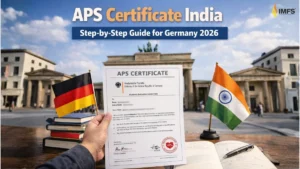
If you're applying from India, the APS (Akademische Prüfstelle) certificate is the single most important thing to start first. It verifies the authenticity of your academic qualifications and is a prerequisite that the German Embassy will not waive.
What APS Verifies
- Authenticity of your 10th, 12th, and Bachelor's degree certificates and marksheets
- That your reported grades match university records
- That your institution is a recognised university (state-approved)
APS Application Process — Step by Step
Visit aps-india.de and create your account. Pay the non-refundable ₹18,000 APS fee online (fastest verification) or by bank transfer. Bachelor's applicants: confirm your Class 12 score meets the 70% threshold before proceeding.
Submit self-attested scanned copies of all certificates and marksheets (10th, 12th, Bachelor's), your passport data page, and a recent passport photograph. Ensure the scans are clear — blurry uploads cause rejections.
If your UG degree is in Engineering, Business, Commerce, Finance, Economics, or Management and you're targeting Summer Semester 2027 or later, register for the dMAT at d-mat.de/en before 15 September 2026 (fee €150). Winter 2026/27 applicants and all other fields can skip this step.
Some applicants are summoned for an in-person document verification meeting at the APS office. This is a factual check — not an academic test. Bring originals and attested copies.
Processing takes approximately 3–4 weeks typically, extending to 8–10 weeks in peak season. Since 24 April 2023, the certificate is issued as a digitally signed PDF sent to your registered email — there is no physical copy — and is valid for 3 years from the date of issue.
Complete Documents Checklist for German Student Visa 2026 (India)
The German Embassy India publishes an official checklist for each visa type. Below is the comprehensive list for the Student Visa (Type D) — the visa required by all degree-seeking Indian students. Bring originals and two full sets of photocopies, organised in this order.
Need Help Preparing Your Germany Visa Document File?
IMFS counsellors review your complete document set — including the 70% rule and dMAT eligibility where relevant — before your embassy appointment.
Blocked Account (Sperrkonto) — How It Works in 2026
A blocked account is Germany's financial safety mechanism for international students. It guarantees that you have enough money to live on — without needing to work illegally. The German government "blocks" the annual amount and releases it to you month by month while you're in Germany.
| Detail | 2026 Requirement | In Rupees (₹110/EUR · August 2026) |
|---|---|---|
| Total deposit required | €11,904 / year | ≈ ₹13,09,440 |
| Monthly release to student | €992 / month | ≈ ₹1,09,120 / month |
| Account activation time | 1–3 weeks (varies by provider) | — |
| One-time setup fee (indicative) | €49–€89 | ≈ ₹5,390–₹9,790 |
Recommended Providers for Indian Students
| Provider | Can Open from India? | Process | Best For |
|---|---|---|---|
| Expatrio | Yes — fully online | Online, designed for international students | Most popular choice for Indian applicants |
| Fintiba | Yes — fully online | SEPA-compliant, English interface | Students who prefer SEPA bank transfer |
| Deutsche Bank | No — in-person in Germany | Requires branch visit in Germany | Students already in Germany on applicant visa |
Step-by-Step: How to Apply for a German Student Visa from India (2026)
The German student visa process for Indian applicants has a strict sequence. Do not start later steps until earlier ones are complete — particularly the APS certificate.
Visit aps-india.de and begin your application immediately — before you even finalise your university list. This step takes 3–4 weeks typically (8–10 weeks in peak season) and cannot be expedited. Delay here cascades into every step that follows.
Apply to recognised German universities through their admissions portals or via uni-assist.de (the central applications portal for international students). Obtain your official admission letter — this is the foundation document for your Student Visa.
If you don't yet have admission and need to travel to Germany for entrance assessments, apply for the Student Applicant Visa instead and complete admission in Germany.
Open your account with Expatrio or Fintiba (both fully online from India) and deposit €11,904. Account activation takes 1–3 weeks. Obtain the official confirmation letter from your provider. Do not book your embassy appointment until you have this confirmation letter.
Compile your complete document file (see checklist above). All documents must be originals plus two sets of photocopies, organised in the sequence specified on india.diplo.de. Have academic certificates notarised if the Embassy's checklist requires it for your specific programme.
Visit india.diplo.de and schedule a visa appointment at the German Embassy or Consulate nearest to you. India has German consular offices in New Delhi, Mumbai, Chennai, Kolkata, and Bengaluru, most of which take appointments through the VFS Global booking portal. Book as early as possible — slots fill weeks in advance, especially between March and July (peak season). Monitor for cancellations if your preferred date is unavailable.
Arrive at least 15 minutes early with your complete document folder. The interview is a factual verification, not an academic test. Expect questions about your programme choice, financial situation, career goals, and intention to comply with visa conditions. Answer clearly and honestly — consular officers are experienced interviewers.
Visa processing typically takes 6–12 weeks from your interview date. During peak season (March–July) it can extend to 3 months. Apply at least 3–4 months before your intended travel date. Once approved, you will be notified to collect your passport with the visa stamp from the Embassy.
📅 Recommended Timeline for Indian Students (2026 Intake)
| Months Before Course Start | Action |
|---|---|
| 6+ months before | Start APS certificate application at aps-india.de (register for dMAT by 15 Sep 2026 if applicable) |
| 5 months before | Submit university applications (uni-assist.de or direct) |
| 4 months before | Open blocked account (Expatrio/Fintiba) + start collecting documents |
| 3 months before | Book embassy appointment as soon as APS + blocked account confirmation ready |
| 2.5 months before | Attend visa interview |
| 1–2 months before | Receive visa + book flights + arrange accommodation |
After Arrival in Germany — Applying for a Student Residence Permit
Your National Visa (Type D) allows you to enter Germany and begin your studies. If your programme exceeds 90 days — and all degree programmes do — you must convert your visa to a student residence permit (Aufenthaltserlaubnis) before your visa expires. This is done at the local Ausländerbehörde (Foreigners' Authority) in your city.
Documents Required for Residence Permit Application
- Completed residence permit application form (from your local Ausländerbehörde)
- Valid passport with current National Visa (Type D)
- Proof of permanent accommodation in Germany (rental contract or university dormitory letter)
- Registration certificate — Meldebescheinigung (obtained after registering your address)
- University enrolment confirmation (Immatrikulationsbescheinigung)
- Proof of financial resources (blocked account confirmation or scholarship letter)
- Valid German statutory health insurance (TK, AOK, Barmer, etc.)
- Application fee — €100 for first issuance
First Steps on Arrival — Checklist
| Action | When | Where | Why |
|---|---|---|---|
| Address registration (Anmeldung) | Within 2 weeks of arrival | Einwohnermeldeamt | Required for residence permit + all official registrations |
| German statutory health insurance | Before university enrolment | TK, AOK, Barmer, or similar | Mandatory for enrolment and residence permit |
| German bank account | First week | N26, Deutsche Bank, Commerzbank | Needed to receive blocked account monthly release |
| Residence permit application | Before visa expires | Ausländerbehörde | Legally required for stays > 90 days |
| Tax ID (Steueridentifikationsnummer) | Automatic after Anmeldung | Posted to your registered address | Required to work legally in Germany |
Post-Study Pathway — Work, PR, and Dual Citizenship (2026 Update)
Germany's post-study pathway is one of the strongest among major study destinations for Indian students. Here is the complete picture, updated for 2026.
| Stage | Visa / Status | Duration | Key Condition |
|---|---|---|---|
| After graduation | Job Seeker Visa | 18 months | Find employment matching your qualification |
| Employed | EU Blue Card / Work permit | Ongoing | Salary ≥ €43,759/year (shortage occupations, BAMF 2026) |
| Permanent Residency (PR) | Niederlassungserlaubnis | After 21 months (B1) or 27 months (A1) | Continuous employment, sufficient pension contributions |
| Naturalisation | German citizenship | After 5 years (expedited) or 3 years (exceptional) | B1 German, clean record, financial self-sufficiency |
| Dual citizenship | Indian + German | Permitted since 2024 | No need to give up Indian citizenship — 2024 Nationality Act (BMI) |
🇩🇪 Why Germany's PR Pathway Stands Out
Compare Germany's 21-month PR pathway with Canada's Express Entry (CRS 480–520+, no guaranteed timeline) or the USA's EB-2/EB-3 green card (50–100+ year backlog for Indians). For Indian STEM graduates who want a clear, legal path to long-term residency, Germany's EU Blue Card route is currently the most direct option available. IMFS Insights tracks how Indian enrolment in Germany has shifted over time — see Germany's Rise as a Study Destination (IMFS Insights INS-006) for the full data. Source: IMFS Insights Team. IMFS Admissions Intelligence Dataset (v2026.1). IMFS, 2026. Available at: https://www.imfs.co.in/insights/
Read our full Germany study guide for the complete admissions, cost, and career picture, or talk to an IMFS counsellor via Master's Counselling if you're comparing Germany against other destinations.
Planning to strengthen your German language level before departure? IMFS's German Language Preparation programme runs from A1 to B2 and directly improves your PR and salary outcomes in Germany.
Full German Student Visa Cost Breakdown (₹, August 2026)
Here is every visa-related cost for Indian students applying for a Germany study visa in 2026, converted to Indian rupees.
| Cost Item | Amount (EUR) | Amount (₹ at ₹110/EUR) | Notes |
|---|---|---|---|
| APS certificate fee | ₹18,000 (fixed, INR) | ₹18,000 | Non-refundable. Source: aps-india.de |
| dMAT fee (if applicable) | €150 | ≈ ₹16,500 | Only for Summer 2027+ MS applicants in Engg/Business/Commerce/Finance/Econ/Mgmt. Source: aps-india.de/dmat |
| Blocked account deposit | €11,904 | ≈ ₹13,09,440 | Returned to you monthly (€992/month) — not a fee |
| Blocked account setup fee | €49–€89 | ≈ ₹5,390–₹9,790 | One-time, varies by provider |
| Visa application fee | €75 (adults) / €37.50 (minors) | ≈ ₹8,250 / ₹4,125 | Non-refundable. Source: German Embassy India |
| Document notarisation/attestation | ~€30–€80 | ≈ ₹3,300–₹8,800 | Varies by document count and notary rates |
| Travel insurance (arrival cover) | ~€30–€60 | ≈ ₹3,300–₹6,600 | Covers 2–3 months until statutory insurance activates |
| Residence permit fee (post-arrival) | €100 | ≈ ₹11,000 | Paid in Germany at Ausländerbehörde |
| Total upfront, excluding dMAT (approx.) | ~€12,288 + ₹18,000 | ~₹13.7 lakh | Blocked account deposit is returned monthly — effective out-of-pocket cost is roughly ₹65,000–₹80,000 (add ~₹16,500 if dMAT applies) |
Free IMFS Calculators & Tools for Your Germany Plan
Before you commit to a university or a blocked account amount, run your numbers through these free IMFS tools.
Tips for a Successful German Student Visa Application
Based on common reasons Indian students face delays or rejections, here are the most important things to get right.
Related Guides for Germany-Bound Students
Reviewed by Sharmila Shaligram, GM Europe & UK Admissions, IMFS.
Frequently Asked Questions — Germany Study Visa Requirements 2026
Talk to an IMFS Consultant — Free
APS · 70% Rule Guidance · dMAT · GRE · University Shortlist · Blocked Account · Visa — IMFS manages every step. No fees. No pressure. Just an honest plan for your profile.