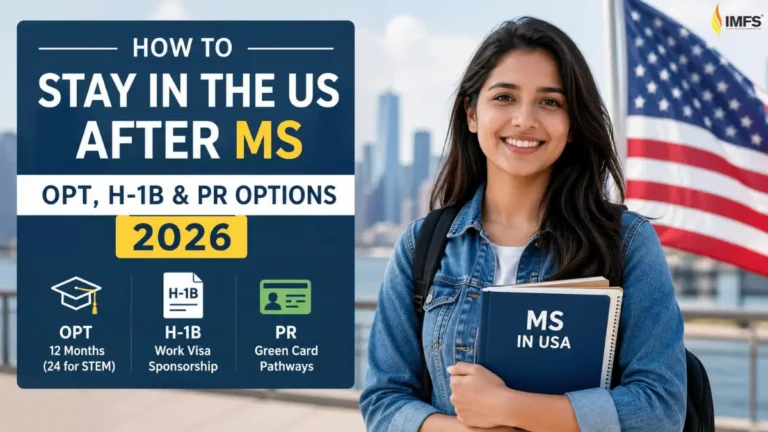
EAD → H-1B → Green Card
US Immigration Roadmap for Indian MS Graduates 2026
Step-by-step playbook: OPT, STEM OPT, H-1B lottery, PERM, I-140, and I-485 — everything an Indian MS graduate needs to know, in the right order, with hard deadlines.
Indian nationals face a 12–17-year backlog for EB-2 and EB-3 Green Cards due to the 7% per-country annual cap. The Final Action Date for EB-2 India in April 2026 is July 2014 — meaning USCIS is currently processing cases filed 12 years ago. Source: US Department of State Visa Bulletin, April 2026 — travel.state.gov.
This does not mean you should avoid the process. It means you must start early, file the I-140 as soon as possible to lock in your priority date, and plan your long-term status strategically. Every year of delay adds to your wait.
| If you want to… | Do this | By when |
|---|---|---|
| Start working legally after your MS | Apply for OPT EAD (Form I-765) | 90 days before graduation |
| Extend work auth if STEM degree | Apply for STEM OPT extension | 90 days before OPT expires |
| Get employer-sponsored work visa | Register for H-1B lottery with employer | Every March |
| Increase H-1B lottery odds | Negotiate Level III/IV wage with employer | Before March registration |
| Lock in your Green Card priority date | File I-140 petition as early as possible | Start of H-1B, no later |
| Stay beyond 6 years on H-1B | Have I-140 approved for 365+ days (AC21) | File I-140 early — this clock starts now |
| Change jobs without losing Green Card | Wait 180 days post-I-140 approval (AC21) | After I-140 is 180 days old |
| Get the fastest possible Green Card | Build credentials for EB-1A (publications, patents, awards) | Start from year 1 of career |
| Keep Green Card independent of employer | File EB-2 NIW self-petition | Anytime if national interest criteria met |
| Work without H-1B while waiting for Green Card | File I-485 when Dates for Filing open | Monitor Visa Bulletin monthly |
- File your I-140 petition the moment your employer is ready — do not wait until you "need" it. The priority date clock does not start until you file.
- From 20+ years of placing Indian MS graduates in the US, we consistently see that students who negotiate a Level III or IV wage offer in their H-1B petition — even at the cost of a slightly lower title — have meaningfully higher lottery selection odds under the new weighted system.
- Target EB-1A from day one of your career, not as a fallback. Students who focus on publications, patents, and peer recognition from year 1 of their US career typically reach EB-1A eligibility by year 5–7, cutting the India EB-2 wait by 7–10 years.
- How do I apply for OPT and my first EAD after my MS?
- How does the STEM OPT extension work — requirements and rules?
- How does the H-1B cap and lottery work for Indian MS graduates?
- What fees does my employer pay for H-1B sponsorship?
- What happens if I don't get selected in the H-1B lottery?
- How long does H-1B status last — can it be extended beyond 6 years?
- How does PERM labor certification work and how long does it take?
- What is the I-140 petition and why should I file it early?
- When can I file I-485 and what does it give me?
- Which Green Card route is fastest for Indian MS graduates?
- Full roadmap — timeline snapshot with key actions
- Frequently Asked Questions
The US immigration path for an Indian MS graduate unfolds in three distinct phases: the EAD (work authorization on F-1 status), the H-1B (employer-sponsored work visa), and the Green Card (permanent residency). Each phase has hard deadlines, filing fees, and — for Indian nationals — specific backlog realities that this guide addresses directly. This playbook was authored by KP Singh, Founder of IMFS, and reviewed by Inderjit Singh Matta, CEO, based on 27+ years of guiding Indian students through the US study and immigration pathway. All policy figures are verified against uscis.gov and travel.state.gov.
IMFS has guided 67,000+ students to universities across the USA, UK, Germany, Canada, Ireland, Australia, and New Zealand from 13 branches across India. We have real placements at Northeastern, UT Dallas, USC, Columbia, and 50+ other US universities. IMFS holds a 4.7★ Google rating across our network. For personalised US university and immigration guidance: Study in USA — IMFS.
How do I apply for OPT and my first EAD after my MS?
Short answer: Apply for your 12-month OPT EAD (Form I-765) up to 90 days before your program end date. USCIS must receive your application before you graduate. Processing takes 3–5 months — do not wait until the window opens to start preparing with your DSO.
When to Apply
- Apply up to 90 days before your program end date. USCIS must receive the application before you graduate.
- Processing takes 3–5 months. Apply as early as the 90-day window opens; do not wait.
- After graduation, you have a 60-day grace period to begin OPT. Your OPT start date must fall within 60 days of your program end date.
Requirements
- Currently enrolled in F-1 status in good academic standing
- Valid I-20 from your university DSO
- Must not have used more than 364 days of full-time CPT — 12+ months of full-time CPT eliminates OPT eligibility entirely
Process
- Request an OPT-recommended I-20 from your DSO (allow 1–3 weeks for DSO processing)
- File Form I-765 online via USCIS. Filing fees: verify current amounts at uscis.gov/i-765 before filing — fees updated April 2024 and are subject to change
- Premium processing for I-765 (OPT) is available for 30 business days of processing — check current fee at uscis.gov
- Once approved, USCIS mails your EAD card. Check it immediately for errors — corrections must happen before you start work
Any full-time CPT lasting 12 months or more will permanently eliminate your OPT eligibility. Part-time CPT (under 20 hrs/week) does not count against OPT. Discuss every internship offer involving full-time CPT with your DSO before accepting. This is one of the most common and most avoidable errors IMFS counselors see in US-bound students.
Maximum unemployment allowed during the initial 12-month OPT period: 90 days total. Track every day carefully. This count carries forward into STEM OPT — the combined limit for the full 36-month period is 150 days. Source: USCIS.
Planning Your US MS + Immigration Strategy?
IMFS has placed students at Northeastern, UT Dallas, USC, Columbia, and 50+ US universities. Get a personalised roadmap — no fees, no pressure.
How does the STEM OPT extension work — what are the requirements and reporting rules?
Short answer: If your MS is in a STEM-designated field, you can extend your 12-month OPT by 24 additional months for a total of 36 months of F-1 work authorization. You must have an E-Verify enrolled employer and complete Form I-983 (Training Plan) with them. Apply up to 90 days before your OPT EAD expires.
When to Apply
- Apply up to 90 days before your OPT EAD expires. The full chain — DSO recommendation in SEVIS → updated I-20 → USCIS filing — takes 2–3 weeks. Request your DSO's I-20 update 90–100 days before expiry.
- First check the DHS STEM Designated Program List to confirm your degree qualifies.
Requirements
- MS degree in a STEM-designated field
- Currently employed by (or have a job offer from) an E-Verify enrolled employer
- Role must be paid, at least 20 hours/week, and directly related to your STEM degree
- Form I-983 (Training Plan) completed and signed by your employer
Reporting Requirements During STEM OPT
- Report to your DSO every 6 months from your STEM OPT start date
- Submit an annual self-evaluation (Form I-983, page 5) every 12 months
- Report any change of employer to your DSO within 10 days — failure to report is a status violation
If you file your STEM OPT application on time (before your OPT EAD expires), you receive an automatic 180-day extension of work authorization while USCIS processes your case. Present your I-797 receipt notice to your employer to continue working without interruption. Important: Do not travel internationally during this period with an expired EAD unless your new STEM OPT EAD card is physically in your possession.
How does the H-1B cap and lottery work for Indian MS graduates in 2026?
Short answer: The H-1B annual cap is 85,000 visas — 65,000 regular and 20,000 for US Master's degree holders. As a US MS graduate, your application is entered into the Master's Cap first, and if not selected there, automatically entered into the regular cap. You get two lottery chances per year. In FY2026, selection odds were approximately 25% per pool. Source: USCIS FY2026 H-1B Cap data.
| H-1B Pool | Slots | Who Qualifies |
|---|---|---|
| Regular Cap | 65,000 | Any qualifying bachelor's degree or higher (US or foreign) |
| Master's Cap (Advanced Degree) | 20,000 | US Master's degree or higher from a US-accredited institution. Entered into Master's Cap first; if not selected, automatically rolled into Regular Cap. |
📌 Source: USCIS H-1B cap programme rules — uscis.gov. US MS graduates receive one entry in the Master's Cap AND, if not selected, a second entry in the Regular Cap.
Annual H-1B Lottery Timeline
| When | What Happens |
|---|---|
| January–February | Prepare documents. Identify employers willing to sponsor. Ensure employer has a USCIS organizational account. |
| Early March (~March 4) | H-1B registration window opens. Employer registers candidate online and pays registration fee. Do not wait until the last day. |
| ~March 19 | Registration window closes. |
| By March 31 | USCIS conducts lottery and notifies selected employers via USCIS online accounts. |
| April 1 – June 30 | 90-day window: selected employers file the full H-1B petition (Form I-129) with all supporting documents and fees. |
| October 1 | H-1B status begins upon petition approval. |
📌 Source: USCIS — uscis.gov/h-1b. Dates vary slightly year to year. Monitor USCIS.gov from January each year.
USCIS has proposed a wage-level weighted lottery for H-1B selection: entries weighted by OES Wage Level I through IV, with higher-wage offers receiving proportionally greater selection odds. The proposed rule would mean a Level IV offer has 4× the selection odds of a Level I offer. This rule's current implementation status must be verified at uscis.gov before the March registration window — the rule was proposed and has been subject to administrative review. If in effect, negotiate the highest possible wage level with your employer before registration, as it directly affects your lottery odds.
What fees does my employer pay for H-1B sponsorship — and what can they charge me?
Short answer: Most H-1B fees are mandatory employer-paid costs that legally cannot be charged to the employee. The base costs for an employer with 25+ employees are approximately $3,395 (excluding optional premium processing). Verify all current fees at uscis.gov before filing.
| Fee | Amount | Paid By |
|---|---|---|
| Registration fee (per candidate) | $215 | Employer |
| I-129 base filing fee (25+ employees) | ~$780 | Employer (mandatory) |
| ACWIA Training Fee (25+ employees) | $1,500 | Employer — cannot be passed to employee |
| Fraud Prevention & Detection Fee | $500 | Employer (new petitions only) |
| Asylum Program Fee (25+ employees) | $600 | Employer |
| Premium Processing (I-907) — optional | $2,965 | Employer or employee by agreement |
| $100,000 supplemental fee | $100,000 | Employer — ONLY if beneficiary is OUTSIDE the US. Does NOT apply to F-1/OPT/STEM OPT Change of Status applicants inside the US. Verify at uscis.gov. |
📌 Source: USCIS — uscis.gov. Fees as of April 2026. Verify at uscis.gov before filing — USCIS updates fees periodically. All figures in USD.
The supplemental fee introduced in September 2025 applies only to new H-1B petitions for beneficiaries who are currently outside the United States. If you are in the USA on F-1, OPT, or STEM OPT filing a Change of Status to H-1B, this fee does not apply. Verify current applicability at uscis.gov before your employer files.
What happens if I don't get selected in the H-1B lottery?
Short answer: Re-register the following year. Most Indian MS graduates secure an H-1B within 2–3 lottery cycles. While waiting, Cap-Gap protection extends your F-1/OPT status, and cap-exempt employers — universities, non-profits, and government research organisations — can hire you immediately without a lottery.
Cap-Gap Protection
If you are on OPT or STEM OPT when an H-1B petition is filed on your behalf, Cap-Gap automatically extends your F-1 status and EAD through September 30 of that year. Your employer must file the petition before your EAD expires. Your I-797 receipt notice serves as your proof of extended work authorization.
Alternatives If Not Selected
- Cap-Exempt employers: Universities, non-profits affiliated with universities, and government research organisations are not subject to the H-1B cap. They can hire you immediately — no lottery required.
- O-1A Extraordinary Ability: No cap, no lottery. For candidates with demonstrated national or international recognition in their field. Building an EB-1A-calibre profile (publications, patents, invited talks) also makes you O-1A-eligible.
- Re-enter the lottery: US MS graduates get two chances every year. Most candidates are selected within 2–3 attempts based on historical odds.
How long does H-1B status last — can it be extended beyond 6 years?
Short answer: Initial H-1B: 3 years. Extension: another 3 years. Maximum: 6 years normally. However, if your I-140 Green Card petition has been approved for 365+ days, you can extend H-1B in 1-year increments indefinitely beyond the 6-year cap under AC21 portability rules. This is why filing the I-140 early is critical.
| H-1B Extension Scenario | Extension Duration | Requirement |
|---|---|---|
| Standard extension | 3 years (total 6 years) | Approved H-1B petition |
| I-140 approved, priority date not yet current | 3-year increments beyond 6 years | Approved I-140 (any stage) |
| I-140 approved for 365+ days | 1-year increments, unlimited | I-140 approved ≥365 days ago |
📌 Source: USCIS, AC21 (American Competitiveness in the 21st Century Act) — uscis.gov.
How does PERM labor certification work and how long does it take in 2026?
Short answer: PERM (Program Electronic Review Management) is the Department of Labor process that certifies no qualified US worker is available for your specific role. It is required for EB-2 (employer-sponsored) and EB-3 Green Cards. As of 2025–26, PERM takes approximately 24–30 months end-to-end before the I-140 can be filed. The PERM filing date becomes your all-important priority date.
| PERM Phase | Duration | Notes |
|---|---|---|
| Prevailing Wage Determination (PWD) | 4–6 months | Employer submits Form 9141 to DOL National Prevailing Wage Center. 50,000+ pending as of Jan 2026. |
| Recruitment period | 30–60 days | Employer must advertise the role and document all candidates reviewed. |
| 30-day waiting period | 30 days | Mandatory wait before filing ETA-9089. |
| PERM Analyst Review (Form ETA-9089) | 15–16 months | Current processing time as of August 2025. Filing date = Priority Date. Source: DOL. |
| Audit (if triggered) | +3–5 months | Significant percentage of cases are audited. Employer has 30 days to respond — no extensions. |
| Total PERM Phase | ~24–30 months | Before I-140 can be filed. |
📌 Source: US Department of Labor — dol.gov. Processing times as of August 2025; verify current times at flag.dol.gov before planning.
Once PERM is filed, the employer, job title, job location, and job duties are locked. Any material change — promotion, relocation, significant change in duties — can invalidate the PERM and require starting over. For Indian nationals facing 12–17 year wait times, this is a significant career planning constraint. Discuss job stability with your employer explicitly before initiating the PERM process. Source: DOL / USCIS.
What is the I-140 petition and why should I file it as early as possible?
Short answer: The I-140 (Immigrant Petition for Alien Workers) is the formal Green Card petition your employer files with USCIS after PERM approval. For EB-2 NIW and EB-1, you can self-petition. The I-140 approval establishes your priority date — your place in the Green Card queue. For Indian nationals, every month of delay in filing is a month added to your wait. File it as early as your employer is ready.
Why the I-140 Timeline Matters So Much
- Priority date = the date your PERM was filed (or I-140 for NIW/EB-1). This is your position in the India EB-2 queue.
- After 180 days of I-140 approval: AC21 portability — you can change employers to a same/similar role without losing your priority date.
- After 365 days of I-140 approval: unlimited H-1B extensions beyond the 6-year cap in 1-year increments.
- I-140 approval is permanent even if you change employers. The priority date stays with you. Only a revocation by the original employer within 180 days can threaten it.
I-140 Processing
- Standard processing: 6–18 months
- Premium processing (I-907): $2,965 for 15 business days — increased from $2,805 effective March 1, 2026. Source: USCIS.
- Strongly recommended: Use premium processing for the I-140. The time saved is worth far more than the cost.
When can I file I-485 — and what does it give me while I wait for the Green Card?
Short answer: You can file Form I-485 (Application to Register Permanent Residence) when your priority date becomes earlier than the Final Action Date (FAD) for EB-2 India in the monthly Visa Bulletin. When USCIS permits use of the Dates for Filing (DFF) chart — which is more advanced — file immediately. Filing I-485 gives you an EAD and Advance Parole, freeing you from H-1B dependency for the duration of your wait.
Visa Bulletin — What to Monitor
- The Final Action Date (FAD): your priority date must be earlier than this to receive a Green Card or get your I-485 approved.
- The Date for Filing (DFF): a more advanced date USCIS sometimes permits for I-485 filing. When available, file immediately — you gain EAD and Advance Parole even before your Green Card is issued.
- Monitor travel.state.gov monthly without exception.
- As of April 2026: EB-2 India FAD = July 2014. Source: US Dept of State Visa Bulletin, April 2026.
I-485 Filing Package
- Approved I-140 (or concurrent filing if priority date is current)
- Form I-485 + Form I-131 (Advance Parole) + Form I-765 (EAD for adjustment applicants)
- Medical examination — Form I-693, by a USCIS-designated Civil Surgeon (valid 2 years)
- Filing fees (as of April 2024): I-485 = $1,440 (ages 14–78) + I-131 = $630 + I-765 = $260. Total when filing all three together: approximately $2,330. Source: USCIS. Verify at uscis.gov before filing.
When USCIS announces that the Dates for Filing chart may be used, file I-485 immediately — even if your Final Action Date is not yet current. The resulting EAD and Advance Parole reduce your dependence on H-1B status and give you significantly greater job flexibility while you wait.
Which Green Card category is fastest for Indian MS graduates — EB-1, EB-2, or EB-3?
Short answer: EB-1A (Extraordinary Ability) is the fastest path for Indian nationals — approximately 5 years versus 12–17 years for EB-2 or EB-3. The strategic approach is to file EB-2 PERM early to lock in your priority date, then simultaneously build toward EB-1A credentials, and port the priority date once EB-1A is approved.
| Category | Who Qualifies | PERM Required? | India Wait (2026) |
|---|---|---|---|
| EB-1A | Extraordinary Ability (self-petition) | No | ~5 years |
| EB-1B | Outstanding Professors & Researchers | No | ~5 years |
| EB-1C | Multinational Executives/Managers | No | ~5 years |
| EB-2 NIW | National Interest Waiver — self-petition | No | 12–17 years |
| EB-2 PERM | Advanced degree (Master's+) with employer | Yes, ~24–30 months | 12–17 years |
| EB-3 | Bachelor's / Skilled Workers with employer | Yes, ~24–30 months | 12+ years |
📌 Source: US Dept of State Visa Bulletin April 2026 (travel.state.gov) for FAD dates. Wait times are estimated from current FAD and are typical, not guaranteed. Actual timelines vary.
The Three Strategic Paths
| Path | Route | Best For | India GC Timeline |
|---|---|---|---|
| Path A (Recommended) | EB-2 PERM early → build credentials → EB-1A upgrade with priority date port | STEM researchers, engineers with publications/patents. Start EB-2 early, target EB-1 in years 4–7. | ~5 years via EB-1 if credentials qualify |
| Path B | EB-2 NIW (self-petition) + parallel EB-2 PERM through employer | Strong independent professionals who can demonstrate national interest. No employer needed for I-140. | 12–17 years (flexible employment) |
| Path C | EB-2 or EB-3 PERM only, wait it out | Those without a path to EB-1 or NIW. File I-140 early, obtain AC21 portability, use I-485 when DFF opens. | 12–17 years (mitigated by early filing) |
📌 This is a strategic overview, not a financial or legal guarantee. Individual timelines vary based on priority date, USCIS processing, and Visa Bulletin movement. Consult a licensed US immigration attorney for case-specific advice.
What is the complete US immigration timeline and roadmap for Indian MS graduates?
Short answer: Below is the full EAD → H-1B → Green Card roadmap with key deadlines and critical rules at each stage.
| Phase | Timeline | Key Action | Critical Rule |
|---|---|---|---|
| OPT EAD | Month 0–12 | File I-765 up to 90 days before graduation | USCIS must receive before program end date. Max 90 days unemployment. |
| STEM OPT | Month 12–36 | File STEM extension 90 days before EAD expires | E-Verify employer required. I-983 Training Plan mandatory. 150-day combined unemployment limit. |
| H-1B Lottery | March each year | Employer registers + pays fee. File petition if selected. | Weighted lottery (verify current rules at uscis.gov). October 1 start. US MS = 2 lottery chances. |
| H-1B Status | Year 1–6+ | 3-year initial + 3-year extension = 6 years max | File I-140 early. 365 days post-approval = unlimited H-1B extensions (AC21). |
| PERM | Start ASAP after H-1B | PWD + recruitment + ETA-9089 filing | ~24–30 months total. Filing date = Priority Date. Job and employer frozen after filing. |
| I-140 | After PERM approval | File Form I-140. Use premium processing ($2,965). | 180 days approved = AC21 portability. Priority date is permanent. |
| I-485 | When priority date is current (or DFF open) | File I-485 + I-765 + I-131 together | Grants EAD + Advance Parole. India EB-2 FAD = July 2014 as of April 2026. |
| Green Card | 12–36 months post I-485 | Biometrics → interview → approval | India EB-2 total wait: 12–17 years from priority date. EB-1 path: ~5 years. |
📌 Source: USCIS (uscis.gov), DOL (dol.gov), US Dept of State Visa Bulletin (travel.state.gov), April 2026. Timelines are typical, not guaranteed. All figures in USD. This is an informational guide — always verify at official sources and consult a licensed US immigration attorney.
- Apply for OPT at the earliest opportunity — 90 days before graduation. Do not let USCIS processing delays eat into your 12-month clock.
- Track unemployment days obsessively during OPT and STEM OPT. Losing status over an undocumented gap is entirely avoidable.
- Tell your employer you hold a US Master's degree before H-1B registration — they get two lottery chances instead of one. Many HR teams do not know this.
- Negotiate the highest feasible wage level for your H-1B offer — verify current lottery rules at uscis.gov, but if weighted selection is in effect, a Level III or IV offer meaningfully increases your selection odds.
- File the I-140 the moment your employer is ready. The priority date clock does not start until you file. Every month of delay is a month added to your India wait.
- After 180 days of I-140 approval, you have AC21 portability. You can change to a same/similar role without losing your Green Card case — this fundamentally changes your negotiating position with any employer.
- Explore EB-2 NIW in parallel — self-petitioning means your Green Card is not tied to any employer. For STEM professionals who can argue national interest, this is a meaningful option worth evaluating early.
- Invest in becoming EB-1 eligible from year one: publish papers, file patents, take leadership roles in professional organisations, secure industry awards, give invited talks. EB-1A approval cuts your India wait from 15 years to approximately 5.
- When USCIS permits I-485 filing using the Dates for Filing chart, file immediately. The resulting EAD and Advance Parole free you from H-1B dependency entirely.
- Work with a qualified US immigration attorney from year one. H-1B and Green Card filings are complex, errors are expensive, and the rules change frequently. IMFS can connect you with vetted immigration attorneys — contact us here.
The US immigration path for Indian nationals is not a sprint. It is a decades-long marathon shaped by a system that was not designed with you in mind.
But here is the truth: every year of delay in starting the process is a year added to your wait. The students who understand this — who file the I-140 early, negotiate their wage level, build toward EB-1, and use every AC21 flexibility available — receive Green Cards in the shortest time the system allows.
"The system is slow. Your actions do not have to be."
— KP Singh, Mentor | Educationist | Founder — IMFS
Trusted by Students Across India
IMFS has a 4.7★ Google rating across our network of 13 branches
Frequently Asked Questions — US Immigration for Indian MS Graduates
Talk to an IMFS Consultant — Free
27+ years of placing Indian students at Northeastern, UT Dallas, USC, Columbia, and 50+ US universities. US immigration planning, MS admissions, GRE/TOEFL prep — one team, one plan. No fees. No pressure.