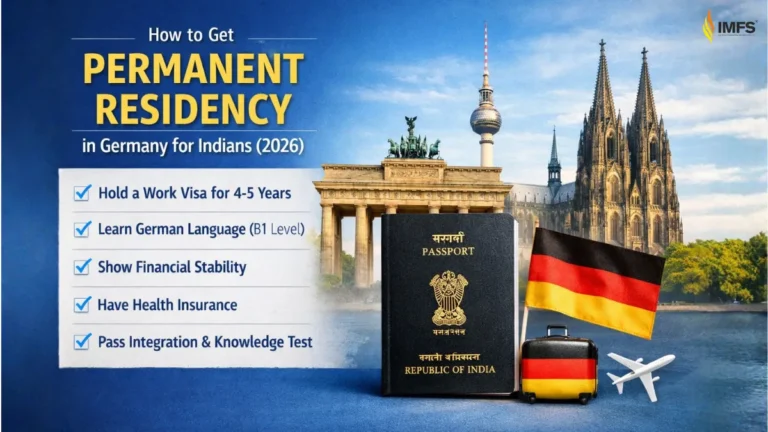
Germany PR for Indians 2026:
Your Complete Guide to Permanent Residency
EU Blue Card (PR in 21 months) · Opportunity Card · Job Seeker Visa · Settlement Permit · Citizenship — every pathway, every requirement, every 2026 policy update. For Indian students and working professionals.
Quick Decision: Which Germany PR Path Is Right for You?
| If you want to… | Your best pathway | Status |
|---|---|---|
| Get PR fastest with a job offer in Germany | EU Blue Card → Settlement Permit (21 months) | Fastest Route |
| Move to Germany first, then find a job | Opportunity Card (Chancenkarte) → Blue Card → PR | No Job Offer Needed |
| Study in Germany and stay after graduation | Student Visa → Job Seeker Visa (18 months) → Blue Card → PR | Most Popular Path |
| Do Ausbildung (vocational training) in Germany | Ausbildung Visa → Skilled Worker Visa → PR (5 years) | Debt-Free Route |
| Work in IT without a formal degree | EU Blue Card (IT professional route) → PR (21–27 months) | No Degree Required |
| Bring your spouse to Germany | EU Blue Card — spouse gets immediate work rights, no German needed | Family-Friendly |
| Get PR without B1 German | EU Blue Card → Settlement Permit at A1 German (27 months) | Slower Timeline |
| Become a German citizen eventually | 5 years residence + B1 German + citizenship test | Standard Path (2026) |
| Work in a shortage occupation (IT, engineering, healthcare) | EU Blue Card at lower salary threshold (€45,934.20 in 2026) | Lower Salary Bar |
| Move to Germany without Indian work experience | Study in Germany (MS/Ausbildung) → Job Seeker Visa → Blue Card | Study First |
🎓 IMFS Recommendation — Based on 27+ Years Guiding Indian Students to Germany
For most Indian engineering and IT students, the Study in Germany → 18-Month Job Seeker Visa → EU Blue Card → PR in 21 months path offers the best combination of low cost, no lottery risk, and a realistic PR timeline. Your total time from landing in Germany to PR can be as little as 3.5 to 4 years. Start German language coaching (A1 at minimum, B1 ideally) in parallel — it is the single biggest lever you control.
- 💡 The EU Blue Card has no H-1B-style lottery — qualification and salary are the only criteria
- 💡 Indian nationals are among the top Blue Card applicants in Germany in 2026
- 💡 Germany's 628,000+ skilled vacancies (2026 estimate) means demand for Indian talent is real
- Why Germany PR Is the #1 Question from Serious India-Germany Aspirants
- All Germany PR Pathways for Indians in 2026
- EU Blue Card — The Fast Track to Germany PR
- 21 Months vs 27 Months: Which PR Route Should You Choose?
- Job Seeker Visa & Opportunity Card (Chancenkarte) Explained
- Step-by-Step: What You Need to Apply for Germany PR
- German Language: The One Factor You Fully Control
- German Citizenship for Indians in 2026 — Key Changes
- Germany PR vs USA Green Card vs Canada PR — The Honest Comparison
- Who Should Choose Germany PR? Profile Fit Guide
- How IMFS Helps You Build the Germany → PR Pathway
- FAQs — Germany PR for Indians 2026
Why Germany PR Is the #1 Question from Serious Germany Aspirants
Every year, thousands of Indian families begin researching Germany for its free public university education. But the students who research deepest — the ones who are truly serious — always end up asking the same question: "What happens after I graduate? Can I actually stay?" The answer, in 2026, is a clear yes — and the pathway is more structured than almost any other country.
Germany has a skills crisis. With 628,000+ unfilled vacancies in 2026 (Destatis, 2026 estimate), the German government has systematically reformed its immigration law to make it easier for qualified non-EU professionals to arrive, work, and stay permanently. The EU Blue Card, the Opportunity Card, the Job Seeker Visa, and the updated Nationality Act are all products of this strategic need. India — already the largest single group of international students in Germany according to a 2023/24 Bintho survey of 120,000+ students — is at the centre of this demand.
This guide covers every PR pathway available to Indian students and professionals in Germany in 2026, with exact timelines, requirements, salary thresholds, and the citizenship realities — including what actually changed in October 2025 that most online articles are still getting wrong.
About IMFS — 27+ Years of Germany Placements
IMFS has been India's most trusted study abroad consultancy since 1997, with 67,000+ students counselled across 13 branches in Maharashtra, Telangana, and Andhra Pradesh. IMFS Germany placements include TU Munich, RWTH Aachen, KIT Karlsruhe, TU Berlin, Heidelberg University, and FAU Erlangen-Nuremberg. Our German language coaching (A1 to C1) is offered at all branches. Explore our complete Germany study guide →
All Germany PR Pathways for Indians in 2026
Germany does not have a single "PR visa." Instead, permanent residency — called a Settlement Permit (Niederlassungserlaubnis) — is the end result of any one of several legal work or study pathways. Here is how each pathway works and who it is suited for.
EU Blue Card Germany — The Fast Track to PR for Indian Professionals
The EU Blue Card is the most important piece of the Germany PR puzzle for Indian students. It is a residence and work permit for degree-holders that opens a direct, legally guaranteed path to a Settlement Permit (PR) — with no lottery, no employer sponsorship lottery, and no country-specific quota. If you qualify, you get it.
EU Blue Card Requirements in 2026
| Requirement | Standard Route | Shortage Occupations / New Grads (≤3 yrs) |
|---|---|---|
| Qualification | University degree (Indian degree must be comparable to German — check Anabin database at anabin.kmk.org) | Same qualification requirement |
| Minimum annual gross salary (2026) | €50,700 (≈ ₹55.8 lakh/year at ₹110/EUR) | €45,934.20 (≈ ₹50.5 lakh/year) + Federal Employment Agency approval |
| Job offer duration | Minimum 6 months | Minimum 6 months |
| Job must match qualification | Yes — must be "qualification-appropriate" | Yes |
| German language | Not required for Blue Card itself | Not required for Blue Card itself |
| Blue Card validity | 4 years (or contract length + 3 months if shorter) | Same |
| Spouse work rights | Immediate, unrestricted — no German language required | Same |
| IT professionals without degree | Not eligible on standard route | Eligible with 3 years IT experience in past 7 years + €45,934.20 salary |
Top Fields Where Indian Blue Card Holders Work in Germany (2026)
Germany's shortage occupation list, maintained by BAMF and the Federal Employment Agency, covers the roles where the reduced salary threshold of €45,934.20 applies. In 2026, this broadly includes:
- Software engineering and IT (web, mobile, cloud, AI/ML, data science)
- Mechanical and electrical engineering
- Civil and structural engineering
- Healthcare — doctors, nurses, physiotherapists
- Mathematics, physics, chemistry research roles
- Automation, robotics, and industrial engineering
For the exact current list, verify at make-it-in-germany.com or the Federal Employment Agency portal (arbeitsagentur.de) before your application.
👋 Not Sure If Your Profile Qualifies for EU Blue Card?
IMFS counsellors map your degree, CGPA, and field to the Anabin database and Blue Card salary thresholds — so you know your path before you apply.
21 Months vs 27 Months: Which PR Route Should You Target?
Once you have an EU Blue Card and start qualifying employment in Germany, you have two options to apply for a Settlement Permit (PR). The critical difference is German language level — and the practical difference can be 6 months of your life.
| Route | 21-Month Route | 27-Month Route |
|---|---|---|
| German Language Requirement | B1 level (Conversational proficiency) | A1 level (Basic phrases) |
| Employment Period Required | 21 months of qualifying employment | 27 months of qualifying employment |
| Pension Contributions Required | 21 months (mandatory alongside employment) | 27 months |
| Timeline from Starting Work (India CGPA to PR) | ~21 months after first Blue Card job | ~27 months after first Blue Card job |
| Typical Total Time (study → PR) | ~3.5 years (2-yr MS + 21 months work) | ~4 years (2-yr MS + 27 months work) |
| Who chooses this? | Students who start German language early — A1 during MS, B1 before job hunting | Working professionals who are too busy to reach B1 quickly |
| IMFS Recommendation | ✅ Strongly recommended — start German language coaching in Year 1 of your MS | Acceptable, but you are vulnerable if you lose your job in Month 24–27 |
You cannot apply for PR if you are in the Probezeit (probation period) of a new job. Probation in Germany typically lasts 6 months. If you switch jobs in Month 18 of your Blue Card, your PR clock effectively resets by 6 months. Plan your job changes carefully — or push to apply for PR before switching roles. Source: caspiaedu.com, reviewed against Residence Act §18c (April 2026).
The Step-by-Step Timeline: Study in Germany → PR
Arrive in Germany on Student Visa
Blocked account: €11,904 required. Start MS (2 years typical). Begin German language at A1 level — this is your highest-leverage action. Source: BAMF; IMFS student visa guide.
Complete MS + Reach German A2/B1
During your MS, work part-time (120 full days or 240 half-days/year allowed on student visa). Complete German language from A1 → B1 — this is achievable in 12–18 months with regular classes. IMFS offers German A1 to C1 at all branches: imfs.co.in/german-language-prep/
Graduate → Apply for 18-Month Job Seeker Visa
German graduates automatically qualify for an 18-month Job Seeker Visa. This is distinct from the Opportunity Card (Chancenkarte), which is for non-German graduates entering from abroad. During the Job Seeker Visa, you cannot work full-time but can do part-time or internships while searching.
Secure Job Offer → Convert to EU Blue Card
Once you have a qualifying job offer (≥€45,934.20 for engineering/IT shortage roles, or ≥€50,700 general), apply for EU Blue Card at local Ausländerbehörde. Clock for 21-month PR starts now. Pension contributions begin automatically with your employment.
Apply for Settlement Permit (PR)
After 21 months of Blue Card employment + B1 German (or 27 months + A1 German) + pension contributions, apply for Niederlassungserlaubnis online via your city portal. Processing fee: €113–€147. Appointment wait: up to 3–5 months in major cities — apply online on the exact day you become eligible. Source: BAMF, germany-visa.org (April 2026).
Optional: Apply for German Citizenship
5 years of total legal residence + B1 German + financial independence + citizenship test. Must renounce Indian passport (India does not permit dual citizenship); apply for OCI card immediately after. German passport: visa-free access to 190+ countries. See citizenship section below.
Job Seeker Visa & Opportunity Card (Chancenkarte) — Explained for Indians
There are two separate "arrive and search" visas in Germany. Many Indians confuse them — here is the precise difference.
| Feature | 🎓 Job Seeker Visa (18 months) | 🃏 Opportunity Card (Chancenkarte) |
|---|---|---|
| Who is it for? | Graduates of German universities after completing their degree | Skilled professionals/graduates from outside Germany (incl. Indian university graduates) without a prior German job offer |
| Duration | 18 months | 12 months (can be extended in some cases) |
| Job offer required? | No | No |
| Work rights during visa | Part-time / internship; no full-time employment | Part-time up to 20 hrs/week + 2-week trial jobs |
| Qualification requirement | German university degree (completed) | University degree or ≥2-year vocational training (recognised in home country) |
| Points needed | Not applicable | Minimum 6 points on official points system |
| Financial proof required | Sufficient funds to support yourself (varies by Ausländerbehörde) | €13,092 blocked account (approx. ₹14.4 lakh at ₹110/EUR) |
| Visa fee | €75 | €75 (Source: Federal Foreign Office, india.diplo.de) |
| Language requirement | Not mandatory for visa, but needed for job hunt | A1 German OR B2 English minimum (for points route) |
| After finding a job | Convert to EU Blue Card or Skilled Worker Visa at Ausländerbehörde | Convert to EU Blue Card or Skilled Worker Visa at Ausländerbehörde |
Opportunity Card Points System — How Indians Score in 2026
To use the points route (for Indian university graduates whose degree may not be fully recognised yet), you need a minimum of 6 points. Points are awarded on these factors:
| Criterion | Points Available |
|---|---|
| University degree (recognised in home country) | Up to 3 points |
| Relevant work experience (2–5 years) | Up to 2 points |
| German language skills (A1 or higher) | 1 point per level |
| Previous ties to Germany (study, internship, etc.) | 1 point |
| Age under 35 | 1 point |
| Working in a shortage occupation sector | Additional point |
Step-by-Step: Documents and Requirements for Germany Settlement Permit (PR)
Once you have completed the qualifying employment period on your EU Blue Card, here is what you need to apply for a Settlement Permit (Niederlassungserlaubnis) at your local Ausländerbehörde.
| Requirement | What's Needed | Notes |
|---|---|---|
| Residence period | 21 months (B1 German) or 27 months (A1 German) of qualifying employment on EU Blue Card | Clock starts from first day of qualifying employment, not from date of arrival |
| Pension contributions | Paid into German Pension Insurance (Deutsche Rentenversicherung) for full qualifying period | Automatic with employment — verify via annual Rentenversicherung statement |
| German language | A1 (27-month path) or B1 (21-month path) | Goethe-Institut certificate or comparable; IMFS offers German coaching from A1–C1 |
| Financial independence | Able to support yourself and dependants — proven via employment contract and payslips | No minimum salary specified for PR itself — your Blue Card salary already qualifies |
| Housing | Adequate accommodation for yourself and family | Registered address (Anmeldung) in your name required |
| No criminal record | Clean criminal record check | Führungszeugnis from German police; also no outstanding issues in India |
| Valid health insurance | Public or private German health insurance | Typically covered by employer via statutory contribution |
| Not in probation (Probezeit) | Your current job must have passed the probation period | Probation is typically 6 months — plan job changes accordingly |
| Application fee | €113–€147 (approximately ₹12,400–₹16,200) | Source: germany-visa.org (April 2026). Confirm current fee with local Ausländerbehörde |
| Processing time | Up to 2 months from submission; appointment wait can be 3–5 months in major cities | Apply online on the exact day you become eligible — "application date" freezes your legal status |
German Language: The Single Biggest Lever You Control on the PR Path
Among all requirements for Germany PR, German language level is the one you can actively build — starting today, before you even apply for a university. Here is how language level affects every stage of your Germany journey.
| German Level | What It Unlocks | Approx. Time to Achieve from Zero |
|---|---|---|
| A1 | Opportunity Card eligibility (points route); PR in 27 months on Blue Card | 2–3 months intensive study |
| A2 | Better job interview performance; part-time jobs in Germany; Ausbildung advantage | 4–6 months from A1 |
| B1 | PR in 21 months on Blue Card (6 months faster); standard Settlement Permit; citizenship pathway | 8–12 months from A1 |
| B2 | German-medium university admission; full-time job eligibility in regulated sectors; citizenship test boost | 12–18 months from A1 |
| C1 | Top job roles; academic research; maximum integration for citizenship | 18–24+ months from A1 |
🎯 IMFS German Language Coaching — All 13 Branches
IMFS offers structured German language coaching from A1 to C1 at all 13 branches. Classes are designed specifically for Indian students heading to Germany, with grammar taught in English and exam preparation for Goethe-Institut and telc certifications. Starting German early — ideally before you apply to universities — gives you a meaningful advantage in job hunting, PR timing, and integration. Explore IMFS German Language Prep →
German Citizenship for Indians in 2026 — What Changed and What It Means
German citizenship has seen the most significant changes in recent years. Here is the accurate picture as of April 2026 — including a major update that most online articles are still reporting incorrectly.
The 3-year fast-track citizenship path, introduced in Germany's 2024 Nationality Act reform, was abolished by the German Bundestag in October 2025. The vote passed 450–134. The standard citizenship requirement is now back to 5 years of residence. This applies retroactively — even pending applications under the old 3-year rule are now assessed against the 5-year standard. The dual citizenship provision and the reduction from 8 to 5 years remain intact. Source: German Bundestag (Drucksache 21/1634, October 2025); Envoy Global; Schlun & Elseven law firm (October 2025).
German Citizenship Requirements for Indians — 2026 Summary
| Requirement | What's Needed | Notes |
|---|---|---|
| Legal residence in Germany | 5 years (reduced from 8 in June 2024 reform — still valid) | Student years partly count (check §12b AufenthG) |
| German language | Minimum B1 (Common European Framework) | Goethe B1, telc B1, or integration course certificate |
| Citizenship test | "Living in Germany" naturalization test — 33 questions, 60 minutes | Tests knowledge of German law, society, and democratic values |
| Financial independence | Must support yourself and dependants without social welfare | Your Blue Card employment typically meets this |
| No criminal record | Clean record — some convictions are absolute bars | No antisemitic, racist, or extremist convictions at any time |
| Commitment to Basic Law | Declaration to uphold Germany's democratic constitution | Active check against extremist associations |
| Application fee | €255 for adults; €51 for minor children naturalising with parents | Source: Schlun & Elseven law firm (February 2026) |
| Processing time | 18–24 months typical; EU citizens ~5 months | Source: Schlun & Elseven; applications have surged since 2024 reform |
Germany has permitted dual citizenship since June 2024 — this is accurate. However, India's Citizenship Act 1955 does NOT permit Indian nationals to hold dual citizenship. This means: if you take German citizenship, you must formally renounce your Indian passport. You will no longer hold an Indian passport. What you should do immediately after renouncing: Apply for OCI (Overseas Citizen of India) status, which provides lifetime visa-free travel to India, property rights, bank accounts, and most non-political benefits of Indian citizenship — but not voting rights or government employment. OCI cost: approximately ₹15,000; it is lifelong and heritable. Source: Ministry of External Affairs India; terratern.com German citizenship guide (February 2026). Talk to an IMFS counsellor about the full implications before making a decision.
Realistic Timeline: Indian Student → German Citizen
Assuming you begin an MS in Germany in 2026, obtain a Blue Card job, and start German A1 immediately:
| Year | Milestone | Visa/Status |
|---|---|---|
| 2026 | Arrive in Germany, start MS | Student Visa |
| 2028 | Complete MS, start job search | Job Seeker Visa (18 months) |
| 2028–2029 | Secure Blue Card job (≥€45,934.20 for IT/engineering) | EU Blue Card |
| 2030 (21 months after Blue Card) | Apply for Settlement Permit — PR | Niederlassungserlaubnis ✅ |
| 2031–2032 | 5 years total legal residence + B1 German + citizenship test | Eligible for German citizenship |
Germany PR vs USA Green Card vs Canada PR — The Honest Comparison for Indians
This is the comparison that serious students and their parents need to see clearly. The numbers below are sourced and dated.
| Factor | 🇩🇪 Germany | 🇺🇸 USA | 🇨🇦 Canada |
|---|---|---|---|
| PR Timeline (skilled worker) | 21–27 months (Blue Card fast track) | EB-2/EB-3: 50–100+ years backlog for Indians (NFAP, 2024) | Express Entry: 6–12 months from ITA (CRS 480–520+, 2026) |
| Lottery / Quota system? | No lottery. No country quota. Qualification-based. | H-1B lottery: ~25–30% approval/year (USCIS FY2025) | No lottery. CRS score competition. Master's grads exempt from study permit cap since Jan 2026. |
| MS Tuition Cost (public university) | €0–€430/semester (most public universities are free) | $25,000–$50,000/year (average out-of-state MS) | CAD 15,000–28,000/year |
| Post-MS Starting Salary (IT/Engineering) | €52,000–€68,000/year (≈ ₹57–75 lakh) | $95,000–$120,000/year (≈ ₹90–114 lakh); top AI roles $160K–$220K | CAD 65,000–90,000/year (≈ ₹40–56 lakh) |
| Citizenship (years) | 5 years (standard, Oct 2025 update) | 5 years (from Green Card — irrelevant given 50–100 yr backlog for Indians) | 3 years from PR |
| Dual citizenship allowed? | Germany YES — India NO (OCI available) | USA allows it — India NO (OCI available) | Canada allows it — India NO (OCI available) |
| Spouse work rights | Immediate, unrestricted (Blue Card holder) | H-4 EAD — depends on employer, delayed; under current policy uncertainty | Open Work Permit — strong spousal rights |
| PR without a job | Opportunity Card — enter Germany first, find job on ground | Not possible on standard work pathways | Express Entry — possible from India if CRS score high enough |
Who Should Choose Germany PR? Profile Fit Guide
Germany is not the right answer for every Indian student. It is the right answer for specific profiles — and it is a genuinely excellent answer for those profiles. Here is an honest guide.
- An engineering or IT student with a strong CGPA (7.0+ on 10) seeking debt-free MS education
- Willing to learn German to at least B1 level (this is the single most important commitment)
- Prioritising long-term residency over maximum starting salary
- Concerned about H-1B lottery risk and prefer a predictable, qualification-based immigration path
- Planning to bring your spouse — Blue Card spouse gets immediate, unrestricted work rights
- Open to a European lifestyle and the medium-term value of an EU passport / OCI combination
- Working in shortage fields: software engineering, mechanical/electrical/civil engineering, healthcare, data science
- Are targeting top-tier AI/ML research roles at FAANG or AI labs ($160K–$220K USA salaries) and have the profile for it
- Are unwilling or unable to invest in learning German — without it, your PR timeline extends and job options narrow significantly
- Need PR speed above all else — Canada Express Entry can be faster from India for those with high CRS scores
- Have family already settled in USA or Canada and long-term family proximity is a priority
- Are in a field not recognised as a shortage occupation in Germany and cannot realistically reach the €50,700 salary threshold in the near term
- Are strongly attached to keeping your Indian passport — renouncing Indian citizenship for German citizenship is a real and permanent decision
💡 The Honest IMFS Assessment
Germany gives Indian students something no other destination currently does at this combination: world-class engineering education at zero tuition, a predictable PR path with no lottery, and growing salary convergence with other English-speaking countries (especially post-2023 USA tech layoffs). For the right profile — engineering/IT focused, German-curious, long-term stability over maximum short-term income — it is arguably the best value-for-life study abroad decision an Indian family can make in 2026. Book a free counselling session to assess your specific profile: imfs.co.in/contact-us/
How IMFS Helps You Build the Germany → PR Pathway
Germany's immigration system is well-designed but has important details that are easy to miss — degree recognition (Anabin database), salary threshold calculation, probation period timing for PR applications, pension contribution records, and the citizenship trade-offs. IMFS has been helping Indian students navigate these since 1997, with direct placements at TU Munich, RWTH Aachen, KIT Karlsruhe, TU Berlin, FAU Erlangen-Nuremberg, and Heidelberg University.
What IMFS Students Say — Verified Google Reviews
Related Guides — Germany & Study Abroad
Frequently Asked Questions — Germany PR for Indians 2026
Talk to an IMFS Consultant — Free
27+ years of placing Indian students in Germany, USA, UK, Canada, Australia, and Ireland. Our Germany counsellors help you check Blue Card eligibility, plan your language timeline, and build a step-by-step PR roadmap — at zero cost, zero pressure.