The Ultimate Guide to Moving, Studying & Working in Germany for Indian Students (2026)
Germany is the #1 destination for Indian students seeking world-class education at near-zero tuition costs. With over 400 public universities, a booming job market, and a structured vocational system unlike anywhere else in the world, Germany offers Indian students a truly transformative path — whether you want to earn a degree, complete a vocational apprenticeship (Ausbildung), or build a long-term career in Europe.
Here’s why Germany stands apart in 2026:
- Most public universities charge no tuition fees — even for international students
- The German job market is facing a shortage of 7 million skilled workers by 2030 — creating massive opportunity
- Germany offers a dedicated Job Seeker Visa to search for work from within the country
- Permanent Residency is achievable within 5 years through the right pathway
- Cities like Munich, Berlin, Hamburg, and Stuttgart consistently rank among the most liveable cities in the world
Whether you’re a 12th-grade student exploring higher education, a BSc nursing graduate looking to work in German hospitals, or a working professional considering an international career switch — Germany has a structured pathway for you.
Part 1: Higher Education in Germany
Is Education in Germany Really Free?
Yes — and no. Here’s the accurate picture:
Public universities (Staatliche Hochschulen): No tuition fees for undergraduate and most postgraduate programmes — for all students, including international ones. You pay only a semester contribution of approximately €150–€350 per semester, which typically includes a public transport pass and student union membership.
Private universities: These do charge tuition fees, ranging from €5,000 to €20,000+ per year. They are generally smaller and more career-focused but are not the norm for Indian students.
Doctoral (PhD) programmes: Most are tuition-free and often come with a paid research position.
→ Read more: Is Education in Germany Really Free?
Top Affordable Universities in Germany for International Students
Germany has over 400 universities. Some of the best and most accessible for Indian students include:
- TU Munich (TUM) — globally ranked, strong in engineering and technology
- RWTH Aachen — Germany’s top technical university
- LMU Munich — excellent for sciences, humanities, and medicine
- University of Stuttgart — a favourite for mechanical and automotive engineering
- Karlsruhe Institute of Technology (KIT) — top-ranked in engineering
Most of these universities charge zero tuition fees and are consistently ranked among Europe’s top 100 institutions.
→ Read more: Top 10 Cheapest Universities in Germany for International Students
Scholarships to Study in Germany
Even though education is largely free, living costs need to be covered. Fortunately, Germany offers excellent scholarship support:
DAAD (Deutscher Akademischer Austauschdienst): Germany’s most prestigious scholarship programme. DAAD offers:
- Full and partial scholarships for Masters, PhD, and research programmes
- Monthly stipends of €850–€1,200
- Travel allowances and health insurance contributions
- Applications open throughout the year depending on the programme
Other scholarships to explore:
- Heinrich Böll Foundation
- Konrad Adenauer Foundation
- Erasmus+ (for EU-linked programmes)
- Deutschlandstipendium (€300/month, offered by individual universities)
→ Read more: Study Free in Germany — DAAD Scholarships 2025
How IMFS Helps You Get Into a German University
At IMFS, our Germany counselling service covers the complete journey — from shortlisting universities that match your profile, to language requirements, application deadlines, SOP writing, and visa preparation. With a 99.8% visa success rate, IMFS has helped thousands of students successfully land in Germany.
👉 Talk to an IMFS Germany Counsellor Today →
Part 2: Ausbildung — Germany’s Vocational Pathway
What Is Ausbildung?
Ausbildung (pronounced owss-bil-dung) is Germany’s dual vocational training system. It’s one of the most respected and practical education pathways in the world — combining on-the-job training at a company with theoretical study at a vocational school (Berufsschule).
Key facts:
- Duration: 2–3.5 years depending on the field
- You are paid a monthly stipend (€620–€1,100+) throughout the training
- Upon completion, you receive a nationally recognised qualification
- Ausbildung holders are in extremely high demand — employers often retain their trainees
- It can lead directly to permanent residency in Germany
Ausbildung is not “lesser” than a university degree in Germany — it is a highly respected, structured, and well-paying career route.
Top Ausbildung Programmes for Indian Students
1. Fachinformatiker (IT Specialist)
The most popular Ausbildung for Indian students with a tech background. Specialisations include:
- Anwendungsentwicklung — Application Development (coding, software)
- Systemintegration — Systems Integration (networks, infrastructure)
Monthly stipend: €800–€1,050
Demand: Extremely high — Germany needs 200,000+ IT professionals urgently
German language required: B1–B2
→ Read more: Fachinformatiker Ausbildung 2025 — The Ultimate Guide to IT Careers in Germany
2. Mechatronics & Electronics
For engineering-inclined students, Mechatronics and Electronics Ausbildung opens doors at Germany’s top manufacturers — including BMW, Bosch, Siemens, and Volkswagen.
- Mechatroniker: combines mechanics, electronics, and IT
- Elektriker/Elektroniker: electrical systems, industrial maintenance
- Monthly stipend: €700–€950
- Among the highest-demand trades in Germany
→ Read more: Mechatronics & Electronics Ausbildung in Germany
3. Hospitality & Tourism
Germany’s hospitality sector — hotels, restaurants, event management — actively recruits international Ausbildung trainees:
- Hotelfachmann/-frau (Hotel Management)
- Restaurantfachmann/-frau (Restaurant Service)
- Veranstaltungskaufmann/-frau (Event Management)
- Major employers: Hilton, Marriott, Steigenberger, Kempinski
→ Read more: Hospitality Ausbildung in Germany — Opportunities with Global Brands
4. Technical Trades (Construction, Automotive, HVAC)
Germany’s technical sector is one of the most under-supplied labour markets in Europe. Trades like Kraftfahrzeugmechatroniker (automotive), Anlagenmechaniker (pipe fitting/HVAC), and Maurer (construction) offer strong pay and a fast track to residency.
→ Read more: Germany’s Skill Route to Success — Ausbildung for Technical Professions
Best Ausbildung Programmes in Germany — 2026 Overview
→ See the full ranked list: Best Ausbildung Programs in Germany for Indians — 2026 Edition
→ Start from scratch: Everything You Need to Know About Ausbildung in Germany
👉 Explore IMFS Ausbildung Counselling →
Part 3: Nursing in Germany — A Career That Changes Lives
Why Indian Nurses Are in High Demand in Germany
Germany faces a critical nursing shortage — with over 200,000 nursing positions currently unfilled and the gap expected to widen as the population ages. As a result, Germany has created dedicated visa pathways and recognition programmes specifically to attract qualified nurses from India.
For Indian nursing graduates, Germany offers:
- Monthly salaries of €2,200–€3,500 for qualified nurses
- Full employment benefits including health insurance and pension contributions
- A clear path to permanent residency within 5 years
- Opportunities to specialize in ICU, paediatrics, geriatric care, and more
- A genuinely welcoming environment for internationally trained nursing staff
What Qualification Do You Need to Work as a Nurse in Germany?
This is the most common question — and the answer matters.
To work as a Gesundheits- und Krankenpfleger/in (qualified nurse) in Germany, you need your Indian nursing qualification officially recognised by the German authority (Anerkennungsbehörde) in the state where you intend to work.
The recognition process evaluates whether your Indian BSc Nursing (or GNM) is equivalent to the German 3-year nursing degree. In most cases, Indian BSc Nursing graduates qualify — sometimes with a compensatory measure (additional examination or supervised practice period).
→ Read more: Which Nursing Qualification Is Required to Work in Germany?
Nursing Ausbildung in Germany — An Alternative Path
If your existing qualification doesn’t meet German recognition requirements — or if you want a direct route into the German healthcare system — you can pursue a Pflegeausbildung (Nursing Ausbildung) in Germany.
- Duration: 3 years
- You are paid throughout (€1,100–€1,500/month in training)
- Covers general care (generalistische Pflegeausbildung) — applicable across hospitals, elderly care, and paediatrics
- Upon completion, your qualification is fully recognised across all EU countries
→ Read more: Nursing Ausbildung in Germany — The Ultimate Guide for Indian Students 2026
👉 Speak to an IMFS Nursing in Germany Specialist →
Part 4: Living in Germany as an Indian Student
Best Cities in Germany for Indian Students
Germany’s cities are diverse — each with its own personality, job market, and cost of living. Here’s a quick overview:
| City | Known For | Avg. Rent (1BHK) | Student Vibe |
|---|---|---|---|
| Munich | Tech, automotive, Ivy-equivalent universities | €900–€1,400 | High energy, career-focused |
| Berlin | Startups, arts, diversity | €700–€1,100 | Creative, cosmopolitan |
| Hamburg | Shipping, media, finance | €750–€1,100 | Professional, port city |
| Stuttgart | Automotive (Mercedes, Porsche) | €700–€1,000 | Engineering hub |
| Frankfurt | Finance, banking, international | €800–€1,200 | Business-oriented |
| Cologne | Media, retail, student life | €650–€950 | Lively, affordable |
| Heidelberg / Freiburg | University towns, scenic | €550–€800 | Relaxed, academic |
For the most affordable student accommodation options: → Read more: Best Cities in Germany for Affordable Student Housing
Address Registration in Germany (Anmeldung)
One of the first and most important tasks after arriving in Germany is registering your address at the local Bürgeramt (civic office). This is legally required within 14 days of moving in and unlocks access to nearly everything else — bank accounts, health insurance, and your Tax ID.
→ Read more: Address Registration in Germany for Indian Students
Getting Your Tax ID (Steuer-ID)
Your Steuer-ID is automatically issued by the German tax authority once you register your address. It’s a permanent 11-digit number you’ll use throughout your working life in Germany.
→ Read more: How to Get Your Steuer-ID in Germany
Transferring Your Indian Driving Licence to a German Licence
Indian driving licences are not directly valid in Germany beyond the first 6 months. You’ll need to convert your Indian licence to a German one — a process that involves theory and practical tests, but is more affordable and faster than starting fresh.
→ Read more: Transfer Indian Licence to German Licence — Step-by-Step Guide
Part 5: After Your Studies — Working and Settling in Germany
Germany Job Seeker Visa
Completed your degree or Ausbildung? Germany’s Job Seeker Visa allows qualified graduates to enter Germany for up to 6 months to search for a job — without needing an employment contract first. Requirements include:
- A recognised university degree or vocational qualification
- Proof of German language proficiency (typically B1+)
- Sufficient funds for your stay (approx. €1,027/month)
- Health insurance coverage
→ Read more: Germany Job Seeker Visa — Unlock Your Career in Europe
Top In-Demand Skills in Germany (2026)
Germany’s talent shortage spans multiple sectors. The most in-demand profiles for Indian students currently include:
- IT & Software Development (full-stack, cloud, AI/ML)
- Nursing & Healthcare
- Mechanical & Electrical Engineering
- Automotive & Mechatronics
- Hospitality & Culinary Arts
- Logistics & Supply Chain
- Finance & Accounting
German language proficiency at B2 level significantly increases employability in all sectors.
Path to Permanent Residency in Germany
Germany offers one of the clearest PR pathways for skilled workers:
| Pathway | Minimum Stay |
|---|---|
| General skilled worker residency (Niederlassungserlaubnis) | 4 years |
| EU Blue Card holders | 21–33 months |
| Ausbildung graduates | 2 years post-completion |
| Nurses (recognised) | 5 years |
Part 6: German Language — Your Most Important Investment
No matter which pathway you choose — degree, Ausbildung, or nursing — German language proficiency is the single biggest factor in your success in Germany.
For university admission, most programmes require B2 (TestDaF or DSH). For Ausbildung and nursing, employers typically require B1–B2. For daily life, even A2–B1 makes an enormous difference.
IMFS offers structured German language coaching — from A1 beginner to C1 advanced — as part of our Germany preparation programmes.
Language milestones:
- A1–A2: Basic communication — greetings, shopping, simple conversations
- B1: Conversational — workplace basics, daily life independence
- B2: Professional — university lectures, hospital environments, office settings
- C1: Advanced — academic writing, complex negotiations, senior roles
IMFS Germany: Your Complete Support System
IMFS has been guiding Indian students to Germany since 1997. Our Germany programme covers:
| Service | What We Offer |
|---|---|
| University Counselling | Profile evaluation, shortlisting, application support |
| Ausbildung Placement | Employer connections, interview prep, offer management |
| Nursing Pathway | Recognition guidance, language prep, placement |
| German Language | A1 to C1, taught by certified trainers |
| SOP & Documentation | Personalised SOP writing, document verification |
| Visa Assistance | End-to-end visa preparation, mock interviews |
| Pre-Departure | Orientation sessions, accommodation support, banking |
| Post-Arrival | Anmeldung guidance, Steuer-ID, driving licence transfer |
Frequently Asked Questions — Germany for Indian Students
Q: Is GRE required for top universities in Germany?
No — GRE is generally not required for German public universities, including the top ones like TU Munich, RWTH Aachen, and KIT. Most German universities evaluate applications based on your undergraduate academic record (CGPA/percentage), your Statement of Purpose, letters of recommendation, and relevant work or research experience. A few internationally oriented or private programmes may request a GRE score as an optional addition to strengthen your profile, but it is rarely a mandatory requirement. This makes Germany an attractive option for students who want a top-ranked engineering or science degree without the added burden of GRE preparation.
Q: Can I study in Germany without knowing German?
Yes — Germany has significantly expanded its English-taught offerings. Hundreds of Masters programmes, particularly in engineering, computer science, and business, are fully taught in English at public universities. However, learning German — even to B1 level — dramatically improves your day-to-day life, increases your chances of landing an Ausbildung or part-time job, and opens the door to roles that require local communication. For Ausbildung and Nursing pathways, German is non-negotiable (B1–B2 minimum).
Q: What is the minimum IELTS score for German universities?
For English-taught Masters programmes, most German universities require IELTS 6.0–6.5 overall. Highly competitive programmes at TU Munich or LMU may expect 7.0. TOEFL scores of 80–95 (iBT) are also widely accepted as an alternative.
Q: Is APS (Academic Evaluation Centre) required for Indian students applying to Germany?
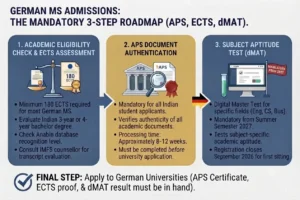
Yes. Indian students applying to German universities are required to go through the APS (Akademische Prüfstelle) certificate process — an academic verification exercise conducted by the German Embassy in India. IMFS counsellors guide students through every step of the APS process as part of the Germany preparation programme.
Q: Can a GNM graduate work as a nurse in Germany?
GNM (General Nursing and Midwifery) graduates may face additional recognition requirements compared to BSc Nursing graduates, as the German standard is a 3-year generalist nursing qualification. In some cases, a compensatory measure — an additional examination or supervised practice period (Kenntnisprüfung or Anpassungslehrgang) — may be required. IMFS counsellors assess your specific qualification and recommend the most direct pathway for your profile. Visit our Nursing in Germany page for a full breakdown.
Q: Does IMFS teach German language classes?
Yes — IMFS offers German language coaching from A1 to C1, taught by certified trainers with a track record of preparing students for both university admission and Ausbildung/nursing placements. Courses are structured around the Goethe-Institut framework and are available across all IMFS branches. Whether you’re a complete beginner (A1) or preparing to clear the B2 level required for hospital environments, IMFS has a batch for you.
Walk into any IMFS branch near you to enquire about the current German language batch schedule:
| Branch | City | State |
|---|---|---|
| IMFS Dadar | Mumbai (Dadar) | Maharashtra |
| IMFS Churchgate | Mumbai (Churchgate) | Maharashtra |
| IMFS Borivali | Mumbai (Borivali) | Maharashtra |
| IMFS Vashi | Navi Mumbai (Vashi) | Maharashtra |
| IMFS Thane | Thane | Maharashtra |
| IMFS Shivaji Nagar | Pune (Shivaji Nagar) | Maharashtra |
| IMFS Pimpri-Chinchwad | Pune (Pimpri-Chinchwad) | Maharashtra |
| IMFS Hyderabad | Hyderabad | Telangana |
| IMFS Kukatpally | Hyderabad (Kukatpally) | Telangana |
| IMFS LB Nagar | Hyderabad (LB Nagar) | Telangana |
| IMFS Madhapur | Hyderabad (Madhapur) | Telangana |
| IMFS Warangal | Warangal | Telangana |
| IMFS Nellore | Nellore | Andhra Pradesh |
| IMFS Manipal | Manipal | Karnataka |
Can’t find your city? Call or WhatsApp IMFS at imfs.co.in/contact-us — our team will connect you with the nearest centre or set you up with an online batch.
Q: How much does it cost to live in Germany as a student?
Approximately €800–€1,200/month covering accommodation, food, transport, health insurance, and personal expenses. Munich is the most expensive city (€1,000–€1,400/month for rent alone), while university towns like Freiburg, Heidelberg, and Chemnitz are significantly more affordable at €500–€700/month for a single room. The semester contribution (€150–€350) often includes a public transport pass, which reduces commuting costs considerably.
Q: How long does it take to get Permanent Residency (PR) in Germany?
The timeline depends on your pathway: Ausbildung graduates can apply for PR after 2 years of full-time employmentpost-training. University graduates on a standard skilled-worker visa are eligible after 4 years. EU Blue Card holders can apply in as little as 21 months if they demonstrate language proficiency. Nurses and healthcare workers typically become eligible within 5 years of regular employment.
Q: Does IMFS offer a free consultation for Germany?
Yes. Book a free counselling session at your nearest IMFS branch — no commitment required. Our counsellors will assess your academic profile, recommend the right Germany pathway (higher education, Ausbildung, or nursing), and map out your complete roadmap from language prep to visa.
👉 Book a Free Germany Counselling Session
IMFS Germany Success Stories — Real Students, Real Universities
These are real IMFS students who made it to Germany (and beyond). Their journeys are proof that the right guidance turns ambition into a boarding pass.
🎓 Vybhav Shetty — TU München (Technical University of Munich) One of Germany’s most competitive universities — and Vybhav got in. TU Munich consistently ranks among the top 50 universities globally, making this a standout achievement for any Indian applicant.
🎓 Austin Vas — University of Stuttgart Stuttgart is the heart of Germany’s automotive and engineering industry — home to Mercedes-Benz, Porsche, and Bosch. Austin is now studying right where the world’s best engineers are trained.
🎓 Aditya Agnihotri — TU Kaiserslautern — Commercial Vehicle Technology A highly specialised programme at one of Germany’s premier technical universities. Aditya is now positioned at the forefront of Germany’s commercial vehicle and transport engineering sector.
🎓 Manuprasad — TU Dresden (Departing soon) TU Dresden is one of Germany’s oldest and most respected technical universities, ranked in the top 200 globally. Manuprasad’s Germany chapter begins next month and we can’t wait to hear his story from Dresden.
🎓 Omkar Wadekar — Philipps-Universität Marburg One of Germany’s oldest universities, founded in 1527. Philipps-Universität Marburg is particularly renowned for its sciences, pharmacy, and research programmes.
🎓 Divya Anvekar — LMU Munich — Biotechnology LMU (Ludwig Maximilian University of Munich) is Germany’s #1 ranked university and one of Europe’s most prestigious institutions. Securing a place in LMU’s Biotechnology programme is a remarkable achievement — congratulations, Divya.
Start Your Germany Journey with IMFS
Whether you’re planning to pursue a Masters degree at a German university, complete an Ausbildung in IT or healthcare, or launch a nursing career in one of Europe’s most respected healthcare systems — Germany offers a clear, well-supported path. And IMFS is here to walk it with you.