Home › Blog › GRE for Germany MS 2026
🇩🇪 GRE + Germany MS in 2026: Real Evidence, Real Strategy, Real Limits
Programme-level facts for TU Munich, RWTH Aachen, Stuttgart INFOTECH & KIT — plus the IMFS Dual-Country Strategy.
India’s application volume to Germany has risen sharply. TU Munich received over 10,000 international MS applications in recent admission cycles for a limited number of seats. RWTH Aachen’s Robotics and Data Science programmes are among the most competitive for non-EU applicants. Against this backdrop, a strong GRE Quant score gives Indian students from non-premier institutions — or those bridging to analytical fields — a measurable, verifiable academic differentiator. One exam. Two countries. Better outcomes. But only when used correctly.
What this article is and is not: This is an evidence-based strategic guide for Indian STEM students considering Germany MS in 2026. GRE is NOT universally required in Germany. This article tells you honestly when it helps, when it does not, and how to use it strategically.
- Germany GRE Reality Check: What Actually Gets You In
- Real Programme Evidence: TU Munich, RWTH, Stuttgart, KIT, Saarland
- Why Germany Is Not Easy Anymore
- The IMFS Dual-Country Strategy Framework
- What GRE Score Should You Target?
- Germany-Specific Admissions Intelligence
- Who SHOULD Take GRE for Germany
- Who Should NOT Take GRE for Germany
- Does GRE Improve Scholarship Chances?
- Post-MS Salary Data & ROI (Verified 2026)
- GRE Cost vs Value
- Frequently Asked Questions
Planning for Fall 2026 or 2027? Join IMFS for a FREE GRE Orientation & Demo Session and learn how GRE opens doors to admits, scholarships, RA/TA pathways, and stronger profiles across USA and Germany.
- GRE strategy & preparation roadmap
- USA & Germany MS opportunities
- Scholarships & finance planning
- 2026–27 admission roadmap
Germany’s MS admissions have fundamentally changed. As recently as 2020, a decent CGPA, a relevant degree, and an IELTS score were often sufficient for a public university offer. In 2026, the landscape is different: rising Indian application volumes, restricted admission in high-demand programmes, competitive APS backlogs, and an admissions process that increasingly requires candidates to differentiate themselves beyond grades.
📊 What Our 492-University Database Reveals
Analysis of 492 universities across 13 countries reveals several trends that most students and even many consultants overlook.
46% of universities in our database do not formally require GRE scores. However, strong GRE scores often act as a differentiator for competitive applicants, particularly at top-ranked programs.
The average IELTS requirement across all 492 universities is exactly 6.5, making it the most common benchmark for international applicants.
The average CGPA cutoff across our database is 6.72. Students with a 7.5 CGPA already exceed the eligibility threshold for most universities worldwide.
Institutions such as TU Munich and RWTH Aachen combine globally respected rankings with extremely low tuition fees compared with other major study destinations.
Average tuition in Canada is approximately 41% lower than the USA while still offering access to highly ranked universities.
Students should avoid making decisions solely on published minimum requirements. Actual admissions outcomes depend on the overall profile, where GRE scores, academic performance, projects, internships, SOP quality, and work experience often influence final decisions.
🎯 Germany GRE Reality Check: What Actually Gets You In
Will GRE alone get you into Germany?
No. Not close.
| Admissions Factor | Priority in Germany | Notes |
|---|---|---|
| Curriculum match (ECTS compatibility) | Critical | Subject-by-subject module compatibility is often evaluated. Irrelevant coursework can disqualify applications regardless of CGPA. |
| Mathematics and core subjects | Critical | German technical universities assess your mathematics, physics, and engineering fundamentals through transcript analysis. Missing core modules = rejection. |
| CGPA and academic consistency | Very High | Germany converts to its own grading system. CGPA gaps or subject fails are scrutinised rigorously. |
| Research & topic alignment | High | Especially important for research-oriented programmes and faculty-supervised applications. |
| Motivation letter / SOP | High | Must demonstrate subject depth, not just generic ambitions. |
| Projects and internships | Moderate to High | Industry and research projects relevant to the programme strengthen applications significantly. |
| GRE Quant score | Supplementary | Acts as a verifiable academic differentiator — particularly for international applicants without strong institutional recognition. NOT a substitute for the factors above. |
| German language proficiency | Helpful to critical | Many Bachelor’s programmes require German. For Master’s, essential for job market integration. |
| APS verification | Mandatory process | Academic document verification for Indian applicants. Not affected by GRE. |
The core message: Germany’s admissions process is built on subject compatibility, mathematical readiness, and academic depth — not standardised test scores. GRE is an additional signal, not a primary filter.
📋 Real Programme Evidence: What Official Pages Say
Methodology: The following programme references are based on official admissions pages as of early 2026. Requirements change every intake — always verify directly at official university pages before applying.
Technical University of Munich (TUM)
MSc Data Engineering and Analytics
TUM’s MSc in Data Engineering and Analytics explicitly assesses applicants through an aptitude assessment process. Students with strong demonstrable quantitative performance — including standardised test scores — have historically presented GRE Quant scores to strengthen the analytical competency component.
📌 Source: tum.de — Verify current requirements directly.
MSc Informatics
TUM Informatics accepts international applicants through a competitive aptitude assessment emphasising formal methods, theoretical computer science, and mathematical rigour.
📌 Source: tum.de
RWTH Aachen University
MSc Robotics
RWTH Aachen’s MSc Robotics is one of the most competitive for Indian applicants. Given the ECTS-heavy mathematics load, applicants presenting GRE Quant 167+ provide an internationally standardised benchmark for quantitative ability.
📌 Source: rwth-aachen.de
MSc Data Science
RWTH Aachen’s Data Science programme is taught in English and highly sought after by Indian applicants. A high GRE Quant score serves as a universally interpretable academic signal.
📌 Source: rwth-aachen.de
University of Stuttgart — INFOTECH
MSc INFOTECH (Information Technology)
Stuttgart’s INFOTECH programme has a strong mathematics-first admission philosophy. A high GRE Quant score directly signals this preparation in a form admissions committees recognise across nationalities.
📌 Source: infotech.uni-stuttgart.de/application
KIT Karlsruhe Institute of Technology
MSc Computer Science / MSc Electrical Engineering and Information Technology
KIT is a Research University in the Helmholtz Association. Its CS and EE programmes use an aptitude assessment process where mathematical and scientific preparation is evaluated alongside subject compatibility.
📌 Source: kit.edu/english/studies
Saarland University — Computer Science
MSc Computer Science
Saarland University hosts the Max Planck Institute for Software Systems and CISPA Helmholtz Center for Information Security. International applicants have used GRE Quant scores to supplement applications.
📌 Source: uni-saarland.de
📊 Germany Is No Longer an Easy Fallback: The Competitiveness Context
| Competitiveness Indicator | Context |
|---|---|
| Indian student volume in Germany | India has consistently been among the top 3 source countries for international students in Germany. Over 43,000 Indian students were enrolled in German universities as of recent Federal Statistical Office data. |
| Restricted admission (Numerus Clausus / NC) | Many high-demand programmes — especially Data Science, CS, AI, Robotics — have restricted admission. Seats are limited. Applicants are ranked. |
| APS bottleneck | The Akademische Prüfstelle (APS) credential verification for Indian applicants adds 6–10 weeks to the timeline and must be started early. |
| ECTS compatibility screening | Transcripts are reviewed module-by-module for ECTS compatibility. A single missing prerequisite can disqualify a technically strong candidate. |
| Institutional recognition gap | IIT/NIT applicants have stronger baseline recognition. Tier-2 and Tier-3 college applicants face an implicit recognition gap that additional academic signals can help bridge. |
📈 The IMFS Dual-Country Strategy Framework
| GRE Score Use Case | 🇺🇸 USA Admissions | 🇩🇪 Germany Admissions |
|---|---|---|
| Admissions requirement | Primary — standard or expected at most universities | Supplementary — recommended in select competitive programmes |
| Scholarship evaluation | Widely used — affects merit aid at many universities | Selective — may strengthen DAAD and fellowship profiles |
| CGPA compensation | Moderate — high GRE can offset average CGPA | Limited — CGPA and curriculum match dominate |
| Validity period | 5 years from test date — same score valid for both destinations simultaneously | |
| Visa or APS relevance | None | None — not evaluated in APS or visa process |
👉 Get Your Personalised USA + Germany Admission Strategy — Free
IMFS can help you build a USA + Germany dual-country strategy, a realistic GRE target plan, a university shortlist, a scholarship approach, and a backup admissions pathway.
🎯 What GRE Score Should You Target?
| Target Programme Area | Recommended GRE Quant | Verbal Target |
|---|---|---|
| AI / Machine Learning | 167–170 | 150+ |
| Data Science / Analytics | 165–169 | 150+ |
| Robotics / Mechatronics | 167–170 | 150+ |
| Computer Science | 165–168 | 150+ |
| Electrical Engineering | 163–168 | 148+ |
| Mechanical / Automotive | 162–167 | 148+ |
| CGPA compensation strategy | 165+ | 148+ |
| Scholarship-focused applications | 166+ | 150+ |
🇩🇪 Germany-Specific Admissions Intelligence You Must Know
| German Concept | What It Means for You |
|---|---|
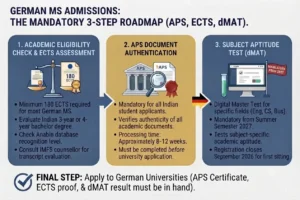
| ECTS (European Credit Transfer System) | Germany evaluates your degree based on ECTS credit equivalence. Your subjects are assessed for compatibility with the programme’s prerequisite modules. A 4-year Indian BE/BTech is typically equivalent to 240 ECTS credits. |
| Aptitude Assessment | Many competitive programmes including TUM, KIT, and Saarland use a formal aptitude assessment. GRE Quant scores can be submitted as supplementary evidence of quantitative readiness. |
| Numerus Clausus / NC (Restricted Admission) | Programmes with restricted seats rank applicants. Every additional signal of academic strength — including a strong GRE Quant score — can affect where you rank. |
| APS (Akademische Prüfstelle) | Indian applicants must complete APS credential verification. APS does not evaluate GRE. It takes 6–10 weeks — start early. |
| German Grade Conversion | Germany converts Indian CGPA to its own 1.0–4.0 grading scale. A 7.5/10 CGPA typically converts to approximately 2.5 in German grading. |
| Blocked Semester Account | German student visa requires €11,904 (~₹13.09 Lakhs) in a German blocked account. GRE has no relevance to this process. |
✓ Who SHOULD Take GRE for Germany in 2026
| Profile | GRE Recommendation | Reason |
|---|---|---|
| Applying to both USA and Germany | ✓ Strongly Recommended | One score, two destinations, zero marginal cost |
| Targeting TU Munich, RWTH, KIT, Stuttgart | ✓ Strongly Recommended | Competitive NC programmes value quantitative evidence |
| Data Science, AI, Robotics specialisations | ✓ Recommended | Most mathematics-intensive programmes — GRE Quant directly relevant |
| CGPA between 7.0–7.9 | ✓ Recommended | High GRE Quant partially compensates for below-target CGPA |
| Tier-2 / Tier-3 college (no IIT/NIT recognition) | ✓ Recommended | Bridges institutional recognition gap with objective score |
| Switching fields (e.g., Mechanical to Data Science) | ✓ Recommended | Demonstrates quantitative readiness for the new domain |
| Scholarship-focused (DAAD, excellence fellowships) | ✓ Recommended | Adds academic strength signal to holistic evaluation |
| Applying for research MS / direct PhD | ✓ Recommended | Research-oriented applications benefit from verifiable analytical performance |
✗ Who Should NOT Take GRE for Germany
Honest advice: GRE is not the right choice for every Indian student applying to Germany.
| Profile | GRE Needed? | Better Investment |
|---|---|---|
| Applying ONLY to non-NC (unrestricted) public university programmes | ✗ Likely Not Needed | Strengthen SOP, IELTS, and curriculum match |
| Civil Engineering, Architecture, Environmental Engineering | ✗ Not Needed | German language skills add far more value |
| IIT / NIT graduate with CGPA 9.0+ | ⚠ Low Priority | Invest in research publications or German language |
| Programme page explicitly states GRE not evaluated | ✗ Not Needed | Follow programme requirements precisely |
| Applying to management or MBA programmes in Germany | ✗ Not Recommended | GMAT is usually preferred for business programmes |
| Budget-constrained with no USA plans | ⚠ Evaluate carefully | Consult IMFS before investing |
🎓 Does GRE Improve Scholarship Chances in Germany?
| Scholarship | GRE Relevance |
|---|---|
| DAAD Scholarship | DAAD selection is holistic. A strong GRE score strengthens the academic credibility component. DAAD does not mandate GRE. |
| University Excellence Fellowships (TUM, KIT, RWTH) | Strong GRE Quant can serve as additional academic evidence during holistic fellowship review. |
| Deutschlandstipendium | GRE has limited direct impact but may contribute to overall academic profile strength. |
| Erasmus Mundus Joint Masters | Where a German university is a partner, a strong GRE score strengthens international competitiveness. |
📈 What Do Indian MS Graduates Actually Earn in Germany? (Verified 2026)
| Specialisation | Entry-Level Gross (EUR/yr) | Approx. in INR | EU Blue Card? |
|---|---|---|---|
| Data Science / ML | €54,000–58,000 | ₹59.4–63.8 Lakhs | Yes ✓ |
| Computer Science / Software | €50,000–58,000 | ₹55–63.8 Lakhs | Yes ✓ |
| Electrical Engineering | €48,000–55,000 | ₹52.8–60.5 Lakhs | Yes ✓ |
| Mechanical / Automotive | €50,000–56,000 | ₹55–61.6 Lakhs | Yes ✓ |
| Robotics / Mechatronics | €50,000–60,000 | ₹55–66 Lakhs | Yes ✓ |
| Factor | 🇩🇪 Germany MS | 🇺🇸 USA MS |
|---|---|---|
| Total 2-year investment | ₹25–35 Lakhs | ₹80–120 Lakhs |
| Entry-level STEM salary | €48k–60k/yr | USD 90k–120k/yr |
| Estimated payback period | Under 1 year | 2–4 years |
| Post-study work visa | 18 months job-seeker visa | OPT 1yr / STEM OPT 3yrs |
💵 GRE Cost vs Value
| Expense | Estimated Cost (May 2026) |
|---|---|
| GRE General Test Registration | ~₹20,900 (USD $220) Verify at ets.org |
| IMFS GRE Preparation Classes | ₹15,000–₹45,000 |
| Mock Tests and Practice Material | ₹3,000–₹10,000 |
📈 Model Your Germany + USA MS Costs — Free Tools
Frequently Asked Questions (FAQs)
No, GRE is not universally required. Most German public universities do not mandate it. However, specific STEM programmes at TU Munich, RWTH Aachen, Stuttgart INFOTECH, and KIT Karlsruhe may recommend or positively evaluate strong GRE Quant scores. Always verify requirements at official programme pages.
Partially. CGPA and curriculum match remain the dominant admissions factors. A strong GRE Quant score (165+) can demonstrate mathematical readiness when CGPA is between 7.0–7.9. GRE cannot compensate for serious academic gaps or missing prerequisite modules.
No. GRE has no direct relevance to the APS credential verification process or the German student visa. APS evaluates academic document authenticity. The student visa assesses financial readiness through a blocked account requirement of €11,904.
If applying only to Germany with a strong IIT profile and CGPA of 8.5+, GRE may not be necessary for most programmes. However, if applying to both USA and Germany simultaneously, or targeting TUM Data Engineering or RWTH Robotics, GRE adds measurable value.
DAAD scholarship selection is holistic. A strong GRE score can strengthen the academic credibility component. DAAD does not mandate GRE.
Students who should likely skip GRE for Germany: (1) Applying only to non-restricted programmes in low-competition fields. (2) Elite IIT/NIT profile with very high CGPA. (3) Target programme explicitly states GRE is not evaluated. (4) Applying to Civil Engineering or management programmes. (5) Budget-constrained with no USA plans.
Related Guides
GRE Score Requirements for Top Universities 2026
USA + Germany score data table — what IMFS students actually scored when they got in.
Study in Germany: The Free Education Pathway
Why Germany remains a top choice for Indian students.
Study in USA: Complete Guide for Indian Students
Everything Indian students need to know about US MS admissions.
GRE Preparation at IMFS
Strategic GRE preparation for Indian STEM students targeting USA and Germany.
Masters Abroad Counselling
Personalised MS admissions counselling covering university selection, SOP review, and strategy.
Scholarships for Indian Students Abroad
Major scholarship programs across Germany and USA.
Trusted by 67,000+ Students Across India
Find Your Nearest IMFS Centre
Get Your Personalised USA + Germany GRE Strategy Plan — Free
27+ years of placing Indian students in Germany, USA, Canada, UK, Ireland, Australia, and New Zealand. Strategic guidance based on your academics, your budget, and your goals.
Speak to IMFS for: GRE preparation planning • Germany university shortlist • ECTS compatibility check • APS guidance • SOP and profile review • USA + Germany combined strategy
Mumbai: Dadar, Thane, Borivali, Vashi | Pune: Shivaji Nagar | Hyderabad: Kukatpally, LB Nagar, Madhapur | Also: Nellore, Warangal