Study in Europe · Academic Systems Explained
ECTS Credits Explained: A Complete Guide for Indian Students
Last reviewed: July 2026 by Sharmila Shaligram, Head – Europe Admissions · Written by Sameer Jadhav, Content Strategist
Before a German or European university evaluates your grades, it evaluates something even more fundamental — whether your degree carries enough ECTS-equivalent credits for admission. This guide tells you exactly where you stand.
If you have shortlisted universities in Germany, the Netherlands, France or Italy, you will have run into three letters on every programme page: ECTS. It looks like a small detail until it decides whether your Indian degree is even eligible for the Master's you want. This guide breaks down what it is, how to convert your transcript, and — crucially — whether your specific Indian degree meets the threshold.
1What is ECTS, and where did it come from?
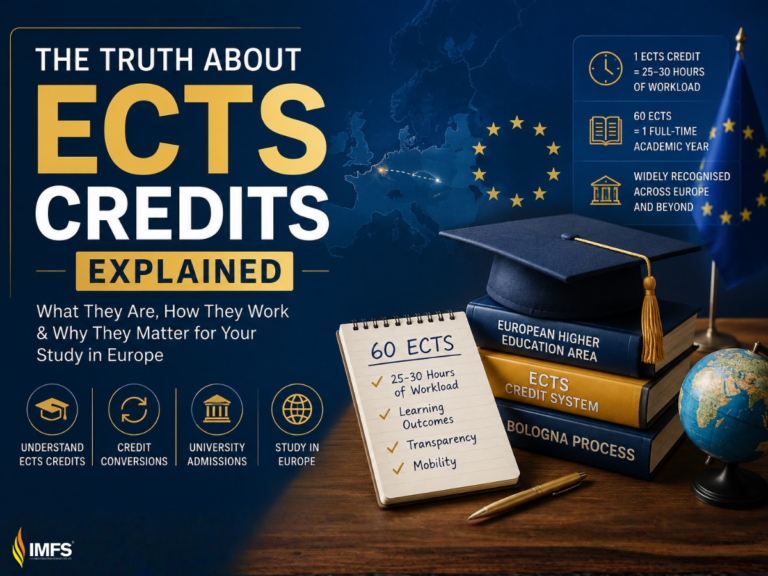
ECTS stands for European Credit Transfer and Accumulation System. It emerged in the late 1980s alongside the Erasmus exchange programme, built to let students moving between countries carry their coursework with them instead of losing it in translation. It grew into the common yardstick for comparing academic effort anywhere in the European Higher Education Area — measuring not grades but the volume of learning a course demands.
ECTS operates within the broader Bologna Process, which formally began in 1999 when 29 European countries signed the Bologna Declaration. The European Higher Education Area now counts 49 member countries on paper — though Russia and Belarus have had their participation rights suspended since 2022, so the system is actively used across 47 countries today.
Why this matters for you: ECTS is not a grading system — it is a workload currency. Two universities in two countries can teach a course completely differently, but if both call it "6 ECTS," admissions officers and credit evaluators know roughly how much effort it represents. When a German university says "minimum 180 ECTS for admission," they mean it in this sense.
2How ECTS credits are calculated
One ECTS credit is pegged to 25–30 hours of total effort — attending class, doing the reading, working through projects, and preparing for the final assessment. A full-time academic year lands at 60 ECTS credits (roughly 1,500–1,800 hours). Universities usually split this across modules: four courses of 15 ECTS each, or six of 10 ECTS, adding to 60 for the year.
The exact hours behind a single credit still varies slightly by country. Germany defines 60 ECTS as roughly 1,800 hours (30 hours/credit); Austria, Ireland, Italy and Malta define it closer to 1,500 hours (25 hours/credit). None of this changes what appears on your transcript — but it explains why one ECTS credit can feel heavier or lighter depending on where you study.
3How many ECTS credits does each degree level need?
| Degree / Cycle | Typical duration | ECTS credits required |
|---|---|---|
| Short-cycle qualification | 1.5–2 years | 90–120 ECTS |
| Bachelor's (first cycle) | 3–4 years | 180–240 ECTS |
| Master's (second cycle) | 1–2 years | 90–120 ECTS |
| Doctorate (third cycle) | Varies by country | No fixed ECTS norm |
A quick sanity-check: if a "3-year Bachelor's" is listed at anything other than roughly 180 ECTS, or a "1-year Master's" is not close to 60 ECTS, confirm directly with the admissions office before you apply.
4Does my Indian degree meet the ECTS threshold?
This is the question IMFS counsellors answer most often for Germany-bound students. The short answer: a 4-year B.Tech usually does, a 3-year BSc often does not. Here is the full picture by degree type.
| Indian Degree | Duration | Typical Indian Credits | Est. ECTS Equivalent | Meets 180-ECTS Threshold? |
|---|---|---|---|---|
| B.Tech / B.E. | 4 years | 160–180 | ~180–210 ECTS | ✅ Usually yes |
| B.Sc. (3-year) | 3 years | 90–120 | ~135–165 ECTS | ❌ Often no — bridging may be required |
| B.Sc. + M.Sc. (combined) | 5 years | — | ~270–300 ECTS | ✅ Yes — well above threshold |
| BCA / BBA | 3 years | 90–120 | ~135–165 ECTS | ❌ Often no — depends on programme |
| B.Com | 3 years | 90–120 | ~135–165 ECTS | ❌ Often no — depends on programme |
| Integrated M.Tech (5-year) | 5 years | 200–240 | ~270–300 ECTS | ✅ Yes |
| B.Arch (5-year) | 5 years | 200+ | ~270+ ECTS | ✅ Yes |
📌 ECTS estimates are based on the workload-proportion formula (see Section 5). These are planning estimates only — your target university's international office or a credential evaluator runs the definitive conversion. Individual programme thresholds vary: some German Master's require 210 ECTS, others accept 180. Always check the exact eligibility statement on the programme page.
The 3-year BSc vs 180-ECTS threshold is the most common eligibility gap we see for Germany-bound students. We have helped students navigate this through combined degree submissions (BSc + MSc transcripts together), targeting programmes with lower stated thresholds, and in some cases, preparatory semesters. This is exactly the kind of issue that should be resolved before you write your SOP — not after you have applied and received a rejection on eligibility grounds.
Germany-Specific Examples (Named Universities)
Most German Master's programmes in engineering and technical fields are structured as 120 ECTS over 4 semesters (30 ECTS per semester). Here is how that looks at programmes Indian students commonly apply to:
| University | Programme | Master's ECTS | Min. Bachelor's ECTS Required |
|---|---|---|---|
| TU Munich | M.Sc. Mechanical Engineering | 120 ECTS (4 semesters) | 210 ECTS (typically) |
| RWTH Aachen | M.Sc. Computer Science | 120 ECTS (4 semesters) | 180 ECTS minimum |
| TU Berlin | M.Sc. Electrical Engineering | 120 ECTS (4 semesters) | 180 ECTS minimum |
| KIT (Karlsruhe) | M.Sc. Mechanical Engineering | 120 ECTS (4 semesters) | 180 ECTS minimum |
| FAU Erlangen-Nürnberg | M.Sc. Data Science | 120 ECTS (4 semesters) | 180 ECTS minimum |
📌 Threshold figures are drawn from each university's published programme pages and are subject to change. Always verify on the official admissions page before applying. A standard Indian 4-year B.Tech (estimated 180–210 ECTS) typically meets all thresholds above; a 3-year BSc typically does not meet the TU Munich 210-ECTS threshold without additional coursework.
Important: Admission decisions are based on complete academic evaluation — not ECTS alone. ECTS clears the first eligibility gate. Your grades, language scores, SOP and — from Summer 2027 — your dMAT score determine competitiveness within that eligible pool.
→ For the complete Germany picture — universities, costs, APS, dMAT and visa: Study in Germany 2026 — Complete Guide →
5The ECTS grading scale — and why it changed
ECTS originally came with its own A–F grading scale. That standalone scale was phased out in 2009; institutions now publish grade distribution tables showing how marks are spread across their student body, and that distribution is used for conversion. When you see "ECTS grade: B," it reflects where you ranked relative to your peers — not a fixed universal definition of B. Always ask your target university how they handle grade conversion for transcripts.
6Converting Indian, US and UK credits to ECTS
India has no single official conversion rate into ECTS because there is no unified national credit framework across UGC, CBCS and NEP structures. There is no officially notified national ECTS conversion issued by UGC (as of July 2026) — which is why universities and credential evaluators rely on workload comparison rather than a fixed multiplier.
| System | How credits are defined | Approx. conversion to ECTS |
|---|---|---|
| India (UGC / CBCS / NEP) | Varies by university — workload-based | Estimated via formula (see below) |
| United States | Weekly classroom hours + expected study time | 1 US credit ≈ 2 ECTS credits |
| United Kingdom (CATS / SCQF) | Total learning time, not just class hours | 120 UK credits per year ≈ 60 ECTS |
The formula for converting Indian credits
ECTS (estimated) = Credits obtained × (60 × years of degree) ÷ Total credits for the full degree
Example: a 4-year B.Tech with 160 total credits where the student has completed 160 credits → 160 × (60 × 4) ÷ 160 = 240 ECTS. A student halfway through (80 credits completed) → 80 × 240 ÷ 160 = 120 ECTS — two years of European workload. Math verified.
This is a planning estimate only. For a formal application, your target university's international office or an official credential evaluation service runs the definitive conversion. Do not submit a self-calculated figure as final.
When we review a student's transcript for Germany eligibility, we do not just run the formula — we also check the specific programme page's stated ECTS threshold, because "minimum Bachelor's degree" and "minimum 180 ECTS Bachelor's" and "minimum 210 ECTS Bachelor's" are three very different bars. A 4-year Indian B.Tech that comfortably clears 180 ECTS can still fall short of a 210-ECTS threshold at TU Munich or similar. The difference between these thresholds is not obvious from the programme name — it requires reading the fine print of the eligibility section.
7Country comparison — how Europe uses ECTS differently
ECTS is the shared standard, but individual countries and universities apply it with different thresholds and expectations. Here is how the most popular European study destinations compare for Indian MS applicants:
| Country | Typical Min. Bachelor's ECTS for Master's | Master's Duration | Language | Indian B.Tech qualifies directly? |
|---|---|---|---|---|
| Germany | 180–210 ECTS (varies by programme) | 120 ECTS / 2 years | English / German | ✅ Usually |
| Netherlands | 180 ECTS | 60–120 ECTS / 1–2 years | English | ✅ B.Tech yes · BSc often ❌ |
| France | 180 ECTS | 120 ECTS / 2 years | French / English | ✅ Usually |
| Italy | 180 ECTS | 120 ECTS / 2 years | Italian / English | ⚠️ B.Tech yes · BSc often ❌ |
| Ireland | Equivalent NFQ Level 8 (≈180 ECTS) | 90 ECTS / 1 year | English | ✅ Usually |
| UK | UK Level 6 Bachelor's (120 UK credits = 60 ECTS) | 180 UK credits / 1 year | English | ✅ Usually |
📌 Thresholds are general programme-level guidance — individual programmes and universities vary. Always verify on the specific programme's admissions page. IMFS counsellors check eligibility against the exact programme-level threshold before shortlisting.
8Why ECTS matters beyond just meeting a number
- Master's eligibility: Most European Master's programmes list a minimum ECTS requirement for your Bachelor's. A 3-year Indian Bachelor's can fall short on paper even when the academic content is equivalent — one of the most common reasons Indian applicants receive bridging-year conditions.
- Visa and full-time status: Student visas in Germany and most European countries require proof of full-time enrolment, defined in ECTS terms — typically 30 ECTS per semester. Falling below this threshold can affect visa compliance.
- Scholarship conditions: Many scholarships tie renewal to a minimum ECTS credit load completed per year — missing the threshold can affect disbursement.
- Exchange and Erasmus mobility: The entire Erasmus+ process runs on a Learning Agreement listing the ECTS value of every course a student plans to take at the host institution.
- Transfer flexibility: If you start a degree in one EHEA country and want to transfer or continue elsewhere, ECTS is what makes your completed coursework portable.
The ECTS-visa link is frequently overlooked by students. We have seen Indian students in Germany drop below 30 ECTS in a difficult semester — especially during the transition to the thesis phase — without realising the full-time status implications for their residence permit. From the very first semester, build a plan that keeps you at or above 30 ECTS per semester, even in the semester where your thesis begins. Your Ausländerbehörde does not distinguish between "thesis semester" and "not full-time."
ECTS Semester Planner — A Typical German Master's for Indian Students
| Semester | ECTS Target | Typical Structure | Key Watch-out |
|---|---|---|---|
| Semester 1 | 30 ECTS | 4–5 taught modules of 5–8 ECTS each | Language gap and adjustment — choose modules strategically, not ambitiously |
| Semester 2 | 30 ECTS | 4–5 taught modules + electives | Must maintain 30 ECTS for visa full-time status |
| Semester 3 | 30 ECTS | Specialisation modules + project | Begin thesis topic discussions with supervisor — don't leave it to Semester 4 |
| Semester 4 | 30 ECTS | Master's thesis (typically 20–30 ECTS) | Confirm thesis is registered before semester starts — ECTS must still hit 30 for visa compliance |
9ECTS and the new dMAT — how they connect
The dMAT (Digital Master Test), announced 29 June 2026 by APS India and g.a.s.t., is now mandatory for Indian MS applicants in Engineering, Business, Commerce, Finance, Economics and Management for Summer Semester 2027 onwards. Understanding why it was introduced helps explain the relationship between ECTS and the dMAT.
ECTS determines whether you are eligible to apply. The dMAT determines whether your academic preparation meets German standards within that eligible pool. ECTS answers: "does your degree count as a Bachelor's of sufficient length?" The dMAT answers: "is your quantitative and field-specific reasoning strong enough?" Both gates must be cleared.
The dMAT was introduced partly because ECTS equivalence alone — especially as applied to the wide diversity of Indian degree structures — was not sufficient to verify academic readiness for German postgraduate study. A student with a 4-year B.Tech (ECTS-eligible) and a student with a 3-year BSc plus a bridging year (also ECTS-eligible) can present very different academic preparation. The dMAT adds a standardised aptitude check on top of the ECTS threshold.
Key dMAT dates: Registration deadline 15 Sep 2026 · Test date 26 Sep 2026 · Results 12 Oct 2026 · Fee: €150 (~₹16,200)
→ Full dMAT guide: what it tests, how to prepare → · dMAT requirement explained →
IMFS dMAT Coaching · Batch starting first week of August 2026
Prepare before the 15 September registration deadline.
Core Module + General Academic Module. All 10 IMFS branches. Limited seats.
🇩🇪 Not sure if dMAT applies to your degree?
Use the free IMFS dMAT Eligibility Checker — answer 6 questions in under 60 seconds. Based on APS India guidance (June 2026). No login required.
Check My dMAT Eligibility →→ APS Certificate — Step-by-Step Guide 2026 → · Required before any German university application · 4–8 weeks process · Begin before your dMAT registration
The dMAT does not replace ECTS eligibility — it adds to it. Students sometimes ask whether a very strong dMAT score can compensate for a degree that does not meet the ECTS threshold. Currently the answer is no: ECTS eligibility and dMAT performance are separate gates, not a combined score. You need both. IMFS is launching dMAT preparation classes at all 10 branches from the first week of August 2026.
10Common questions
Does APS calculate ECTS credits?
No. APS (administered by the German Cultural Centre in India) verifies the authenticity of your academic documents — it does not calculate or assign ECTS credits. ECTS equivalence is assessed separately by each university's admissions office using your verified transcripts. APS gives you a certificate confirming your documents are genuine; the university then determines what your degree is worth in ECTS terms. The two processes are independent and both are required for German Master's applications.
Can I compensate for low ECTS with work experience?
For the formal ECTS eligibility threshold — no. Work experience does not substitute for degree-level ECTS in standard German Master's admissions. However, some German universities offer aptitude assessment or individual review pathways for applicants slightly below the stated threshold, where professional experience may be considered holistically alongside academic content. These pathways are programme-specific and not guaranteed — never assume they apply without confirming directly with the admissions office. For UG pathway planning, also see: IMFS Bachelor's Counselling →
Does every European country actually use ECTS?
The EHEA counts 49 member countries on paper, but Russia and Belarus have had their participation rights suspended since 2022 — leaving 47 countries actively engaged. The UK sits within the EHEA but its universities run on their own CATS or SCQF frameworks rather than ECTS directly — though the two convert cleanly (2 UK credits = 1 ECTS credit).
Is a higher ECTS number always a harder course?
Not necessarily harder — it reflects more total workload. A 10-ECTS course expects more combined hours than a 5-ECTS course; the two could be equally rigorous per hour studied.
What if my Indian Bachelor's does not meet the 180-ECTS threshold?
This is common for 3-year Indian Bachelor's degrees. Depending on the university, you may be offered conditional admission with a bridging semester, asked to submit additional coursework evidence, or advised toward programmes with lower thresholds. If you have both a 3-year BSc and a 2-year MSc from India, submitting both transcripts together typically gives you 270+ estimated ECTS — well above the threshold. IMFS counsellors assess your specific transcript before you apply.
Do ECTS credits expire?
ECTS credits themselves do not expire, but individual universities can set validity windows for recognising credits toward a specific degree — particularly for transfers or resumed studies after a long gap. Confirm directly with the receiving institution.
How does the dMAT affect ECTS-eligible students?
The dMAT is a separate requirement — not a substitute for ECTS eligibility. If your degree meets the ECTS threshold, you still need to register for and sit the dMAT before the September 2026 deadline to be considered for Summer Semester 2027 programmes. ECTS determines eligibility; the dMAT tests academic preparation. Both are required.
Not sure if your degree meets the ECTS threshold?
IMFS counsellors review your transcript against your shortlisted universities' exact ECTS requirements — before you spend time on an application that will not clear eligibility. Free session, no obligation.
Book a Free Counselling SessionSources & references
All figures drawn from official European Commission, EHEA, and credit-framework bodies, verified against institutional procedures where available.
- European Commission — ECTS Official DefinitionOfficial EU definition, credit ranges by degree cycle, workload calculation.
- EHEA — Official List of Member Countries49-country membership; 2022 suspension of Russia and Belarus confirmed.
- SCQF Partnership — Official FAQsOfficial confirmation of the 2:1 UK-to-ECTS credit conversion.
- UNC Charlotte — ECTS Equivalency ProcedureUniversity procedure confirming 1 US credit ≈ 2 ECTS convention.
- APS India — dMAT Official InformationSource for dMAT announcement, dates, fee and eligible subjects. Announced 29 June 2026.
Related reading on IMFS
- Study in Europe — Country-by-Country GuideCompare tuition, intake cycles and top programmes across the EHEA.
- Study in Germany — Complete 2026 GuideUniversities, costs, APS, dMAT, visa — everything for Indian students.
- The New dMAT Test: What Changed for Indian ApplicantsHow Germany's new standardised test affects your Summer 2027 application.
- dMAT Requirement Explained — Dates, Fee and SubjectsRegistration deadline, test date, results date, and which subjects are affected.
- IMFS Master's CounsellingEnd-to-end support from ECTS eligibility check to visa documentation.