🇩🇪 Germany Master's — Complete Authority Guide 2026
APS Certificate, ECTS, UniAssist and dMAT — Everything Indian Germany MS Applicants Need to Know
Written by Sameer Jadhav, Content Strategist and International Education Research Specialist | Reviewed by Sharmila Shaligram, Head – Europe Admissions and Counseling, IMFS | Updated: July 2026
APS, ECTS, UniAssist, and dMAT are four different Germany MS requirements that most Indian students confuse or combine. ECTS checks whether your degree is equivalent. APS verifies it is authentic. UniAssist processes your application. dMAT (from Summer 2027) tests your aptitude. All are mandatory — in a specific order — and each has a distinct timeline that must be planned in advance.
🇩🇪 Not sure if dMAT applies to your degree?
Use the free IMFS dMAT Eligibility Checker — answer 6 questions in under 60 seconds. Based on APS India guidance (June 2026). No login required.
Check My dMAT Eligibility →📋 Key Takeaways — Read This First
- Four separate requirements — ECTS (credit equivalency), APS (document authentication), UniAssist (application portal for some universities), dMAT (aptitude test from Summer 2027). None replaces another.
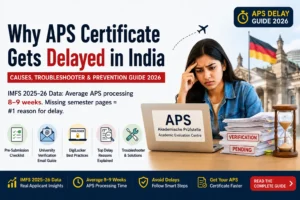
- IMFS data (2025-26): Average APS processing = 8–9 weeks. Fastest = 6 weeks. Longest = 13 weeks. Top delay cause = missing transcript semester pages.
- ECTS minimum is 180 credits — 4-year Indian degrees (BTech, BE) typically qualify; 3-year degrees (BCom, BCA, BSc 3yr) usually do not
- APS is mandatory for almost all Indian students — German universities and consulates require it; apply at least 4–6 months before your deadline
- UniAssist ≠ APS — UniAssist is an optional application portal used by ~170 German universities; APS certificate is needed regardless of whether you use UniAssist
- Anabin H+ / H- rating matters — if your Indian university is H- or unlisted, German universities may not process your application even with valid APS
- dMAT mandatory from Summer 2027 for Engineering, Business, Commerce, Finance, Management — registration deadline 15 September 2026
- Module Handbook — German university course catalogue that determines whether your Indian credits meet subject-specific ECTS requirements. IMFS counsellors compare your transcript against it.
- Winter Semester (Oct start) is recommended for most Indian students — wider program choice, more competitive scholarships
- Parents: Plan 18–24 months ahead — ECTS check, APS, dMAT, SOP, German language, and university applications all have non-overlapping lead times
Short Answer: How Do APS, ECTS, UniAssist and dMAT Connect?
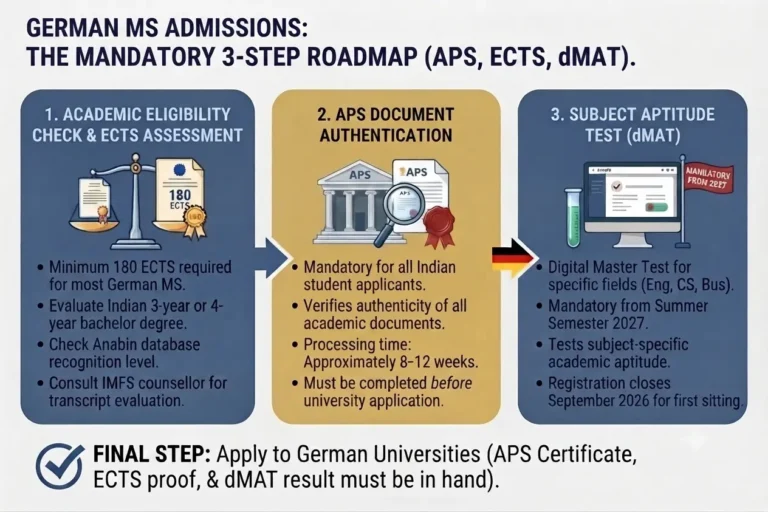
ECTS is the credit framework that determines if your Indian degree is academically equivalent to a European bachelor's. APS independently verifies that your documents are authentic. UniAssist is an optional application processing portal used by some German universities. dMAT (from Summer 2027) is a new aptitude test for specific fields. You need all applicable requirements completed — in the order shown in this guide — before any German MS application will be processed.
The Four Germany MS Requirements — Visualised
Decision Tree — Do You Need All Four Requirements?
🌳 Start Here — Which Requirements Apply to You?
→ Back to the full picture: Study in Germany — Complete Guide for Indian Students 2026
Layer 1 — ECTS: Does Your Indian Degree Qualify?
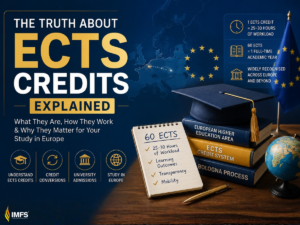
ECTS (European Credit Transfer and Accumulation System) is the credit framework of the European Higher Education Area (EHEA) — 49 countries across Europe that have harmonised their higher education systems through the Bologna Process. Germany is a signatory. German universities use ECTS to compare academic workload from non-European degrees — including India's — against European standards.
Reference benchmark: A standard German bachelor's = 180 ECTS. A German master's = 120 ECTS. Total = 300 ECTS. German universities typically require your Indian bachelor's to meet at least 180 ECTS before they will consider you for MS admission.
1 ECTS = 25–30 notional learning hours — including contact hours, self-study, assignments, and exam preparation. A typical Indian 4-credit semester subject requiring ~120 total hours ≈ 4 ECTS.
How Indian Credits Convert to ECTS
| Indian University Credit | Typical Total Hours | Approx. ECTS | Basis |
|---|---|---|---|
| 1 credit (contact-hour based) | 15–18 hrs contact + self-study | ~0.6 ECTS | 1 credit ≈ 1 ECTS only if 30 hrs workload |
| 3-credit course | 45–90 hrs total | 1.5–3 ECTS | Varies by university; check your university's credit definition |
| 4-credit course (common in BTech) | 60–120 hrs total | 2–4 ECTS | Higher-workload courses closer to 4 ECTS |
| Full 4-year BTech / BE (240+ Indian credits) | ~6,000–8,000 hrs total | 210–240 ECTS | Typically qualifies for German MS |
| Full 3-year BCom / BSc / BCA | ~3,000–4,500 hrs total | 120–160 ECTS | Often below 180 ECTS — may not qualify |
| Source: European Commission ECTS Users' Guide; IMFS Germany counselling experience. Actual ECTS depends on your specific university's workload structure. | |||
Decision Tree — Does My Indian Degree Have Enough ECTS?
🌳 ECTS Eligibility Check
Indian Degree Eligibility — Quick Reference
| Indian Degree | Duration | Typical ECTS | German MS Eligibility | Action |
|---|---|---|---|---|
| BTech / BE | 4 years | 210–240 | Usually qualifies | Confirm subject-specific ECTS |
| BSc Hons (4-year) | 4 years | 180–220 | Usually qualifies | Verify total hours with IMFS |
| BArch (5-year) | 5 years | 240–300 | Qualifies | Check architecture-specific requirements |
| Integrated MTech/MCA (5yr) | 5 years | 270–300 | Qualifies | Standard transcript assessment |
| BSc General (3-year) | 3 years | 120–160 | Often does not qualify | Consider Indian master's first |
| BCom (3-year) | 3 years | 120–150 | Often does not qualify | MCom or MBA needed |
| BCA (3-year) | 3 years | 120–150 | Often does not qualify | MCA or additional credits |
| Indian MSc/MCom/MA (after 3yr UG) | Combined 5yr | 240–260 | Usually qualifies combined | Submit combined transcript |
| MBA (2yr after UG) | Combined 5yr | 240–300 | Verify per program | Some German MS programs prefer BSc+MSc over BSc+MBA |
The Anabin Database — H+ vs H- Explained
The Anabin database (anabin.kmk.org), maintained by KMK (Kultusministerkonferenz) — Germany's Standing Conference of the Ministers of Education — categorises every international university by recognition level. Your ECTS count is meaningless if your university has a poor Anabin rating.
| Rating | What it means | India examples | APS impact |
|---|---|---|---|
| H+ | Degree fully recognised in Germany | IITs, NITs, central universities (DU, BHU, JNU), many autonomous colleges | Standard APS process |
| H+* | Recognised with specific conditions | Some state universities with programme-specific conditions | Additional documents may be required |
| H- | Limited recognition — assessed case-by-case | Some private deemed universities, newer autonomous institutions | German universities may individually assess; admission not guaranteed |
| Unlisted | Not in the database | Very new institutions or unrecognised institutions | Contact target German university directly before applying |
💡 H- does not mean disqualified. It means German universities will individually assess rather than automatically process. Some H- rated Indian universities have applicants who succeed at German programs — but it requires more documentation and a stronger overall profile. IMFS checks your Anabin rating as the first step in Germany counselling.
→ Full ECTS explainer: ECTS Credits — Complete Guide for Indian Students
Layer 2 — APS Certificate: What It Is, How Long It Takes, What Goes Wrong
APS (Akademische Prüfstelle — Academic Evaluation Centre) India verifies that your Indian academic credentials are authentic. Without APS certificate, German universities will not process your application and German consulates will not issue a student visa.
IMFS APS Processing Data — 2025-26 Germany Applicants
| Metric | IMFS Data (2025-26) | Official APS Guidance |
|---|---|---|
| Average processing time | 8–9 weeks | 8–12 weeks |
| Fastest case | 6 weeks (complete documents, no queries) | — |
| Longest case | 13 weeks (multiple document follow-ups) | — |
| #1 delay cause | Missing transcript semester pages | Incomplete documents |
| #2 delay cause | Bonafide certificate not matching degree certificate exactly | — |
| Peak slow period | October–January (application season overlap) | — |
Data based on IMFS Germany applicant cohort 2025–26. Individual results vary. Source: IMFS Germany counselling records.
APS Timeline
Applying for APS and then discovering your degree doesn't meet ECTS requirements wastes 8+ weeks and the APS fee. ECTS check takes one IMFS counselling session — do this first.
Every mark sheet from Class 10 onward — every semester page (missing pages = most common delay). Degree certificate, bonafide/transfer certificate, passport, photos, application form, fee payment. Verify current list at aps-india.de.
Submit at APS India office (New Delhi or Chennai). Some university categories require an APS interview. IMFS Germany counsellors review your document set before submission to prevent rejection.
Do not delay university shortlisting, SOP preparation, or German language coaching during this period — all can proceed in parallel. APS is the bottleneck; everything else should run alongside it.
Collect original. This certificate is presented to German universities and attached to your student visa application. Valid indefinitely once issued.
APS vs Anabin vs UniAssist — Common Confusion Resolved
| APS India | Anabin Database | UniAssist | |
|---|---|---|---|
| What it is | Document authentication body | University recognition database | Centralised application portal |
| Who runs it | APS India (aps-india.de) | KMK — German Ministry of Education (anabin.kmk.org) | uni-assist e.V. (uni-assist.de) |
| What it checks | Are your documents genuine? | Is your Indian university recognised in Germany? | Is your application complete and forwarded to the university? |
| Mandatory? | Yes — for almost all Indian students | No action required from you — German universities use it automatically | Only for universities that use UniAssist (~170 German universities) |
| Your cost | ~₹6,000–8,000 | Free (you look it up) | €75 first university + €30 each additional |
| Timeline | 8–13 weeks | Immediate (online lookup) | 4–6 weeks to process your application |
| Output | APS certificate | Recognition rating for your university | Application forwarded to German university |
→ Full APS step-by-step: APS Certificate India — Step-by-Step Guide 2026
Layer 3 — dMAT: The New Aptitude Test (Summer 2027 Onwards)
Announced 29 June 2026, dMAT (Digital Master Assessment Test) is mandatory from Summer Semester 2027 for Engineering, Business, Commerce, Finance, and Management MS applicants from India. It is administered by g.a.s.t. (Gesellschaft für Akademische Studienvorbereitung und Testentwicklung) at the TestDaF Institute in Bochum — the same body that conducts the TestDaF German language exam.
dMAT vs GRE — For Students Choosing Between Germany and USA
| Dimension | dMAT (Germany) | GRE (USA / global) |
|---|---|---|
| Who requires it | Mandatory for Germany MS (affected fields, Summer 2027+) | Required by most top US MS programs; some European programs |
| What it tests | Core: Figure Sequences, Mathematical Equations, Latin Squares · Subject Module: field-specific | Verbal Reasoning, Quantitative Reasoning, Analytical Writing |
| Language demand | Low — Core Module is largely non-verbal | High — Verbal section requires strong English vocabulary |
| Math level | Arithmetic + algebraic reasoning (systems of equations) | Up to undergrad statistics and algebra |
| Total duration | ~3 hours + 30 min break | ~3 hours 45 minutes |
| Prep time needed | 4–6 weeks structured coaching | 3–6 months for competitive scores |
| Fee | €150 (~₹16,200) | USD $220 (~₹20,900) |
| Score validity | Indefinite | 5 years |
| Tuition comparison | Germany: €0 tuition at most public universities | USA: USD $15,000–60,000/year tuition |
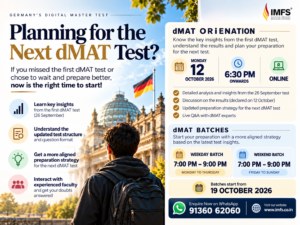
⚠️ 2026 dMAT dates: Registration deadline 15 September 2026. Test: 26 September 2026. Results: 12 October 2026.
New Exam date: Q1 2027->IMFS dMAT orientation & batch:
12 October 2026 at all 10 branches. → Register now for the new dMAT batch→ dMAT Preparation Guide 2026 · IMFS dMAT Coaching Programme · dMAT Requirement Explained
Winter vs Summer Intake — Which to Target?
| Winter Semester (Recommended for most) | Summer Semester | |
|---|---|---|
| Intake period | October/November to February/March | April to July/August |
| Application deadlines | May–July (varies by university) | November–January (varies) |
| Program availability | Most MS programs open — much wider choice | Limited — many programs only offer Winter intake |
| Competition | Higher — more applicants, more places | Lower — fewer applicants and fewer places |
| dMAT timing | ✅ October 2026 results in time for Winter 2027/28 applications | ❌ October 2026 results too late for Summer 2027 applications |
| DAAD scholarships | Most scholarships available for October intake | Limited scholarship availability |
| IMFS recommendation | ✅ Target Winter 2027/28 for all first-time Germany MS applicants | Only if you have missed Winter deadline and specific program has Summer availability |
10 Common APS, ECTS and dMAT Mistakes Indian Students Make
These are the actual mistakes IMFS Germany counsellors encounter repeatedly — not generic advice. Each one has a direct, practical fix.
- Starting APS after receiving a German admission offer
German universities issue conditional offers that expire while APS is processing (8–13 weeks). By the time APS is done, the offer deadline has passed.
✅ Fix: Start APS at the same time as university shortlisting — not after. - Submitting incomplete transcripts to APS
Missing even one semester's mark sheet causes APS to return documents and restart processing — the #1 delay cause in IMFS 2025-26 data, adding 4–6 weeks.
✅ Fix: Compile every mark sheet from Class 10 onward before starting APS. IMFS counsellors verify completeness. - Confusing APS with UniAssist
APS (aps-india.de) authenticates documents. UniAssist (uni-assist.de) processes university applications. They are different organisations, different fees, different timelines. Many students think paying APS means they've applied to universities.
✅ Fix: Complete APS first. Then use UniAssist (if your target university requires it) to submit applications with your APS certificate. - Assuming 3-year Indian bachelor's qualifies for German MS
Most 3-year Indian degrees produce 120–160 ECTS — below the 180 ECTS minimum. Students apply to German programs only to be rejected at the ECTS check stage, losing application fees and time.
✅ Fix: Get ECTS eligibility assessed by IMFS before applying anywhere. Takes one session; avoids months of wasted effort. - Ignoring the Anabin rating of their Indian university
An H- rated or unlisted university means German universities may individually assess your application — or not process it at all — even with a valid APS certificate and sufficient ECTS.
✅ Fix: Check your university at anabin.kmk.org before starting the Germany MS process. IMFS counsellors advise on strategies for H- rated applicants. - Not checking ECTS before starting APS
Students submit APS, wait 12 weeks, receive certificate — then discover their degree doesn't meet ECTS requirements at their target German university. APS fee and 12 weeks lost.
✅ Fix: ECTS check is always the first step. 30 minutes with an IMFS Germany counsellor can prevent this. - Skipping dMAT registration thinking "it doesn't apply to me"
Many students in Engineering, Business, and CS assume they're exempt. dMAT applies to any Indian student applying for MS in affected fields for Summer 2027 onwards, if their APS process started after 29 June 2026.
✅ Fix: Verify at aps-india.de/dmat. When in doubt, register — the cost of not registering (missing the 15 Sep 2026 deadline) is higher than the €150 exam fee. - Not reading the German university's Module Handbook
Some German MS programs don't just require 180 ECTS total — they require specific credits in mathematics, programming, or engineering core subjects. Students with sufficient total ECTS but insufficient subject-specific ECTS are rejected.
✅ Fix: Before applying, check the Modulhandbuch (Module Handbook) of your target program. IMFS Germany counsellors compare your Indian transcript against it. - Targeting Summer Semester when dMAT results aren't available in time
dMAT results arrive 12 October 2026 — after Summer 2027 application deadlines (typically November–January). Students who need dMAT cannot apply for Summer 2027.
✅ Fix: Target Winter Semester 2027/28. dMAT results (October 2026) are available well before most Winter 2027/28 deadlines (May–July 2027). - Assuming APS approval means university admission
APS only certifies your documents are genuine. It does not evaluate your academic quality, shortlist you for programs, or guarantee admission. Many students receive APS certificates and then apply randomly to German universities without any shortlisting strategy.
✅ Fix: Combine APS with proper Germany university shortlisting through IMFS — matching your ECTS profile, Anabin rating, CGPA, and dMAT score against realistic program targets. → IMFS Master's Counselling
If Your ECTS Is Not Enough — Your Practical Options
- Complete an Indian master's degree — A 2-year Indian master's (MSc, MCom, MBA, MA) combined with your 3-year bachelor's typically produces 240–280 ECTS — well above the German threshold. This adds 2 years but opens significantly more German programs, including RWTH Aachen and TU Munich flagship MS courses.
- Take additional coursework at your Indian university — Many students can add one extra semester of coursework to reach the required ECTS threshold. Practical for recent graduates. Check whether your university will add credits to your existing transcript.
- Apply to German universities with flexible thresholds — Not all German universities apply 180 ECTS uniformly. Some newer programs, regional universities, or applied science universities (Fachhochschulen) have more flexible assessment. IMFS Germany counsellors identify realistic targets given your ECTS count.
- Apply to a related field where your ECTS distribution qualifies — A BCom student with insufficient maths ECTS for Quantitative Finance MS may qualify for International Business Management MS. Your ECTS distribution matters, not just total.
Use the IMFS Study Abroad Cost Calculator to model the financial impact of an additional Indian master's year vs applying to Germany directly.
Complete Timeline — Winter Semester 2027/28 Target
| When | Action | Why |
|---|---|---|
| July 2026 | ECTS eligibility assessment with IMFS | Confirm you qualify before investing in APS/dMAT |
| Aug 2026 | IMFS dMAT coaching batch (if applicable) | 3 Aug – 3 Sep batch; complete before registration deadline |
| 15 Sep 2026 | Register for dMAT at d-mat.de (if applicable) | Hard deadline — no extensions |
| 26 Sep 2026 | dMAT exam | First sitting; results 12 October |
| Oct–Nov 2026 | Begin Germany university shortlisting with IMFS + Start APS application | APS takes 8–13 weeks — must start now for May 2027 deadlines |
| Nov 2026–Jan 2027 | SOP + LOR preparation; German language coaching | Run parallel to APS — do not wait for APS certificate |
| Feb–Mar 2027 | APS certificate received | Attach to university applications. Use to set up UniAssist if applicable. |
| Mar–May 2027 | Submit German university applications | With APS + dMAT score + all required documents |
| Jun–Aug 2027 | Admission letters + blocked account + student visa | €11,208 blocked account + visa application with APS certificate |
| October 2027 | 🎓 Depart for Germany — Winter Semester 2027/28 |
→ Blocked Account Guide for German Student Visa · Cost of Living in Germany 2026 · Scholarships for Indian Students in Germany
For Parents — The Germany MS Investment Picture
👨👩👧 What Parents Need to Plan and Budget
Germany is the most cost-effective global MS destination for Indian students — most public universities charge zero tuition. The real costs are living (€900–1,100/month in Munich, Berlin, or Aachen) and the blocked account (€11,208/year frozen as visa proof-of-funds).
What parents need to track across all four requirements:
- ECTS check: Free with IMFS counselling session — book as early as possible (ideally when child is in final year of graduation)
- APS fee: ~₹6,000–8,000 (verify at aps-india.de) — one-time, non-refundable. Budget alongside coaching and application fees.
- dMAT fee: €150 (~₹16,200) — one-time per sitting. Separate from IMFS coaching fee.
- UniAssist fee: €75 first university + €30 per additional — budget for 3–5 universities = €195–225
- Lead time: 18–24 months of planning is realistic. Starting in the final year of graduation — when APS, ECTS, dMAT, SOP, German language, and shortlisting all converge — is the most stressful and least successful approach.
Use the IMFS Study Abroad Cost Calculator to model total Germany MS costs. Use the Scholarships Guide — DAAD offers specific scholarships for Indian students that can partially offset living costs.
Get Your ECTS, APS, dMAT and Germany Plan from IMFS
IMFS Germany counsellors assess your ECTS eligibility, prepare your APS documents, provide dMAT coaching, and shortlist German universities — all from one team at one branch.
All Your APS, ECTS, UniAssist and dMAT Questions Answered
What is the difference between APS, ECTS, UniAssist and Anabin?
Four different things: APS (aps-india.de) verifies your Indian documents are authentic — mandatory. ECTS is the European credit framework that determines whether your Indian degree is academically equivalent to a European bachelor's — threshold is typically 180 ECTS minimum. Anabin (anabin.kmk.org), maintained by KMK, rates your Indian university's recognition level in Germany. UniAssist (uni-assist.de) is a centralised application portal used by ~170 German universities — it forwards your application after APS verification. APS and ECTS are always required. Anabin is automatic (German universities use it). UniAssist depends on which university you apply to.
How long does APS take in India in 2026?
Based on IMFS data from 2025–26 Germany applicants: average APS processing is 8–9 weeks. Fastest: 6 weeks (complete documents, no queries). Longest: 13 weeks (multiple document follow-ups). Most common delay: missing transcript semester pages. The official APS India guidance is 8–12 weeks. During peak periods (October–January), processing may extend to 14+ weeks. Start at least 4–6 months before your German application deadline.
How many ECTS credits do I need for a German master's?
Most German MS programs require a minimum of 180 ECTS at bachelor level. Some require 210 ECTS. Some programs specify subject-specific ECTS requirements (mathematics, CS, core engineering credits). Reference: a German bachelor's = 180 ECTS; German master's = 120 ECTS; total = 300 ECTS. Indian 4-year BTech/BE typically produces 210–240 ECTS. Indian 3-year degrees typically produce 120–160 ECTS — often insufficient. Always verify specific requirements for your target program.
What is UniAssist and is it the same as APS?
No. APS verifies document authenticity — mandatory for all Indian students. UniAssist (uni-assist.de) is an application processing service used by approximately 170 German universities — it receives your complete application package and forwards it to the university. You need APS certificate regardless of whether you use UniAssist. Fee: €75 first university + €30 each additional. Timeline: 4–6 weeks to process. Do APS first, then UniAssist for universities that use it.
What is the Anabin database and what do H+ and H- mean?
Anabin (anabin.kmk.org), maintained by KMK, rates Indian universities as: H+ (recognised — IITs, NITs, central universities; standard APS process), H+* (recognised with conditions), H- (limited recognition — case-by-case assessment by German universities), or unlisted (no automatic recognition). H- does not disqualify you — it means more documentation and individually assessed applications. Check your university before starting the Germany MS process.
Does my 3-year Indian degree qualify for German MS?
Typically not directly. A 3-year BCom, BSc, or BCA typically produces 120–160 ECTS — below the 180 ECTS minimum. Options: (1) complete a 2-year Indian master's — combined ECTS usually qualifies, (2) additional coursework for supplementary credits, (3) apply to programs with flexible thresholds. Book an IMFS Germany counselling session for a transcript assessment against your specific target programs.
Do I need dMAT in addition to APS and ECTS?
From Summer Semester 2027, yes — if your field is Engineering, Business, Commerce, Finance, or Management. dMAT is required in addition to (not instead of) APS and ECTS. Registration deadline: 15 September 2026. Exam: 26 September 2026. IMFS coaching: 3 August 2026. Source: aps-india.de/dmat · → Full dMAT guide
What is a Module Handbook and why does it matter for Germany MS?
A Module Handbook (Modulhandbuch) is the official document from each German university listing every course module, its learning outcomes, and ECTS credits. When German universities assess subject-specific ECTS requirements — for example, requiring 20 ECTS in mathematics — they compare your Indian transcript against their Module Handbook. IMFS Germany counsellors identify which German programs have module requirements compatible with your Indian transcript before you apply.
Winter Semester or Summer Semester for Germany MS?
Target Winter Semester (October intake) for most Indian students — wider program availability, most scholarships, and dMAT results (October 2026) are available in time for Winter 2027/28 application deadlines (May–July 2027). Summer Semester (April intake) has fewer programs and dMAT results arrive after most Summer 2027 deadlines. Apply for Winter unless your specific target program is Summer-only.
What are the most common APS and ECTS mistakes?
Top 5: (1) Starting APS after receiving an admission offer — too late. (2) Missing transcript semester pages — #1 delay cause (IMFS data). (3) Confusing APS with UniAssist — separate fees, separate processes. (4) Assuming 3-year degree qualifies — most don't at 180 ECTS. (5) Ignoring Anabin H- rating — can derail an otherwise complete application. See the full 10-mistake list in this guide.
Can I apply to German universities without APS certificate?
No. APS certificate is mandatory for almost all Indian students applying to German universities — undergraduate, postgraduate, or doctoral. German universities will not process your application and German consulates will not issue a student visa without APS certificate. Very limited exceptions exist for specific exchange or double-degree programmes. Always verify at aps-india.de before assuming you are exempt.
How does ECTS differ from Indian university credits?
Indian universities use various credit systems — none directly equal ECTS. 1 ECTS = 25–30 notional learning hours. A typical 4-credit Indian course requiring ~120 total hours ≈ 3–4 ECTS. A full 4-year BTech (typically 240+ Indian credits across 8 semesters) usually produces 210–240 ECTS. The actual ECTS mapping depends on your specific university's contact hours and assessment workload — not on the credit number on your transcript. German universities use your transcript and Module Handbook comparison to calculate equivalency.
What documents do I need for APS India?
Core documents: all original mark sheets from Class 10 onward (every semester page — missing pages are the most common delay), degree certificates, bonafide or transfer certificate, valid passport, recent photographs, completed APS application form, fee payment proof. Some categories require additional documents. Verify current list at aps-india.de. IMFS Germany counsellors review your document set before APS submission to prevent rejections and delays.
About This Guide
Written by Sameer Jadhav, Content Strategist and International Education Research Specialist, IMFS. Sameer builds IMFS's research-driven content including this ECTS cluster series, the Germany admissions intelligence reports, and the dMAT preparation guide.
Reviewed by Sharmila Shaligram, Head – Europe Admissions and Counseling, IMFS. Sharmila leads Germany, France, Netherlands, and wider Europe MS and MBA admissions counselling. All APS processing data in this guide is sourced from IMFS Germany applicant cohort 2025-26. Last reviewed: July 2026.
APS and dMAT policies change — verify all deadlines and requirements at aps-india.de and d-mat.de before taking any action.
Explore More — ECTS, APS, dMAT and Germany