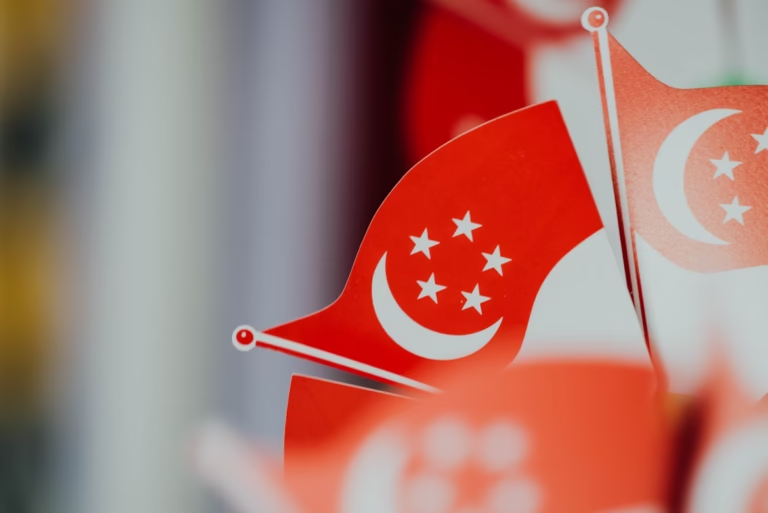
Master’s in Singapore 2026: NUS, NTU Fees, Career Prospects & Why Indian Students Choose It
Honest guide from IMFS counsellors — fees in rupees, work visa rules, and the real Singapore vs UK trade-off.
Singapore has emerged as a premier destination for international students seeking a Master’s degree — offering world-class universities, a thriving economy, and a multicultural environment. This guide explains the top reasons to choose Singapore in 2026, the programs it’s renowned for, a realistic cost breakdown (SGD + ₹), and the honest trade-offs versus the UK and Canada.
The decision of where to pursue your advanced studies is significant. Singapore presents a compelling proposition: its strategic location, coupled with its commitment to innovation and education, creates an environment full of opportunity. Choosing the right country and program can feel overwhelming — but with the right information, you can make an informed decision.
1. What are the top reasons to pursue a Master’s in Singapore in 2026?
Here are five key reasons to consider Singapore for your Master’s degree:
World-Class Universities
Singapore is home to two internationally acclaimed universities — National University of Singapore (NUS) and Nanyang Technological University (NTU). Both consistently rank among the world’s top universities and offer high-impact Master’s programs with strong real-world application.
Career Opportunities
Singapore is a regional hub for multinational corporations, offering strong opportunities across technology, finance, consulting, engineering, and analytics. Many programs include internships and industry projects that improve employability.
Innovation and Research Hub
Singapore attracts significant investment in R&D. For students in CS, engineering, and biomedical fields, the university–industry ecosystem offers strong exposure to cutting-edge research and practical innovation.
Comparing Singapore with UK or Canada?
Get an honest, personalised comparison in 30 minutes — aligned to your profile, budget, and career goals.
Multicultural Environment
Singapore is a melting pot of cultures. The diverse population makes the transition smoother for Indian students and helps you build global communication skills that matter in international workplaces.
Strategic Location
Singapore’s location in Southeast Asia makes it a gateway to regional opportunities, conferences, and networks — useful if you’re building an international career in Asia-Pacific.
2. Which Master’s programs is Singapore globally renowned for?
Singapore is known for industry-relevant programs, strong faculty, and an innovation-driven ecosystem. Here are popular areas students shortlist:
Engineering
Strong in electrical, mechanical, chemical, and systems — with industry links and practical projects.
Ask IMFS about Engineering programs →Business & Finance
Singapore’s finance hub advantage supports specialised Master’s programs with strong placements.
Ask IMFS about Business programs →Computer Science & IT
AI, cybersecurity, data analytics — strong labs, strong research, and strong employer ecosystem.
Ask IMFS about CS/IT programs →Public Policy (LKY School)
Globally recognised public policy training for leadership and impact-oriented careers.
Ask IMFS about Public Policy →3. How do research and innovation opportunities compare to other countries?
Singapore’s university–industry model offers practical research exposure. But the post-study search window is shorter than UK/Canada — so strategy matters.
✅ Singapore Advantages
- Strong R&D concentration in tech, engineering, biomedical
- Hands-on projects via industry collaboration
- Modern facilities and labs
- High-quality peer group across Asia
⚠️ Considerations
- 1-year LTVP post-study search window
- Research roles are competitive
- High cost of living vs some UK/Canada cities
- Non-thesis programs may have limited research depth
4. What does a Singapore Master’s actually cost?
For most taught one-year programs, international students budget between S$35,000 and S$60,000 for tuition. Rent is usually the biggest monthly variable, especially off-campus.
Also explore scholarships (where applicable) and financial planning early — because intake deadlines arrive faster than expected.
🎓 Ready to shortlist NUS/NTU (or compare with UK/Canada)? IMFS can help.
In one session, we’ll map:
- University shortlisting (NUS vs NTU vs SMU) based on your profile
- SOP + resume positioning aligned to your program goals
- Budget + loan planning for the ₹32–55L range
- Timeline & deadlines so you don’t miss intakes
Frequently Asked Questions (Singapore Masters 2026)
No hidden/accordion content — everything is visible, so nothing gets truncated in Elementor.
Is a Singapore Master’s worth it?
If your goal is a fast, high-quality Master’s with strong industry proximity in Asia, Singapore can be a powerful option — provided your shortlisting, positioning, and deadlines are handled strategically.