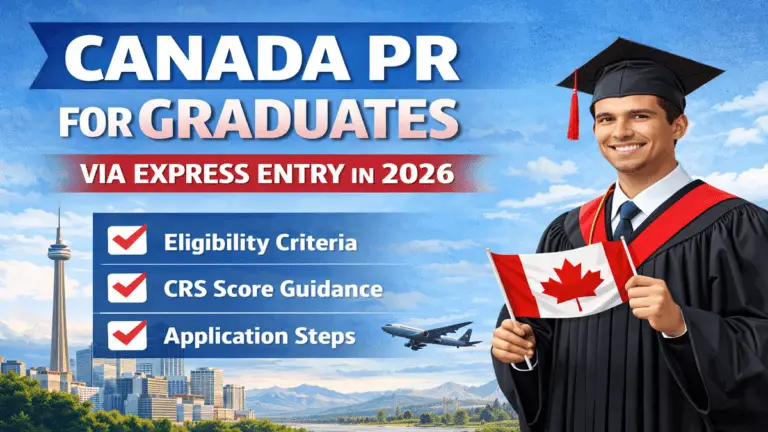
Earning a graduate degree in Canada is a huge accomplishment, but for many international students, the journey doesn’t end there. The dream often extends to building a life and career within the country. The good news is that Canada’s Express Entry system offers a clear pathway to Permanent Residency (PR), especially for those who’ve studied and gained work experience there. While it might seem a bit intricate at first, with the right guidance, this transition is absolutely achievable. Let’s explore how your Canadian education and newfound work experience can become your biggest assets in securing PR.
It’s widely understood that Canada truly values international graduates. The country has invested in a world-class education system and aims to retain global talent. This commitment is reflected in the Express Entry system, which features specific pathways designed for you. Let’s cut through any jargon and demystify what this means for your future.
How Does Express Entry Actually Work for Graduates?
Think of Express Entry not as a single immigration program but as the digital backbone Immigration, Refugees and Citizenship Canada (IRCC) uses to manage immigration applications. It’s essentially a database of potential immigrants. This system selects candidates for three main federal economic programs: the Federal Skilled Worker Program (FSWP), the Federal Skilled Trades Program (FSTP), and the Canadian Experience Class (CEC).
For most international graduates, the Canadian Experience Class (CEC) is often the most relevant and straightforward route. It specifically values the skilled work experience you’ll gain in Canada after completing your studies. It’s almost custom-built for those who have integrated into the Canadian workplace.
The system uses the Comprehensive Ranking System (CRS) to score all candidates in the Express Entry pool. This score considers factors like age, education level, language proficiency (English or French), and work experience. Experts often observe that candidates with Canadian education and work experience tend to gain a significant advantage in their CRS scores, making this a popular and effective option for graduates aiming for PR.
Canadian Education: Your Powerful Asset for CRS Points
Your Canadian education matters immensely! Completing a degree, diploma, or certificate at a recognized Canadian institution can substantially boost your overall education score. Beyond that, you might also qualify for additional CRS points specifically for your Canadian credentials. The exact points awarded depend on the level and length of your program. For instance, a one-year post-secondary credential or longer from Canada will often net you a nice chunk of points, with higher-level degrees (like a master’s or PhD) typically offering an even greater advantage.
This isn’t merely a bonus; it highlights Canada’s strategic approach. The country aims to retain the bright minds it has already invested in through its education system. It demonstrates a commitment to integrating international graduates like you into society and the workforce. It’s a clear signal: “We like what we see; stay a while!”
The Canadian Experience Class (CEC): Your Path to PR
So, what exactly is the Canadian Experience Class (CEC), and could you be eligible? In essence, it’s an immigration program for individuals who have gained skilled work experience in Canada. It’s a hugely common pathway for international graduates who’ve entered the Canadian workforce directly after their academic journey.
To be eligible for the CEC, you generally need at least one year of full-time (or an equivalent amount of part-time) skilled work experience in Canada. This experience needs to be gained within the three years before you apply. Many graduates pursue this experience using a Post-Graduation Work Permit (PGWP), which is specifically designed for this purpose.
A key point to remember: your qualifying work experience must fall under specific occupational categories. These are classified as TEER 0, 1, 2, or 3 under Canada’s National Occupational Classification (NOC) system. These categories define skilled jobs. For example:
- TEER 0: Management jobs (e.g., financial manager, restaurant manager).
- TIER 1: Professional jobs requiring a university degree (e.g., software engineer, registered nurse, accountant).
- TEER 2: Technical jobs typically requiring a college diploma, apprenticeship training of two or more years, or supervisory occupations (e.g., Web Developer, Electrician, Medical Laboratory Technician).
- TEER 3: Trades requiring a college diploma, apprenticeship training of less than two years, or more than six months of on-the-job training (e.g., plumber, chef, administrative assistant).
One notable advantage: unlike some other immigration streams, you don’t actually need a job offer to be eligible for the Canadian Experience Class if you meet the work experience criteria. This can be a game-changer for many!
How Long Does PR Take Through Express Entry After Graduation?
Once you receive an Invitation to Apply (ITA) for PR through Express Entry, the Canadian government generally aims to process applications within six months. While this processing time is quite efficient, the full journey from graduating to actually becoming a permanent resident often takes longer.
Why the longer overall timeline? Well, it includes the time you’ll spend gaining that all-important Canadian work experience. Then there’s the waiting period in the Express Entry pool for an ITA—the CRS cut-offs and frequency of draws can shift. Finally, you’ll need time to meticulously prepare all your supporting documents. It can feel like a bit of a marathon, not a sprint, but it’s absolutely manageable with good planning.
Experts often advise that early preparation and careful planning are absolutely essential. Keeping an eye on updates from Immigration, Refugees and Citizenship Canada (IRCC) about draw results and processing times helps you anticipate and prepare for each stage.
Maximizing Your Chances: Expert Insights
With decades of experience helping students achieve their global education and immigration dreams, numerous expert advisors have learned a few things about navigating the Canadian PR maze. Here are top tips for graduates eyeing Express Entry:
- Plan Your PGWP Strategically: Your Post-Graduation Work Permit (PGWP) is invaluable. Don’t just take any job. Aim for skilled positions (TEER 0, 1, 2, or 3) that align with your field of study. This maximizes your chances for CEC eligibility and boosts your CRS score. Remember, it’s about quality experience, not just any experience.
- Boost Your Language Scores: Even if you aced your IELTS or CELPIP for admission, consider retaking it if you think you can improve. Higher language proficiency scores significantly impact your CRS points. Those extra points can sometimes be the difference between getting an ITA and waiting longer.
- Consider a Second Credential: Sometimes, gaining a second credential in Canada, especially a graduate certificate or diploma, can beef up your CRS points considerably. However, this has to be a strategic move, balancing cost with potential PR benefits. Seek advice to weigh the pros and cons for your specific situation.
- Keep Your Network Strong: Networking in Canada isn’t just about finding a job; it’s about building a connection to the community and often securing better employment opportunities that count towards your CEC requirements.
- Stay Updated, Always: IRCC policies can evolve. What’s valid one year might have slight changes the next. Subscribing to official IRCC news feeds and checking their website regularly keeps you informed.
- Address Job Market Challenges: Many international graduates face challenges like underemployment or difficulty finding TEER 0-3 jobs immediately. To overcome this, focus on internships, volunteer work, and targeted skills development during your studies. Leverage career services at your institution, join professional associations, and be prepared to start in roles that offer a stepping stone to your desired skilled profession. Persistence and adaptability are key.
Don’t underestimate the details. Every piece of your application matters. Countless success stories stem from individuals who meticulously followed these steps, and you can be one of them too!
Frequently Asked Questions (FAQs)
Key questions international graduates ask about Express Entry, CEC, and PR pathways in Canada (2026).
How much Canadian skilled work experience do I need for CEC in 2026?
You generally need a minimum of one year (1,560 hours) of full-time or equivalent part-time skilled work experience in Canada, gained within the three years before applying. The experience must fall under TEER 0, 1, 2, or 3 occupations.
Can I apply for Express Entry while still on my study permit in 2026?
No. Most graduate-friendly Express Entry streams, including the Canadian Experience Class, require you to complete your studies and hold a Post-Graduation Work Permit (PGWP) or another valid work permit to gain eligible skilled work experience. You may create a profile early, but you will not receive an ITA until all criteria are met.
Is a job offer mandatory for Express Entry after graduation in 2026?
A job offer is not mandatory for the Canadian Experience Class if you meet the work experience requirement. However, having a valid job offer can significantly increase your CRS score and improve your chances of receiving an Invitation to Apply (ITA).
How do English language test scores (IELTS or CELPIP) affect my PR application?
Language scores are a major component of your Comprehensive Ranking System (CRS) score. Higher performance in listening, speaking, reading, and writing leads to more CRS points. For CEC applicants, targeting CLB 7 or higher is recommended to remain competitive.
What are the typical costs for applying for PR through Express Entry in 2026?
Costs generally include a CAD 950 processing fee per adult applicant, a Right of Permanent Residence Fee (RPRF) of CAD 575, biometric fees (CAD 85 per person or CAD 170 per family), language test fees (approximately CAD 250–300), educational credential assessments if required (around CAD 200–300), plus medical exams and police certificates.
Can my spouse and dependent children be included in my Express Entry application?
Yes. Your spouse or common-law partner and dependent children can be included. In some cases, your spouse’s education, language ability, and work experience may contribute additional CRS points.
What if my CRS score is not high enough for an ITA?
If your CRS score is below recent cut-offs, you can improve it by retaking language tests, gaining more Canadian skilled work experience, or applying through Provincial Nominee Programs (PNPs), which offer substantial additional CRS points.
What is a Provincial Nominee Program (PNP) and how can it help?
Provincial Nominee Programs allow Canadian provinces and territories to nominate candidates who meet local labour market needs. A provincial nomination adds 600 CRS points, virtually guaranteeing an Invitation to Apply. Many PNP streams are designed specifically for international graduates.
What are the average living costs in Canada for graduates in 2026?
Living costs depend on the city. On average, graduates should budget between CAD 1,000 and CAD 1,500 per month for accommodation, food, transport, and utilities, excluding tuition. Cities like Toronto and Vancouver tend to be more expensive.
What post-study work permit options are available after graduation in 2026?
The Post-Graduation Work Permit (PGWP) remains the primary option. Depending on the length of your study program, it allows you to work in Canada for up to three years, enabling you to gain the skilled experience required for CEC.
Wrapping It Up
The Canada Express Entry system genuinely offers a valuable and streamlined pathway to permanent residency for international graduates like you. By truly understanding the Canadian Experience Class (CEC), leveraging your Canadian education strategically within the CRS system, and planning your application timeline meticulously, you can significantly boost your chances of success.
While Express Entry provides an efficient route, particularly for those with Canadian work experience, success ultimately comes down to having accurate information, preparing well in advance, and meeting every single eligibility requirement. It’s a journey, but it’s one that many have navigated successfully with the right guidance.
Ready to take the next step? Contact IMFS for personalized guidance on making your graduate degree count!
Verified by IMFS editorial guidelines—30+ years of global education expertise.
References:
Canadian Bureau for International Education (CBIE). “International Student Survey.” https://cbie.ca/what-we-do/research/ (Accessed February 15, 2026).
Immigration, Refugees and Citizenship Canada (IRCC). “Express Entry.” https://www.canada.ca/en/immigration-refugees-citizenship/services/immigrate-canada/express-entry.html (Accessed February 15, 2026).
Government of Canada. “National Occupational Classification (NOC) 2021.” https://www.canada.ca/en/immigration-refugees-citizenship/corporate/publications-manuals/operational-instructions-guidelines/assessment-factors/noc-matrix.html (Accessed February 15, 2026).
Statistics Canada. “Average student expenses in Canada.” https://www150.statcan.gc.ca/t1/tbl1/en/tv.action?pid=3710007801 (Accessed February 15, 2026).