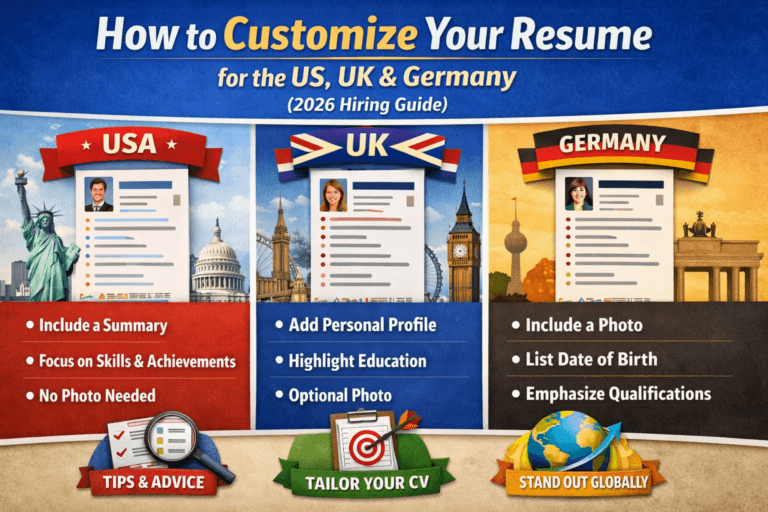
Landing your first job abroad isn’t just about academic credentials—it’s about presenting them correctly. One of the most common mistakes international students make is using the same resume format across different countries, unknowingly violating professional norms and triggering automatic rejections. Are you planning to work in the USA, UK, or Germany after graduation? Your resume strategy needs to be completely different for each.
This guide provides detailed, country-specific instructions for crafting resumes that pass Applicant Tracking Systems and impress hiring managers. Understanding these cultural nuances isn’t just helpful—it’s essential. Employers in each country have distinct expectations, and your resume is often screened before a human ever sees it. With over 30 years of experience placing students in international careers, IMFS has identified exactly what works in each market. Let’s ensure your resume opens doors instead of closing them.
QUICK NAVIGATION
WHY THIS MATTERS
Academic and Career Impact:
- Your resume is screened before interviews—wrong format = automatic rejection, regardless of qualifications
- 75% of resumes are rejected by Applicant Tracking Systems (ATS) before reaching human recruiters
- Cultural misalignment (e.g., photo on US resume) signals unfamiliarity with local professional norms
- Proper resume formatting can increase interview callback rates by 40-60%
Visa and Work Authorization Implications:
- Clear work authorization statements prevent immediate disqualification
- Properly formatted resumes help employers understand visa sponsorship needs upfront
- Including visa status incorrectly can raise red flags or create confusion
- OPT, Graduate Route, and German work permits have different declaration requirements
Risk of Generic or Poor Formatting:
- Using Indian resume formats abroad marks you as inexperienced in international job markets
- Including prohibited information (age, photo in the USA) can lead to discrimination concerns
- Missing required elements (signature in Germany, photo) signal cultural ignorance
- Generic, non-customised resumes get filtered out within seconds by both ATS and recruiters
Parent Relevance:
- Parents investing ₹40-60 lakhs in education expect ROI through employment
- Resume quality directly impacts job search timeline (3 months vs 12+ months)
- Understanding hiring norms helps parents provide better career guidance
- Poorly formatted resumes waste visa work authorization periods (OPT limited to 12-36 months)
KEY DECISION FRAMEWORK
Decision Criteria
1. Target Country Professional Culture
- USA: Fast-paced, results-oriented, brevity-focused culture values quantifiable achievements
- UK: Professional yet conversational, values well-rounded candidates with personality
- Germany: Formal, detail-oriented, values thoroughness and complete documentation
2. Legal and Anti-Discrimination Norms
- USA: Strict anti-discrimination laws prohibit age, marital status, photo, and nationality
- UK: Similar to the USA but slightly more flexible on personal details
- Germany: Expects comprehensive personal information, including photo, DOB, marital status
3. ATS (Applicant Tracking System) Requirements
- USA: 90% of large companies use ATS; requires keyword optimization and simple formatting
- UK: Moderate ATS usage; balance between visual appeal and ATS-friendliness
- Germany: Less reliance on ATS; human review more common, format flexibility higher
4. Work Authorization Clarity
- Must clearly state visa status without over-explaining or appearing desperate
- Different countries need different levels of detail
- Timing of disclosure (resume vs cover letter vs interview) varies
5. Language and Cultural Adaptation
- British vs American English spelling differences matter
- German technical terminology and formal language expectations
- Cultural context for achievements (individualistic vs collective framing)
6. Document Length Expectations
- USA: 1-2 pages maximum (1 page for fresh graduates)
- UK: 2 pages standard, 3 acceptable for experienced professionals
- Germany: 2-3 pages standard, completeness valued over brevity
Comparison Table: Resume Requirements by Country
| Requirement | USA (Resume) | UK (CV) | Germany (Lebenslauf) |
|---|---|---|---|
| Document Name | Resume | CV (Curriculum Vitae) | Lebenslauf |
| Length | 1-2 pages maximum | 2 pages standard (can extend to 3) | 2-3 pages (completeness prioritized) |
| Professional Photo | ❌ NO (illegal to request) | ❌ Not standard | ✅ YES (required, professional headshot) |
| Personal Details | Name, phone, email, LinkedIn only | Name, contact, location, nationality (optional) | Full details: DOB, birthplace, nationality, marital status |
| Signature & Date | ❌ Not required | ❌ Not required | ✅ Required at bottom |
| Format Style | Clean, modern, bullet points | Professional, traditional, balanced | Tabular format (table structure) |
| Content Focus | Achievements with metrics | Comprehensive career history | Chronological detail with precision |
| Personal Statement | 2-3 line summary (optional) | 3-5 line profile (recommended) | Not typical (cover letter handles this) |
| References | “Available upon request” | 2 referees or “Available upon request” | Separate reference letters attached |
| ATS Optimization | Critical (90% use ATS) | Important (moderate usage) | Less critical (more human review) |
Realistic Applicant Scenarios
Scenario 1: Computer Science Graduate Targeting USA Tech Jobs
- Challenge: H-1B visa sponsorship needed, competing against US citizens
- Strategy: 1-page resume, quantify coding projects, highlight STEM OPT eligibility prominently
- Format: ATS-optimised (simple fonts, no graphics), keyword-rich technical skills section
- Timeline: Start 4-6 months before graduation, apply to 50-100 companies
Scenario 2: Business Graduate Seeking UK Consulting Roles
- Challenge: Graduate Route visa valid 2 years, need to secure a role before expiry
- Strategy: 2-page CV with a strong personal statement, emphasize cross-cultural experience
- Format: Professional design, British spelling throughout, detailed education section
- Timeline: Start 3-4 months before course completion, target 30-50 applications
Scenario 3: Engineering Graduate Pursuing German Manufacturing Jobs
- Challenge: German language proficiency needed, cultural integration expectations are high
- Strategy: German-language Lebenslauf with professional photo, demonstrate German fluency (B2-C1)
- Format: Tabular structure, signed and dated, comprehensive timeline with no gaps
- Timeline: Start 6 months early, obtain German language certification, and network through the university
ELIGIBILITY & REQUIREMENTS
Country-Specific Resume Requirements
| Country | Must Include | Never Include | Optional/Recommended | Technical Requirements |
|---|---|---|---|---|
| USA |
• Name • Phone & email • LinkedIn URL • Work experience with metrics • Education (degree, school, year) • Relevant skills |
• Photo (illegal) • Age/DOB • Marital status • Nationality • Religion • Social Security Number |
• Professional summary • OPT eligibility statement • Certifications • Volunteer work • Publications |
• PDF format • Standard fonts (Arial, Calibri) • No headers/footers • No tables or text boxes • Keywords from job description |
| UK |
• Full name • Contact details • Location (city) • Personal statement • Work experience • Education with grades |
• Photo (not standard) • National Insurance Number • Salary expectations • Reasons for leaving jobs |
• Nationality (if relevant for visa) • Graduate Route visa status • Interests/hobbies • References (or “upon request”) • Professional memberships |
• PDF or Word accepted • Professional fonts • British spelling • Consistent formatting • 2 pages ideal |
| Germany |
• Professional photo • Full personal details (DOB, birthplace) • Nationality • Complete work history • Education with grades • Language skills (CEFR levels) • Signature & date |
• Casual or social media photos • Incomplete timeline • Vague date ranges • Unaccounted gaps |
• Marital status • Children (number) • Driving license • Hobbies • Voluntary work • Further education/certificates |
• PDF format (signed scan) • Tabular structure • Professional photo (passport style) • Exact dates (MM/YYYY) • German language preferred |
Work Authorisation Documentation Requirements
| Country | Visa/Work Permit Type | How to State on Resume | Additional Documents Needed |
|---|---|---|---|
| USA | F-1 OPT / STEM OPT | “Eligible for 12-month F-1 OPT (Available: May 2026)” or “STEM OPT eligible (36 months total work authorization)” | EAD card, I-20, university verification letter |
| UK | Graduate Route Visa | “Authorized to work in UK until July 2028 via Graduate Route visa” or “No visa sponsorship required (Graduate Route valid 2 years)” | BRP card copy, visa endorsement, right to work check |
| Germany | Job-Seeking Permit / Residence Permit | “Residence permit for employment (valid until Dec 2026)” or “Job-seeking permit (§18c AufenthG) – no work restrictions” | Residence permit, passport, university degree certificate |
TIMELINE (YEAR-ALIGNED)
For 2026 Graduates Targeting Post-Study Employment
| Phase | Timeline | Key Activities | Resume Milestones |
|---|---|---|---|
| Foundation Building | January–March 2026 (Final semester) |
• Complete internships/projects • Gather achievement data (metrics, results) • Collect recommendation letters • Research target companies/roles |
• Draft baseline resume (all experiences) • Identify 3-5 target job titles • List quantifiable achievements • Create achievement statement library |
| Country-Specific Customization | March–April 2026 |
• Research company-specific requirements • Understand ATS systems in target country • Get professional photo (Germany) • LinkedIn profile optimization |
• Create USA version (1 page, ATS-optimized) • Create UK version (2 pages, personal statement) • Create Germany version (tabular, with photo) • Get resume reviewed by native speakers |
| Active Job Search | April–June 2026 |
• Apply to 20-30 companies per week • Attend career fairs • Network on LinkedIn • Customize each application |
• Tailor resume for each application (keywords) • Track versions in spreadsheet • Update with new certifications/projects • A/B test different formats |
| Interview Preparation | May–July 2026 |
• Respond to interview invitations within 24 hours • Prepare behavioral interview answers • Research companies thoroughly • Practice technical/case interviews |
• Bring printed resumes to interviews (3-5 copies) • Prepare “walk me through your resume” pitch • Update resume with interview feedback • Have references ready |
| Offer Negotiation | June–August 2026 |
• Evaluate multiple offers • Negotiate salary/benefits • Complete background checks • Finalize work authorization |
• Archive successful resume version • Remove “seeking” language • Update LinkedIn with new role • Keep resume current for future opportunities |
Critical Timeline Notes:
- USA: OPT applications must be filed 90 days before graduation, approved before you can work—start job search early
- UK: Graduate Route visa activates after course completion—you have 2 years to find employment
- Germany: Job-seeking permit allows 18 months to find work—earlier start recommended due to language barriers
COST & ROI
Investment Required for Professional Resume Development
DIY Approach:
- Resume templates (Canva, Overleaf, Microsoft): Free–₹500
- Professional photo (Germany): ₹1,000–₹3,000
- Grammar checking tools (Grammarly Premium): ₹850/month
- Total DIY Cost: ₹2,000–₹5,000
Professional Services:
- Resume review by career counsellor: ₹3,000–₹8,000
- Professional resume writing service: ₹8,000–₹25,000
- Complete application package (resume + cover letter + LinkedIn): ₹15,000–₹40,000
- Total Professional Cost: ₹15,000–₹40,000
Tools & Resources:
- ATS scanning tools (Jobscan, Resume Worded): $30–50/month (₹2,500–₹4,000)
- Professional networking (LinkedIn Premium): $40/month (₹3,300)
- Interview preparation platforms: ₹5,000–₹15,000
- Total Tools Cost: ₹10,000–₹25,000
ROI Analysis
| Scenario | Resume Quality | Avg. Time to Job Offer | Salary Impact | Career ROI |
|---|---|---|---|---|
| Poorly formatted, generic resume | Low | 9-12+ months | -10 to -20% below market | High opportunity cost, potential visa expiry |
| Self-created, country-appropriate resume | Moderate | 5-7 months | Market rate | Standard career progression |
| Professionally crafted, ATS-optimized resume | High | 3-4 months | +5 to +15% above market | Faster start, compound career growth |
Financial Impact Examples:
USA Scenario:
- Entry-level software engineer salary: $80,000–$100,000 (₹66–83 lakhs)
- Poor resume → 10 months to offer at $80,000
- Professional resume → 3 months to offer at $92,000
- Net benefit: ₹10 lakhs higher annual salary + 7 months faster employment = ~₹58 lakhs advantage over 5 years
UK Scenario:
- Graduate consultant salary: £30,000–£40,000 (₹31–42 lakhs)
- Generic CV → 8 months to offer at £32,000
- Optimized CV → 4 months to offer at £36,000
- Net benefit: ₹4 lakhs higher annual salary + 4 months faster employment = ~₹28 lakhs advantage over 5 years
Germany Scenario:
- Junior engineer salary: €45,000–€55,000 (₹40–49 lakhs)
- Without photo/improper format → 12+ months, potential visa expiry
- Professional Lebenslauf → 5 months to offer at €50,000
- Net benefit: Securing job before visa expiry + market rate salary = career stability + ₹35+ lakhs over 5 years
Key ROI Insight: Investing ₹15,000–₹40,000 in professional resume development can return ₹25–60 lakhs in faster employment and higher starting salaries over the first 5 years of your career.
TIPS FOR SUCCESS
For Students
1. Create a Master Resume First, Then Customize
- Build a comprehensive 3-4 page master document with ALL experiences, projects, achievements
- From this, extract relevant 1-2 pages for the USA, 2 pages for the UK, 2-3 pages for Germany
- Maintain master resume as your “source of truth” for all customizations
2. Quantify Everything Possible
- Replace “Managed social media” with “Increased Instagram engagement by 150% (2,500 to 6,250 followers) in 6 months”
- Replace “Led team project” with “Led cross-functional team of 5 to deliver mobile app 2 weeks ahead of schedule, adopted by 500+ users”
- Use percentages, dollar amounts, time saved, people impacted, and rankings achieved
3. Master ATS Optimization (Especially for the USA)
- Use standard section headers: “Work Experience,” “Education,” “Skills” (not creative alternatives)
- Avoid tables, text boxes, headers, footers, graphics (ATS can’t read them)
- Use standard bullet points (not symbols or custom icons)
- Include exact keywords from the job description (but don’t keyword stuff)
- Save as PDF with selectable text (not scanned image)
4. Build Country-Specific Achievement Libraries
- USA: Aggressive, individualistic tone (“I increased,” “I developed,” “I led”)
- UK: Balanced, team-oriented tone (“Collaborated to increase,” “Contributed to”)
- Germany: Formal, precise tone (“Responsibilities included,” exact metrics)
5. Get Multiple Rounds of Feedback
- Peer review (catch basic errors, get a fresh perspective)
- Native speaker review (catch cultural/language issues)
- Professional review (optimise for ATS and hiring manager appeal)
- Iterate at least 3-5 times before finalising
6. Tailor for Each Application
- Spend 15-20 minutes customizing for each job application
- Mirror the exact job title and key requirements
- Rearrange bullet points to prioritize most relevant experiences
- Adjust skills section to match job description priorities
7. Build Evidence Portfolio
- Keep screenshots, certificates, and recommendation letters ready
- Document metrics with evidence (analytics screenshots, project reports)
- Create a GitHub portfolio for tech roles, a design portfolio for creative roles
- Be ready to prove any claim on your resume
For Parents
1. Understand the Stakes
- Resume quality directly impacts job search duration (3 months vs 12+ months)
- Visa work authorization is time-limited (OPT: 12-36 months, Graduate Route: 2 years)
- A poor resume can waste precious visa time and force a return without employment
- Professional resume investment (₹15,000–₹40,000) returns ₹25–60 lakhs in career advantage
2. Don’t Write or Heavily Edit Your Child’s Resume
- Hiring managers can spot parent-written content instantly (overly formal, outdated language)
- Interviews will expose content your child didn’t write themselves
- Instead: help gather achievement data, proofread for errors, fund professional services if needed
3. Invest in Professional Services Strategically
- If the budget allows, professional resume writing is a high-ROI investment
- Prioritize services that teach your child (not just deliver the final product)
- Look for services with country-specific expertise (not generic resume writers)
- Check reviews and ask for samples before committing
4. Support Job Search Logistics
- Help maintain the application tracking spreadsheet (applications, versions, deadlines)
- Ensure reliable printer access for interviews (UK/Germany often request printed CVs)
- Budget for professional photo (Germany: ₹2,000–₹5,000)
- Maintain open communication without micromanaging
5. Manage Expectations Around Timeline
- USA tech jobs: 100-200 applications for 5-10 interviews for 1-2 offers (3-6 months)
- UK graduate schemes: 30-50 applications for 3-5 interviews for 1 offer (4-6 months)
- Germany (with language barriers): 50-100 applications for 2-3 interviews for 1 offer (6-9 months)
- Patience and persistence are essential—early rejections are normal
6. Understand Visa-Work Authorization Connection
- USA: F-1 OPT requires a job offer to activate—resume quality affects the timeline
- UK: Graduate Route gives 2 years regardless, but earlier employment is better ROI
- Germany: 18-month job-seeking permit—proper Lebenslauf accelerates process
- Help track visa deadlines and work authorization periods
7. Encourage Cultural Learning
- Support language learning (especially German for Germany jobs)
- Understand that resume norms reflect bigger cultural differences
- Don’t impose Indian professional norms on international markets
- Celebrate adaptation and cultural intelligence as valuable skills
KEY TAKEAWAYS
- One resume does NOT work everywhere: the USA, UK, and Germany have fundamentally different expectations—customize rigorously
- USA = Results + Brevity: 1-2 pages max, no photo/personal details, quantified achievements, ATS-optimised
- UK = Professional + Comprehensive: 2 pages, personal statement, British spelling, balanced tone
- Germany = Formal + Complete: Photo required, signature essential, tabular format, precise chronological detail
- Work authorization clarity is critical: State visa status clearly without over-explaining or appearing desperate
- Best Strategy: Create a master resume with all content → Extract country-specific versions → Customize for each job application (20+ versions expected for serious job search)
FREQUENTLY ASKED QUESTIONS
1. Should I use the same resume for all countries?
Absolutely not. Using the same resume across the USA, UK, and Germany will significantly hurt your chances. Each country has distinct legal requirements, cultural expectations, and technical standards. A photo is required in Germany but discouraged in the USA. Resume length expectations vary (1 page in the USA vs 2–3 pages in Germany). ATS optimization is critical in the USA but less so in Germany. Always create separate, country-specific versions and customize further for each application.
2. Is it really illegal to include a photo on my USA resume?
While it’s not illegal for you to include a photo, US employers cannot request one due to anti-discrimination laws. Many companies use Applicant Tracking Systems (ATS) that automatically reject resumes with photos to avoid legal risk. Including a photo signals unfamiliarity with US professional norms and can lead to rejection. Reserve photos for Germany and select European countries.
3. How do I explain gaps in my timeline on a German CV?
German employers expect a complete, gap-free chronology. Any gaps (job search, travel, family care) should be clearly labeled with dates and brief explanations.
- 03/2024 – 08/2024: Job search and language courses (German B2 certification)
- 06/2023 – 12/2023: Family caregiving responsibilities
Unexplained gaps raise red flags and may be interpreted as dishonesty. Transparency is highly valued in German professional culture.
4. What’s the difference between a resume and a CV?
In the USA, a resume is a 1–2 page document used for industry roles, while a CV is a longer academic document for research or teaching positions. In the UK and most of Europe, “CV” is the standard term for what Americans call a resume. When applying in the UK, use the term “CV” and follow local formatting expectations.
5. How should international students state their work authorization status?
Be clear and concise without over-explaining. Place this near the top of your resume.
- USA: “Eligible for 12-month F-1 OPT (available May 2026)” or “STEM OPT eligible (36 months)”
- UK: “Authorized to work in the UK until July 2028 via Graduate Route visa”
- Germany: “Residence permit for employment (valid until Dec 2026)”
6. How important is ATS (Applicant Tracking System) optimization?
Critical in the USA—around 90% of large employers use ATS. Moderately important in the UK and less critical in Germany. To optimize, use standard fonts, avoid tables and graphics, include exact keywords from job descriptions, use standard section headers, and save as a text-readable PDF. Always test your resume with ATS tools before applying.
7. Should I include hobbies and interests on my resume?
- USA: Usually skip unless directly relevant to the role.
- UK: A short “Interests” section is common and helps show personality.
- Germany: Optional but acceptable, especially if hobbies reflect teamwork or discipline.
8. How many pages should my resume be as a recent graduate?
- USA: Strictly 1 page
- UK: 2 pages is standard
- Germany: 2–3 pages is acceptable
These are firm expectations. Deviating from them signals poor judgment or lack of cultural awareness.
9. Can I use creative or colourful resume designs?
- USA: Minimal colour, ATS-friendly, clean and professional.
- UK: Slight flexibility, but still conservative.
- Germany: Very conservative—black text, white background, structured layout.
Creative fields allow more flexibility, but ATS compatibility remains essential for US applications.
10. How often should I update my resume?
Update your resume after every significant achievement or certification. Maintain multiple versions:
- Master resume: Complete record
- Country-specific templates: Updated quarterly
- Job-specific versions: Customized per application
During active job searches, expect to create 20–30 tailored versions. Use clear file names like Resume_USA_SoftwareEngineer_Google_v3.pdf.
COUNSELLOR’S NOTE
Over 30 years of guiding students through international career transitions, one truth remains constant: your resume is a cultural document as much as a professional one. The students who thrive aren’t necessarily those with the highest grades—they’re the ones who understand that securing a job abroad requires adapting to local norms, not importing homegrown expectations.
I’ve seen brilliant candidates rejected by US companies for including photos, and equally talented students struggle in Germany for submitting single-page resumes without signatures. These aren’t just formatting errors—they signal a lack of cultural awareness that employers interpret as an inability to adapt to their workplace culture.
Here’s what I tell every student: invest the time to truly understand each country’s expectations. Don’t just change the page length—understand why Americans value brevity (fast-paced work culture, high volume recruiting) while Germans value thoroughness (detailed documentation culture, comprehensive hiring processes). This understanding will serve you not just in job applications, but throughout your career in that country.
Parents, your role is to support without controlling. Your child needs to own their resume content—their authentic voice must come through, not yours. Where you can help: logistics, proofreading, funding professional services, and managing the emotional roller coaster of job search rejections. Trust that the investment you’ve made in their education has prepared them for this challenge.
One final thought: the job search timeline varies dramatically by country and field. Students applying to 100-200 US tech companies might wait 4-6 months for offers. German job searches, especially with language barriers, can take 6-9 months. This isn’t failure—it’s the reality of competitive international markets. Start early, stay persistent, and remember that every rejection brings you closer to the right opportunity.
At IMFS, we don’t just help students create resumes—we help them build international careers. The resume is your first step across that cultural bridge. Make it count.
HOW IMFS CAN HELP
Align Your Resume With Global Universities & Post-Study Careers
Your resume isn’t just for jobs—it plays a critical role in university applications, internships, assistantships, part-time work, and post-study employment pathways in the USA, UK, and Germany.
✓ Study-Abroad Resume Alignment: Tailor resumes for university applications, internships, and assistantships in the USA, UK & Germany
✓ Country-Specific Academic & Industry Formats: Understand what universities and employers expect—before and after graduation
✓ Internship & Part-Time Readiness: Position your profile for on-campus jobs, summer internships, and co-op opportunities
✓ Post-Study Work Strategy: Resume guidance aligned with OPT (USA), Graduate Route (UK), and German residence permits
✓ Academic + Career Continuity: Ensure your resume evolves smoothly from admissions to post-study employment
✓ LinkedIn for International Students: Build a global academic-to-career digital profile
From university admissions to post-study work—build a resume that supports your entire international education journey