A clear, experience-led guide for students and parents planning study abroad sensibly.
Studying abroad is often assumed to be expensive because most conversations revolve around the same few destinations. However, the real cost of education depends far more on how a country funds its universities than on its popularity.
In 2026, several countries continue to offer globally respected education at a fraction of the cost, simply because higher education there is treated as a public responsibility, not a business.
This guide breaks down those options honestly — tuition, living costs, work opportunities, and what students can realistically expect after graduation.
Why Affordability Works Differently in 2026
Tuition alone does not decide affordability. Over three to four years, rent, food, transport, insurance, and city selection usually cost more than fees. Countries with regulated systems keep these costs stable, which makes planning far safer for families.
What “Affordable” Really Means
| Factor | Why It Matters |
|---|---|
| Tuition stability | No sudden fee increases mid-degree |
| Living costs | Daily expenses remain manageable |
| Work rights | Support monthly spending legally |
| Post-study clarity | Clear career or return-on-investment path |
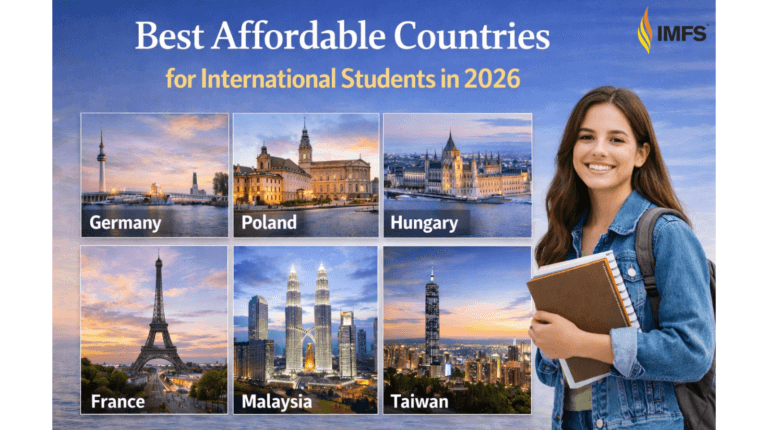
Best Affordable Countries for International Students
Germany
Germany remains one of the strongest options for affordability. Public universities charge no tuition fees, and students pay only a small semester contribution. Living costs vary by city, making location choice extremely important.
Poland
Poland offers EU-recognised degrees with low living expenses. It suits students seeking an affordable European education without complex language requirements.
Hungary
Hungary combines relatively low costs with government-funded scholarship programs, making it attractive for medical, engineering, and science students.
France
France regulates tuition at public universities and provides housing assistance. Outside Paris, many cities are surprisingly affordable for students.
Malaysia
Malaysia offers English-medium education at a very low total cost, ideal for students prioritising affordability over migration.
Taiwan
Taiwan has emerged as a strong destination for STEM students, with reasonable tuition, safe cities, and industry-linked education.
Not Sure Which Country Fits Your Profile Best?
Affordability depends on more than budget. Course choice, language comfort, career plans, and long-term goals all matter. A country that works well for one student may not suit another.
A short, focused discussion can help you avoid costly mistakes before applications and deposits begin.
Get a Profile-Based Country Shortlist27+ years of counselling excellence • 63,000+ students advised • Trusted by Indian families since 1998
Living Costs: What Students Actually Spend
Student living costs are lower than general cost-of-living figures. Shared accommodation, student transport passes, and subsidised insurance reduce monthly expenses significantly.
Part-Time Work: What to Expect
Part-time work helps manage daily expenses but should never be treated as the primary funding source. Work hours are legally capped to protect academic focus.
Post-Study Outcomes
Some countries offer structured post-study job search periods, while others work better for students planning to return to India with international exposure and qualifications.
Frequently Asked Questions (Detailed)
1. What does “affordable” truly mean for international students?
Affordability means the total cost of education — tuition, living expenses, insurance, and daily costs — remains manageable throughout the course. Low tuition alone does not guarantee affordability if living costs are high.
2. Why are some countries consistently cheaper than others?
Because their governments fund universities directly. This allows tuition to be regulated or subsidised, unlike market-driven systems where fees rise with demand.
3. Is the quality of education lower in affordable countries?
No. Many affordable destinations have strong public universities with excellent research output and global recognition. Cost reflects policy, not academic standards.
4. How realistic are student living cost estimates?
They are based on student lifestyles — shared housing, public transport, and basic living — not luxury or tourist spending. City choice can change costs dramatically.
5. Can part-time work cover all expenses?
Part-time work can reduce monthly costs but is not meant to fund tuition or replace family financial planning.
6. Are scholarships essential in affordable countries?
No. In many cases, education remains affordable even without scholarships. Scholarships should be viewed as a bonus, not a necessity.
7. How important is learning the local language?
While many programs are taught in English, basic language skills improve daily life, part-time work opportunities, and long-term integration.
8. What hidden costs should families prepare for?
Health insurance, housing deposits, residence permits, and initial setup costs are often underestimated. Early planning avoids surprises.
9. Do affordable countries offer good post-study careers?
Career outcomes depend on country and field. Germany and France offer clearer post-study pathways, while others suit return-to-India career plans.
10. What is the most common mistake students make?
Choosing a country based only on tuition fees, without considering living costs, work options, and long-term value.
Sources & Verified Public References
All information presented in this guide is supported by official government portals, intergovernmental organisations, public education authorities, and accredited universities. No private study abroad consultancies, recruitment platforms, or commercial aggregators have been used as references.
Global & Policy-Level Sources
-
OECD – Education at a Glance
https://www.oecd.org/education/education-at-a-glance/ -
OECD – Student Costs & Living Indicators
https://www.oecd.org/education/students/ -
UNESCO Institute for Statistics (UIS)
https://uis.unesco.org/en/topic/education -
European Higher Education Area (Bologna Process)
https://www.ehea.info/ -
Eurostat – Cost of Living & Inflation Data
https://ec.europa.eu/eurostat
Germany – Public Universities, Tuition & Work Rights
-
Federal Ministry of Education & Research (BMBF)
https://www.bmbf.de -
DAAD – Cost of Living & Study Structure
https://www.daad.de/en/study-and-research-in-germany/plan-your-studies/cost-of-living/ -
Make it in Germany – Official Migration Portal
https://www.make-it-in-germany.com -
German Foreign Office – Student Visa Regulations
https://www.auswaertiges-amt.de/en/visa-service
France – Regulated Tuition, Housing & Work Rights
-
Campus France – National Education Agency
https://www.campusfrance.org -
Ministry of Higher Education & Research (France)
https://www.enseignementsup-recherche.gouv.fr -
CAF – Official Housing Assistance
https://www.caf.fr -
Service Public France – Student Work Rights
https://www.service-public.fr
Poland – Affordable EU Education
-
Polish National Agency for Academic Exchange (NAWA)
https://nawa.gov.pl/en -
Study in Poland – Government Portal
https://study.gov.pl -
Office for Foreigners – Residence & Work Rules
https://www.gov.pl/web/udsc
Hungary – Subsidised Education & Scholarships
-
Stipendium Hungaricum (Government Scholarship)
Stipendium Hungaricum
-
Tempus Public Foundation
https://tpf.hu -
Hungarian Government Portal
https://www.kormany.hu
Malaysia – Low-Cost English-Medium Education
-
Education Malaysia Global Services (EMGS)
https://educationmalaysia.gov.my -
Ministry of Higher Education Malaysia
https://www.mohe.gov.my -
StudyMalaysia – Official Portal
https://www.studymalaysia.com
Taiwan – Subsidised STEM Education
-
Ministry of Education, Taiwan (English)
https://english.moe.gov.tw -
Study in Taiwan – Official Portal
https://www.studyintaiwan.org -
Taiwan Scholarship Program
https://www.taiwanscholarship.moe.gov.tw
Public University References (Examples)
- Germany – Technical University of Munich: https://www.tum.de
- France – Sorbonne University: https://www.sorbonne-universite.fr
- Poland – University of Warsaw: https://www.uw.edu.pl
- Hungary – Semmelweis University: https://semmelweis.hu
- Malaysia – University of Malaya: https://www.um.edu.my
- Taiwan – National Taiwan University: https://www.ntu.edu.tw
Plan Your Study Abroad Journey the Smart Way (2026)
Before choosing a country based on fees alone, get clarity on total cost, outcomes, and long-term value.
27+ years of counselling excellence • 63,000+ students advised • Trusted by Indian families since 1998