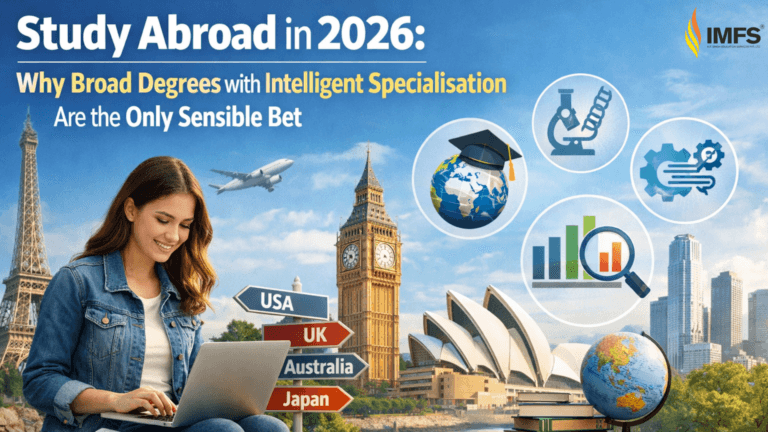
Study Abroad in 2026: Why Broad Degrees with Intelligent Specialisation Are the Only Sensible Bet
If you are choosing a course to study abroad in 2026 because it promises a “job”, you are already asking the wrong question.
Jobs no longer come with long shelf lives. Roles mutate, industries realign, and technologies rewrite themselves faster than most university brochures can keep up. And yet, year after year, I meet students who are preparing for a version of the world that has quietly stopped existing. They come armed with rankings, shortlists, and carefully curated degree titles. On paper, everything looks right. But when I ask a simple follow-up question, “What happens if this role changes in five years?” The conversation often pauses, and that pause is revealing.
The real risk in studying abroad today is not choosing the wrong country or the wrong university. It is choosing a rigid academic identity in a world that now rewards flexibility, reinvention, and the ability to think across disciplines. In 2026, certainty is not found in narrow promises. It is found in building foundations strong enough to evolve, especially given the sweeping changes expected with the advent of AI.
The uncomfortable global reality we must acknowledge
Multiple global institutions have been signalling the same message for years now, though this insight is often drowned out by marketing noise. The https://www.weforum.org/publications/the-future-of-jobs-report-2025/?utm underscores how macroeconomic forces, technology trends, demographic shifts, and climate action are reshaping what jobs will look like by 2030 and which skills will be needed. Employers globally anticipate a workforce in transition, with both displacement and creation of new roles requiring more versatile skill sets.
This is reinforced by research covered in https://www.oecd.org/en/publications/2025/12/oecd-skills-outlook-2025_ac37c7d4.html?utm, which examines how countries can build and sustain “21st-century skills” that enable individuals to thrive in rapidly evolving labour markets. The OECD highlights that disparities in skill development can limit opportunity and economic performance, suggesting that adaptability and foundational competence matter more than ever.
The World Bank’s World Development Report 2019 on The Changing Nature of Work similarly emphasises that technological progress may be disruptive even as it creates opportunities, and that people will need complex problem-solving, teamwork, and adaptability to remain relevant in the labour force. (See: World Bank World Development Report 2019 — The Changing Nature of Work)
These are not speculative predictions. They are evidence-based observations drawn from employment data, economic restructuring, and demographic change. And yet, paradoxically, as uncertainty increases, many students are being pushed toward degrees that are more narrowly defined than ever before, programs marketed as “job-focused,” but often tied to a fleeting moment in the market.
The dangerous comfort of premature certainty
One of the most common and costly mistakes I see in counselling rooms today is the belief that a sharply specialised degree offers security, for example, an MS in AI. On paper, such programs look decisive. They carry impressive names, promise alignment with current hiring trends, and appear to remove ambiguity from the decision-making process.
In reality, they often do the opposite.
Technologies evolve. Platforms change. Industries restructure. A degree of optimisation that is too tightly focused on a single job function or toolset can become fragile alarmingly quickly. When that happens, the graduate is not just unemployed; they are boxed in, with limited lateral exits and few pathways to reinvent themselves without significant retraining.
In uncertain times, over-optimising for a single job title is not ambition. It is risk disguised as clarity.
Why breadth is not dilution, but strategy
The most resilient professionals I have encountered, across engineering, technology, policy, healthcare, and industry, did not begin their careers with narrow academic identities. They began with broad, well-established degrees and layered specialisation thoughtfully as their interests and the market evolved.
This is not accidental. It is precisely how the world’s most respected universities design their academic frameworks. A strong foundational degree builds conceptual depth rather than reliance on tools. It allows graduates to pivot across roles and sectors without having to start from scratch. Most importantly, it signals to employers an ability to learn, not just to execute.
Breadth, in this sense, is not the absence of direction. It is insurance against obsolescence.
The broad degree families that actually make sense in 2026
When one steps back from trends and examines decades of global hiring behaviour, certain degrees of family types stand out, not because they are fashionable, but because they endure. These are not trendy labels. They are intellectual frameworks that allow graduates to move across industries, geographies, and economic cycles.
Let us examine a few programs:
- Computer Science remains a prime example. Its value lies not in any single specialisation, but in its ability to branch into artificial intelligence, systems engineering, data science, cybersecurity, and software engineering as demand shifts.
- The same logic applies to Electrical and Computer Engineering, which sits at the heart of semiconductors, electric vehicles, robotics, embedded systems, and energy infrastructure, sectors that governments across the US, Europe, and Asia are actively funding as strategic priorities.
- Mechanical Engineering, often dismissed as “traditional,” has quietly reinvented itself through automation, robotics, and advanced manufacturing, feeding directly into Industry 4.0, aerospace, and high-end production.
- Industrial Engineering and Operations Research focus on optimisation, systems thinking, and analytics-driven decision-making, skills that become even more valuable when supply chains fracture, and efficiency becomes a competitive advantage.
- Applied Mathematics and Statistics form the backbone of modern economies, powering artificial intelligence, financial risk modelling, actuarial science, and complex system simulation.
- Economics and Public Policy, when pursued with quantitative rigour and technological integration, prepare graduates for roles at the intersection of data, regulation, and decision-making, both in governments and global corporations.
- Environmental Engineering and Energy Systems are no longer niche disciplines. Climate commitments, infrastructure renewal, and sustainability mandates have made them central to long-term economic planning.
- Biomedical Engineering continues to grow steadily, driven by ageing populations, healthcare digitisation, and medical device innovation.
- Information Systems and Engineering Management bridge the persistent gap between technology teams and business execution. Interdisciplinary Science and Engineering programs, particularly CS+X models, reflect how innovation actually happens at the boundaries of disciplines.
These are not “safe” degrees.
They are strategic degrees, chosen not for comfort, but for endurance.
Where specialisation actually belongs
One of the most damaging misconceptions in study-abroad decision-making is the belief that specialisation must be locked in at the degree level itself. In reality, the most successful academic trajectories treat specialisation as a layer, not a foundation.
A Computer Science student who specialises in AI, cloud systems, or cybersecurity within a strong CS program retains far more flexibility than one enrolled in a narrowly defined standalone master’s. The same holds for Mechanical Engineering students moving into robotics or smart manufacturing, Economics graduates specialising in data analytics or policy modelling, and Electrical Engineering students focusing on semiconductors or energy systems.
This layered approach delivers three advantages simultaneously: immediate job relevance, long-term mobility, and protection against industry shocks. In an era defined by uncertainty, this is not conservatism; it is rational planning.
What I see go wrong most often
Certain patterns repeat themselves so frequently in counselling rooms that they are impossible to ignore. The first is the student who chose a degree name rather than a degree pathway. The program looked impressive, aligned with current trends, and promised quick employability. Within a couple of years, the market shifted, leaving the students locked into a narrow profile with few lateral exits.
The second is the student who did everything right academically but outsourced thinking at the decision stage. Strong grades, good test scores, even a reputed university, yet the choice was driven by peer behaviour or external advice rather than conscious intent. Later, they struggle not because they lack a degree, but because they lack a narrative.
The third pattern emerges after the first hiring slowdown or visa shock: graduates whose education does not travel well across geographies or industries. When conditions change, they have nowhere to pivot.
What unites all three is not poor effort, but short-term optimisation in a long-term game.
What employers actually hire for
Employer behaviour quietly confirms everything discussed so far. Data published by the US Bureau of Labour Statistics shows that high-growth roles consistently reward strong foundational knowledge, the ability to learn new tools quickly, and comfort with ambiguity and systems.
What employers rarely optimise for is the exact name of a narrowly defined degree, tool-specific credentials with short shelf lives, or cosmetic specialisations that look impressive but lack transferability.
They hire for capability, not labels.
A final word to students and parents
Studying abroad today is one of the largest financial and emotional investments an Indian family will ever make. The real risk is choosing the wrong country or university. The real risk is choosing a degree with no second act.
The most valuable graduates of the next decade will not be those who chased the sharpest trend, but those who built strong intellectual foundations and adapted faster than the world around them.
That is not just a study-abroad strategy.
It is a life strategy.
Frequently Asked Questions (FAQs)
1. Is it risky to choose a highly specialised degree like AI or Data Science in 2026?
Not inherently — but it becomes risky when the specialisation replaces foundational depth. A narrowly defined degree tied to one toolset or market moment can limit lateral mobility. A broader degree (such as Computer Science or Electrical Engineering) with an AI specialisation layered within it offers both immediate employability and long-term adaptability.
2. How do I know if a degree is “broad enough” for long-term career flexibility?
A broad degree typically:
- Builds conceptual foundations (mathematics, systems, core theory)
- Allows multiple elective tracks
- Supports cross-disciplinary movement
- Is recognised across industries and geographies
If your qualification only prepares you for one job title, it may be too narrow.
3. Are employers actually valuing broad degrees over niche qualifications?
Employer data consistently shows hiring preference for strong foundational skills, the ability to learn, and long-term adaptability. While niche skills may open entry doors, long-term growth depends on transferable competence. Employers hire for capability, not labels.
4. Will choosing a broader degree reduce my chances of immediate employment after graduation?
No — provided you specialise strategically through electives, internships, research projects, and certifications. The layered approach (broad foundation + targeted focus) offers both short-term job readiness and long-term resilience.
5. Which degree families are considered future-resilient for 2026 and beyond?
Degrees that consistently demonstrate cross-sector relevance include:
- Computer Science
- Electrical & Computer Engineering
- Mechanical Engineering
- Industrial Engineering & Operations Research
- Applied Mathematics & Statistics
- Economics (quantitative track)
- Environmental Engineering & Energy Systems
- Biomedical Engineering
- Information Systems / Engineering Management
These are strategic because they evolve with industries rather than depend on them.
6. How does this strategy impact post-study work visas and immigration pathways?
Broader degrees often align better with evolving labour market classifications and skills shortage lists across countries. When immigration rules shift, graduates with transferable skills have more flexibility to qualify under alternative job categories.
7. What if a specialised program has better marketing and rankings?
Rankings and branding should be evaluated carefully. A highly ranked program is valuable — but the question remains: does it build intellectual depth or just align with a current hiring trend? Prestige without adaptability can still create long-term rigidity.
8. Can I specialise later if I start with a broader degree?
Yes — and often more effectively. Specialisation can occur through electives, research assistantships, internships, industry certifications, capstone projects, or further academic study.
9. How should parents evaluate return on investment when choosing between broad and niche degrees?
ROI should be measured over 10–15 years, not just first salary outcomes. A degree that allows multiple pivots across industries, countries, and economic cycles typically generates stronger lifetime value than one tied to a single market phase.
10. What is the single biggest mistake students make when selecting a study abroad program today?
Optimising for the present job market without stress-testing the decision against future shifts. If a degree does not allow you to pivot within five years without retraining from scratch, it may not be strategically designed for 2026 and beyond.
Ready to Plan Your 2026 Study Abroad Strategy?
Presented by IMFS — India’s most trusted study abroad guide since 1997, empowering 63,000+ students across major global destinations to build future-ready international careers.
Authored by K. P. Singh
Mentor | Educationist | Founder – IMFS
Empowering the Global Indian Student