Options after the 12th Standard. Studying in Europe: A Beginner’s Guide
When families first hear about studying undergraduate programs in Germany, the reaction is usually a mix of curiosity and disbelief.
- Is it really almost free?
- Are the degrees taught in English?
- Is German mandatory?
- Isn’t the system too rigid?
- 1. Why study undergraduate programs in Germany?
- 2. Academic eligibility: the most critical section
- 3. Entrance exams and language requirements
- 4. Duration of undergraduate programs
- 5. Nature of the program: theory, practice, and structure
- 6. Credits and academic workload
- 7. Semester system
- 8. Credits per semester
- 9. Cost of education
- 10. Cost of living
- 11. Can students work while studying?
- 12. Accommodation: on-campus or off-campus
- 13. Post-study prospects and staying back
- 14. When should students start the application process?
- 15. Admission timelines
- 16. Visa process
- 17. When does the student travel?
- Closing reflection
- Frequently Asked Questions: Studying Undergraduate Programs in Germany
Germany is often spoken about as a value destination. That description is incomplete; Germany is not just affordable, it is academically uncompromising. It offers one of the strongest undergraduate education systems in the world, but only to students who understand the rules of the system and prepare accordingly.
This article will explain, calmly and clearly, how undergraduate education in Germany actually works, who it suits, and what families must do, well in advance, to make it successful.
1. Why study undergraduate programs in Germany?
Germany is Europe’s industrial and engineering backbone. Its universities are deeply integrated with research institutions, manufacturing ecosystems, and global industry.
Key reasons students choose Germany include:
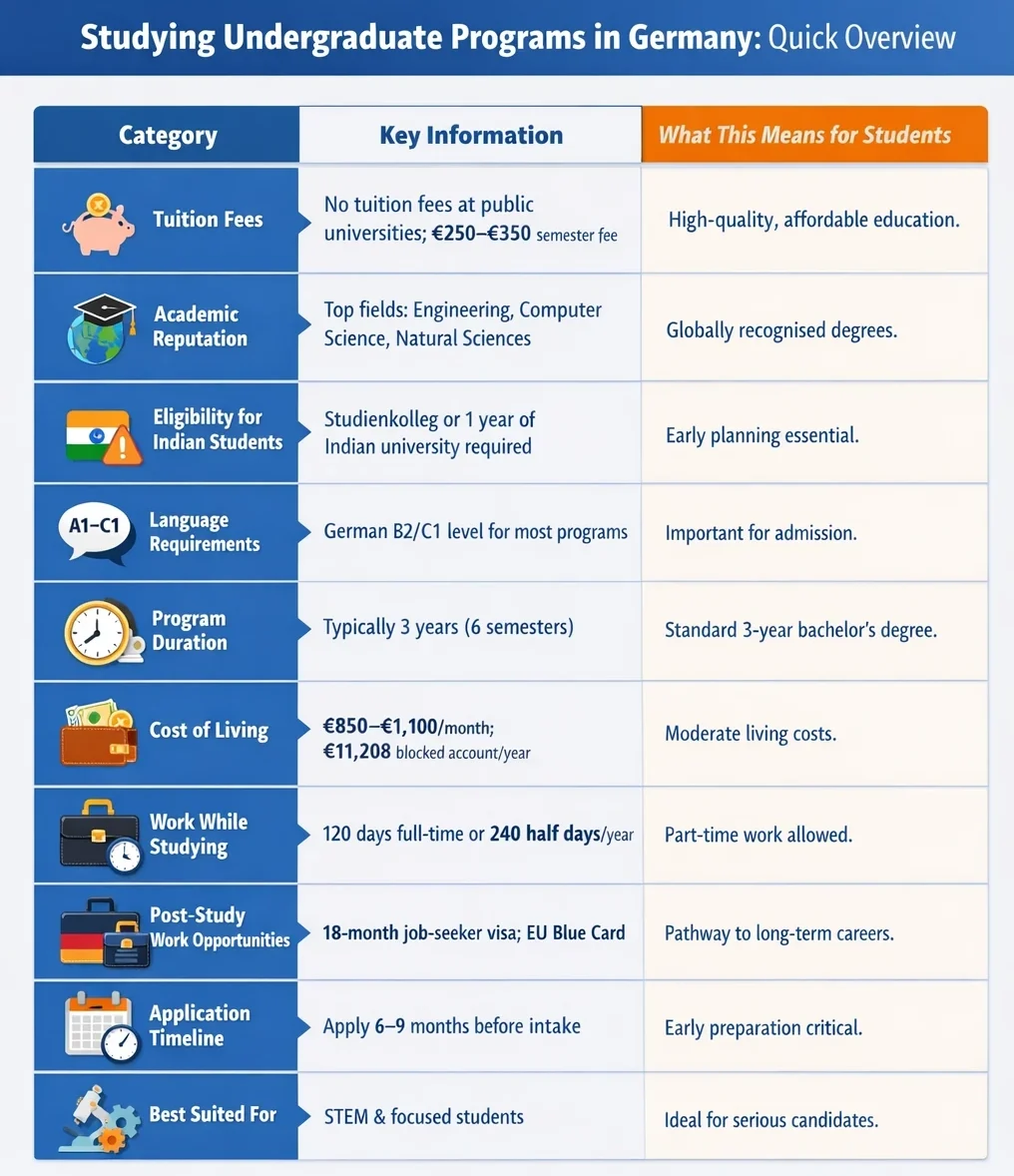
- Public universities with very low or no tuition fees
- Strong global reputation in:
- Engineering
- Computer Science
- Natural Sciences
- Economics and Applied Mathematics
- High academic standards and rigorous evaluation
- Degrees recognised across Europe and globally
- Clear pathways to employment in Europe’s largest economy
Germany does not market education aggressively; it assumes students who apply are serious, prepared, and academically aligned. This mindset defines the entire system.
2. Academic eligibility: the most critical section
This is where Germany differs sharply from the UK, Ireland, or even Scandinavia.
Germany does not automatically accept the Indian Class 12 as a sufficient qualification for direct undergraduate entry.
For Indian students, there are three common routes:
- Class 12 + one year of university in India
(in a relevant discipline) - Class 12 + Studienkolleg (Foundation Year)
followed by a qualification exam (Feststellungsprüfung) - IB / A-Levels / certain international curricula
may qualify for direct entry, depending on subjects and grades
This is not flexible or negotiable. If the system says you are not eligible, no agent or consultant can override it.
3. Entrance exams and language requirements
Germany does not rely heavily on standardised tests like the SAT for undergraduate admissions.
However, requirements include
- Strong academic alignment with the intended field
- German language proficiency for most UG programs:
- Typically B2 or C1 level
- Some universities accept English-taught UG programs, but they are:
- Limited in number
- Highly competitive
English proficiency:
- IELTS / TOEFL required for English-taught programs
German proficiency tests:
- TestDaF
- DSH
Language preparation is not an “add-on” in Germany; it is central and often the key to your admission.
4. Duration of undergraduate programs
Most undergraduate programs in Germany are
- 3 years (6 semesters)
- Some applied sciences or engineering programs may take 3.5–4 years
Germany follows the Bologna system, making degrees compatible across Europe.
5. Nature of the program: theory, practice, and structure
German undergraduate education is conceptually deep and structured.
Typically:
- Strong emphasis on:
- Core theory
- Mathematical and scientific foundations
- Less continuous assessment
- More weight on:
- End-semester exams
- Final projects or theses
In Universities of Applied Sciences (Hochschulen):
- Greater emphasis on:
- Practical training
- Industry-linked projects
- Internships
Students are expected to be self-disciplined. The system will not chase you.
6. Credits and academic workload
Germany follows the European Credit Transfer System (ECTS).
- 60 ECTS credits per academic year
- Typically:
- 180 credits for a 3-year UG program
Credits are earned through:
- Lectures
- Tutorials
- Labs
- Exams
- Projects or thesis work
7. Semester system
Germany follows a semester system, but the calendar is different.
- Winter Semester: October to March
- Summer Semester: April to September
There is often a long break between semesters, which students use for:
- Internships
- Language courses
- Part-time work
8. Credits per semester
- Approximately 30 ECTS credits per semester
- Course load is demanding but predictable
The challenge is not volume; it is depth.
9. Cost of education
This is Germany’s biggest attraction, but also its biggest misunderstanding.
Tuition fees:
- Public universities:
- No tuition fees in most states
- Small semester contribution: €250–€350
- Exception:
- The state of Baden-Württemberg charges ~€1,500 per semester for non-EU students
10. Cost of living
Living costs are moderate by European standards, but not cheap.
Average monthly expenses:
- €850–€1,100 per month
Major cities (Munich, Frankfurt, Hamburg):
- Higher costs
Smaller cities:
- More affordable and student-friendly
Germany requires proof of funds via a blocked account:
11. Can students work while studying?
Yes.
International students can work:
- 120 full days or 240 half days per year
- Student assistant roles (HiWi) are popular and relevant
Work helps with experience, not full financial support.
12. Accommodation: on-campus or off-campus
- On-campus housing exists but is limited
- Most students live:
- In shared apartments (WG)
- In private student housing
Apply early; housing is competitive in major cities.
13. Post-study prospects and staying back
Germany offers one of the strongest post-study pathways in Europe.
After graduation:
- 18-month job-seeker residence permit
- Once employed:
- Transition to work permit or EU Blue Card
Germany actively retains international graduates, especially in STEM fields.
14. When should students start the application process?
Ideally:
- 18–24 months before intended intake
- Early language preparation is critical
- Document preparation includes:
- Academic transcripts
- Language certificates
- CV
- Motivation letter
15. Admission timelines
- Winter intake (October):
- Applications: December–July
- Summer intake (April):
- Applications: October–January
Decisions are usually released 4–8 weeks after complete submission.
16. Visa process
Once admitted:
- Open a blocked account
- Arrange health insurance
- Apply for a student visa
Processing time:
- 4–8 weeks (can be longer during peak season)
17. When does the student travel?
- Typically, 3–4 weeks before the semester begins
- Students must:
- Register residenceEnrol at the university
- Open a local bank account
Germany expects students to settle independently but supports them once they do.
Closing reflection
Germany offers one of the most academically honest undergraduate systems in the world. It rewards preparation, discipline, and clarity of intent. It does not tolerate shortcuts. For students willing to plan early, learn the language, and respect the system, Germany offers not just a degree but a long-term professional future in Europe.