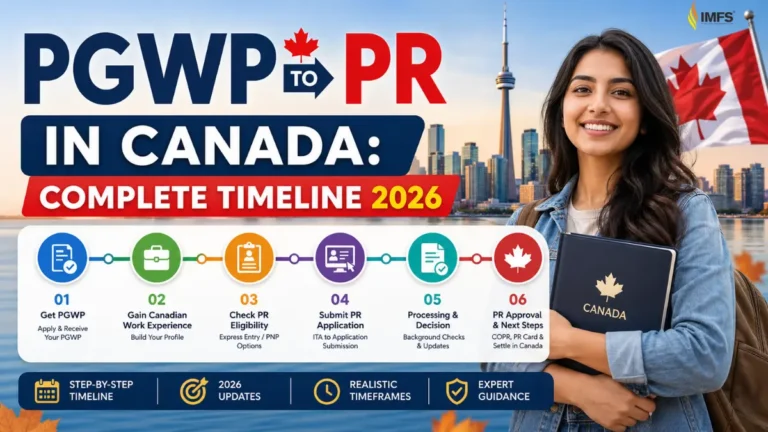
Canada PR After MS: The Complete PGWP → Express Entry → PR → Citizenship Playbook for Indian Students
7 stages. Every deadline. Every document. Every fee — updated April 2026. By K.P. Singh, Founder, IMFS.
Canada's immigration system offers Indian MS graduates something no other major destination can match: a structured, predictable path from graduation to citizenship in as little as 4–6 years — with no lottery, no per-country backlog, and no decade-long wait. But CRS cut-offs are rising. PNP allocations run out early. Fees are increasing. If you have an MS in progress or are planning one, the decisions you make in the next 12 months will determine whether you reach PR in Year 2 or Year 5.
📌 Quick Decision Table — Canada PR After MS
Use this to identify your situation and jump to the right section.
| If you want to… | Then your best path is… |
|---|---|
| A 3-year work permit after a 1-year MS | ✅ PGWP — all MS graduates qualify |
| PR without a job offer | ✅ Saskatchewan or Manitoba PNP |
| The fastest PR route | ✅ PNP nomination (+600 CRS points) |
| A lower CRS cut-off draw | ✅ French-language or STEM category draws |
| Save on PR fees right now | ⚠️ Submit a complete application before April 30, 2026 |
| Dual citizenship — keep Indian passport | ✅ Canada permits dual citizenship |
| Sponsor family to Canada | ✅ Available after PR is granted |
| Work anywhere in Canada after MS | ✅ PGWP is an open work permit — no employer tie |
| Use your pre-PR Canada days for citizenship | ✅ Student + PGWP days count as half-days (max 365 credit) |
| CRS boost from French proficiency | ✅ French CLB 7 adds up to 74 CRS points + lower draw cut-offs |
📌 Source: IRCC, ircc.canada.ca — as of April 2026. Individual outcomes vary. This is an illustrative guide, not a guarantee of any immigration outcome.
🍁 IMFS Recommendation — Based on 67,000+ Students Guided
- Take your IELTS before graduation. CLB 9 (IELTS General 7.0 all bands) adds 124 CRS points + a 50-point skill transferability bonus — the single highest-impact action you can take.
- Target a PNP as soon as you have 6+ months of Canadian work experience. A provincial nomination adds 600 CRS points and makes an ITA virtually certain — even in a competitive year.
- Apply for PNP early in the year. Ontario, BC, and Alberta all exhausted their 2025 PNP allocations before year-end. January/February applications have significantly better odds than October/November ones.
📋 Table of Contents
- What is the PGWP and how do I apply after my MS?
- How long is the PGWP for an Indian MS graduate — does program length matter?
- What CRS score do Indian MS graduates need for Canada PR in 2026?
- How does Express Entry work for PGWP holders in 2026?
- Which Provincial Nominee Programs (PNP) are best for Indian MS graduates in 2026?
- How do I apply for Canada PR — documents, fees, and timeline?
- What are my rights and obligations after getting Canada PR?
- How long does it take to get Canadian citizenship after an MS degree?
- What has changed in Canada immigration for Indian students in 2025–2026?
- FAQ — Canada PR After MS: 10 Most-Asked Questions
Canada remains the most accessible permanent residency pathway for Indian MS graduates among all major English-speaking destinations. The path follows a clear, legislated sequence: graduate, receive your Post-Graduation Work Permit (PGWP), build Canadian work experience, create an Express Entry profile, target a Provincial Nomination, receive your Invitation to Apply, and submit a complete PR application. This guide — authored by K.P. Singh, Founder and Mentor at IMFS, and reviewed by Inderjit Singh Matta, CEO at IMFS — walks you through every stage with current fees, policy changes as of April 2026, and the exact strategies that give Indian MS graduates the highest probability of success.
About IMFS — 27+ Years of Study Abroad Expertise
- 27+ years placing Indian students at universities worldwide, including University of Toronto, UBC, Waterloo, McMaster, Western, and Queen's University.
- 67,000+ students guided — India's largest study-abroad counseling network with 13 branches and a 4.7★ Google rating from 2,100+ reviews.
- IMFS Canada counselors track IRCC, the Canada Gazette, and provincial PNP draws in real time. Every figure in this guide is sourced from official government publications.
What is the PGWP and how do I apply after my MS?
The PGWP is the foundation of Canada's PR pathway for international graduates. Unlike the UK's Graduate Route or Australia's 485 visa, the Canadian PGWP is an open work permit — you can work for any employer in any province, change jobs freely, and work in any TEER category. This flexibility is critical for building a competitive CRS profile through Canadian work experience.
Applying for Your PGWP — Key Rules
Stage 1 of 7 | Apply within 180 days of program completion| Requirement | Rule / Detail | Source |
|---|---|---|
| Application window | Within 180 days of receiving written confirmation of program completion (e.g., official completion letter). Apply before study permit expires if that comes first. | IRCC |
| Lifetime limit | PGWP is issued once in a lifetime and cannot be extended (unless issued on short-term basis due to passport expiry). | IRCC |
| Eligible institution | Must have graduated from a PGWP-eligible Designated Learning Institution (DLI). Verify your university's DLI status at ircc.canada.ca before applying. | IRCC |
| Full-time study | Must have maintained full-time student status throughout the program. Part-time permitted only in the final semester or during scheduled breaks. | IRCC |
| Language (from Nov 1, 2024) | CLB 7 in English = IELTS General 6.0 in all 4 bands. Test results must be no more than 2 years old. University-level degree holders (including MS) must meet this requirement. | IRCC, Nov 2024 |
| Field-of-study restriction | MS/Master's and PhD graduates are EXEMPT from field-of-study PGWP restrictions. You do not need to have studied in a specific CIP code. | IRCC |
| Application fee | CAD $255 (open work permit holder fee $100 + processing $155). Plus biometrics $85 if not given in last 10 years. Verify current fees at ircc.canada.ca before submitting. | IRCC fees page |
| Implied status | If you apply before your study permit expires, you may work while IRCC processes your PGWP application (implied status). You can remain in Canada during processing. | IRCC |
📌 Source: IRCC, ircc.canada.ca — as of April 2026. Verify current fees and requirements at ircc.canada.ca before applying. Actual processing times vary.
💡 Spouse Open Work Permit: Spouses of students enrolled in master's programs of 16 months or longer can apply for a Spousal Open Work Permit (SOWP) valid for the same period as your study permit. Once you receive your PGWP and work in a TEER 0 or TEER 1 occupation (or designated sector), your spouse can apply for a new SOWP tied to your PGWP. Source: IRCC, ircc.canada.ca.
How long is the PGWP for an Indian MS graduate — does program length matter?
Before February 2024, PGWP duration was tied to program length — a 1-year MS got a 1-year PGWP. The rule change transformed the economics of studying in Canada. A 1-year MS now delivers the same 3-year work permit as a 2-year programme, and that 3 years of Canadian work experience is the primary engine of your CRS score and Express Entry eligibility.
| Qualification | PGWP Duration | Notes |
|---|---|---|
| Master's degree (any duration, min. 8 months) | 3 years | Fixed 3-year PGWP regardless of program length. Even a 1-year MS qualifies. Effective February 15, 2024. |
| PhD / Doctoral degree | 3 years | Same as Master's. |
| Bachelor's degree (2+ years) | Up to 3 years | Duration matches program length, up to a maximum of 3 years. |
| Bachelor's (8 months – under 2 years) | Same as program length | Shorter permit — an important reason to pursue an MS over an accelerated bachelor's. |
| Post-secondary diploma (2+ years) | Up to 3 years | Duration matches program length, up to 3 years. |
📌 Source: IRCC, ircc.canada.ca — as of April 2026. Verify current PGWP rules at ircc.canada.ca before making program enrollment decisions.
💡 The MS Advantage: 3 years of Canadian work experience is the primary driver of your CRS score. It qualifies you for the Canadian Experience Class (CEC), gives you time to receive a Provincial Nomination even if your first year involves job-hunting, and accelerates your citizenship timeline. From 27+ years of placing Indian students in Canada, we consistently see that students who enter the PGWP stage with a high IELTS score (CLB 9+) and a TEER 0–1 job offer within 6 months build competitive Express Entry profiles well within the 3-year window.
What CRS score do Indian MS graduates need for Canada PR in 2026?
CRS (Comprehensive Ranking System) points are awarded across four main factors: core human capital (age, education, language, Canadian experience), spouse factors, skill transferability, and additional points (PNP, French, siblings in Canada). The table below shows how each factor contributes for a typical Indian MS graduate.
| CRS Factor | Max Points | Key Details |
|---|---|---|
| Age (peak: 20–29) | 110 | Decreases sharply after 30. Age 35: 77 pts | Age 40: 50 pts | Age 44: 6 pts | Age 45+: 0 pts. Act fast if approaching 30. |
| Education — Master's/PhD (Canadian) | 135 | A Canadian master's scores the maximum. Foreign master's (ECA required): 126 pts. PhD (any): 150 pts. Always get an ECA from WES for foreign degrees — this is mandatory for your Express Entry profile. |
| Language — CLB 9+ (all bands) | 136 | CLB 9 = IELTS General 7.0 all bands = 124 pts. CLB 10+ = 136 pts. CLB 7 (IELTS 6.0) = 68 pts only. The single most high-impact improvement available — invest in IELTS preparation. |
| Language — French (CLB 7+) | Up to 74 bonus | French CLB 7+ adds up to 74 additional CRS points on top of your English score. French-language draw cut-off was 428 in February 2025 vs 500+ for general draws. Source: IRCC. |
| Canadian Work Experience — 1 year | 40 | TEER 0–3 employment in Canada. Minimum to qualify for Canadian Experience Class (CEC). |
| Canadian Work Experience — 3 years | 64 | Maximum CWE benefit achievable within the 3-year PGWP window. |
| Skill Transferability — Education + Language (CLB 9+, Master's) | 50 | CLB 7–8: 25 pts. CLB 9+: 50 pts (doubles it). A critical multiplier — this alone is why IELTS 7.0 matters more than IELTS 6.5 for CRS. |
| Skill Transferability — Education + CWE (Master's + 2 yrs) | 50 | Master's + 1 yr CWE: 25 pts. Master's + 2+ yrs CWE: 50 pts. |
| Canadian Education (2+ year Canadian credential) | 30 | 30 pts for studying in Canada — another reason the Canadian MS is strategically valuable over a foreign MS. |
| Provincial Nomination (PNP) | 600 | Game-changer. Virtually guarantees an ITA in the next draw. The strategic priority: have 6+ months of Canadian work experience, then apply to a provincial stream. |
| Sibling in Canada (PR or citizen, 18+) | 15 | If a sibling already holds Canadian PR or citizenship. |
📌 Source: IRCC CRS score grid, ircc.canada.ca — as of April 2026. CRS point values are set by IRCC regulation and are subject to change. Verify the current grid at ircc.canada.ca before submitting your profile.
📊 Sample CRS Score — Typical Indian MS Graduate (Age 26, IELTS 7.0 all bands, 1 year Canadian work experience)
📌 This is an illustrative model — not a financial or immigration guarantee. Actual CRS scores depend on individual profile details. Calculations based on the IRCC CRS grid as of April 2026. Add French CLB 7 (+74 pts) → ~588 pts. Add PNP (+600 pts) → ITA virtually guaranteed. Consult IMFS for a personalised CRS estimate.
⚠️ Job Offer Points: Removed March 2025 — Reinstatement Planned. IRCC removed job offer points (50–200 CRS points) from the CRS effective March 25, 2025, describing it as a temporary measure to address LMIA fraud. In March 2026, IRCC announced plans to reintroduce job offer points as part of a broader reform package. The effective date of reinstatement had not been confirmed as of April 2026. Re-evaluate your CRS if you have a valid job offer and monitor canada.ca for the official update. Source: IRCC, canada.ca.
How does Express Entry work for PGWP holders in 2026?
After building your CRS profile (language test, ECA, Canadian work experience), you submit an Express Entry profile via your IRCC account. You are then ranked against all other candidates in the pool. IRCC holds regular draws — inviting the highest-scoring candidates in each draw type. There are now four types of draws, and knowing which one you are eligible for determines your strategy.
| Draw Type | Who Is Invited | Typical CRS Cut-Off (2025–26) | Best Strategy for Indian MS Grads |
|---|---|---|---|
| General Draws | All Express Entry programs, ranked by CRS | 490–540+ | Realistic only if CRS 510+. Aim for this through PNP + French combination. |
| CEC (Canadian Experience Class) | CEC-eligible candidates only (1+ yr CWE) | 470–510 | Primary draw for PGWP holders with 12+ months experience. Target this as your baseline. |
| Category-Based (STEM, Healthcare, etc.) | Candidates with experience in specific categories (IT, Engineering, Healthcare) | 350–450 (significantly lower) | Most accessible for CS/IT/Engineering graduates. Check if your NOC is included in each draw. |
| French-Language Draws | Candidates with CLB 7+ French proficiency | 360–430 (70–100 pts lower) | Highest ROI strategy. French CLB 7 is achievable in 6–9 months of dedicated study. |
📌 Source: IRCC draw history, ircc.canada.ca — as of April 2026. Cut-off scores vary draw-to-draw. Verify the most recent draw results at ircc.canada.ca before finalising your strategy.
Which Express Entry Program Suits You?
| Program | Who Qualifies | Best For Indian MS Graduates? |
|---|---|---|
| Canadian Experience Class (CEC) | At least 12 months of skilled Canadian work experience (TEER 0–3) in the last 3 years. | Yes — primary pathway. After ~12 months on PGWP in a TEER 0–3 role, most MS graduates qualify for CEC and have higher CRS scores than FSWP applicants. |
| Federal Skilled Worker Program (FSWP) | Skilled work experience outside Canada (TEER 0–3). Must score 67/100 on the FSWP 67-point grid. | Yes — for graduates with pre-Canada work experience (e.g., worked in India before MS). Master's degree + IELTS 7+ + 1 year foreign experience typically scores 67+ on the grid. |
| Federal Skilled Trades Program (FSTP) | Qualified tradespeople. | Not typically applicable for MS graduates. |
📌 Source: IRCC, ircc.canada.ca — as of April 2026.
🍁 Get Your Canada PR Decision Plan — Free
Unsure about your CRS score, which PNP to target, or whether your field qualifies for a category-based draw? IMFS Canada counselors can build your personalised PR roadmap — at no cost.
Which Provincial Nominee Programs (PNP) are best for Indian MS graduates in 2026?
PNP is the most powerful tool available to Indian MS graduates with a moderate CRS score. Even if your CRS sits at 450–490 — below general draw cut-offs — a provincial nomination gives you 600 additional points and virtually guarantees your next ITA. The critical rule: apply for PNP streams early in the year. Major provinces exhausted their 2025 federal PNP allocations before year-end. Source: IRCC, provincial government reports.
| Province | Key Stream | Job Offer Required? | 2025–26 Notes |
|---|---|---|---|
| 🇨🇦 Ontario | Employer Job Offer — International Student Stream | Yes | Human Capital Priorities stream was largely inactive in 2025. Employer-driven streams now dominant. Ontario exhausted 2025 PNP allocations before year-end — apply early. |
| 🇨🇦 British Columbia | BC PNP Tech (weekly draws) | Yes | Weekly draws for 29 tech-eligible NOC codes. Lower SIRS score thresholds. BC received reduced 2025 nominations — still active but competitive. |
| 🇨🇦 Alberta | AAIP Accelerated Tech Pathway | Yes | Alberta ran the most PNP draws of any province in 2025. Lower cost of living than ON/BC. Strong for CS/IT/Engineering graduates with Alberta employer. |
| 🇨🇦 Saskatchewan | SINP International Skilled Worker — Express Entry | No (for EE stream) | CRS 350–450 competitive. No job offer required for the Express Entry stream. Good for graduates with moderate CRS scores. |
| 🇨🇦 Manitoba | Skilled Worker in Manitoba Stream | Job offer or Manitoba connection | Frequently active, lower competition than ON/BC/AB. Manitoba connection (study, family, work) can substitute for a job offer in some streams. |
| 🇨🇦 Atlantic Provinces (NB, NS, PEI, NL) | Atlantic Immigration Program (AIP) | Yes (designated employer) | Lower competition, faster PR processing, strong for healthcare, trades, and general STEM. Designated employers across Atlantic provinces actively recruit internationally. |
📌 Source: IRCC, provincial government websites — as of April 2026. PNP allocations, eligible streams, and score thresholds change annually and sometimes mid-year. Verify current stream availability at the official provincial immigration website before applying. Individual outcomes vary.
🚨 PNP Allocations Run Out — Apply Early. Ontario, BC, and Alberta all exhausted their 2025 federal PNP allocations before year-end. January/February applications have significantly better odds than October/November ones. If you are eligible for a PNP stream, do not wait. Source: IRCC, provincial government announcements.
How do I apply for Canada PR — what documents, fees, and timeline are involved?
Documents for Your PR Application
Stage 5 of 7 | 60-day window from ITA — no extensionsThe 60-day ITA window is absolute — no exceptions and no extensions are granted by IRCC. Do not wait for the ITA to begin gathering documents. Start assembling your package as soon as your Express Entry profile is active.
| Document | Key Rule / Detail |
|---|---|
| Valid passport | Must be valid for the intended period of residence in Canada. Ensure it does not expire soon. |
| Educational Credential Assessment (ECA) | From WES or an approved body for all foreign degrees. WES processing takes 7–10 weeks — apply immediately after confirming your institution. Source: IRCC. |
| IELTS/CELPIP results | CLB 7+ minimum. Must be less than 2 years old at time of application. Aim for CLB 9 (IELTS General 7.0 all bands). |
| Canadian work experience proof | T4 slips, CRA Notice of Assessment, Records of Employment (ROE), employment contracts on company letterhead, paystubs. Must cover 12+ months TEER 0–3 work. |
| Police clearance — India | From NCRB (National Crime Records Bureau). Indian clearances typically take 3–5 weeks. Start this process early. Also required for every country where you lived 6+ months since age 18. |
| Medical examination | By a designated IRCC panel physician. Upfront medicals now preferred by IRCC; valid for 12 months from exam date. Find a designated physician at ircc.canada.ca. |
| Provincial nomination letter | If applicable — include the provincial nomination letter and certificate. |
| Photos | To IRCC specifications — digital photos to exact pixel dimensions specified at ircc.canada.ca. |
🚨 PR Application Fees — April 30, 2026 Increase
| Fee Item | Amount (CAD) — from April 30, 2026 | Notes |
|---|---|---|
| Right of Permanent Residence Fee (RPRF) | $600 | Per adult applicant. Increased from $575 effective April 30, 2026. Source: Canada Gazette, March 27, 2026. |
| Processing fee — principal applicant | $990 | Increased from $950 effective April 30, 2026. |
| Processing fee — accompanying spouse | $990 | Same as principal applicant. |
| Processing fee — dependent child | $270 | Increased from $260 effective April 30, 2026. |
| Total — principal applicant (processing + RPRF) | $1,590 | ≈ ₹98,580 at 1 CAD = ₹62 (April 2026 rate). Verify at ircc.canada.ca before paying. |
📌 Source: Canada Gazette, March 27, 2026; IRCC fees page, ircc.canada.ca. Previous rates (RPRF $575 + processing $950 = $1,525 total) apply if a complete application is submitted before April 30, 2026. Rates as of April 2026: 1 CAD = ₹62 — rates change daily; consult IMFS for a current estimate.
💡 Bridging Open Work Permit (BOWP): If your PGWP expires while your PR application is still being processed, apply for a BOWP. You qualify if you have an ITA or approved PNP, a valid PGWP at the time of application, and have submitted your PR application. Apply at least 90 days before PGWP expiry. Source: IRCC, ircc.canada.ca.
What are my rights and obligations after getting Canada PR?
What Canadian PR Gives You
- Live, work, and study anywhere in Canada — all 10 provinces and 3 territories, unlimited mobility
- Access to provincial healthcare, social services, and education at domestic tuition rates
- Right to sponsor eligible family members (spouse, dependent children, parents, grandparents) for Canadian PR
- Protection under the Canadian Charter of Rights and Freedoms
- PR card — valid for 5 years, renewable. Required for re-entry to Canada by commercial carrier.
Residency Obligation — Do Not Ignore This
- Must be physically present in Canada for at least 730 days (2 years) out of every 5-year rolling window
- Failure to meet the obligation = risk of loss of PR status
- CBSA officers check residency compliance at every border re-entry
- If you intend to travel extensively or work abroad, consult a Regulated Canadian Immigration Consultant (RCIC) or immigration lawyer before doing so
- Days outside Canada for employment with a Canadian employer may count — verify specific rules with an RCIC
📌 Source: IRCC, ircc.canada.ca — as of April 2026. Residency obligation rules are set by the Immigration and Refugee Protection Act (IRPA). Consult a Regulated Canadian Immigration Consultant (RCIC) for guidance on your specific situation.
How long does it take to get Canadian citizenship after an MS degree?
| Milestone | Timeline | Key Rule / Action |
|---|---|---|
| Arrive — begin MS program | Year 0 | Student visa days begin accumulating as half-days (max 365 total credit toward citizenship). |
| Graduate — receive 3-year PGWP | Year 1–2 | Begin working. Start IELTS preparation if not already done. Begin building CRS profile (ECA, language test, Express Entry profile). |
| Submit Express Entry / PNP application | Month 12–18 | CEC eligible after 12 months of Canadian work experience. Update Express Entry profile immediately when any score-improving event occurs. |
| Receive ITA — submit PR application | Month 18–24 | 60-day window to file. Documents must be 100% complete. No extensions. Fee: CAD $1,590 for principal applicant from April 30, 2026. |
| PR granted | Year 2–3 | 730-day residency obligation (per 5-year rolling window) begins. PR card valid 5 years. Track physical presence days from this point. |
| 1,095 days physical presence reached | Year 3–4 | Pre-PR half-day credits (up to 365 days) can significantly accelerate this. Use the IRCC Physical Presence Calculator at ircc.canada.ca. |
| Citizenship application submitted | Year 3–5 | Must also have filed Canadian income taxes for 3 of the 5 years before applying. CLB 4+ English or French required. Citizenship test: 75% pass mark on 25 questions about Canada. |
| Canadian citizenship and passport | Year 4–6 | Processing approximately 8 months as of 2025 (IRCC). Dual citizenship permitted — keep your Indian passport. Canadian passport: visa-free or visa-on-arrival to 185+ countries. |
📌 Source: IRCC, canada.ca — as of April 2026. This is a typical timeline, not a guarantee. Individual timelines vary based on PR processing times, physical presence tracking, and application completeness. Always verify at canada.ca/citizenship.
🇨🇦 Citizenship Application Fees (Updated March 31, 2026)
| Applicant Type | Total Fee (CAD) | Notes |
|---|---|---|
| Adult (18+) | $653.00 | Processing fee $530 + Right of Citizenship $123.00. Right of Citizenship fee increased from $119.75 to $123.00 effective March 31, 2026. Source: IRCC. |
| Minor (under 18) | $100 | Processing fee only. Unchanged as of April 2026. |
📌 Source: IRCC fees page, canada.ca — as of April 2026. Verify current fees at ircc.canada.ca before applying. Rates as of April 2026: 1 CAD = ₹62 — rates change daily.
💡 Track Your Physical Presence from Day One. Every day in Canada as a student or PGWP holder counts toward citizenship as a half-day (maximum 365 half-day credit). Use the IRCC Physical Presence Calculator at ircc.canada.ca from the day you arrive. Also file Canadian income taxes every year from your first year — you need 3 years of tax filings within the 5-year window before your citizenship application. Source: IRCC, canada.ca.
What has changed in Canada immigration for Indian students in 2025–2026?
| Change | Detail | What It Means for You | Source |
|---|---|---|---|
| PR admission targets reduced | 395,000 in 2025 (down from 464,265 in 2024). Targets continue falling: 380,000 in 2026; 365,000 in 2027. | Fewer ITAs issued per year. A PNP nomination is now more important than ever. | IRCC, ircc.canada.ca |
| Job offer CRS points removed (March 2025) | 50–200 CRS points for a valid job offer were removed effective March 25, 2025. Reinstatement planned per IRCC March 2026 announcement. | If you have a valid job offer, monitor canada.ca for the reinstatement date — it may significantly boost your CRS when restored. | IRCC, canada.ca (March 2025 and March 2026) |
| Master's study permits exempt from cap (Jan 2026) | Master's and PhD study permits are now exempt from the IRCC study permit cap. No PAL (Provincial Attestation Letter) required since January 1, 2026. | Graduate program applications to Canadian universities are no longer restricted by the national cap — no change to your visa process if applying to an MS program. | IRCC, canada.ca, January 2026 |
| PGWP language requirement (Nov 2024) | CLB 7 English (IELTS General 6.0 all bands) now mandatory for all university degree PGWP applicants. Effective November 1, 2024. | Take your IELTS before graduation. IELTS 6.0 in all bands is the minimum — aim for 7.0 (CLB 9) for CRS benefits. | IRCC, November 2024 |
| GIC requirement increased | Guaranteed Investment Certificate (GIC) requirement is CAD $20,635 as of 2025–2026 (verify current amount at ircc.canada.ca). | Higher initial capital requirement for Canadian study visa. Verify current amount at ircc.canada.ca before applying. | IRCC, canada.ca |
| PNP allocations exhausted early (2025) | Ontario, BC, and Alberta all exhausted their 2025 PNP federal allocations before year-end. | Apply to provincial PNP streams as early in the year as possible — January/February applications have significantly better odds. | IRCC, provincial government announcements |
| PR fees increasing (April 30, 2026) | RPRF rises from $575 to $600; processing from $950 to $990. Total for principal applicant: $1,590 from April 30, 2026. Source: Canada Gazette, March 27, 2026. | If you can submit a complete application before April 30, 2026, you save $65 per adult applicant. | Canada Gazette, March 27, 2026 |
| Citizenship fee increased (March 2026) | Right of Citizenship fee rose to $123.00. Total adult citizenship fee: $653 CAD effective March 31, 2026. | Budget accordingly when projecting total Canada immigration costs. | IRCC |
📌 Source: IRCC (ircc.canada.ca), canada.ca, Canada Gazette — as of April 2026. Canada immigration rules change frequently. Verify all policies at ircc.canada.ca before making any application decisions.
🎯 What IMFS Counselors Tell Every Indian MS Graduate Heading to Canada
From 27+ years of placing Indian students in Canada and tracking thousands of Express Entry outcomes, the IMFS Canada team has identified the patterns that separate those who reach PR in Year 2 from those who are still waiting in Year 5.
Take IELTS Before Graduation
CLB 9 (IELTS General 7.0 in all four bands) adds 124 CRS core points plus a 50-point skill transferability bonus — 174 points combined. This single test decision has more impact on your PR timeline than any other factor within your control. Do not graduate without sitting the IELTS General Training test.
Learn French — Seriously
French-language Express Entry draws had cut-offs 70–100 points lower than general draws throughout 2025. TEF Canada CLB 7 is achievable in 6–9 months of dedicated study. Based on the students IMFS has counseled in Canada pathways, those who add French CLB 7 to their profile while on PGWP consistently receive ITAs 12–18 months faster than those relying solely on English CRS points.
Apply for PNP in January/February
Ontario, BC, and Alberta exhausted their 2025 federal PNP nominations before year-end. January or February PNP applications in competitive provinces have meaningfully better odds than October or November ones. Build your 6-month Canadian work experience as quickly as possible so you are eligible to apply for PNP streams by your first February in the job market.
File Canadian Taxes Every Year
Three years of Canadian tax filings within the 5-year window before your citizenship application are a mandatory requirement — even if you owe nothing, even if you are on a student visa. File from your first year in Canada without exception. Source: IRCC, canada.ca.
Work With an RCIC
The IRCC system is unforgiving of errors. A single missing document or incorrect answer on a PR application form can delay processing by months or result in refusal. Work with a Regulated Canadian Immigration Consultant (RCIC) for your Express Entry profile and PR application. IMFS can connect you with licensed RCIC partners — ask at any branch.
Consider Atlantic Provinces
New Brunswick, Nova Scotia, PEI, and Newfoundland offer the Atlantic Immigration Program with lower competition than ON/BC/AB, active employer networks, and faster PR processing. If your priority is PR speed over city choice, Atlantic provinces are strategically underused by Indian MS graduates.
🇮🇳 IMFS — Trusted by 67,000+ Students Since 1997
📚 Related IMFS Guides
Admissions, visa, costs, scholarships, and PR pathway — all in one place.
Shortlist the best MS programs across Canada, USA, UK, Germany, and Ireland.
Compare Australia's 485 post-study visa and PR pathway with Canada's PGWP route.
UK Graduate Route duration, Skilled Worker visa, and how it compares to Canada PR.
Financing your MS in Canada — loan options, GIC requirements, and repayment planning.
ROI calculators, CRS score estimators, and cost-of-living tools for every destination.
FAQ — Canada PR After MS: 10 Most-Asked Questions by Indian Students
Talk to an IMFS Canada Expert — Free
27+ years of placing Indian students in Canada. CRS score assessment, PNP strategy, PGWP guidance. No fees. No pressure. Just expert advice grounded in 67,000+ real student outcomes.