Destination Comparison — Indian Students 2026
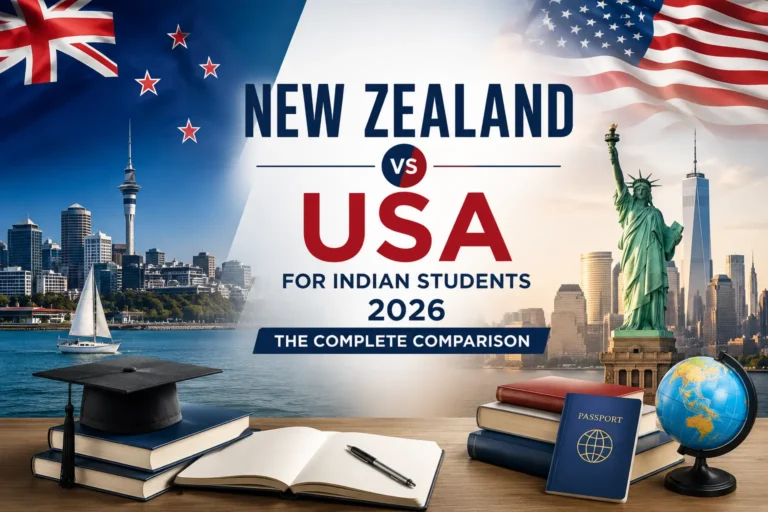
New Zealand vs USA for Indian Students 2026 — Trade-offs, Risk Analysis, and the Settlement Probability Question
Written by Sameer Jadhav, Content Strategist and International Education Research Specialist | Reviewed by Reshma Bokaria, IMFS | Updated: July 2026
The USA dream — MIT, Silicon Valley, OPT, H-1B — is the default aspiration for Indian STEM students. But in 2026, the gap between studying in the USA and actually settling there is wider than it has ever been. This guide does not declare a winner. It maps the trade-offs honestly: H-1B lottery odds, EB-2 India backlog, F-2 spouse restrictions, and healthcare costs on the US side — versus a smaller job market, remote geography, and fewer Fortune 500 employers on the NZ side. The right answer is conditional on your priorities, not universal.
🆕 India–NZ FTA Signed April 2026 — No India-USA FTA Exists
India-NZ FTA signed 27 April 2026 (pending ratification): Student Mobility Annex guarantees 20+ hrs/week work, PSWV 3 years (STEM), 4 years (PhD), 1,000 Working Holiday Visas/year for Indians aged 18–30. Source: MFAT NZ 🟢
India-USA: No bilateral FTA as of July 2026. Indian students in the USA have no treaty-level protection of work rights, post-study visa duration, or student access caps. 🟢
📋 Key Takeaways — NZ vs USA 2026 (Conditional)
- There is no universal answer. The better destination depends entirely on your career goals, financial capacity, and risk tolerance
- USA wins on: university rankings (MIT #1, Stanford #5, Harvard #4), research ecosystem, salary ceiling for those who secure H-1B, global tech network
- NZ wins on: settlement probability for most occupations, policy certainty (India-NZ FTA), spouse work rights, healthcare cost, safety (GPI #4 vs #131), lower financial risk
- H-1B lottery reality: 14–18% selection rate per year. Most Indian graduates will not secure H-1B within three attempts — plan for this scenario, not against it 🟢 USCIS
- Healthcare is a hidden cost: USA has no universal coverage; international students bear $3,000–$15,000+ in insurance and out-of-pocket costs over 2 years — rarely budgeted for 🟡
- F-2 spouse reality: Zero work authorisation in USA. Your spouse cannot earn a single dollar during your study period 🟢 USCIS
- EB-2 India backlog: ~50+ year wait at current processing rates for Indians. PR is not a realistic near-term outcome for most Indians in the USA under current law 🟢 US Dept of State
Quick Answer — Conditional on Your Priority
If your target is MIT, Stanford, Harvard, Caltech, or another top-10 global research institution: USA — the research ecosystem and global employer brand justify the immigration risk for that specific profile. If your primary goal is long-term settlement in 5–8 years, or your spouse needs to work, or you cannot absorb H-1B lottery failure: New Zealand offers a significantly more predictable pathway. The choice should be made with full awareness of trade-offs — not on the assumption that US salaries alone make the USA the better option.
Decision Lens — The Conditional Analysis
Instead of declaring NZ or USA the winner per category, this table gives you conditional answers. The right destination depends on which priority drives your decision — and many of those answers are genuinely different for different students.
| If your priority is… | Better choice | Why — the honest analysis |
|---|---|---|
| Ivy League / top-10 research university | 🇺🇸 USA | MIT, Stanford, Harvard, Caltech are world-class in a way NZ universities cannot match. Research ecosystem, faculty, and alumni network are genuinely different in kind — not just rank. |
| Lower financial and immigration risk | 🇳🇿 New Zealand | No H-1B lottery, no EB-2 queue, no F-2 spouse restriction, lower tuition at private-equivalent institutions, universal healthcare equivalent via ACC. NZ's total financial risk is substantially lower. |
| Global tech career (Silicon Valley / Big Tech) | ⚖️ Depends on risk tolerance | USA offers Google, Amazon, Apple, Meta, Microsoft headquarters. But access is H-1B-lottery-dependent. Accept that 14–18% annual lottery odds mean most Indian graduates will not achieve this outcome. NZ offers a growing tech sector with near-certain settlement. |
| Long-term settlement in 5–8 years | 🇳🇿 New Zealand | NZ Green List direct PR — find a qualifying job, apply for PR, done. USA: H-1B lottery then EB-2 India queue (~50 years). Settlement probability for most Indians is dramatically higher in NZ. |
| Spouse needs to work during studies | 🇳🇿 New Zealand | F-2 in USA has zero work authorisation — non-negotiable. NZ spouse gets an open work visa for programs of 9+ months. For dual-income households, the financial difference is substantial. |
| Work-life balance and personal safety | 🇳🇿 New Zealand | NZ GPI #4 vs USA ~#131. Smaller cities, lower population density, no gun violence risk equivalent. Quality of life metrics consistently favour NZ for families prioritising wellbeing over career maximisation. |
| Cutting-edge AI / deep tech research | 🇺🇸 USA | Stanford AI Lab, MIT CSAIL, CMU, UC Berkeley — the concentration of AI research capability in the USA has no equivalent anywhere. For PhD students in AI, robotics, or foundational computing: USA is the right choice. |
| Policy certainty over a 10-year horizon | 🇳🇿 New Zealand | India-NZ FTA (pending ratification) creates treaty-level protections. US immigration policy has changed dramatically across administrations; Indian students have no equivalent bilateral protections. |
| Lower total healthcare cost | 🇳🇿 New Zealand | USA has no universal coverage. $1,500–$3,500/year in premiums alone, plus deductibles and co-pays. A single US emergency room visit can cost more than a month of NZ living expenses. ACC covers accident injuries in NZ regardless of visa status. |
🎓 IMFS Expert View
Neither the United States nor New Zealand is universally better. The right destination is determined by which priority drives the decision — and those priorities differ across students. A student whose primary goal is a PhD at MIT should choose the United States. A student whose primary goal is long-term settlement with a spouse who needs to work should choose New Zealand. Framing the choice as a universal ranking misses the point. IMFS counsellors map each student's specific priority set against each destination's actual risk profile — not its marketing claims.
— IMFS Counselling Team · July 2026 · Not immigration or legal adviceSide-by-Side Comparison — 13 Dimensions
| Dimension | 🇳🇿 New Zealand | 🇺🇸 USA | Edge (July 2026) |
|---|---|---|---|
| Universities in QS Top 20 | 0 — Auckland #65 | 8 — MIT #1, Harvard #4, Stanford #5, Caltech #10, Chicago #11, Columbia #12, Cornell #13 | 🇺🇸 USA — dominant at the top |
| Work During Study | 25 hrs/week — all students 🟢 | On-campus 20 hrs/week only. Off-campus requires OPT/CPT authorisation. F-2 spouse: zero work rights 🟢 | 🇳🇿 NZ — clear |
| Post-Study Work | PSWV up to 3 years, open — no degree-link, no E-Verify required 🟢 | OPT 1 year + STEM OPT 2 years = 3 years; must be degree-related; employer must be E-Verify enrolled 🟢 | 🇳🇿 NZ — fewer restrictions |
| Work Visa After Graduation | Green List PR (direct) or SMC (points) — no lottery | H-1B lottery: 85,000 cap, ~14–18% selection rate 🟢 USCIS | 🇳🇿 NZ — dramatically more certain |
| PR Pathway (Indian nationals) | Green List (direct) + SMC (points-based) — no queue | EB-2 India: ~Oct 2012 priority date = 13–14 year backlog → ~50 year wait 🟢 Visa Bulletin | 🇳🇿 NZ — no comparison |
| Spouse Work Rights | Open work visa for programs 9+ months 🟢 | F-2: NO work authorisation — zero, non-negotiable 🟢 USCIS | 🇳🇿 NZ — critical for family finance |
| Healthcare | ACC covers accident injuries (all residents/students). Public health accessible. 🟢 ACC NZ | No universal coverage. Students need insurance ($1,500–$3,500/yr min) + deductibles + co-pays. Emergency care: $500–$5,000+ out-of-pocket 🟡 | 🇳🇿 NZ — significant hidden cost advantage |
| Annual Tuition | NZD 22,000–55,000 (~₹11–28 lakhs) | State: $15,000–$35,000; Private: $35,000–$65,000 (~₹12–54 lakhs) | 🇳🇿 NZ — cheaper vs private USA |
| Safety (GPI 2024) | #4 globally 🟢 IEP | ~#131 globally (gun violence, militarisation metrics) 🟢 IEP | 🇳🇿 NZ — very significant gap |
| Post-Graduation Salary | NZD 65,000–95,000/year (tech/engineering) | $90,000–$180,000+/year (tech in major hubs, if H-1B secured) 🟡 | 🇺🇸 USA — significantly higher, but H-1B-contingent |
| Settlement Probability (Indian nationals) | High — Green List: direct PR for qualifying occupations | Low to moderate — H-1B lottery failure likely for most; EB-2 India queue effectively permanent | 🇳🇿 NZ — dramatically higher for most Indians |
| Bilateral FTA with India | Signed 27 April 2026 — pending ratification 🟢 | No FTA as of July 2026 | 🇳🇿 NZ — treaty advantage |
| Risk-Adjusted Return | More predictable — lower ceiling, more certain outcome | Higher ceiling — contingent on H-1B success and EB-2 India queue resolution | 🤝 Depends on risk tolerance |
Star Rating Scorecard
| Factor | 🇳🇿 New Zealand | 🇺🇸 USA |
|---|---|---|
| Settlement Probability | ★★★★★ | ★☆☆☆☆ |
| University Rankings | ★★★☆☆ | ★★★★★ |
| Spouse Work Rights | ★★★★★ | ☆☆☆☆☆ |
| Safety | ★★★★★ | ★★☆☆☆ |
| Healthcare Cost | ★★★★★ | ★★☆☆☆ |
| Salary Ceiling | ★★★☆☆ | ★★★★★ |
| Financial Risk | ★★★★☆ | ★★☆☆☆ |
| Policy Certainty | ★★★★★ | ★★☆☆☆ |
The Settlement Probability Gap — Not Just a Policy Difference
This is the most consequential comparison for most Indian students — and the one most systematically underestimated when families plan for the USA. The gap is not between a good pathway and a difficult pathway. It is between a near-certain pathway and a lottery followed by a half-century queue.
USA: Four Sequential Bottlenecks for Indian Nationals
New Zealand: Two Clean Routes
⚠️ The probability calculation most families miss: When evaluated on average outcomes — not best-case scenarios — the comparison is stark. Average USA outcome for an Indian graduate: H-1B lottery failure within 3 attempts (majority outcome), return to India or third country. Average NZ outcome: PSWV, Green List employment, PR in 4–6 years. The USA's best-case outcome is genuinely better. The USA's average outcome is significantly worse. 🟢 USCIS FY2026
🎓 IMFS Expert View — Settlement Probability
The United States offers the highest salary ceiling of any English-speaking destination for Indian STEM graduates who successfully navigate H-1B selection. The operative word is 'successfully' — at 14–18% annual lottery odds, the majority of Indian graduates will not. New Zealand's Green List converts the settlement question from a probability problem to a planning problem: find a qualifying job at or above median wage, and PR follows predictably. For students whose primary objective is long-term settlement rather than a specific top-10 research institution, New Zealand's pathway is more predictable in 2026 — and this difference should be central to the decision, not a footnote.
— IMFS Counselling Team · July 2026 · Verify at USCIS and Immigration NZ before decisionsSalary Analysis — Why the Number Alone Misleads
US tech salaries are higher in absolute terms: $90,000–$180,000+ annually for senior software engineers in major hubs versus NZ NZD $75,000–$120,000. But that comparison, made in isolation, systematically misrepresents the actual return on investment. Here is what the full picture looks like:
| Factor | 🇳🇿 New Zealand | 🇺🇸 USA |
|---|---|---|
| Post-grad salary (tech/engineering) | NZD 75,000–120,000/yr | $90,000–$180,000+/yr (if H-1B secured) |
| Tuition (2-year master's, private) | NZD 44,000–110,000 | $70,000–$130,000 |
| Healthcare cost (2 years) | Negligible — ACC + public system | $3,000–$15,000+ (insurance + out-of-pocket) 🟡 |
| Spouse income (2 years study) | Possible — open work visa | Zero — F-2 has no work authorisation |
| Probability of accessing that salary | High — Green List employment near-certain for qualified graduates | Moderate to low — H-1B lottery required; 3 attempts, 14–18% each |
| Time to stable employment + PR | 4–6 years from arrival | 15–25+ years under current law for most Indians |
📌 The expert perspective on salary comparisons: Higher US salaries often come with substantially higher tuition, living costs, healthcare expenses, and immigration uncertainty. Students should evaluate long-term risk-adjusted return on investment — not salary figures alone. A $120,000 salary that is H-1B-contingent and never accessible produces a worse financial outcome than a NZD $90,000 salary with near-certain access and PR in five years. The comparison must include probability of outcome, not just value of outcome.
Risk Analysis — What Most Comparison Guides Don't Show You
Every destination carries risks. Honest analysis quantifies them. Below is the risk profile comparison across five dimensions most Indian families underweight when planning.
| Risk Category | 🇳🇿 New Zealand | 🇺🇸 USA | Notes |
|---|---|---|---|
| Immigration uncertainty | LOW | VERY HIGH | Green List PR is predictable. US: H-1B lottery + EB-2 India ~50-year queue — PR is not realistically achievable for most Indians under current law. |
| Tuition and education cost | MODERATE | HIGH | NZ: NZD 22K–55K/yr. USA private: $35K–$65K/yr. State universities cheaper but out-of-state rates apply for international students. |
| Healthcare cost | LOW | HIGH | NZ: ACC covers accidents; public health accessible. USA: No universal coverage. International students average $3K–$15K+ over 2 years in premiums and out-of-pocket costs. 🟡 |
| Spouse income risk | LOW | VERY HIGH | NZ: Spouse eligible for open work visa. USA: F-2 = zero work rights. For dual-income planned households, this creates a complete income gap during the study period. |
| Job market competition | MODERATE | HIGH | NZ: Smaller market but less competition; Green List roles actively recruited. USA: Hundreds of thousands of F-1 OPT students competing for skilled roles; STEM OPT employers must be E-Verify enrolled. |
| Global employer recognition | MODERATE (within APAC) | VERY LOW (global) | University of Auckland is respected in APAC. Harvard, MIT, Stanford are globally recognised. For students targeting global careers: US brand carries further. |
| Personal safety | LOW (GPI #4) | HIGH (GPI ~#131) | Gun violence in the USA is a statistically real risk. NZ has none equivalent. For parents, this is the clearest objective safety difference between any two major study destinations. |
| Policy uncertainty | LOW | HIGH | India-NZ FTA (pending ratification) creates treaty-level stability. US immigration policy has changed significantly across administrations; Indian students have no bilateral protection equivalent. |
🎓 IMFS Expert View — Risk Analysis
Risk profiles matter as much as outcome profiles. Indian students evaluating the United States often compare best-case US outcomes — Stanford degree, Big Tech job, H-1B success — against average New Zealand outcomes. The honest comparison requires examining average US outcomes against average NZ outcomes. The average US outcome for an Indian STEM graduate includes: a mid-tier state university program, H-1B lottery failure within three attempts (the majority outcome by probability), and mandatory departure from the USA. The average NZ outcome: a mid-tier NZ university, Green List employment, and PR in five to six years. When compared on expected values rather than best cases, New Zealand's risk-adjusted return on investment is more compelling for most Indian students — and this is the comparison families should be making.
— IMFS Counselling Team · July 2026 · Not investment or financial adviceWhat Universities Don't Tell You
Admissions materials highlight strengths. Here is the complete picture — strengths and weaknesses — for both destinations. Balanced understanding increases trust and improves decisions.
🇺🇸 United States
🇳🇿 New Zealand
Net 2-Year Cost Calculator — NZ vs USA
🧮 Model Your Scenario — NZ vs USA Net Cost in ₹
All figures indicative — July 2026 exchange rates (1 NZD ≈ ₹51, 1 USD ≈ ₹83). Healthcare costs for USA are included in the estimate.
Estimated Net 2-Year Cost (₹) — Including Healthcare
Indicative estimates only. Healthcare = ₹2.5L NZ (negligible) vs ₹5L–₹12L USA. Actual costs vary by program, city, and lifestyle. 🔴 Indicative
Myth vs Reality — What Indian Families Get Wrong About the USA
H-1B is easy to get if you're good at your job and have a strong employer
H-1B selection is a lottery — not merit-based. A Google offer and a startup offer have identical 14–18% lottery odds. H-1B caps were introduced in 1990 and have not increased since 2004 despite US workforce growth. Planning for US settlement requires planning for H-1B lottery failure — because that is the majority outcome by probability. Source: USCIS FY2026. 🟢
My wife can work while I study — we'll manage financially with a dual income
F-2 visa (spouse of F-1) has zero work authorisation. Your spouse cannot earn a dollar, take a paid internship, or do freelance work. This is non-negotiable and not subject to exceptions. Families planning dual-income budgets must plan for 100% of living expenses on a single-student budget. In NZ, spouses of students on 9+ month programs get open work visas — this is one of the biggest practical financial differences between the two destinations. Source: USCIS. 🟢
Once I get H-1B I'm on the path to a Green Card
H-1B is temporary work authorisation only. It does not create a PR pathway. For Indian nationals, the EB-2 PR queue has a priority date of approximately October 2012 as of early 2026 — meaning Indians who filed in 2012 are being processed now. Indians filing today face approximately a 50-year wait at current advancement rates. Even with a US employer willing to sponsor, permanent residence for an Indian national today is not a realistic near-term life plan under current US law. Source: US Dept of State Visa Bulletin. 🟢
The USA is safe — it's a developed, modern country
The USA ranks approximately #131 on the Global Peace Index 2024 — significantly lower than any other major English-speaking study destination. The primary factors are gun violence rates and militarisation metrics. Gun-related incidents in US universities and cities are not theoretical: they are statistical. NZ ranks #4. Australia #22. Canada #12. For parents evaluating safety as a criterion, the USA is statistically the most dangerous major English-speaking study destination. Source: Institute for Economics and Peace GPI 2024. 🟢
📊 IMFS Annual Outlook — NZ vs USA, 2026–27
Low. Despite ongoing Congressional discussions, no significant H-1B cap increase or merit-based reform is expected in 2026-27. Indian students should plan for 14–18% lottery odds to continue. This has not meaningfully changed since 2004 despite repeated proposals.
IMFS expects NZ to expand the Green List in 2026-27, potentially adding more data science, construction, and digital health roles. The India-NZ FTA (once ratified) adds treaty-level certainty that further widens NZ's policy stability advantage versus USA.
US international student healthcare costs continue rising. IMFS counsellors are increasingly including healthcare as a line item in US budget models — it is one of the most consistently underestimated costs in US-bound family planning.
IMFS Expert View — Reviewed July 2026
The United States remains the preferred destination for students whose primary objective is research, cutting-edge innovation, or employment with global technology companies. MIT, Stanford, Harvard, and Caltech represent a depth of research ecosystem that no other English-speaking country matches — and for students admitted to funded programs at these institutions, the immigration complexity may be a reasonable trade-off.
For the majority of Indian students considering the USA for a taught master's at a mid-tier state institution, the calculation is fundamentally different. H-1B lottery failure is the majority outcome by probability. The EB-2 India Green Card is not a near-term life plan under current law. The F-2 spouse restriction eliminates family income. Healthcare is not covered. And there is no treaty-level bilateral protection of any of these circumstances.
New Zealand's Green List, the signed India-NZ FTA, and a predictable 4–6 year settlement timeline represent a different risk profile entirely. For students whose primary goal is long-term settlement with reasonable financial planning: New Zealand is the more rational choice in 2026. Neither destination is universally better. The right answer is conditional on career goals, financial capacity, and risk tolerance — not on which country sounds more prestigious.
— IMFS Counselling Team, reviewed July 2026. Policies change — verify at USCIS, US Dept of State, and Immigration NZ before making decisions.
NZ or USA? IMFS Will Give You an Honest, Risk-Adjusted Answer
Free counselling at all 10 IMFS branches. We map your profile, occupation, spouse situation, and budget against both destinations — including H-1B probability, EB-2 queue implications, and healthcare cost modelling.
New Zealand vs USA — All FAQs
Is New Zealand better than USA for Indian students in 2026?
Neither is universally better — it depends on your priority. USA wins for: Ivy League / top-10 research, global tech career ambitions. NZ wins for: long-term settlement probability, spouse work rights, healthcare cost, policy certainty, safety. Use the Decision Lens in this guide to map your priority against the better destination. Book a free IMFS session for a personalised assessment. imfs.co.in/contact-us
What is the H-1B lottery and how does it affect Indian students?
H-1B annual cap: 85,000 (65,000 regular + 20,000 US master's exemption). Selection is a lottery — merit and employer quality don't affect odds. FY2026 selection rate: approximately 14–18%. During OPT/STEM OPT (3 years), Indian students get three lottery chances. Three consecutive failures = mandatory departure from USA. This is the majority outcome by probability — plan for it, not against it. Source: USCIS FY2026. 🟢 Official
What is the EB-2 India backlog?
EB-2 India Priority Date (early 2026): approximately October 2012 — Indians filing for EB-2 PR today face approximately 50+ years at current processing rates. US PR is not a realistic near-term goal for most Indians under current law, even after H-1B success. Source: US Dept of State Visa Bulletin. 🟢 Official
Can my spouse work in the USA while I study?
No. F-2 visa holders have zero work authorisation — non-negotiable. Your spouse cannot earn income, take paid internships, or do freelance work. NZ spouse gets an open work visa for 9+ month programs. This is one of the most financially significant and commonly misunderstood differences between USA and NZ study. Source: USCIS. 🟢
What are the healthcare costs for Indian students in the USA?
The USA has no universal healthcare. International F-1 students carry health insurance ($1,500–$3,500/year minimum) plus deductibles and co-pays. A single emergency room visit can cost $500–$5,000+ out-of-pocket after insurance. Over a 2-year program: $3,000–$15,000+ in total healthcare costs. NZ's ACC covers accident injuries; public health is accessible. Healthcare is one of the most consistently underestimated costs in US-bound budgets. 🟡 Multiple sources
Is US salary really better than NZ when you account for all costs?
US salaries are higher in absolute terms. But they come paired with higher tuition, living costs, healthcare expenses, and critically — immigration uncertainty that makes those salaries contingent on H-1B lottery success. A $120,000 salary you cannot access because H-1B fails produces a worse outcome than NZD $90,000 with near-certain access and PR in five years. Evaluate risk-adjusted return on investment, not salary figures alone.
Is NZ safer than USA?
Yes — significantly. NZ #4 GPI 2024 vs USA ~#131. Gun violence in the USA is a statistically real risk that does not have a NZ equivalent. For parents evaluating safety, the difference is among the clearest objective differences between any two major study destinations. Source: Institute for Economics and Peace. 🟢
Which universities are better — NZ or USA?
USA dominates at the top — MIT #1, Harvard #4, Stanford #5, Caltech #10. For research PhD and top-tier programs, USA wins clearly. For mid-tier taught master's programs at state universities vs NZ's top institutions (Auckland, Canterbury), the quality difference is much smaller than rankings suggest. Program quality matters more than country ranking for most Indian students.
What does the India-NZ FTA mean vs no India-USA FTA?
India-NZ FTA (signed 27 April 2026, pending ratification) creates treaty-level protections: 20+ hrs/week work guaranteed, PSWV 3 years (STEM), 4 years (PhD), no student cap. No India-USA FTA exists. Indian students in the USA have no equivalent bilateral protections — their rights are subject to US domestic policy changes across administrations. Source: MFAT NZ. 🟢
What is the settlement probability comparison?
NZ Green List: find qualifying employment → direct PR application. Realistic timeline: 4–6 years. USA: H-1B lottery (14–18%/year) × 3 attempts then EB-2 India queue (~50 years). Evaluated on average outcomes — not best cases — NZ's settlement probability for most Indian graduates is dramatically higher. Source: USCIS, US Dept of State. 🟢
What are the biggest risks for Indian students choosing USA?
Five key risks: (1) H-1B lottery failure — majority probability outcome for Indian graduates (2) EB-2 India backlog — PR not achievable near-term (3) Spouse income loss — F-2 zero work rights (4) Healthcare costs — $3K–$15K+ unbudgeted over 2 years (5) Policy uncertainty — no India-USA FTA, US immigration policy changes significantly across administrations. Honest risk planning means planning for all five.
How do I decide between NZ and USA?
Use the conditional Decision Lens in this guide. Core questions: (1) What is my primary goal — research prestige or settlement predictability? (2) Does my spouse need to work during my studies? (3) Can I absorb H-1B lottery failure without major financial harm? (4) What is my risk tolerance for immigration uncertainty over 10 years? Book a free IMFS session to map your specific profile: imfs.co.in/contact-us
About This Guide
Written by Sameer Jadhav, Content Strategist and International Education Research Specialist, IMFS. Reviewed by Reshma Bokaria, IMFS.
Data sources: USCIS FY2026, US Dept of State Visa Bulletin (early 2026), MFAT NZ, Immigration NZ, QS World University Rankings 2026, GPI 2024 (Institute for Economics and Peace), College Board, Kaiser Family Foundation, ACC NZ. Last reviewed: July 2026. Policies change — verify at official sources before decisions.