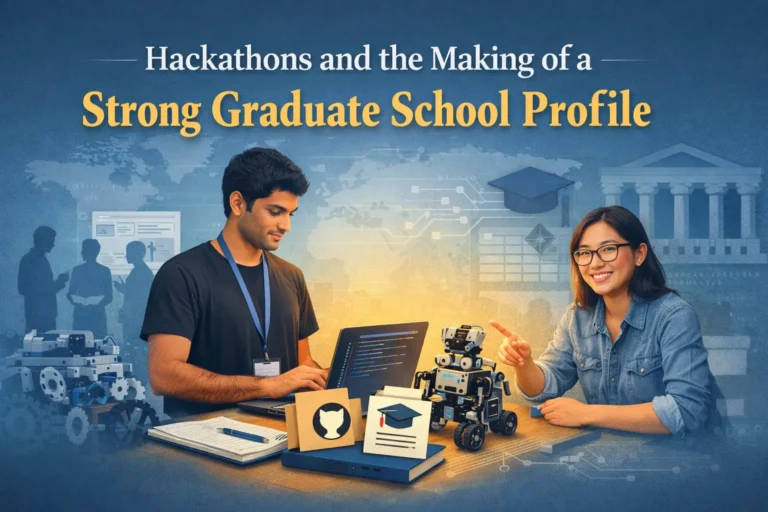
Hackathons and the Making of a Strong Graduate School Profile

Hackathons

Why events like HackOverflow 4.0 matter for students planning an MS abroad

K P Singh
By K. P. Singh
Educationist and Founder, Institute of Management & Foreign Studies (IMFS)
K. P. Singh is an educationist and the founder of IMFS, one of India’s leading study abroad and test preparation institutes. With decades of experience mentoring students for global universities, he has guided thousands of students in building successful international academic careers.
Book a one-on-one counseling session with KP Singh
HackOverflow 4.0: Where Students Build the Future
At HackOverflow 4.0, hosted by the Department of Computer Engineering at Pillai HOC College of Engineering and Technology, the atmosphere in the room felt very different from what one normally experiences in a classroom.

Students were gathered in small teams around their laptops. One group debated the architecture of their system, while another tested whether their algorithm could process data more efficiently.

A whiteboard nearby carried layers of diagrams, each representing a new attempt to refine an idea.

Students collaborated intensely, discussing system architecture, debugging code, and testing ideas in real time.
The room reflected the spirit of a real innovation lab rather than a traditional classroom environment.

The energy in the room was unmistakable.

Students were no longer simply studying technology. They were using it to build something new.

Events like this are increasingly supported through collaborations between institutions. HackOverflow 4.0 benefited from academic engagement from Binghamton University (SUNY) and support from IMFS, reflecting a growing effort to connect Indian students with the innovation-driven environments common in global universities.

For students planning to pursue an MS abroad, this shift—from learning concepts to applying them—can make a profound difference.

Innovation begins when knowledge is put to work.
What Exactly Is a Hackathon?
A hackathon is an intensive innovation event in which students collaborate to develop technological solutions to real-world problems within a limited time frame, typically 24 to 48 hours.

Participants work in teams with complementary abilities. Each team brings together different skills that allow them to transform an idea into a working prototype within a very short period of time.

Programmer / Backend Developer
Responsible for building the core functionality and technical infrastructure.
Data Science or AI Specialist
Works with datasets, machine learning models, or analytical tools.
System Architect
Designs how different components of the system interact and scale.
Interface Designer or Presenter
Focuses on user experience, design, and presenting the final solution.

Teams are given a problem statement and must conceptualize, design, and build a functional prototype that addresses that challenge.

At the end of the event, judges evaluate solutions based on several key criteria:

Originality
How creative and innovative the idea is.
Technical Execution
How well the technology is implemented.
Feasibility
Whether the idea can realistically be implemented.
Real-World Impact
The potential of the solution to solve meaningful problems.

Unlike traditional examinations that test theoretical knowledge, hackathons measure something far more meaningful:

the ability to apply knowledge creatively under pressure.

“Innovation rarely emerges from memorizing answers. It begins when students attempt to build something that did not exist before.”

Why Hackathons Matter for Students Planning to Study Abroad

Students preparing for graduate study often assume that admissions depend mainly on academic grades, standardized tests, and recommendation letters.

While these elements remain important, universities increasingly evaluate applicants through a broader perspective. Admissions committees want to see evidence that a student has initiative, intellectual curiosity, and the ability to apply knowledge to real problems.

Hackathons provide exactly that evidence. Participation in such events demonstrates qualities that universities value deeply.
Intellectual curiosity beyond classroom coursework
The willingness to take initiative and experiment with ideas
The ability to collaborate effectively with peers
Practical engagement with real technological challenges
As discussed in our earlier article:
How Profile Building Strengthens Your Admission Chances at Top Universities

In that piece, we explained how successful MS applications are built not only on academic scores but also on projects, research exposure, internships, and innovation-driven activities.

Hackathons are one of the most effective ways for students to begin building such a profile.

They transform learning into evidence of capability.

Most students planning an MS abroad focus on three things:

  • Grades
  • Test scores
  • Recommendation letters

All are important, but increasingly, top universities look for something else. They want evidence that students can apply knowledge, collaborate, and solve real problems.

This is where hackathons become powerful.

Last week, while interacting with students at HackOverflow 4.0, I watched teams of young engineers working through complex problems, arguing over algorithms, redesigning system architectures, and building prototypes under intense time pressure.

What struck me was not just the technology they were developing. It was the mindset they were building.

Hackathons do something classrooms rarely replicate: they push students to turn ideas into working solutions.

For students planning an MS abroad, that experience can make a real difference.

In my latest article, I discuss:

  • What hackathons really are
  • Why they strengthen MS applications
  • How they help students stand out in graduate admissions
  • Why experiential learning is becoming central to global education

You can read the full article here:

LinkedIn Post

Full Article on LinkedIn

And if you are interested in understanding how students build strong profiles for top universities, you may also find these articles useful:

How Profile Building Strengthens Your Admission Chances at Top Universities

LinkedIn Version of the Profile Building Article

Grades may open the door.

But curiosity, initiative, and the courage to experiment often determine how far that door opens.
Two Students, Two Applications

Consider two students applying for an MS in Computer Science.

Student One

The first student has excellent grades and strong test scores. The transcript is impressive, but the application reflects mostly classroom achievements.

Student Two

The second student has similar academic results and has also participated in hackathons, built a machine learning prototype, and collaborated with a team to solve a real-world problem.

To an admissions committee reviewing hundreds of similar applications, the distinction becomes meaningful. The second student demonstrates initiative beyond the curriculum.

This broader perspective was discussed earlier in our article:

Your Future Career Is Being Reshaped by AI — Are You Ready?

As technological change accelerates, universities increasingly seek students who demonstrate adaptability, creativity, and a willingness to experiment with ideas.

Hackathons nurture precisely these qualities.

Grades may open the door to graduate school.

But initiative and innovation often determine who walks through it.
How Hackathons Strengthen a Graduate School Profile

Participation in hackathons strengthens an MS application in several meaningful ways.

Real-World Problem Solving
Hackathons demonstrate that students apply theoretical knowledge to practical challenges beyond the classroom.
Tangible Outcomes
Prototypes, GitHub repositories, and presentations become valuable material for statements of purpose and interviews.
Teamwork & Communication
Graduate research environments rely heavily on collaboration, something hackathons simulate effectively.
Confidence in Innovation
Students learn that ideas evolve through experimentation, iteration, and persistence.
From Hackathons to Careers
The value of hackathons extends well beyond graduate admissions. Technology companies increasingly recognize that hackathons reveal qualities that traditional recruitment processes often fail to capture.

During these events, employers observe how students:

  • approach unfamiliar problems
  • experiment with solutions
  • collaborate with teammates
  • adapt when ideas do not work immediately

Several successful technology start-ups have even emerged from hackathon prototypes.

In uncertain times, the ability to think creatively and solve meaningful problems becomes one of the most valuable assets a student can possess.

Preparing for Your First Hackathon

Students sometimes assume that hackathons require advanced expertise. In reality, curiosity and willingness to experiment are far more important.

Strengthen Technical Foundations
Build confidence in programming languages, frameworks, and development tools.
Work on Small Projects
Experiment with simple applications or contribute to open-source initiatives.
Develop Teamwork Skills
Hackathons reward students who communicate ideas clearly and collaborate effectively.
Stay Curious
Participants who approach problems with curiosity often gain the most from these experiences.

Hackathons transform learning into experience.

They show universities—and future employers—that a student can turn knowledge into innovation.
The Larger Lesson

Education around the world is undergoing a quiet but important transformation.

Universities are moving steadily toward models that emphasize experiential learning, interdisciplinary collaboration, and innovation-driven thinking. Hackathons represent one small but powerful reflection of that transformation.

For students aspiring to pursue an MS abroad, participation in events like HackOverflow is not merely about competing or winning prizes. It is about learning how to approach problems with curiosity, resilience, and creativity.

The most successful engineers and researchers are rarely those who simply mastered their textbooks. They are the individuals who learned how to experiment, collaborate, and persist when solutions were not immediately visible.

Every hackathon project begins with uncertainty. Ideas evolve, mistakes occur, and solutions emerge gradually through persistence and teamwork.

That process mirrors the journey of discovery itself.

Innovation is rarely a straight path — it is a process of exploration.
Closing Reflection

In the end, education is not merely about accumulating knowledge.

It is about developing the confidence to use that knowledge in ways that improve the world around us.

A transcript may record what a student has learned. But experiences like hackathons reveal how a student thinks, builds, collaborates, and creates.


And that difference, more often than we realise, is what shapes both careers and contributions to the world.
Presented by
IMFS – India’s Most Trusted Study Abroad Guide Since 1997
Authored by K. P. Singh
Mentor | Educationist | Founder – IMFS
Empowering the Global Indian Student
Explore Study Abroad Opportunities
Frequently Asked Questions
Do hackathons help with MS admissions abroad?
Yes. Hackathons strengthen an MS application by demonstrating problem-solving ability, teamwork, and initiative. Universities value applicants who apply theoretical knowledge to real-world challenges.
How can hackathons improve a student’s graduate school profile?
Hackathons often produce tangible outcomes such as prototypes, GitHub repositories, and technical presentations. These achievements can strengthen statements of purpose, portfolios, and graduate school interviews.
Do universities value hackathon participation in applications?
Many universities appreciate hackathon participation because it reflects innovation, collaboration, and experiential learning. Admissions committees often look for evidence that students can work on real projects.
Do students need advanced programming skills to join a hackathon?
No. Hackathons involve teams with complementary skills. While programming helps, curiosity, creativity, and willingness to experiment are often more important.
Can hackathons help students with technology careers?
Yes. Hackathons showcase creativity, adaptability, and problem-solving skills under pressure. These qualities are highly valued by technology companies and research organizations.
author avatar
KP Singh
K P Singh is a distinguished leader in shaping the overseas education landscape in India. With strong ties to universities across North America, Europe, Australia, and New Zealand, as well as collaborations with embassies, educationists, regulators, and banking organizations, he has been a pivotal advocate for students aspiring to study abroad.Mr. Singh has played a transformative role in streamlining visa and application processes, guiding NBFCs to offer education loans, and partnering with universities to create India-specific programs and scholarships. His expertise has made global education more accessible to Indian students. An influential figure in the Indian academic system, Mr. Singh has collaborated with colleges to revise curricula, fostering globally aware students and facilitating partnerships between Indian and foreign institutions.As the Founder and Managing Director of the Institute of Management and Foreign Studies (IMFS), Mr. Singh has propelled IMFS to be India’s premier Test Prep institution, preparing thousands for their journey abroad.Achievements: • 26 Years at IMFS: Supported over 60,000 students in achieving their international education goals. • Recognition: Awarded for educational excellence for three consecutive years; a pioneer in the Test Prep sector. • Education Partnerships: Serves on management committees of several Mumbai colleges.Media & Publications: • TV Appearances: Regular guest on CNBC, sharing insights on global education. • Writer: Contributed to major newspapers, including Times of India and Hindustan Times. • Author: “Comprehensive Guide to Cracking THE GRE.” • Speaker: Delivered over 2000 seminars, including a TEDx talk, inspiring over 150,000 students.Guidance & Mentorship: • GRE Mentorship: Mentored eight students to perfect GRE scores—a national record. • Admissions Success: Guided students to top universities such as Harvard, Columbia, and Purdue.Leadership: • IMFS Growth: As Chief Verbal Faculty and Head Counsellor, built a strong team and set high standards for exam prep. • Global Recognition: Led IMFS to be among the top 7 education companies (PIEoneer Awards). Mr. Singh’s career embodies educational excellence, innovation, and student empowerment, solidifying IMFS’s status as a beacon of success, transforming lives, and fostering futures.
Chat
Get in touch with us Now

You're just one step away from your Dream University!

Avail Free GMAT Test

Avail Free SAT Test