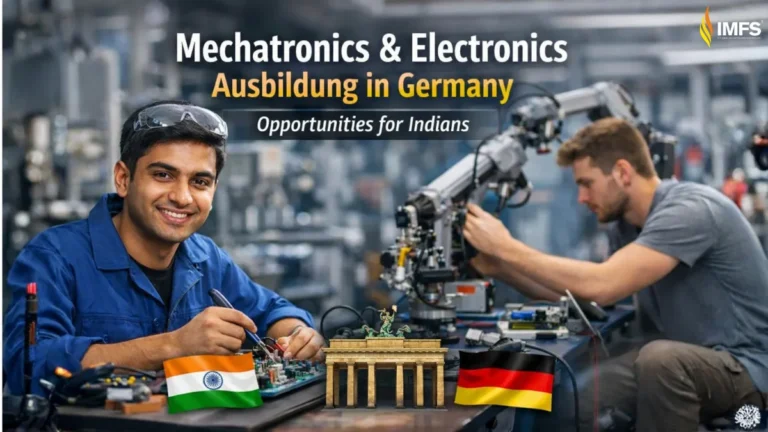
Ausbildung in Mechatronics & Electronics in Germany: The Complete 2026 Guide for Indian Students
Earn ₹1.15L–₹1.49L/month as an apprentice at Siemens, Bosch, or BMW — while Germany pays for your training. Here is everything you need to know.
Quick Decision Guide
| If you want… | Ausbildung is… | Why |
|---|---|---|
| To start earning in Germany immediately | ✅ Ideal | Stipend from Day 1; no tuition fees at Berufsschule |
| To avoid taking an education loan | ✅ Ideal | No blocked account needed; training company covers costs |
| Hands-on factory/industrial work environment | ✅ Ideal | 80% of your time is on-site at a real German engineering company |
| A direct path to permanent residency in Germany | ✅ Strong | 21–27 months to PR after qualification (with German language); dual citizenship with India since 2024 |
| To work at a company like Siemens, Bosch, BMW, or VW | ✅ Direct Route | These firms are among Germany’s top Ausbildung providers |
| Research, design engineering, or an R&D career | ⚠️ Not Ideal | A Bachelor of Engineering suits R&D/design roles better |
| Academic progression to a Master’s or PhD | ⚠️ Not Direct | Ausbildung → Techniker/Meister → some university access is possible but takes longer |
| You have a PCM Class 12 background | ✅ Eligible | Minimum academic requirement; a relevant diploma strengthens your application |
| You are willing to learn German (B2) | 🔑 Required | B2 German certificate is non-negotiable for factory-floor communication |
| You prefer theoretical/classroom-based learning | ⚠️ Reconsider | Ausbildung is predominantly practical; Berufsschule is applied, not theoretical |
📌 This table is an orientation guide — individual outcomes depend on your profile, German language level, and the specific company and region. IMFS counsellors provide a personalised assessment.
🎯 IMFS Recommendation — Based on 67,000+ Students Guided
- Best fit: Indian students with a strong PCM Class 12 record, an aptitude for hands-on technical work, and the commitment to reach B2 German proficiency.
- Strongest applicants: Those who also hold a 3-year diploma in Mechanical, Electrical, or Electronics Engineering — eligible for Ausbildungsverkürzung (course shortening by 6–12 months).
- Start planning 18 months early: German language prep + APS India certificate + document translation + visa processing — the timeline is longer than most students expect.
📋 Quick Navigation
- What Is an Ausbildung — and Why Does It Beat a Regular Degree?
- The Two Professions: Mechatroniker vs. Elektroniker
- Curriculum, Stipend & What You Earn (2026 Figures)
- Salary & Career Prospects After Ausbildung
- Step-by-Step Application Guide for Indian Students
- Visa: Why You Do NOT Need a Blocked Account
- Ausbildung vs. Bachelor of Engineering in Germany
- Who Should Choose Which Path?
- Frequently Asked Questions
For decades, the phrase “German Engineering” has been a global benchmark for quality and precision. An Ausbildung in Mechatronics or Electronics lets you do more than study that system — you become part of it, working on the factory floors of companies that build the future. This 2026 guide covers everything an Indian student needs to know: what you will learn, what you will earn, how to apply from India, and whether this path is right for you.
What Is an Ausbildung — and Why Does It Beat a Regular Degree?
Germany’s Ausbildung is a vocational apprenticeship built on the dual system — one of the most admired workforce development models in the world (BIBB, 2025). You split your time between a company (practical training, typically 3–4 days per week) and a state vocational school — the Berufsschule (theory, 1–2 days per week). Both are compulsory, both are structured, and both are paid.
For Indian students, the key distinction from a university degree is this: you are an employee from day one, not a student. Your training company pays your stipend, covers your Berufsschule fees, and in most cases provides a full-time job offer the moment you graduate.
The Two Professions: Mechatroniker vs. Elektroniker
While closely related, these are distinct, nationally recognised qualifications regulated by the German Federal Institute for Vocational Education and Training (BIBB). Understanding the difference is critical before applying.
🔋 2026 Update: E-Mobility Is Driving Unprecedented Demand
Volkswagen, BMW, and Mercedes-Benz are each investing tens of billions into EV production lines. This has created a dramatic surge in demand for both Mechatroniker (who maintain robotic assembly lines) and Elektroniker (who design and service high-voltage EV battery systems). German apprenticeship data from BIBB (2025) shows both occupations in the top tier for vacancy-to-applicant ratio nationwide.
Curriculum, Stipend & What You Earn — 2026 Figures
The Ausbildung for both professions runs for 3.5 years (7 semesters), structured under the nationally standardised dual-system curriculum approved by BIBB. You spend roughly 70% of your time at the training company and 30% at the Berufsschule.
What You Learn at the Berufsschule (Mechatronics)
- Mechanical assembly and fabrication of machine components
- Electrical wiring, installation, and component testing
- PLC programming to automate industrial tasks (Siemens S7, Allen-Bradley)
- Reading and creating complex technical drawings and circuit diagrams
- Hydraulic and pneumatic systems
- Quality assurance and measurement technology
What You Learn at the Berufsschule (Electronics — Industrial Technology)
- Installing and commissioning power supply systems and control cabinets
- Programming and configuring automation systems
- VDE safety standards and legally mandated safety protocols
- Advanced measurement and analysis of electronic systems
- Troubleshooting complex circuits and programmable controllers
- Renewable energy systems (solar inverters, wind power electronics) — new 2026 curriculum addition
Monthly Stipend — 2026 Figures
| Year of Training | Avg. Monthly Stipend (Gross, €) | Approx. in ₹ (@ ₹110/€, March 2026) |
|---|---|---|
| Year 1 | €1,050 – €1,150 | ₹1,15,500 – ₹1,26,500 |
| Year 2 | €1,100 – €1,200 | ₹1,21,000 – ₹1,32,000 |
| Year 3 | €1,150 – €1,300 | ₹1,26,500 – ₹1,43,000 |
| Year 4 (final 6 months) | €1,200 – €1,350 | ₹1,32,000 – ₹1,48,500 |
📌 Source: BIBB Datenreport 2025. Stipends vary by company, region, and collective bargaining agreement (Tarifvertrag). Large employers (Siemens, Bosch, BMW) typically pay at or above the upper range. Exchange rate: 1 EUR = ₹110 (March 2026). Rates change daily — verify at IMFS. This is an illustrative figure, not a financial guarantee.
Not sure if Ausbildung is right for your profile?
IMFS counsellors have guided students into Mechatronics and Electronics Ausbildung placements in Germany. Get a free, honest assessment of your eligibility — no pressure, no fees.
Salary & Career Prospects After Ausbildung
Completing this Ausbildung places you in the Facharbeiter (skilled worker) tier — the engine of Germany’s industrial economy and one of the most protected and well-compensated categories in the German labour market.
Starting Salary — Newly Qualified (2025–2026)
| Qualification | Starting Gross Salary (€/month) | Approx. in ₹ (@ ₹110/€, March 2026) | Source |
|---|---|---|---|
| Mechatronics Technician (entry) | €3,000 – €3,600 | ₹3.30L – ₹3.96L/month | Bundesagentur für Arbeit, Entgeltatlas 2025 |
| Electronics Technician — Industrial (entry) | €3,100 – €3,800 | ₹3.41L – ₹4.18L/month | Bundesagentur für Arbeit, Entgeltatlas 2025 |
| Industriemeister (after 3–5 yrs experience + exam) | €4,200 – €5,500 | ₹4.62L – ₹6.05L/month | IHK salary surveys, 2025 |
| Staatlich geprüfter Techniker (2yr advanced programme) | €4,000 – €5,200 | ₹4.40L – ₹5.72L/month | IHK salary surveys, 2025 |
📌 Gross salary figures. German income tax, church tax (if applicable), and social insurance contributions apply. Net salary is typically 60–70% of gross for standard tax classes. Source: Bundesagentur für Arbeit Entgeltatlas 2025; IHK salary surveys 2025. Exchange rate: 1 EUR = ₹110 (March 2026). This is an illustrative model — not a financial guarantee. Individual outcomes vary by employer, region, and collective bargaining agreement.
Job Roles After Qualification
The Long-Term Career Ladder: Meister & Techniker
The Ausbildung is the foundation, not the ceiling. After 2–5 years of work experience, you can pursue:
- Industriemeister: A prestigious IHK qualification covering advanced technical mastery and team/project management. Qualifies you to train your own apprentices. Salary step up: €4,200–€5,500/month gross.
- Staatlich geprüfter Techniker (State-Certified Technician): A two-year advanced programme bridging skilled worker and engineer-level roles. Opens doors to design, project management, and R&D support positions. Some Techniker qualifications also provide a pathway to university admission.
Step-by-Step Application Guide for Indian Students (2026)
The Ausbildung application process from India requires more lead time than most students expect. Begin at least 18 months before your target start date.
Visa: Why You Do NOT Need a Blocked Account
One of the most common misconceptions among Indian students is that the German blocked account (Sperrkonto) requirement applies to all Germany visa pathways. It does not.
| Visa Type | Purpose | Blocked Account Required? | Financial Proof Used Instead |
|---|---|---|---|
| Studienvisum (Student Visa) | University degree programmes | Yes — €11,904 (2026) | — |
| Ausbildungsvisum (Vocational Training Visa) | Ausbildung apprenticeships | No | Signed Ausbildungsvertrag (training contract) from your German employer |
📌 Source: German Embassy India / BAMF 2026. Verify current visa requirements at the German Embassy India website before applying — requirements can change. IMFS counsellors provide up-to-date visa guidance for Ausbildung applicants.
Ausbildung vs. Bachelor of Engineering in Germany
This is the most important decision an Indian PCM student targeting Germany must make. Both are excellent paths. The right choice depends entirely on your career goal and working style.
| Factor | 🔧 Ausbildung | 🎓 Bachelor of Engineering |
|---|---|---|
| Duration | 3.5 years | 3–4 years |
| Tuition Fees | €0 (company-paid) | €0 (public university) + semester fee ~€150–€350 |
| Income During Study | €1,050–€1,350/month stipend | Part-time jobs only (20 hrs/week limit) |
| Financial Proof for Visa | Training contract (no blocked account) | €11,904 blocked account (Sperrkonto) |
| German Language Requirement | B2 (mandatory) | B2–C1 for German-medium; B2 for English-medium programmes |
| Work Focus | Hands-on, practical, factory/site-based | Theoretical, research-oriented, laboratory-based |
| Career Path | Skilled technician → Meister/Techniker → Engineering management | Graduate engineer → R&D, design, or Master’s/PhD |
| Direct Hire Rate After Completion | 90%+ offered permanent contract (BIBB 2024) | Varies by field and university — no guaranteed job offer |
| Ideal For | Students who love building, fixing, and operating machines | Students targeting R&D, design engineering, or postgraduate study |
📌 Data: BIBB Germany 2024–2025; DAAD 2026; BAMF 2026. Exchange rate: 1 EUR = ₹110 (March 2026). Individual outcomes vary — this is an illustrative comparison, not a financial or career guarantee. Consult IMFS for a personalised assessment based on your academic profile.
Who Should Choose Which Path?
- You are fascinated by how automated machines, robots, and complex systems work
- You want to work at companies like BMW, KUKA, Festo, or Volkswagen on production lines
- You enjoy integrating mechanical, electrical, and software components together
- You have a Class 12 PCM background (strong Maths and Physics)
- A diploma in Mechanical or Electrical Engineering strengthens your application further
- You are committed to reaching B2 German proficiency
- You prefer earning over borrowing and want a job from Day 1
- You are passionate about circuits, power systems, and control electronics
- You want to specialize in industrial automation, EV battery systems, or renewable energy electronics
- You want to work with Siemens, ABB, Schneider Electric, or similar firms
- You have a strong Physics and Electronics background at Class 12 level
- An Electronics or Electrical Engineering diploma gives you a shortening advantage
- You are detail-oriented and comfortable with precision diagnostics
- The e-mobility and renewable energy boom is where you want to build your career
What IMFS Students Say
More Germany Guides from IMFS
Frequently Asked Questions
Yes — a strong Class 12 PCM background is the minimum academic requirement, and it provides a solid foundation. However, the Berufsschule applies physics and maths to practical engineering scenarios rather than purely theoretical problems: you will calculate circuit resistance using Ohm’s Law to design real systems, use trigonometry for machine angles, and apply logic for PLC programming. Students who also hold a 3-year diploma in Mechanical, Electrical, or Electronics Engineering have a significant advantage in applications and may qualify for Ausbildungsverkürzung — a reduction in the 3.5-year programme by 6–12 months — via the IHK (Chamber of Commerce and Industry).
A B2 level German certificate from the Goethe-Institut (Max Mueller Bhavan India) or Telc is the standard minimum requirement. For safety-critical factory-floor roles, verbal communication in German must be fluent — this is non-negotiable. Starting from zero, most students reach B2 in 14–18 months with structured, consistent study (6–8 hours per week minimum). IMFS offers German language coaching at multiple branches. Visit imfs.co.in/german-language-prep/ to start your preparation.
Based on BIBB Datenreport 2025, gross monthly stipends range from €1,050–€1,150 in Year 1 to €1,200–€1,350 in Year 4 (final 6 months). At 1 EUR = ₹110 (March 2026), this is approximately ₹1,15,500–₹1,26,500 in Year 1 and ₹1,32,000–₹1,48,500 in Year 4. Large employers (Siemens, Bosch, BMW) typically pay at or above the upper range. Gross-to-net deductions are relatively low at this income level (~10–15%), so take-home pay is approximately ₹1.0–1.3L/month after deductions. Exchange rates change daily — verify current figures at IMFS. This is an illustrative estimate, not a financial guarantee.
No. The blocked account (Sperrkonto) of €11,904 is required for the German Studienvisum (university student visa). For the Ausbildung pathway, you apply for an Ausbildungsvisum (vocational training visa). The signed training contract (Ausbildungsvertrag) from your German employer is the primary financial proof. You do not need to lock up €11,904 before your visa is granted. Source: German Embassy India / BAMF 2026. Always verify current requirements at the German Embassy India website before applying, as requirements can change.
Both are in the top tier of Germany’s most-demanded skilled occupations (BIBB 2025). The choice depends on your interest. Mechatronics is ideal if you want to work with large, complex integrated systems — industrial robots, automated manufacturing lines, and Industry 4.0 smart factories. Electronics (especially Elektroniker für Betriebstechnik) is the field to choose if you want to specialise in power and control systems — demand is surging due to Germany’s e-mobility transition (EV battery systems) and renewable energy infrastructure (solar, wind). Both occupations have over 90% direct hire rates and strong salary growth trajectories. Choose based on what genuinely interests you — both paths are future-proof.
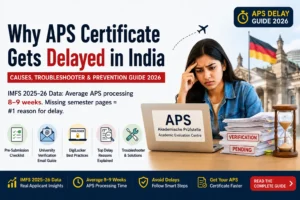
APS India (Academic Evaluation Centre India — Akademische Prüfstelle) is a body that verifies and authenticates the academic qualifications of Indian students applying for German visas. As of 2026, an APS certificate is mandatory for all Indian students applying for any German visa — including the Ausbildungsvisum. The process involves submitting your academic documents for verification and takes approximately 6–8 weeks. Apply at aps-india.de well in advance. This is a new requirement that many older online guides do not mention — factor this into your 18-month preparation timeline.
Yes — this is called Ausbildungsverkürzung. If you hold a relevant 3-year engineering diploma (Mechanical, Electrical, Electronics), you can apply to the IHK (Chamber of Commerce and Industry) to have the training period reduced by 6–12 months. The decision is made on a case-by-case basis, requires your training company’s agreement, and is assessed against your specific diploma curriculum. This makes you a more attractive and cost-effective hire for the company and gets you into a skilled worker salary faster.
German companies test how you think, not what you have memorised. Expect: logical reasoning puzzles or flowchart interpretation; spatial awareness tasks (drawing 2D views from a 3D object shown to you); basic physics and electronics questions (“What happens to current if resistance increases?”); and problem-solving scenarios (“A motor is not starting — what are the first three things you check?”). Interviews are typically conducted in German — this is another reason why strong B2 proficiency is essential, not just a checkbox. IMFS counsellors offer mock interview preparation for German Ausbildung applicants.
This is a strategic choice based on your career goal — both paths lead to strong outcomes. Ausbildung is the faster, debt-free route to a skilled, well-paying job: you earn from Day 1, gain 3.5 years of hands-on experience, and are typically offered a permanent contract on graduation. It is ideal for students who love practical, hands-on work. A Bachelor of Engineering is better for students targeting R&D, design engineering, or a Master’s/PhD pathway. It requires significant financial planning (€11,904 blocked account for the student visa) and 3–4 years before you start earning. IMFS recommends consulting a Germany counsellor for a profile-specific decision — the wrong path costs years.
Yes. While these fields have historically been male-dominated, the German government and major industries are actively driving gender diversity in MINT fields (Mathematics, Informatics, Natural Sciences, Technology) through initiatives like the annual “Girls’ Day” (Zukunftstag). Large employers — Siemens, Bosch, and BMW in particular — have formal diversity targets and actively recruit qualified female applicants. Female candidates with strong PCM backgrounds, solid German language skills, and well-prepared applications are very welcome. Diversity-focused companies may give additional consideration to strong female applicants from underrepresented regions.
Talk to an IMFS Consultant — Free
27+ years of placing Indian students in Germany. Ausbildung, university programmes, blocked account guidance, visa support. No fees. No pressure. Just honest, expert advice.
View all 13 branches →
list-item -->
- Application Process & Career Outlook for Indian Students: Indian students need strong academic records, B2-level German proficiency, and strategic applications to top companies, with excellent career growth opportunities in Germany's high-tech sectors.