And It’s Not Just About the Pattern

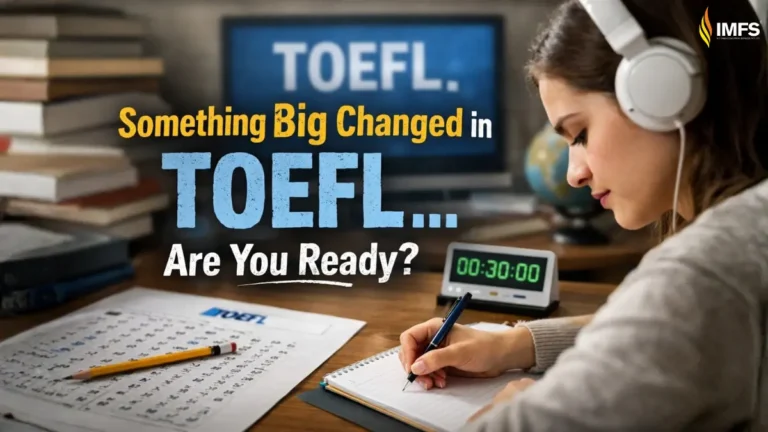
The TOEFL Has Changed — And It’s Bigger Than You Think
For years, English proficiency tests have been treated like hurdles—something to be cleared, forgotten, and never looked back at. Students would ask which test is easier, which one needs fewer weeks of preparation, and which one gives marks faster.
Institutions, however, were asking a very different question: Does this student actually have the language ability to survive, participate, and thrive in an academic environment?
In January 2026, TOEFL quietly shifted its answer to that question. What ETS did was not merely shorten the test or tweak a few sections—it redefined what it means to measure academic English in a global classroom.
And that shift has real consequences for how students prepare, how universities evaluate applicants, and how we, as mentors and educators, guide decision-making.
When did this change actually come into effect?
The updated TOEFL iBT took effect from January 21, 2026. Any test taken on or after this date follows the new format, while tests taken before that remain under the older structure.
ETS’ official announcement: Read here →
What changed and why it matters
At first glance, the changes may seem technical. In reality, they reflect a deeper shift in how academic English proficiency is assessed.
Shorter, more efficient test: The TOEFL is no longer a three-hour endurance exercise. It is now a focused assessment of roughly 90 minutes, designed to reduce fatigue while improving accuracy.
Adaptive testing model: Reading and Listening sections are now multistage adaptive. The test adjusts based on performance—strong responses move you forward, while weaker areas are identified without unnecessary repetition.
This approach is widely used in modern educational assessment and provides a more precise and student-friendly evaluation.
New scoring aligned with CEFR: TOEFL scores are now mapped to the globally recognised CEFR framework.
Each skill is scored on a 1–6 band scale, corresponding to levels such as B2 or C1. During the transition, ETS will also provide an equivalent 0–120 score for easier interpretation by universities.
More details from ETS: Learn more →
What Exactly Changed: TOEFL 2026 (In Plain Language)
1. The Test Is Now Shorter (and Smarter)
The old TOEFL felt like an endurance sport. The new one doesn’t.
- Earlier: ~3 hours
- Now: ~90 minutes
If you’re strong, the test moves faster and deeper. If you struggle, it avoids irrelevant difficulty.
That’s a measurement upgrade, not a downgrade.
2. The Scoring System Finally Speaks a Global Language
Earlier, TOEFL scores lived in a bubble: “Is 92 good?” “Is 100 enough?”
Now, TOEFL aligns with the CEFR framework, used globally.
- Each skill is scored on a 1–6 band scale
- Bands map to B1, B2, C1, C2 levels
During the transition:
- Reports will show the new 1–6 scale
- Also include a mapped 0–120 score
Official explanation from ETS: View details
3. Reading & Listening Are Now Adaptive
Reading and Listening are now multistage adaptive.
- Your early performance influences what comes next
- The test quickly identifies your true level
This reduces:
- Guess-inflated scores
- Random difficulty swings
- Fatigue-based errors
It aligns more closely with how language is measured in research environments.
4. Speaking & Writing Are No Longer Theatrical
The old TOEFL often felt like a performance:
- Long monologues
- Artificial prompts
- Unrealistic essays
The new TOEFL focuses on real communication:
- Clear responses
- Summarising and explaining
- Short, structured academic writing
This mirrors:
- Classroom discussions
- Professor interactions
- Campus communication
Official structure overview: View structure
So… Does This Help Students or Hurt Them?
- Actually use English (not just memorise templates)
- Think clearly under time pressure
- Understand academic language
- Depend only on memorised formats
- Prioritise length over clarity
- Prepare for patterns instead of real usage
The gap between real ability and coached performance is shrinking.
What This Means for Applications
Admissions officers don’t want:
- A poet who can’t participate in class
- Long essays without clarity
They want students who can:
- Listen
- Process
- Respond
- Write with intent
The new TOEFL aligns with this reality.
A Note for Students Preparing Now
If you’re taking TOEFL in 2026 or later, your strategy must adapt:
- Use old mock tests cautiously
- Practice adaptive reading & listening
- Focus on clarity in speaking
- Prioritise relevance in writing
Official free resources:
Ready to Take the Next Step?
Get personalised guidance from expert counsellors and plan your study abroad journey with clarity and confidence.
Book Your Counselling Session