- The F-1 visa refusal rate for Indian students rose from ~23% in 2015 to ~61% in 2025. Source: Shorelight 2026 / US State Department data.
- 72% of global employers report difficulty filling roles, especially in AI. Source: ManpowerGroup 2026 Talent Shortage Survey, 39,000+ employers, 41 countries.
- Germany, Canada (Master's/PhD), UK, Ireland, and New Zealand are actively recruiting the talent US windows are declining.
- Talent doesn't stop being ambitious when one door closes. It redirects — to the country that believes in it.
- A multi-destination application strategy is now essential for Indian families, not optional.
There is a particular silence that falls in a household the evening before a visa interview. Bags not yet packed — no one wants to tempt fate. An admit letter read so many times the words have stopped meaning anything and started meaning everything. Somewhere in the next room, a mother is praying. A father is reviewing bank statements one final time. The student is not sleeping. The student is rehearsing.
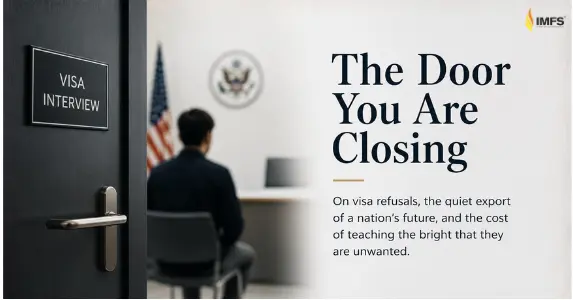
By morning, this young person will stand at a consular window. The officer behind the glass holds — in three or four questions — the power to redirect the course of a life. The conversation will last, on average, less than five minutes.
Five minutes against five years of preparation. That is the arithmetic we have quietly accepted. And I want to ask, as gently and as seriously as I can — whether we understand what we are doing.
What does the consular window not see about Indian students?
The window does not see the student from a tier-two town who taught himself calculus from borrowed notes. It does not see the woman who scored in the top percentile while caring for a sick grandparent — who chose biomedical engineering not because it was fashionable, but because she watched someone she loved suffer and decided to spend her life solving it for everyone else.
What the window sees is a face, a folder, and a clock.
A structural problem, not a personal one. A system can become cruel without a single cruel person inside it. When genuine, fully funded students are refused within minutes — often with a printed slip and no real explanation — the cruelty is architectural. The orders may be fixed. The tone is always free. And the two are not the same.
For most of these young people, the consular officer is the first — and perhaps only — representative of that nation they will ever meet. What an unkind word costs is not measured in five minutes. It is measured in a lifetime of how that student, and their children, think about the country that wore that face.
What is the US F-1 visa refusal rate for Indian students in 2025–2026?
The numbers are sobering. According to the 2026 Shorelight report compiling United States Department of State data, the refusal rate for Indian F-1 applicants has more than doubled in a decade:
European applicants in the same year faced a refusal rate of approximately 9%. The same degree. The same ambition. The same human worth. A gap of more than fifty percentage points in the right to walk through the door.
When excellence stops being a defence, students don't conclude they weren't good enough. They conclude the game was never theirs to win — and that is when trust breaks.
Worried about US visa uncertainty?
IMFS counsellors assess your profile and build a multi-destination strategy — free of charge.
Why does the collapse of trust in US visa outcomes matter for Indian families?
For decades, the unwritten contract was simple: demonstrate genuine intent, prove your merit, and the door will open. That contract was the quiet engine of American higher education's global standing.
When families begin to believe — rightly or wrongly — that the outcome is decided before the interview begins, the contract breaks. And in matters of trust, perception is not a footnote to reality. It is the reality that drives decisions.
A family that believes the process is fixed will not spend two years and ₹47 lakh for a 61% chance of refusal. They will look elsewhere. And they are. — K.P. Singh, Founder, IMFS
The damage radiates outward in widening circles: the student, the parents, the counsellors, the universities that admitted these students, designed labs around them, and now watch classrooms thin. A refusal at a window is never a single event. It is a stone dropped into still water.
What does the global talent shortage mean for Indian students right now?
The ManpowerGroup 2026 Talent Shortage Survey — covering 39,000+ employers across 41 countries — found 72% report difficulty filling roles, with AI-related skills the single hardest capability to source anywhere on earth. At precisely the same moment, US entry-level job postings have fallen roughly a third since early 2023 (Revelio Labs), raising the prospect of a "seniority cliff" within a decade.
The Demand Side
72% of 39,000+ global employers can't fill roles. AI and technical talent are the scarcest resources of the coming decade. (ManpowerGroup 2026)
The Supply Squeeze
US entry-level postings down ~33% since early 2023. If juniors never grapple with hard problems, the pipeline of future senior experts hollows out. (Revelio Labs)
The Contradiction
The world needs graduate talent more than ever. Yet one of its great talent magnets is making it harder for that talent to enter — at precisely this moment.
The Historical Record
Many of America's most prominent technology companies were built by people who once stood at a consular window in Delhi or Hyderabad. They were let in. The country that welcomed them benefited a thousandfold.
The value of the founder who is refused is invisible — you cannot photograph the company never started, the patent filed in another country's name. The loss does not announce itself. It accrues in silence, until a nation looks up and wonders where its edge went.
Compare USA, Germany, Canada, UK & Ireland
Use IMFS tools to find the destination that best fits your profile.
Which countries are actively courting the Indian students the US is turning away?
Ambitious students do not stop being ambitious when one door closes. They redirect. And the world's competing nations have taken precise note of the opening.
| Destination | Post-Study Work | Key Signal for Indian Students | 2026 Trend |
|---|---|---|---|
| 🇩🇪 Germany | 18-month job seeker visa | €0 tuition at public universities; high approval rate for complete applications; actively recruiting engineers. Blocked account: €11,904. Source: DAAD, BAMF. | Opening |
| 🇨🇦 Canada | PGWP up to 3 years | Master's & PhD exempt from study permit cap from Jan 2026; priority processing for shortage-field graduates. Source: IRCC. | Graduate-Friendly |
| 🇬🇧 UK | 2-year Graduate Route (until Dec 2026); 3 years for PhD | 1-year Master's degrees; Russell Group rankings; clear pathway to work post-study. Source: gov.uk. | Stable |
| 🇮🇪 Ireland | 2-year Stamp 1G stay-back | Critical Skills Permit from March 2026: €40,904 salary threshold, no Labour Market Needs Test. Google, Meta, Apple, LinkedIn European HQs in Dublin. Source: enterprise.gov.ie. | Opening |
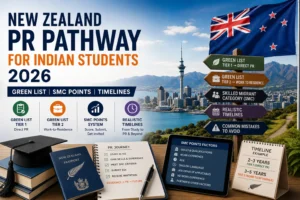
| 🇳🇿 New Zealand | Up to 3 years (Green List) | Widening post-study work access from late 2026; new skilled migrant pathways. Source: immigration.govt.nz. | Expanding |
| 🇺🇸 USA | OPT 12m + STEM OPT 24m = 36m total | World-class research and salary ceiling. But ~61% F-1 refusal rate for Indian applicants in 2025. Source: Shorelight 2026. | Tightening |
📌 Source: Shorelight 2026 (US data) | IRCC | BAMF/DAAD | gov.uk | enterprise.gov.ie | immigration.govt.nz | As of April 2026. Visa policies change — verify at official sources and IMFS before finalising any plan.
Talent is not loyal to the country that humiliates it. Talent is loyal to the country that believes in it. — K.P. Singh, Founder, IMFS
What should Indian students and families do in the face of this uncertainty?
I want to be careful here, because disappointment can curdle into bitterness — and bitterness teaches nothing. The USA remains, in countless ways, an extraordinary place to learn. IMFS still sends students there with genuine hope. But hope, to be responsible, must be paired with a plan.
The margin has narrowed to a sliver. The welcome has cooled. This is not an attack. It is the warning a teacher gives a brilliant student about to make an avoidable mistake — not out of anger, but because the teacher can see the cliff the student cannot.
From 27+ years of guiding Indian students, we consistently see that families who build a multi-destination strategy — rather than betting everything on one consular window — emerge with stronger outcomes and lower financial risk. The student who holds a strong offer from Germany, Canada, or Ireland alongside their US application walks into every interview from a position of security, not desperation.
— K.P. Singh, Founder, IMFS | 27+ years guiding Indian students globallyThe question is not whether the brightest will rise. They always do. The only question is where they will be standing when they do — and which country will call their success its own.
Somewhere, a gentle giant is still holding a door — spending the last of himself so that the young and the hopeful can pass through to safety. It was never really an instruction about a door. It was an instruction about who we choose to be when the cold comes.
K.P. Singh founded IMFS in 1997 with a single conviction: that every Indian student deserves honest, expert guidance toward the global education opportunity that fits them best. Under his leadership, IMFS has guided 67,000+ students to 280+ universities across the USA, UK, Germany, Canada, Ireland, Australia, and New Zealand. All data in this article is drawn from named official sources and is current as of April 2026. Exchange rates used: 1 USD = ₹95, 1 EUR = ₹110 (April 2026) — verify current rates at IMFS before finalising any financial plan.
Trusted by 67,000+ Indian students across 13 branches
Related Reading
Frequently Asked Questions
What is the current F-1 visa refusal rate for Indian students?+
According to the 2026 Shorelight report compiling US Department of State data, the F-1 refusal rate for Indian applicants reached approximately 61% in 2025 — up from 36% in 2023 and 23% in 2015. European applicants in the same period faced a rate of approximately 9%. Figures vary by reporting period; verify at uscis.gov for the latest data.
Which countries are best for Indian students if the US visa is rejected?+
Germany (€0 tuition at public universities, 18-month post-study job seeker visa), Canada (Master's/PhD exempt from study permit cap from Jan 2026), UK (2-year Graduate Route visa until Dec 2026), Ireland (2-year Stamp 1G stay-back, Critical Skills Employment Permit for tech graduates), and New Zealand (widening post-study access from late 2026) are all actively recruiting Indian graduate talent.
Is Germany a good alternative to the USA for Indian MS students in 2026?+
Yes — for the right profile. German public universities charge €0 tuition as of 2026 (source: DAAD/BAMF). The visa requires a blocked account of €11,904. Germany's 18-month post-study job seeker visa and EU Blue Card pathway (€43,759 minimum salary for shortage occupations) offer a clear, affordable route into European technology and engineering careers. Full details: imfs.co.in/study-in-germany/.
Does Canada's study permit cap affect Master's and PhD students from India?+
No. From January 2026, IRCC exempted Master's and doctoral students at public institutions from both the study permit cap and the Provincial Attestation Letter (PAL) requirement. Canada also committed to faster processing for doctoral applicants and is prioritising graduates in healthcare, STEM, and skilled trades. Source: IRCC official announcement, January 2026.
Should Indian students still apply to the USA given the high refusal rate?+
The USA remains a destination of exceptional academic quality and IMFS still counsels students toward it for the right profile. However, with a ~61% refusal rate for Indian applicants in 2025, families should build a multi-destination strategy rather than betting everything on one visa outcome. Book a free IMFS counselling session to assess your individual probability across destinations.
What is the global talent shortage in 2026 and why does it matter?+
The ManpowerGroup 2026 Talent Shortage Survey (39,000+ employers, 41 countries) found 72% of employers struggle to fill roles — AI-related skills being the hardest to source globally. Nations that actively welcome graduate talent now will benefit most over the next decade. Indian students who position themselves in talent-hungry markets (Germany, Canada, Ireland) enter with structural advantage.
What is Ireland's appeal for Indian tech graduates in 2026?+
Ireland's 2-year Stamp 1G stay-back visa follows graduation. The Critical Skills Employment Permit from March 2026 sets a salary threshold of €40,904 (€36,848 for recent graduates within 12 months of graduation) with no Labour Market Needs Test. Dublin hosts the European headquarters of Google, Meta, Apple, LinkedIn, Stripe, Airbnb, and Pfizer. Source: enterprise.gov.ie (DETE), March 2026.
How does IMFS help Indian students build a multi-destination strategy?+
IMFS counsellors across 13 branches evaluate your academic profile, financial position, career goal, and visa probability across all major destinations — USA, UK, Germany, Canada, Ireland, Australia, and New Zealand. The result is a prioritised application plan that maximises your combined probability of success. The initial counselling session is free. Book at imfs.co.in/contact-us/.
Planning Your Study Abroad Journey?
27+ years of placing Indian students globally. No fees. No pressure. Just honest, expert guidance.
Disclaimer: This article reflects the author's reasoned opinion as an educationist and is for general guidance only — not legal or immigration advice. Visa refusal data drawn from Shorelight 2026 compiling US Dept of State figures; individual outcomes vary. Verify all policies at official government sources before acting.