Which MS is Right for You? Navigating Data Science & Business Analytics for 2026 Careers
Picking the right graduate degree is a big deal. It shapes so much of what comes next. If you’re drawn to working with data, you’ve probably found yourself weighing an MS in Data Science against an MS in Business Analytics. Both paths look incredibly promising for 2026, but honestly, understanding their real differences is key to making a choice you’ll be happy with. We’re going to break down what each field involves, what you might earn, and where the jobs are going. This way, you can figure out which degree truly fits your ambitions. From our 30 years at IMFS, we’ve seen firsthand how studying abroad can give you a massive edge, broadening your outlook and really boosting your resume in either field. You’ll get to work with diverse datasets and meet all sorts of people, making you a much more appealing candidate globally. Let’s dig in and see which degree will open the doors you want.
What’s the Real Difference Between a Data Scientist and a Business Analyst?
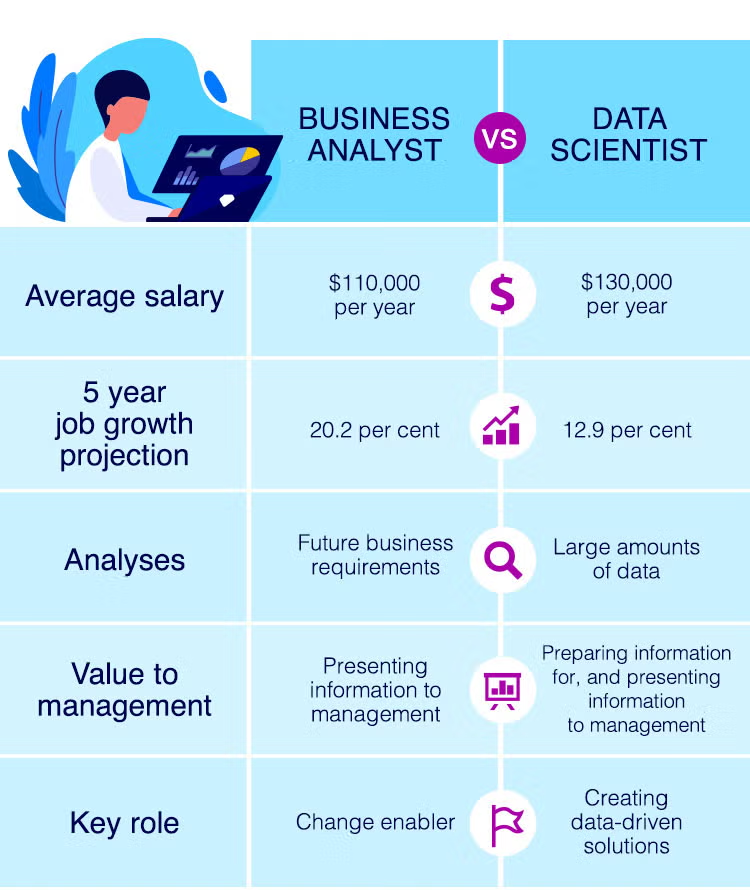
When you look at it, both Data Science and Business Analytics are all about digging into data. But their core aims? They’re quite distinct. Data Science really focuses on discovering new insights from often messy, unstructured data. Think sophisticated stats and machine learning techniques. A Data Scientist builds algorithms, creates predictive models, and uncovers those hidden patterns in huge datasets. They’re often the ones developing the cutting-edge tech that makes sense of raw information.
Business Analytics, on the other hand, is about applying data analysis to solve specific business problems and make better decisions. A Business Analyst uses data to spot trends, check how things are performing, and then offer data-driven advice to the folks running the show. They usually work with more structured data and rely heavily on tools like SQL, Excel, and great visualisation software to explain what they’ve found. What’s the main takeaway here? Data Science is about exploring new knowledge, while Business Analytics is about using that knowledge to improve a business. Studying abroad for either of these degrees can greatly enrich your learning experience, exposing you to different ways businesses operate globally.
From our experience at IMFS, students often ask if these roles ever overlap. And yes, they do! A great Data Scientist understands the business context, and a top Business Analyst knows enough about advanced analytics to ask the right questions and interpret complex models. It’s often a spectrum rather than a hard line.
Understanding the Core Focus
- Data Science:
- Goal: Discovering new patterns, building predictive models, and developing algorithms from vast, often unstructured datasets.
- Typical Tasks: Machine learning model development, big data processing, advanced statistical analysis, and data mining.
- Key Skills: Python, R, Java, machine learning, deep learning, statistical modelling, data engineering, cloud platforms (AWS, Azure, GCP).
- Outcome: Innovation, new capabilities, cutting-edge insights.
- Example Project: Building a recommendation engine for an e-commerce site or developing an AI model to detect fraud.
- Business Analytics:
- Goal: Applying data insights to solve specific business problems, optimise operations, and guide strategic decision-making.
- Typical Tasks: Reporting, dashboard creation, trend analysis, performance measurement, stakeholder communication, prescriptive analytics.
- Key Skills: SQL, Excel, Tableau, Power BI, communication, business acumen, problem-solving, data storytelling.
- Outcome: Improved efficiency, better decision-making, and actionable business strategies.
- Example Project: Analysing sales data to identify underperforming products or optimising marketing spend based on customer segmentation.
Impact on Organisations
Imagine a large retail company. A Data Scientist might develop an entirely new algorithm to predict customer churn with incredibly high accuracy, using complex demographic and behavioural data. They’re innovating the way the company understands its customers. Meanwhile, a Business Analyst in the same company would use existing sales data, market trends, and perhaps even the Data Scientist’s churn predictions, to recommend specific marketing campaigns or inventory adjustments for the upcoming quarter. They’re ensuring the business makes smart, immediate decisions. Both are vital, but their contribution points differ.
Salary Outlook for 2026: Which Degree Could Pay More?
It’s tricky to pin down exact salary numbers, since so many things—your skills, where you live, the industry—play a part. But honestly, as of 2026 projections, folks with an MS in Data Science might just see a slightly higher starting salary. Why? There’s a huge demand for people who can handle advanced machine learning, AI, and complex statistical modelling. Companies are really pushing to use data for a competitive edge, and these are the skills driving that push.
That said, I don’t think it’s a massive gap. The difference between Data Scientists and Business Analysts isn’t always huge. Your individual experience, any specialised skills you bring, your location, and even the industry you’re in can really sway your earning potential. Both roles, with experience and expertise, definitely have the potential for competitive salaries.
To boost your earning potential in either area, you’ve got to focus on practical skills, grab those internships, and build a strong portfolio that shows off what you can do. If you’re thinking about studying abroad, places like the USA, the UK, and Canada generally offer excellent salaries for both Data Science and Business Analytics. An international degree, coupled with a solid skill set, can really open doors for your career and your wallet.
A Quick Note on Salaries
While the following projections provide a credible baseline for 2026, it is important to recognize that technology salaries—particularly in data-focused roles—are highly market-sensitive. Verified insights from salary aggregators, industry compensation reports, and government labour statistics indicate that remuneration varies substantially based on multiple factors. These include company size (startup versus large enterprise), geographic location, sector specialization (such as healthcare AI, fintech, or advanced analytics), and individual leverage derived from internships, depth of project experience, and negotiation capability.
In several markets, notably the United States and Australia, the upper end of the salary range typically reflects high performers, specialised skill sets, or employment in high-cost metropolitan regions. Conversely, lower salary bands are more representative of entry-level roles, smaller firms, or non-metro locations. Across all regions, a strong professional portfolio, hands-on exposure to relevant tools, and demonstrable real-world project experience remain decisive in enabling candidates to secure compensation toward the higher end of the range.
Projected Starting Salaries (Approximate Monthly, 2026)
The figures below represent average, realistic salary ranges rather than guaranteed outcomes. Actual offers may vary based on market conditions and individual profiles.
United States
- Data Scientist: USD 8,000 – 12,000 per month
(Aligned with current market medians; the upper range reflects strong demand and high-cost metropolitan areas) - Business Analyst: USD 6,500 – 9,000 per month
(Upper band adjusted to reflect verified averages; USD 10,000 per month is uncommon at entry level)
United Kingdom
- Data Scientist: GBP 3,500 – 5,500 per month
(GBP 6,000 per month is more typical of experienced professionals or London-based roles) - Business Analyst: GBP 2,800 – 4,800 per month
Canada
- Data Scientist: CAD 6,000 – 8,500 per month
(Lower bound adjusted upward to align with current national averages) - Business Analyst: CAD 4,500 – 7,000 per month
Australia
- Data Scientist: AUD 7,500 – 10,500 per month
(Verified market data indicates current averages already exceed AUD 9,000 per month) - Business Analyst: AUD 7,000 – 9,000 per month
(Earlier lower estimates understated prevailing market conditions)
Germany
- Data Scientist: EUR 4,000 – 6,000 per month
(EUR 6,500 per month is achievable but typically associated with senior or specialised roles) - Business Analyst: EUR 3,800 – 5,400 per month
Ireland
- Data Scientist: EUR 4,500 – 6,500 per month
(Lower bound revised upward to reflect Dublin-centric hiring trends) - Business Analyst: EUR 3,500 – 5,500 per month
Key Takeaway for Students and Early Professionals
These verified salary ranges confirm that Data Science roles consistently command a compensation premium over Business Analytics roles across major global markets. However, long-term career acceleration is driven far more by technical proficiency, tool mastery, and applied project experience than by degree title alone. Candidates who enter high-demand niches and demonstrate tangible, real-world impact frequently exceed average salary bands within the first 12 to 24 months of employment.
Are Job Prospects Still Robust for Business Analysts in 2026?
Absolutely, the job market for Business Analysts is strong, and we expect it to stay that way through 2026. Businesses everywhere are relying more and more on data to make decisions, and that means they desperately need people who can take data, analyze it, and then turn all that complex information into clear, actionable advice. Organizations need individuals who can effectively talk about their findings and guide leaders toward better performance.
While Data Science is definitely soaring, the role of a Business Analyst—bridging the gap between complicated data and straightforward recommendations for business leaders—is totally essential. Business Analysts are crucial for helping companies make smart choices and hit their goals. You’ll find roles like marketing analyst, financial analyst, and operations analyst, all playing a key part in their respective departments.
Also, a Business Analytics degree often gives you a more direct path into specific industries like healthcare, finance, or retail. If you’ve got a clear idea of your career path, it might be a more targeted choice. And studying abroad as an aspiring Business Analyst? It can give you invaluable exposure to different business environments and international markets, really boosting your skill set and career prospects. At IMFS, we often highlight how this global perspective makes our students stand out.
- Bureau of Labour Statistics (BLS) Data (US): The BLS projects a significant growth for Management Analysts (a category that often overlaps with Business Analysts) over the next decade. While specific to the US, this trend broadly reflects global demand for data-driven strategic planning (Source: U.S. Bureau of Labour Statistics, Occupational Outlook Handbook, Management Analysts, projected 2022-2032 growth).
- McKinsey & Company: Reports consistently emphasise the ongoing need for professionals who can translate analytics into business value, underpinning the demand for Business Analysts (Source: McKinsey & Company, “The next normal in M&A: Technology and the future of work” 2023 report touches on data-driven growth).
Can You Become a Data Scientist with a Business Analytics Degree?
Moving from a Business Analytics degree into a Data Science role is definitely possible, but it usually means you’ll need to go the extra mile and really focus on building certain skills. A Business Analytics degree gives you a cracking foundation in data analysis, statistical methods, and visualising data—all super valuable in Data Science. However, it might not cover the more advanced machine learning and programming skills that many Data Science positions demand.
If you’ve got a Business Analytics background, you can absolutely pivot into Data Science. How? By actively picking up those extra skills through online courses, intense bootcamps, or even another formal qualification. Learning programming languages like Python and R, mastering different machine learning algorithms, and putting together a portfolio of Data Science projects are essential steps in this journey.
For example, beyond your core degree, you could pursue:
- Specific Certifications: Look into certifications like AWS Certified Machine Learning Speciality, Google Cloud Certified Professional Data Engineer, or Microsoft Certified: Azure AI Engineer Associate. These validate your skills in cloud-based data science.
- Intensive Bootcamps: Programs from providers like General Assembly, DataCamp, or Springboard offer immersive training in Python, R, machine learning, and essential data science tools, culminating in portfolio projects.
- Online Specialisations/Courses: Platforms like Coursera (e.g., “Applied Data Science with Python” from the University of Michigan), edX (e.g., “Professional Certificate in Data Science” from Harvard), or Udacity’s nanodegrees can fill skill gaps.
- Building a Strong Portfolio: This is crucial! Demonstrate your abilities with projects on platforms like Kaggle, or by creating your own projects. Examples include building a sentiment analysis tool, developing a churn prediction model, or optimizing an e-commerce recommendation system using advanced algorithms.
- Short-term Post-Graduate Diplomas: Some universities offer specialised diplomas, often for 6-12 months, which focus intensively on the advanced statistical modelling, machine learning, and programming aspects required for Data Science, serving as a bridge qualification.
Lots of universities now offer special “bridge” programs or targeted courses specifically designed to help Business Analytics grads get the knowledge and skills they need for Data Science careers. This can be a huge bonus, especially for students studying abroad, as they might find unique programs and expert faculty that can make their transition into Data Science much smoother. Don’t underestimate how much an international university’s network can help!
IMFS Expert Insights: At IMFS, we’ve guided countless students through this very decision. What we’ve seen is that the drive to continuously learn is the biggest differentiator. For a Business Analyst looking to transition to Data Science, building a strong GitHub portfolio with diverse projects is just as important as any formal qualification. Think about projects that show you can clean messy data, build a predictive model, and interpret its results, all with good code. This practical demonstration often speaks louder than any single degree.
We often tell students: Your passion is your compass. If you love building models and delving into the mathematical underpinnings of algorithms, Data Science might be for you. If you get a thrill from seeing data directly inform business strategy and improve outcomes, then Business Analytics could be your calling. Both are exceptional fields, and your success often boils down to how well your role aligns with what truly excites you.
Business Analytics vs Data Science: FAQs (2026 Outlook)
A focused comparison to help you choose the right analytics career path in 2026.
Spotlight on Top Programs & Universities for 2026
When considering studying abroad for Data Science or Business Analytics, certain institutions consistently stand out.
- USA: For Data Science, look at programs like the MS in Data Science at UC Berkeley, known for its blend of theory and practical application, or Columbia University’s MS in Data Science, strong in statistical methods and machine learning. For Business Analytics, the MIT Sloan Master of Business Analytics offers a rigorous, hands-on approach, often featuring industry projects and a strong focus on management science. The University of Texas at Austin (McCombs School of Business) also has a highly regarded MS in Business Analytics.
- UK: The University of Edinburgh’s MSc in Data Science is highly quantitative, while the UCL (University College London) MSc in Data Science emphasises machine learning and AI. For Business Analytics, the Imperial College London MSc Business Analytics is top-tier, blending business strategy with advanced analytical techniques.
- Canada: University of Toronto’s Master of Management Analytics (MMA) at Rotman School of Management is excellent for Business Analytics, focusing on managerial decision-making. For Data Science, the University of British Columbia’s Master of Data Science offers an accelerated, practical program.
- Australia: University of Melbourne’s Master of Data Science covers a broad spectrum from statistics to computing. The University of Sydney’s Master of Commerce (Business Analytics specialisation) is highly respected for its blend of commerce and data-driven decision-making.
- Germany: The Technical University of Munich (TUM) MSc Data Engineering and Analytics offers deep technical training, often with a research focus. For Business Analytics, the Frankfurt School of Finance & Management’s Master’s in Applied Data Science has a strong business application.
- Ireland: University College Dublin’s MSc in Data Science is strong in statistical modelling and machine learning, while the National University of Ireland Galway (NUIG) MSc in Business Analytics focuses on practical, industrially relevant skills.
These programs often feature capstone projects, industry partnerships, and comprehensive career services, making them highly attractive for international students. Researching their specific curriculum, faculty expertise, and alumni networks will help you find the perfect fit.
Deciding between an MS in Data Science and an MS in Business Analytics is no small feat. It really comes down to your personal interests, skills, and where you want your career to go. While Data Science might nudge ahead on starting salaries for 2026, Business Analytics offers a robust, versatile career full of opportunities. The key to making the most of either field is gaining practical skills, building an impressive portfolio, and genuinely considering what an international education can do for you. Both degrees, especially when pursued abroad, can set you up for a fantastic future.
Ready to take the next step? Contact IMFS for personalized guidance on making your graduate degree count!
Verified by IMFS editorial guidelines — 30+ years of global education expertise.



![Is an Ivy League Degree Worth It [2025 Guide to Salaries, ROI & Career Growth]](https://www.imfs.co.in/wp-content/uploads/2025/04/Is-an-Ivy-League-Degree-Worth-It-2025-Guide-to-Salaries-ROI-Career-Growth-300x169.jpg.webp "Is an Ivy League Degree Worth It [2025 Guide to Salaries, ROI & Career Growth] | Best Study Abroad Consultants in India")