Why Study in the USA? A 2026 Guide for Indian Students
India was the largest source of international students in the United States in 2024/25, with 363,019 Indian students enrolled — up from 331,602 the year before, according to Open Doors data referenced in IMFS's own USA admissions research. But popularity alone shouldn't decide your destination. This guide breaks down what actually makes the USA a strong fit — and, just as importantly, when it isn't the right choice for your profile.
- 363,019Indian students in the US, 2024/25
- 5,000+Accredited US universities to choose from
- 12–36Months of OPT / STEM OPT for eligible grads
- $250New Visa Integrity Fee under the 2025 law, pending collection
What Makes the USA Different From Other Study Destinations?
Most study-abroad decisions come down to three things: how much choice you get in what and how you study, what you're allowed to do for work while studying and after, and how much the whole thing costs versus what it returns. The USA scores unusually high on the first factor and needs careful planning on the other two — which is exactly why a generic "USA is the best" answer isn't useful for every applicant.
With more than 5,000 accredited institutions, the US system lets students combine a major with a minor from an entirely different field — biology with music, or finance with computer science — and switch specialisations well into the degree. That flexibility is unusual internationally; most UK, Australian, and European systems expect you to commit to a single subject at the point of application.
If university ranking and starting salary are your top priorities — the US holds roughly half of the world's top-ranked universities across most global rankings, and its research funding, faculty depth, and industry partnerships remain difficult for other countries to match at the same scale. This matters most in fields like computer science, engineering, and finance, where the university's research profile and recruiter relationships directly affect the roles you can access.
Career and Work-Authorization Pathways
A US degree by itself doesn't guarantee a job, H-1B status, or permanent residence — these are three separate approval processes with their own eligibility rules. What the F-1 visa framework does provide is a defined, if limited, path to gain US work experience directly after graduation:
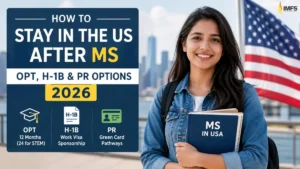
- Optional Practical Training (OPT): up to 12 months of authorized work tied to your field of study, available to eligible F-1 graduates.
- STEM OPT extension: an additional 24 months (36 months total) for graduates of qualifying STEM-designated programs.
- On-campus work: up to 20 hours/week while classes are in session, subject to F-1 rules — this should never be treated as a primary funding source.
Two 2026 policy updates worth tracking before you apply: the U.S. Department of State's expanded online-presence review for F, M, and J visa applicants, and a new $250 Visa Integrity Fee introduced under the One Big Beautiful Bill Act (signed July 2025), which was still pending formal collection as of mid-2026. Fees and screening rules change — always verify the current figure on the official Department of State fee schedule before you pay anything.
💡 Your next question is probably: "What GRE or IELTS score do I actually need for a US Master's?"
Score requirements vary by university and program, but IMFS's own admissions dataset shows Indian applicants who were eventually admitted scored well above the general benchmark on both exams — see the exact gap by exam.
Full breakdown: GRE Score Target for MS in USA — IMFS Insights
Which Student Profile Suits the USA — and Which Doesn't?
Which Student Profile Suits the USA — and Which Should Look Elsewhere?
Your right answer depends on your specific academic profile, budget, and risk tolerance — not on rankings or popularity alone.
Choose the USA if you are:
- ✅ Targeting a highly specialized program, research track, or interdisciplinary major
- ✅ Aiming for roles in tech, finance, consulting, or research where US employer networks dominate
- ✅ Able to fund the degree through family savings, scholarships, or an education loan — not part-time work
- ✅ Comfortable with a multi-year, non-guaranteed path from OPT to H-1B to PR
- ❌ Not the right fit if: your primary goal is the lowest possible total cost, or a fast, predictable route to permanent residency
Consider other destinations if you are:
- ✅ Working with a tighter budget and need lower tuition plus part-time earning potential to help cover costs
- ✅ Prioritizing a clear, time-bound PR pathway over brand prestige
- ✅ Looking for a 1-year Master's to minimize total time and cost out of India
- ✅ Risk-averse about visa policy shifts and prefer more settled immigration frameworks
- ❌ Not the right fit if: you specifically need access to US-only research labs, faculty, or recruiter pipelines
If your primary constraint is cost — run the full picture (tuition, living, insurance, visa fees, and part-time earnings offset) before comparing the USA against other countries, since sticker-price tuition alone is misleading. Use the calculator below to convert everything into ₹.
If your goal is permanent residency — treat US PR as a separate, later decision rather than an assumption baked into your study plan. F-1 → OPT → H-1B → employment-based green card is a real pathway for some graduates, but each stage has its own eligibility bar, and Indian nationals in particular face long employment-based backlogs at the PR stage. If a predictable PR timeline matters more to you than brand prestige, weigh that honestly against countries with more defined post-study residency routes.
If visa certainty and job market stability matter most to you — it's worth knowing that Indian student mobility patterns have shifted meaningfully since 2020. IMFS's own dataset shows GRE test usage among Indian applicants falling sharply post-COVID while IELTS usage rose, alongside broader destination shifts across the applicant pool.
See the full pattern: How COVID Changed Indian Student Mobility — IMFS Insights
Undergraduate vs Graduate vs Doctoral Study in the USA
Program structure varies meaningfully by level. A Bachelor's typically runs about four years with room to explore before declaring a major; a Master's usually runs one to two years and is far more specialisation-driven; a PhD is multi-year and research-first. If you're still deciding which level fits your stage of education, IMFS's step-by-step guide walks through eligibility and timelines for each.
💡 Your next question is probably: "Okay, I'm sold on the USA — what's the actual application process from India?"
The process runs through eight broad stages, from defining your academic goal to completing the F-1 visa interview, typically over a 12–18 month planning window.
Full step-by-step process: How to Study in the USA from India: Complete Guide
Student Life and Campus Culture
Beyond academics, US campuses run on a dense layer of clubs, research groups, cultural associations, and career-services infrastructure that international students can plug into from week one. For many Indian students, this is also the first extended stretch of independent living — budgeting, cooking, and managing logistics without family support nearby — which is its own adjustment worth planning for alongside the academic one.
Is the USA Worth It for You?
There's no universal answer — only a profile-specific one. Run your numbers through the cost and ROI calculators above, check where your test scores land against real admitted-student data, and be honest about whether you're optimising for prestige, cost, speed, or long-term residency. Whichever destination you land on, the decision should follow from your own constraints, not from how popular a country happens to be this year.
Frequently Asked Questions
How much does the new Visa Integrity Fee for US student visas cost?
A $250 Visa Integrity Fee was signed into law in July 2025 under the One Big Beautiful Bill Act, and was still pending formal collection as of mid-2026. Because implementation details can change, always confirm the current fee on the official U.S. Department of State site before paying.
What GRE or IELTS score should I target for a US Master's?
Requirements vary by university and program, so there's no single target score. IMFS's own admissions dataset shows a measurable gap between the general benchmark and the scores of students who were eventually admitted.
For a complete breakdown: GRE Score Target for MS in USA — IMFS Insights
What's the actual step-by-step process to apply to a US university from India?
Broadly: define your academic goal, shortlist universities, check program-specific requirements, prepare tests and documents, submit applications, evaluate offers, receive your Form I-20, and complete the F-1 visa process.
For a complete breakdown: How to Study in the USA from India: Complete Guide
Does studying in the USA guarantee a path to permanent residency?
No. F-1 status, OPT, STEM OPT, H-1B, and permanent residence are five separate approval stages, each with its own eligibility requirements. Indian nationals also face significant employment-based green card backlogs, so PR should be evaluated as a separate, longer-term question rather than assumed.
Is the USA more expensive than other study destinations?
Often, yes — but the honest comparison has to include tuition, living costs, insurance, visa fees, and realistic part-time earnings offset, converted into a single currency. Run your specific target university and city through a calculator rather than relying on a country-wide average.
Try it here: Study Abroad Cost Calculator
💡 Your next question is probably: "What does it actually cost to study in the USA, city by city?"
Tuition is only one line item — accommodation, insurance, food, and travel typically add 40–60% on top of tuition depending on the city and university type.
Full cost breakdown: Cost of Studying in the USA: Tuition, Living, and More
Not sure the USA is your right fit yet?
Talk it through with a counsellor who works exclusively on USA admissions — bring your scores, budget, and target field, and leave with a realistic shortlist.
Book a Free Counselling SessionFind your nearest centre on the IMFS branch page, or book an online session from anywhere in India.
Sources: Open Doors 2024/25 international student data (via IMFS USA admissions research); U.S. Department of State visa fee schedule; USCIS OPT/STEM OPT guidance. IMFS Insights figures — IMFS Admissions Intelligence Dataset (v2026.1). IMFS, June 2026. Available at: https://www.imfs.co.in/insights/. Reviewed for accuracy: September 2026.