🇩🇪 Germany Master's · New Requirement · 2026
dMAT Exam Preparation Guide 2026 — Complete Syllabus, Question Types and Study Plan
Written by Sameer Jadhav, Content Strategist and International Education Research Specialist | Reviewed by Nitin Lathe, Head of Test Preparation Faculty | Updated: 29 September 2026
The dMAT has two parts: the Core Module (Figure Sequences, Mathematical Equations, Latin Squares — same for all) and the General Academic Module (also same for all applicants, regardless of field). This guide explains exactly what each question type looks like, how the General Academic Module works, and how IMFS's 6-weeks structured coaching programme prepares you before the next exam date.
🇩🇪 Not sure if dMAT applies to your degree?
Use the free IMFS dMAT Eligibility Checker — answer 6 questions in under 60 seconds. Based on APS India guidance (June 2026). No login required.
Check My dMAT Eligibility →→ dMAT Exam Germany 2026: · Pattern, Difficulty & Honest analysis of the first dMAT exam
📋 Key Takeaways — Read This First
- dMAT has two modules — Core Module + General Academic Module. Both are mandatory for ALL applicants regardless of bachelor's degree or field of study.
- Core Module has 3 question types — Figure Sequences, Mathematical Equations, and Latin Squares. All single-choice. Same for everyone.
- General Academic Module is NOT field-specific — ALL applicants get the SAME questions. It tests ability to apply cognitive skills to academic problem-solving. Topics span mathematics, natural sciences, engineering, business, social sciences, and humanities. You read a text, then answer questions about it — no memorised factual knowledge required.
- Official preparation materials (Core Module + General Academic Module): Download from d-mat.de → Note: samples don't represent full difficulty or range of actual test questions.
- Figure Sequences test pattern recognition in abstract visual series — identify the rule, predict both the 5th and 6th matrix
- Latin Squares are always 5×5 grids (letters A–E) — elimination is the primary solving strategy
- Mathematical Equations are simultaneous systems — logic deduction, NOT BODMAS or ratio questions
- Total duration: ~3 hours of exam time + a 30-minute break between the two modules
- No notes allowed during any part of the exam. Always attempt every question — no penalty for wrong answers
- IMFS coaching: 3 August – 3 September 2026 — Morning, Evening, and Weekend batches at all 10 branches. 5 Full-Length Tests included.
- First test: 26 September 2026 (registration closes 15 Sep). Next test: Q1 2027 — date TBC at d-mat.de
- dMAT is not pass/fail — APS India will not reject your application for a low score. Universities set their own cut scores.
What is the dMAT Syllabus?
The dMAT consists of two modules. The Core Module covers: Figure Sequences (abstract pattern recognition), Mathematical Equations (algebraic and numerical reasoning), and Latin Squares (logic grid completion). The General Academic Module is the same for ALL applicants — it covers a broad range of areas (mathematics, sciences, engineering, business, social sciences, humanities) using a text + questions format that tests application skills, not memorised knowledge. Always guess if unsure — there is no penalty for wrong answers. Source: d-mat.de and official prep PDF July 2026
Who Needs to Prepare for dMAT?
Before investing in preparation, confirm that dMAT applies to you. All five conditions must be true:
- You are applying for a Master's programme (not Bachelor's or PhD)
- Your target intake is Summer Semester 2027 or later
- You started APS registration on or after 29 June 2026
- You are not part of an official exchange or double-degree programme
- Your degree is in: Engineering (including CS and IT Engineering) · Commerce / Accounting / Finance / Economics · Business / Management
Quick Decision — Do You Need dMAT?
| Your Situation | dMAT Required? |
|---|---|
| Final-year Engineering (B.Tech / BE) — applying Summer 2027+ | ✅ Start preparation now |
| B.Com / BBA / BMS — applying Summer 2027+ | ✅ Start preparation now |
| Winter Semester 2026/27 applicant | ❌ Not required — exempt |
| APS certificate already submitted before 29 June 2026 | ❌ Usually exempt — verify at aps-india.de |
| Humanities / Arts / Pure Sciences (degree not in scope) | ⚪ Usually not applicable — confirm your degree wording |
| Bachelor's or PhD applicant | ❌ Exempt |
| Official exchange or double-degree programme | ❌ Exempt |
How dMAT Fits With Other Tests
| Test | Purpose | Mandatory for Germany MS? |
|---|---|---|
| APS Certificate | Document verification — confirms your Indian degree and transcripts are genuine | ✅ Yes — all Indian applicants |
| dMAT | Aptitude assessment — tests cognitive and academic application ability | ✅ Yes — if degree in scope, Summer 2027+ |
| GRE | Graduate admissions test — some German universities recommend for CS/Data Science | ⚪ University-specific |
| IELTS / TOEFL | English language proficiency | ✅ Usually yes — for English-taught programs |
| TestDaF / DSH | German language proficiency | ✅ If program is in German |
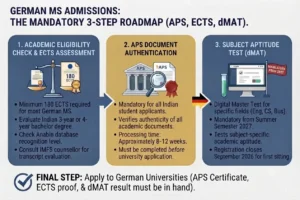
📌 Key point: APS and dMAT are completely separate processes — submitting your APS file does not register you for dMAT. Check for the next dMAT exam update at d-mat.de. New exam dates: Q1 2027
⚠️ Interdisciplinary degrees: The official wording on your degree certificate is decisive. Verify at aps-india.de/dmat before registering.
→ dMAT requirement explained in full · APS + ECTS + dMAT — Complete Germany MS Guide
Who Develops and Administers the dMAT?
The dMAT was developed by g.a.s.t. (Gesellschaft für Akademische Studienvorbereitung und Testentwicklung). The format was developed in cooperation with the University of Ulm and the University of Kassel. The development is supported by DAAD (Deutscher Akademischer Austauschdienst), Germany's national agency for international academic exchange.
The test is computer-based, administered in English, and centrally evaluated at the TestDaF Institute in Bochum. Administration in India is linked to APS India (for eligibility scoping) and g.a.s.t. directly (for registration and scoring at d-mat.de).
📌 Long-term signal: The DAAD and German university partnerships signal this is not an experimental requirement — it is expected to be fully embedded for all future intakes. The score is valid indefinitely, so taking it early is strategically sound.
The dMAT Core Module — Three Question Types Explained
The Core Module is the same for all applicants regardless of field. It tests general cognitive ability — how you reason and identify patterns, not what you know. Here is exactly what each type involves, with worked examples.
Figure Sequences
What it is: A series of abstract visual matrices that follow a rule. You are given 4 matrices and must determine what the next two matrices look like — selecting both the 5th and 6th matrix from given options.
Confirmed rules from the official dMAT PDF:
- Figures can change colour, rotate around their own axis, or move (vertically, horizontally, or diagonally)
- The x+1 step rule: a figure that moves 1 step from matrix 1→2 moves 2 steps from matrix 2→3, then 3 steps, and so on
- Figures cannot disappear or overlap each other
- Figures cannot leave the matrix — they either bounce off the boundary or move along the outer boundary
- Multiple rules can operate simultaneously on different figures
- ⏱ 20 series in 25 minutes — approximately 75 seconds per question
How to approach it:
- Track each figure independently across all 4 given matrices
- Identify the movement rule for each figure before predicting next positions
- Apply the x+1 step rule — check if step count is increasing between matrices
- Check boundary behaviour — does the figure bounce or wrap along the edge?
- Select both the 5th and 6th matrix answers separately
🔷 x+1 Colour Change Rule — each matrix the figure changes colour:
In a real dMAT question, both movement AND colour rules apply at the same time. The square moves 1 step (Matrix 1→2), 2 steps (2→3), 3 steps (3→4), and also changes colour each matrix. You must identify both rules to predict the 5th and 6th matrix correctly.
Mathematical Equations
What it is: Simultaneous systems of equations with multiple letter variables (A, B, C, D…), each an integer between 1 and 20. You must find values satisfying all equations simultaneously. This is logic deduction — not standard algebra, not BODMAS, not ratios.
⚠️ Critical: Students expecting BODMAS, ratio or proportion, or substitution problems will be unprepared. The format is entirely different from standard Indian exam maths.
How to approach it:
- Read all equations before solving any
- Solve the simplest equation first to anchor one variable
- Substitute into remaining equations
- Verify your final values satisfy every equation
Worked examples — three difficulty levels:
B – 3 = A
A + C = 8
2 × A + 2 × C = B
10 × B = C
5 × B = A
11 + B = D
⏱ 20 questions in 25 minutes — approximately 75 seconds per question.
Latin Squares
What it is: Always a 5×5 grid using exactly five letters: A, B, C, D, E. Each letter appears exactly once in every row and exactly once in every column. You are given a partially completed grid and must identify the missing element(s). Named after Leonhard Euler's 18th-century mathematical concept.
The solving strategy — Elimination:
- Look at the row containing the empty cell — list all symbols already present
- Look at the column containing the empty cell — list all symbols already present
- The missing symbol is the one not yet in either the row or column
- Start with the row or column that has the most entries
Key fact: The dMAT always uses a 5×5 grid with exactly five letters: A, B, C, D, E. Prepare with 5×5 grids only.
Example — 5×5 Latin Square:
Row 3 (C,D,?,A,B): Missing = E. Row 5 (E,?,B,C,D): Missing = A. Verify column 3: C,D,E,A,B ✓
⏱ 20 questions in 25 minutes — 75 seconds per question.
dMAT Time Breakdown
| Section | Questions | Time | Time per Question |
|---|---|---|---|
| Figure Sequences | 20 | 25 minutes | ~75 seconds |
| Mathematical Equations | 20 | 25 minutes | ~75 seconds |
| Latin Squares | 20 | 25 minutes | ~75 seconds |
| Core Module Total | 60 | ~75 min | — |
| Break | — | 30 minutes | — |
| General Academic Module | Varies | 90 minutes | — |
| Total Exam Time | — | ~3 hours | — |
💡 75 seconds per question is tight. Students who pause too long on any one question consistently run out of time. IMFS FLT sessions are timed to the second to train pacing — not just accuracy.
The General Academic Module — What It Actually Tests
✅ Updated from official d-mat.de PDF (July 2026): The General Academic Module for the APS process is the same for ALL applicants, regardless of bachelor's degree or field of study. It is NOT split by discipline. All test takers receive the same questions.
The General Academic Module tests your ability to apply cognitive and analytical skills to academic problem-solving. The format is consistent throughout:
- You receive a text describing a concept, problem, or phenomenon
- You answer a set of single-choice questions based on that text
- You apply what you read — no memorised factual knowledge is required
- Transfer and application skills matter — not rote knowledge
📚 Topics Covered in the General Academic Module
The possible topics span a wide range — the actual exam may include questions from any of these areas in any combination:
Vector calculations, scalar products, linear algebra, applied mathematics
Data structures, algorithms, computational reasoning, programming concepts
Physics, hydrostatics, fluid mechanics, chemistry fundamentals
Applied engineering problems, mechanics, systems thinking
Inventory management (e.g., optimal order quantity), operations, cost models
Economic models, quantitative analysis, decision frameworks
Research methodologies, qualitative vs quantitative approaches, study design
Analytical reading, text interpretation, structured reasoning
Sample exercises from official d-mat.de PDF (July 2026):
Ex 1 — Vector Calculations: scalar products, vector products, triple products
Ex 2 — Hydrostatics: water pressure, buoyancy, fluid mechanics
Ex 3 — Optimal Order Quantity: inventory management formula, cost minimisation
Ex 4 — Research Strategies in Social Sciences: qualitative vs quantitative methods
📄 Official preparation materials (Core Module + General Academic Module):
Download from d-mat.de — dMAT General Academic Module Preparatory Materials (PDF, July 2026) →
Contains: Core Module instructions + 6 exercises per type; General Academic Module instructions + 4 full sample exercises with solutions. Reading this PDF before starting preparation is mandatory.
📌 IMFS coaching covers both modules. The General Academic Module sample exercises in the official PDF (vector calculations, hydrostatics, inventory management, social science research methods) show the breadth of topics students may encounter. IMFS builds analytical reading and application skills across all topic areas — not just subject-specific content. The actual exam can cover any academic domain.
Exam Day Rules — Two Rules Every Student Must Know
🚫 No notes allowed during any part of the exam. This applies to both the Core Module and the General Academic Module. You cannot bring scratch paper, formula sheets, or any written material. Practice working without writing — especially for high-difficulty equation systems.
✅ Always guess if unsure — there is no penalty for wrong answers. The dMAT does not deduct marks for incorrect answers. Every unanswered question is a guaranteed zero. An educated guess gives you a chance of earning points. Never leave a question blank.
IMFS dMAT Coaching — October 2026 Batch Details
IMFS is India's first institute to offer structured dMAT preparation covering both modules. Our 6-weeks programme is designed around the complete exam prep required for dMAT.
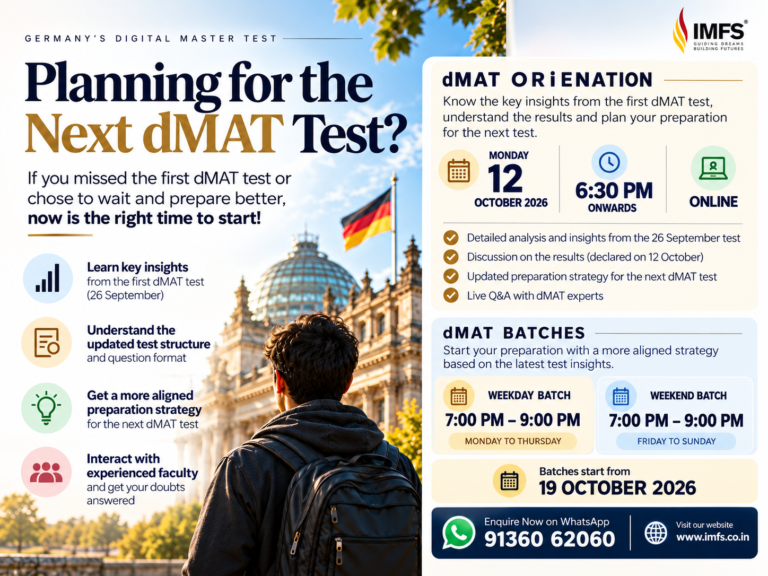
Register for the upcoming dMAT orientation and batches here
What Does Your dMAT Score Actually Mean?
The dMAT reports results on a normalised scale of 0–200 with a mean of 100, plus a percentile rank. The 0–200 scale rewards both accuracy and speed. Students who complete all questions accurately score higher than students who answer 15 questions perfectly and leave 5 blank.
💡 How to think about targets: Treat 100 as a floor, not a target. Individual German universities will publish their own cut scores or score expectations as the exam matures — check your target university's admissions page after results release on 12 October 2026.
| Score Range | What It Suggests | Strategic Implication |
|---|---|---|
| Below 100 | Below norm group mean | Unlikely to strengthen application at competitive universities |
| 100–130 | Mean to moderate above | Satisfies APS requirement; may not differentiate at top programs |
| 130–160 | Strong performance | Competitive at most German MS programs |
| 160+ | Very strong | Differentiating signal at selective programs |
Score guidance is indicative. University-specific cut scores will be published after October 2026 results. Verify at your target university's admissions page.
Which German universities are currently using the dMAT score? As of August 2026, two universities have confirmed they use the dMAT score in admissions: RWTH Aachen (Battery Engineering MS) and Georg-August University Göttingen (Data Science MS). No other German university has published a minimum dMAT cut score yet — the first India cohort results release on 12 October 2026. Check your target university's official admissions page after that date. Source: aps-india.de/dmat
dMAT 2026 — Registration, Test Centres, and Key Dates
Missed the September 2026 test?
The next dMAT test is planned for Q1 2027. The exact date has not yet been confirmed. Visit d-mat.de regularly for updates. Students applying for Summer Semester 2027 should prioritise the September 2026 test — if you miss it, confirm Q1 2027 dates as soon as they are announced.
| Item | First Test (Sep 2026) | Next Test |
|---|---|---|
| Registration deadline | ⚠️ 15 September 2026 | TBC — check d-mat.de |
| Test date | 26 September 2026 | Q1 2027 (planned) |
| Results available | 12 October 2026 | TBC |
| Exam fee | €150 (~₹16,200 at July 2026 rates — verify current rate at xe.com before paying) — paid to g.a.s.t. at d-mat.de | |
| Test format | Computer-based · English · Single-choice throughout | |
| Score | 0–200 scale (mean 100) + percentile rank · Valid indefinitely | |
| Test centres (India) | Ahmedabad · Bengaluru · Bhopal · Chandigarh · Chennai · Kolkata · Mananthavady · Mumbai · New Delhi · Pune | |
| Administered by | g.a.s.t. (not APS India) · Contact: [email protected] | |
| Official prep PDF | Download from d-mat.de → | |
All dates sourced from aps-india.de/dmat and d-mat.de. Verify before registering.
dMAT vs GRE vs GMAT vs TestAS — Key Differences
Students already preparing for GRE or GMAT often ask whether that preparation transfers to dMAT. The answer is: partially, but not directly. Here is how the tests compare.
| dMAT | GRE | GMAT | TestAS | |
|---|---|---|---|---|
| Purpose | Part of APS India process for Germany MS | Graduate admissions — USA, some Germany programs | MBA admissions globally | Optional aptitude test for German universities |
| Duration | ~3.5 hours | ~1.5 hours (Focus Edition) | 2.25 hours (Focus Edition) | ~3 hours |
| Score scale | 0–200, mean 100, valid indefinitely | 260–340 combined, valid 5 years | 205–805, valid 5 years | Separate subscores per subject |
| Negative marking | ❌ None — always attempt every question | ❌ None | ❌ None | ❌ None |
| Question format | Single-choice throughout | Single-choice + multiple-select + numeric entry | Single-choice + multi-source | Single-choice |
| Vocabulary tested | ❌ No | ✅ Yes — Verbal is heavily vocabulary-based | ✅ Yes | ❌ No |
| Maths level | Class 10–12 algebra only | Up to Class 12 — statistics, geometry, algebra | Similar to GRE Quant | Higher — subject-specific |
| Does GRE/GMAT prep help? | Partially. GRE Quant builds underlying numerical reasoning that overlaps with dMAT Mathematical Equations. Logical reasoning practice overlaps with Figure Sequences and Latin Squares. However, dMAT question formats — simultaneous equations, 5×5 Latin grids, x+1 pattern rules — are entirely different from GRE/GMAT formats. Students need dMAT-specific format practice regardless of GRE/GMAT preparation level. IMFS dMAT coaching is built on the same analytical reasoning framework as IMFS GRE Quant coaching — adapted specifically to dMAT formats and timing. | |||
IMFS advantage: IMFS has coached 45,000+ students for GRE, GMAT, and SAT since 1997. The reasoning skills at the core of the dMAT — analytical patterns, mathematical logic, structured problem-solving — are the same skills our faculty train for GRE Quantitative and SAT Math. The dMAT coaching curriculum applies that existing expertise to India's newest Germany requirement, with question-type drills built specifically around the three Core Module formats and the General Academic Module.
Reserve Your IMFS dMAT Coaching Seat
Batch starts 19 October 2026. Both Core Module and General Academic Module covered. 5 Full-Length Tests included. All 10 IMFS branches — Morning, Evening, and Weekend timings.
dMAT 2026 — All Your Questions Answered
What is the dMAT Core Module syllabus?
The dMAT Core Module has three topics: Figure Sequences (abstract pattern recognition), Mathematical Equations (algebraic and numerical reasoning), and Latin Squares (logic grid completion). All single-choice. No negative marking — always attempt every question. Source: d-mat.de
What is the General Academic Module — and is it the same for everyone?
Yes — the General Academic Module is the same for ALL applicants, regardless of their bachelor's degree or field of study. It tests the ability to apply cognitive and analytical skills to academic problem-solving. The format: you receive a text about a concept, then answer single-choice questions. Topics span mathematics, computational sciences, natural sciences, engineering, business administration, economics, social sciences, and humanities. You do NOT need memorised factual knowledge — you apply what the text gives you. Official prep materials: download from d-mat.de → Source: g.a.s.t. official PDF, July 2026.
What are Figure Sequences in the dMAT?
Figure Sequences present a series of abstract visual figures following a pattern. Your task: identify the rule and select both the 5th and 6th matrix. Common rules: rotation, reflection, addition/removal of elements, shading, size changes, and the x+1 step rule (step count increases each matrix). Figures cannot leave the matrix — they bounce off or wrap along the boundary. ⏱ 20 questions in 25 minutes.
What are Latin Squares in the dMAT?
Latin Squares in the dMAT are always 5×5 grids using exactly five letters: A, B, C, D, E. Each letter appears exactly once in every row and once in every column. The solving strategy is elimination: list letters already in the target row, list letters already in the target column, the missing letter is absent from both. Practice with 5×5 grids only.
What are Mathematical Equations in the dMAT?
Simultaneous systems of equations with multiple letter variables, each an integer between 1 and 20. This is fundamentally different from BODMAS or ratio problems. Example: A – B + C – D = 2 / 10 × B = C / 5 × B = A / 11 + B = D → A=5, B=1, C=10, D=12. IMFS coaching covers three difficulty levels with worked examples.
Where can I find official dMAT preparation materials?
The official preparation materials PDF (covering Core Module + General Academic Module) is available at: d-mat.de — Preparatory Materials PDF (July 2026) →. Contains 6 exercises per Core Module question type (2 each at low/medium/high difficulty) and 4 General Academic Module exercises with full solutions. Note: sample questions do not necessarily reflect the difficulty level of the actual test.
What is the dMAT registration deadline, exam date, and next test?
First test: Registration closes 15 September 2026. Test date: 26 September 2026. Results: 12 October 2026. Fee: €150 (~₹16,200) at d-mat.de.
Next test: Planned for Q1 2027 — exact date TBC. Check d-mat.de regularly for confirmation. Source: aps-india.de/dmat, d-mat.de
How long should I prepare for dMAT?
IMFS recommends a minimum 4 weeks of structured preparation covering both modules — exactly the August coaching batch duration (3 August – 3 September 2026). The next test after September 2026 is Q1 2027 — if you miss the first test, start preparation early for Q1 2027.
Is dMAT a pass/fail test?
No. APS India explicitly states the dMAT is not a stand-alone pass-or-fail test. A low score does not automatically cause APS refusal. Individual German universities set their own cut scores. Source: aps-india.de
Where are the dMAT test centres in India?
Test centres in the introductory phase: Ahmedabad, Bengaluru, Bhopal, Chandigarh, Chennai, Kolkata, Mananthavady, Mumbai, New Delhi, Pune. Popular centres fill quickly — do not wait until the next deadline. Source: aps-india.de/dmat
Where can I get dMAT coaching in India?
IMFS offers structured dMAT coaching from 19 October 2026 at all 10 active branches across Mumbai, Pune, Hyderabad, Nellore, and Warangal. Two batch timings: Evening (Mon–Thu 7–9 PM), Weekend (Fri–Sun 7–9 PM). The 6-week programme covers both Core Module and General Academic Module, including 5 Full-Length Tests. To get detailed information,test insights and curriculum structure, join our dMAT orientation on 12th October. Reserve your seat at imfs.co.in/germany-dmat-2026 or WhatsApp us.
About This Guide
Written by Sameer Jadhav, Content Strategist and International Education Research Specialist, IMFS. Updated July 30, 2026 to reflect official g.a.s.t. General Academic Module PDF (July 2026) and confirmed Q1 2027 next test date.
Reviewed by Nitin Lathe, Head of Test Preparation Faculty, IMFS. Nitin has 26 years of teaching experience and has trained over 45,000 students. He is the principal architect of IMFS's dMAT coaching curriculum.
Sources: d-mat.de · aps-india.de/dmat · Official prep PDF (July 2026). Last reviewed: July 30, 2026. Next review: October 2026 (post-results).
Explore More — dMAT and Germany MS