
Choosing where to study abroad is a big decision—one that will affect not just your education but your career, finances, and where you might live for the next five to ten years. The landscape is shifting faster than ever, and honestly, it can feel overwhelming. Some countries are throwing open their doors, while others are tightening their grip. Traditional favorites are getting more expensive, while lesser-known options are quietly offering exceptional value.
This guide is different. We’re not selling you a dream. We’re showing you real data from actual government sources, comparing what you’ll actually spend, what job opportunities you’ll have, and what your real chances are of staying long-term. Because the truth is, today’s global education is about one thing: what are you paying, and what are you genuinely getting in return?
The Big 4: Should You Go Traditional? Here’s What’s Actually Happening
The United States, the United Kingdom, Canada, and Australia are still the biggest names in international education. But things are changing in ways that might surprise you.
United States: The World’s Universities, But Playing It Safe Getting Harder
Why students go: The US is still king for research and innovation. If you want to push yourself intellectually in STEM fields, this is where the world’s best research happens.
The real numbers: In 2024, there were 1,582,808 students on F-1 and M-1 visas, up 5.3 per cent from 2023, with the majority coming from India (422,335) and China (329,541). That’s a lot of students, but growth has actually slowed.
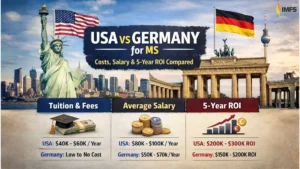
What you’ll pay: Tuition runs USD 25,000 to USD 65,000+ per year. Add living expenses (USD 10,000-USD 15,000), and a 2-year Master’s will cost you USD 90,000-USD 160,000+. That’s not money to spend lightly.
Work after graduation: Here’s where it gets interesting. In 2024, 194,554 students were able to work through Optional Practical Training (OPT), up 21 per cent on the year before, with a further 95,384 getting work training through STEM OPT. If you’re doing STEM, you can actually get up to 36 months of work authorisation (12 months base + 24-month STEM extension). That’s real time to build your career.
Real talk about PR: The H-1B visa lottery is the bottleneck. You need an employer willing to sponsor you, and even then, you’re competing with thousands of others. It’s not impossible, but it’s not a guarantee either.
Official sources: SEVIS by the Numbers Report, US State Department Visa Statistics
United Kingdom: Quality Degree, But Watch the Changing Rules
Why students go: One-year Master’s degrees. You can finish your degree, start earning, and build experience while someone else takes four years to get started elsewhere. Plus, the universities are genuinely world-class.
The real situation: There were 393,000 sponsored study visas granted to foreign students in 2024, 14% fewer than in 2023. This is a significant drop. Why? Rules keep changing, and students are getting uncertain about whether staying after graduation is really worth it.
What you’ll pay: Tuition is £12,000 to £25,000 per year. Living expenses (especially outside London) run £10,000-£15,000. For a 1-year Master’s, you’re looking at £22,000-£40,000 total. That’s actually cheaper than Canada or the US when you factor in the time saved.
Work after graduation—here’s the critical part: The number of graduates staying on as part of the Graduate route has increased over time to almost 250,000 in 2024, 72% of which were for main applicants. Right now, you get 2 years (3 years if you’re doing a PhD). But here’s what you need to know: The government is reviewing this. In last month’s long-awaited White Paper, the Labour government announced that graduate visas will be reduced from two years to 18 months.
Should you be scared? Not necessarily. That’s still time to find work. But it means you need to be strategic and start job hunting immediately after graduation, not afterwards.
Real talk about PR: After your Graduate Route ends, you’d need to secure a Skilled Worker Visa (which requires employer sponsorship), and that leads to settlement after five years total work authorisation. It’s possible, but requires planning.
Official sources: UK Home Office Immigration Statistics, Migration Advisory Committee Graduate Route Review
Canada: The Surprising Reality of Opportunity (But Timing Matters)
Why it was attractive: Canada built a reputation as the friendliest destination for international students wanting to stay. Clear PR pathways, generous work visas. It sounded perfect.
What’s actually happening now: The total number of new study permits issued in 2024 was 267,890 – a roughly 48% reduction from 2023 levels and nearly 100,000 study permits below the official IRCC target. That’s a massive drop.
Why? The Canadian government wanted to ease housing shortages and the strain on services, so they capped international students. For 2025, IRCC plans to issue a total of 437,000 study permits, which represents a 10% decrease from the 2024 cap. This is a big deal—if you’re serious about Canada, you need to apply early and have strong applications.
What you’ll pay: Tuition is CAD 15,000 to CAD 35,000 for a Master’s, with living costs of CAD 10,000 to CAD 15,000. Total for 2 years: CAD 50,000-CAD 70,000 (~USD 37,000-USD 52,000). That’s actually cheaper than the UK or the US.
Work after graduation—the real advantage: The Post-Graduation Work Permit (PGWP) grants a visa of up to 3 years, which is a critical step toward residency. Here’s why this matters: Every month you work in Canada counts toward your PR application through Express Entry or Provincial Nominee Programs (PNPs). With 3 years, you have real time to build up points.
Real talk about PR: Canada is genuinely the most transparent destination for PR. You can calculate your points, see your chances, and plan accordingly. It’s not easy, but it’s fair.
The catch: Approval rates have gotten much stricter. Approval rates for new study permit applications have fallen to 30% through June 2025, compared to 51% for the same period in 2024. You need a strong financial profile, a clear purpose for studying, and proof that you can actually succeed.
Official sources: Immigration, Refugees and Citizenship Canada (IRCC), IRCC Study Permit Statistics
Australia: Lifestyle, But Expect Fewer Visas
Why it appeals: Beautiful country, excellent universities, generous work visas post-graduation. What’s not to love?
The real situation: Australia is getting stricter. The government is trying to manage population growth, and international students are part of that conversation.
What you’ll pay: Tuition is AUD 20,000 to AUD 45,000 annually, with living costs around AUD 13,700 per year. For a 2-year Master’s, expect AUD 67,400-AUD 103,000+. That’s comparable to the UK.
Work after graduation: The Temporary Graduate Visa ranges from 2 to 4 years, depending on your qualification and study location. But here’s the key: approval numbers are down. Visas issued fell significantly due to policy changes.
Real talk about PR: Clear pathways exist, but they often require regional study (studying outside major cities) or working in high-demand fields. If you’re not flexible, this gets trickier.
Official sources: Department of Home Affairs – Student Visa Program, Australian Department of Education – International Student Data
The European Game-Changer: Where Your Money Actually Goes Further
Here’s where things get interesting. Europe isn’t the traditional choice for Indian students, but it offers something the “Big 4” can’t: genuine affordability without sacrificing quality.
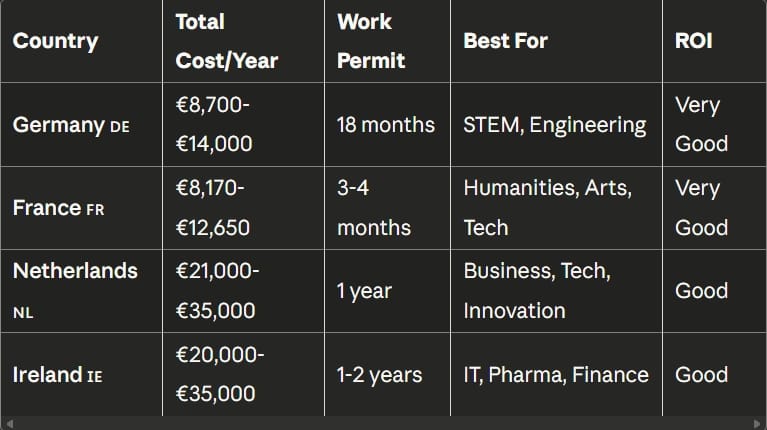
Key Takeaways
- Most Affordable: Germany and France offer the lowest total annual costs
- Best Post-Study Work Options: Germany (18 months) and Ireland (1-2 years)
- Highest Investment Required: Netherlands and Ireland, with similar cost ranges
- Top ROI: Germany stands out with exceptional value, especially for STEM fields
Germany: Why This Isn’t Getting More Attention (It Should Be)
Let me be honest—Germany is arguably the best-kept secret in international education right now.
The tuition situation: Most public universities in Germany charge no tuition. Seriously. You only pay a semester administrative fee of €150-€250. If you come from India and you’re not considering Germany, you’re potentially leaving massive savings on the table.
The numbers: India remains the largest source market for international students in Germany, with over 49,000 students in 2023/24, with China as the second largest at nearly 39,000. The market is growing, but it’s still not as crowded as the UK or the US.
Real math for a 2-year Master’s:
- Germany: €17,400-€28,000 total
- UK: £44,000-£80,000 (USD 56,000-USD 101,000)
- Canada: CAD 50,000-€70,000 (USD 37,000-USD 52,000)
- US: USD 90,000-USD 160,000+
Germany is 2-5x cheaper. Let that sink in.
Work after graduation: You get an 18-month Job Seeker Visa. Use that time to find a job. Once hired, you transition to the EU Blue Card—a fast-track to permanent residency. The system is designed to keep you if you’re valuable to the economy.
Scholarships available: The DAAD Scholarship Programme is substantial—it covers full tuition, monthly stipends of €992-€1,400, travel allowance, and health insurance. Honestly, if you don’t at least look into German scholarships, you’re doing yourself a disservice.
Real challenge: The language barrier. Most postgraduate programs are taught in English, but daily life requires German. That said, most Germans speak English, and learning German is an asset.
Official sources: DAAD – German Academic Exchange Service, Studying in Germany Official Portal, DAAD Statistics 2024-25
Complete Cost Reality Check: 2-Year Master’s Degrees (What You’ll Actually Spend)
Let’s be real about money. Here’s what a 2-year Master’s genuinely costs, start to finish:
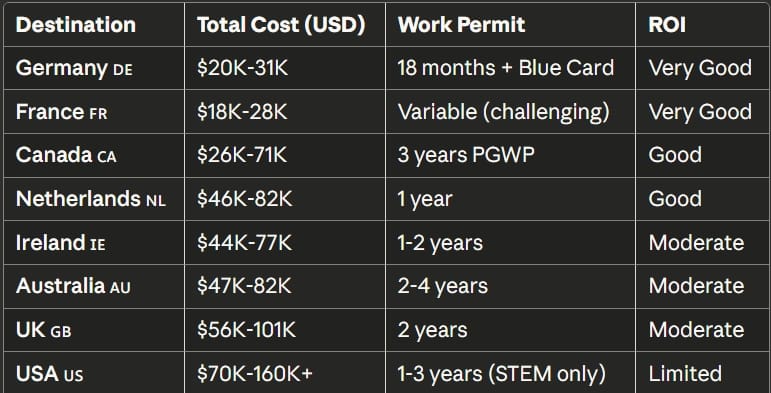
Key Insights
- Most Affordable: Germany and France offer the lowest total costs
- Best Work Opportunities: Canada (3 years) and Australia (2-4 years) provide the longest post-study work permits
- Highest Investment: The USA and the UK require the most significant financial commitment
- Best Value: Germany combines low costs with strong work permit options (18 months + Blue Card pathway)
Post-Study Work: How Much Time Do You Actually Have?
Your work visa after graduation is everything. It’s the difference between staying or leaving, between building a career or starting over at home.
The longest opportunities:
- Canada: 3 years (PGWP) – no job offer needed upfront
- Australia: 2-4 years (Temporary Graduate Visa) – depends on location and field
- Germany: 18 months (Job Seeker Visa) → then EU Blue Card
The shortest/most uncertain:
- USA: 12 months OPT for non-STEM (24 additional months for STEM), but requires H-1B sponsorship lottery
- UK: 2 years currently, but possibly 18 months after reforms
Why this matters: Longer work permits = more time to build experience, save money, and strengthen your PR application. A 3-year PGWP in Canada gives you 3x more time than a 1-year OPT in the US.
How to Actually Choose: A Framework That Works
1. What’s your real goal?
I want to stay long-term: Germany, Canada, or Australia. These have transparent PR pathways and enough work time to qualify.
I want prestige above all else: US or UK. Yes, it costs more, and the path is less clear, but the brand recognition is unmatched.
I want to save money without sacrificing quality: Germany or France. You’ll spend 1/3 to 1/4 of what you’d spend in the UK or US.
I want to balance cost, quality, and opportunity: Canada. It’s not the cheapest, but it offers genuine value and clear PR pathways.
2. Calculate YOUR real ROI
Don’t just look at tuition. Calculate:
- Total cost (tuition + living for entire program)
- Average starting salary in your field in that country
- Post-graduation work authorisation length
- PR probability in that country
- Your home country’s cost of living (currency matters)
3. When does timing matter?
- UK: Apply now if you’re interested. Visa policy is in flux. Wait too long, and the rules might change.
- Canada: Early application essential. Approval rates are low (30%), so get in before allocations fill up.
- US: F-1 policy changes starting October 2025. Know what you’re getting into before you apply.
- Germany: Scholarships open October-March. Plan accordingly.
4. Field of study matters (a lot)
- STEM fields: US OPT offers 36 months total, Germany’s tech job market is strong, and Canada has co-op programs
- Business/Finance: The UK, Australia, and Canada offer strong employer networks
- Arts/Humanities: France, Netherlands, Germany offer affordability + culture + career opportunities
12 FAQs That Actually Matter (Based on Real Search Trends)
Q1: What are the most affordable study destinations 2026-27 for international students?
A: Germany wins hands-down for affordability. Most public universities charge no tuition, only €150-€250 semester fees. Combined with living costs of €992/month, a 2-year Master’s totals €18,400-€28,000. France is similarly affordable (€170-€650/year tuition). Poland and Hungary are even cheaper but offer fewer English-taught postgraduate programs. The key: affordability doesn’t mean compromising quality. Germany and France have excellent universities.
Q2: Which countries offer the best post-study work visas for the 2026 intake?
A: Canada tops the list with a 3-year PGWP, no job offer required upfront. Australia offers 2-4 years, depending on the field and location. Germany’s 18-month Job Seeker Visa transitions directly to the EU Blue Card PR. The UK offers 2 years (possibly being reduced). The US offers 12-36 months, depending on the field. Longer isn’t always better if the PR path isn’t clear—but Canada and Australia make that part transparent.
Q3: Is the UK still a good choice despite the Graduate Route changes?
A: Yes, but strategically. There were 393,000 sponsored study visas granted to foreign students in 2024, 14% fewer than in 2023, showing reduced interest. The one-year Master’s is still unbeatable for speed. Tuition + living costs are lower than in the US. BUT: You must be strategic about job searching. The proposed 18-month work visa means you need a job offer faster. If you’re confident about UK employment, go for it. If uncertain, consider Canada or Germany.
Q4: Is it easier to get permanent residency in Canada or Australia?
A: Canada is more transparent. Express Entry uses a points-based system where you can literally calculate your chances before applying. Provincial Nominee Programs (PNPs) specifically favour international graduates. Australia is also clear but often requires regional study or specific high-demand fields. Winner for clarity: Canada. Winner for regional opportunities: Australia.
Q5: How much does it cost to study in Germany vs. Canada vs. the USA?
A: 2-year Master’s: Germany (€18,400-€28,000) vs. Canada (CAD 36,000-€100,000, ~USD 26K-71K) vs. USA (USD 70,000-€160,000+). Germany is 2-5x cheaper. However, factor in post-graduation earning potential—higher-paying jobs in the US/Canada might offset the higher initial cost. But if cost is your primary concern, Germany is unbeatable.
Q6: Which destination offers the best scholarships for international students?
A: Germany (DAAD covering full tuition + €992-€1,400/month stipend + travel), Netherlands (€5,000-€25,000 from universities), France (€10,000-€19,000), Canada (institution-based, varies by province), USA/UK (Chevening, Fulbright—extremely competitive). Accessibility: Germany and the Netherlands. Prestige: Fulbright/Chevening.
Q7: What are the current study permit approval rates for 2024-25?
A: Approval rates for new study permit applications have fallen to 30% through June 2025 (Canada), compared to 51% for the same period in 2024. The UK’s rejection rate is 3-5%. The USA is typically 80%+. Australia is 85-87%. Bottom line: Canada is now the hardest to get approved for. The UK is the easiest. The USA is the middle ground.
Q8: Can international students work during their studies and after graduation?
A: Yes, varies by country. During studies: US (on-campus only or CPT), UK (20 hrs/week during term), Canada (full-time off-campus), Germany (120 full days/240 half days per year), Australia (20 hrs/week during term). After graduation: All countries allow it, but duration varies (see Q2 for specifics).
Q9: What is the return on investment (ROI) for studying abroad in 2026-27?
A: ROI = (Average Starting Salary – Total Cost) / Total Cost. Germany offers the best ROI (1.5-2.0x) due to low cost + EU Blue Card PR pathway. Canada offers a strong ROI (1.2-1.8x) with a 3-year PGWP. The US offers a mixed ROI depending on the field and H-1B success. The UK offers a moderate ROI due to a shorter work window and visa uncertainty. Best for value: Germany. Best for security: Canada. Best for prestige ROI: USA/UK (but riskier).
Q10: Are there differences in visa processing times and requirements for 2024-2025?
A: Yes. USA: F-1 visa appointments are taking longer due to increased social media screening. Canada: 30-51% approval rates with delays due to the cap system. UK: 3-week processing for offshore, 8-week for onshore. Australia: Streamlined but strict assessments. Germany: Faster through DAAD and university channels. Fastest: Germany. Most challenging: Canada (due to low approval rates).
Q11: How do currency fluctuations affect study abroad costs in 2026-27?
A: Significantly. Strong EUR and GBP relative to INR increase European/UK costs. Weaker CAD and AUD can make Canada and Australia more affordable. USD is relatively stable. Monitor exchange rates 3-6 months before enrollment. Germany’s stable €992/month living cost provides predictability compared to volatile currency pairs. Action item: Check historical exchange rates and forecast trends before committing.
Q12: What are the specific F-1 visa changes for US study in 2025?
A: Starting October 1, 2025, F-1 students now receive a fixed four-year maximum admission period, inclusive of Optional Practical Training (down from “duration of status”). This requires tighter academic planning and earlier OPT preparation. Interview waivers also narrowed, starting September 2, 2025, meaning more students face in-person interviews (longer waits). Action item: Plan your entire US timeline, knowing you have a maximum of 4 years total, including work.
The Real Decision: What’s Right for YOU?
After all the numbers, here’s what actually matters:
Choose Germany if:
- You’re cost-conscious (seriously, the savings are enormous)
- You’re studying STEM or Engineering
- You want maximum clarity on PR (the EU Blue Card is straightforward)
- You’re willing to learn German
- You value work-life balance and don’t mind leaving if you don’t get PR
Choose Canada if:
- You want the clearest PR pathway
- You value transparency and fairness in the system
- You’re comfortable with 30% approval rates (strong application essential)
- You want to stay long-term and are willing to work hard for it
- You value Canadian culture and lifestyle
Choose UK if:
- You prioritise prestige above cost
- You want to finish quickly (1-year Master’s)
- You’re confident about securing UK employment immediately post-graduation
- You don’t need to bring family
- You can handle policy uncertainty
Choose the USA if:
- You’re pursuing STEM and are confident about H-1B sponsorship
- You’re willing to invest heavily upfront for brand reputation
- You want cutting-edge research opportunities
- You’re comfortable with the work visa lottery system
- You have strong employer connections or plan to develop them
Choose Australia if:
- You want a generous post-study work (2-4 years)
- You value lifestyle and are flexible on regional study
- You’re working in high-demand fields
- You want a multicultural experience
- You’re willing to navigate stricter policy changes
Choose Netherlands/France if:
- You want European experience at a reasonable cost
- You’re comfortable with shorter post-study work windows
- You value culture and quality of life
- You want to explore Europe while studying
- You’re not solely focused on long-term residency
The Bottom Line: You Have More Options Than You Think
The days when the “Big 4” were your only choices are over. Germany offers exceptional value without sacrificing quality. The Netherlands, France, and Ireland are underrated. Canada’s PR pathways are genuine (if increasingly competitive). The UK is still quality but increasingly uncertain.
Your choice should reflect three things:
- Your financial reality (How much can you actually spend?)
- Your career goal (Where do you want to work after graduation?)
- Your long-term intention (Do you want to stay or return home?)
Most importantly: Make a strategic decision, not an emotional one. Visit websites, talk to students already there, run the numbers yourself. Don’t just follow the crowd to the UK or the US because that’s what everyone does.
The world’s best education isn’t the most expensive one. It’s the one that gives you genuine opportunity and aligns with your goals.
Why Navigating This Alone Is Harder Than It Looks
Here’s the truth: You’ve read through 8 countries, 7 different visa systems, scholarship programs, approval rate changes, and policy shifts happening right now in 2025. Your head is probably spinning.
The reality is that choosing the wrong destination can cost you USD 50,000+ and three years of your life. Choosing correctly can open doors you didn’t even know existed.
But here’s the thing—you don’t have to figure this out alone.
This is where IMFS comes in.
How IMFS Helps You Navigate All These Options (And Choose the Right One)
IMFS has been guiding international students since 1997—that’s 28+ years of experience watching policy changes, visa systems evolve, and scholarships come and go. They’ve helped over 60,000 students successfully navigate exactly what you’re facing right now. Their 99.8% visa success rate isn’t luck. It’s expertise.
Here’s how they actually help:
1. They Match You to the RIGHT Destination (Not Just Any Destination)
Most consultants give you a list. IMFS does something different.
They take your specific profile—your scores, your field, your budget, your long-term goals, your family situation, your visa history—and match it to the destination that actually makes sense for YOU. Not for the person sitting next to you. For you.
Real example: You might think Canada is your best bet. But IMFS’s counsellors might realise that Germany’s DAAD scholarship actually covers your full costs + living expenses, and your STEM background qualifies you for their tech job market. Suddenly, you’re saving EUR 50,000 and have clearer PR pathways. That’s the difference between generic advice and expert guidance.
They analyse:
- Your actual ROI (not just tuition, but starting salaries, work permit duration, PR probability)
- Scholarship opportunities specific to your profile
- Field-specific job markets in each country
- Currency considerations based on your home country
- Your realistic chances of approval in each destination
Why this matters: A wrong choice means wasting money, time, and emotional energy. A right choice means maximum value and genuine career growth.
2. They Know the Policy Changes BEFORE They Become Headlines
When the UK announced the Graduate Route might be reduced to 18 months, when Canada capped study permits at -10%, when the US changed F-1 visa timelines—IMFS’s team was already adjusting their recommendations.
Their expert counsellors:
- Monitor immigration policy changes in real-time
- Understand what changes mean for YOUR application timeline
- Know which policy changes are permanent vs. temporary
- Advise you on when to apply to avoid policy traps
Real example: A student thinking about applying to Canada in 2025 needs to know that approval rates are now 30% (down from 51% in 2024). IMFS advises whether to apply now, wait, or pivot to Germany. That’s the difference between rejection and acceptance.
They’re not just reading news headlines—they’re interpreting what headlines mean for your specific situation.
3. They Master the Scholarship Game (So You Don’t Miss Money)
Most students leave scholarship money on the table. Not because they’re lazy—because they don’t know where to look or what they actually qualify for.
IMFS’s counsellors know:
- Hidden scholarships most students don’t find (institutional scholarships, foundation grants, country-specific programs)
- Your actual qualification level for competitive programs like Chevening, Fulbright, DAAD
- How to craft applications that win scholarships (strong SOPs, LORs, financial profiles)
- Timing windows for each scholarship (many open/close on specific dates)
The impact: Scholarships they help secure range from EUR 5,000 to covering full tuition + living + travel. That can literally be the difference between “I can’t afford this” and “This is affordable.”
Their track record: Students guided by IMFS have secured scholarships at rates significantly higher than average because their counsellors know exactly what each institution is looking for.
4. They Handle the Complex Financial & Visa Documentation
This is where many students struggle. You need:
- Proof of funds that satisfy visa officers in multiple countries (with different standards)
- Education loan applications (coordinating with banks)
- Tax clearance certificates, employment letters, family documentation
- Financial affidavits that actually hold weight
IMFS’s team:
- Structures financial documents so that visa officers have confidence in you
- Coordinates with education loan providers (they know which banks are easier to work with)
- Handles mock visa interviews so you’re genuinely prepared
- Ensures every document aligns with your chosen destination’s specific requirements
Why this matters: A visa rejection for “insufficient funds” or “unclear financial profile” doesn’t just cost you—it creates a black mark on your visa history. Future applications become harder.
Their 99.8% visa success rate exists because they get this part right.
5. They Create a Personalised “Study Abroad Roadmap” for YOU
Not a generic checklist. A real roadmap.
Based on your profile, they create a document that shows:
- Your ideal destinations (ranked by ROI and fit)
- Timeline for applications (when to apply to maximise approval chances)
- Scholarship opportunities you specifically qualify for
- Work permit durations and PR probabilities in each country
- Cost projections for your specific situation (factoring in currency, scholarship potential)
- Next steps you should take immediately
This roadmap becomes your single source of truth. Instead of feeling lost amid 8 countries and conflicting information, you have a clear path forward.
6. They Advocate for You
When issues arise—a university asking for additional documents, a visa processing delay, a scholarship deadline confusion—IMFS doesn’t just tell you to figure it out yourself. They advocate on your behalf.
Their relationships with:
- Universities (28 years of working with them)
- Visa officers (they understand what concerns different embassies have)
- Scholarship committees (they know the people making decisions)
- Lenders and financial institutions (they coordinate loan approvals)
… means your application gets actual attention, not just algorithmic processing.
What Sets IMFS Apart: More Than Just Experience
28+ years isn’t just experience. It’s credibility.
IMFS has guided students through:
- Policy changes (Brexit, US visa restrictions, Canadian caps)
- Economic shifts (currency fluctuations, scholarship fund changes)
- Global crises (visa backlogs, processing delays)
- Personal challenges (rejected applications, visa denials, visa appeals)
Their counsellors aren’t reading advice from websites. They’re living this work every day, talking to students, universities, visa officers, and lenders. They know what actually works—and what sounds good but doesn’t.
Over 60,000 successful students is more than a number. It represents:
- Students who found the right destination
- Students who secured scholarships and reduced their costs by 30-50%
- Students who got visa approvals when others got rejected
- Students who now have careers in their chosen countries
99.8% visa success rate means something specific: Out of every 1,000 students IMFS counsels, only 2 face visa rejection. That’s not an accident. That’s expertise.
How This Translates to YOUR Success
Let’s say you’re facing exactly the situation outlined in this blog—8 countries, different costs, different timelines, policy uncertainty. Here’s what IMFS does for you:
Week 1-2: Initial Assessment
- An expert counsellor listens to your goals, scores, budget, and career aspirations.
- Analyses your profile against current destinations and policies
- Identifies 3-4 “ideal fit” destinations based on YOUR criteria
- Explains why each destination works (or doesn’t) for you specifically
Week 3-4: Deep Dive Into Opportunities
- Maps scholarship opportunities you qualify for
- Creates cost projections for each destination (including currency scenarios)
- Explains PR pathways and work permit timelines
- Discusses field-specific job markets and starting salaries
Month 2: Application Strategy
- Builds a personalised application timeline
- Identifies which scholarships to pursue aggressively
- Coordinates university shortlisting and applications
- Prepares financial documentation
Month 3-4: Visa & Financial Preparation
- Structure education loan applications
- Prepares financial documents for visa submission
- Conducts mock visa interviews
- Ensures you’re genuinely ready for visa appointments
Ongoing: Support Through the Journey
- Updates you on policy changes affecting your applications
- Advocates with universities or visa offices if issues arise
- Celebrates your acceptances
- Guides your final decision based on actual offers received
The Cost of Choosing Wrong vs. the Value of Expert Guidance
If you choose the wrong destination, you lose:
- USD 30,000-USD 100,000+ in unnecessary costs
- 2-3 years of your life
- Career momentum (starting over after graduation)
- Mental energy spent regretting a bad decision
If you choose the RIGHT destination with expert help, you gain:
- Savings of USD 20,000-USD 50,000+ through scholarships
- Clarity on your path to long-term residence (if that’s your goal)
- Confidence in your decision (knowing it was strategic, not emotional)
- Real support through a complex process
- A career that aligns with your goals
Expert guidance from IMFS isn’t an expense. It’s an investment that pays for itself in scholarships and better outcomes.
Why Now Is the Time to Get Expert Help
Policy is changing. Fast.
- UK Graduate Route may be reduced to 18 months (affecting your work window)
- Canada’s approval rates are at 30% (you need a strong application)
- USA F-1 timelines changed (you need to plan carefully)
- Australia’s intake is tightening (selective approvals)
- Germany’s DAAD scholarships are competitive (you need strategic positioning)
This isn’t a decision to make based on outdated information or generic advice.
IMFS’s counsellors know the current landscape. They understand what’s changing and what it means for you. They can advise you on optimal timing, destination selection, and application strategy in real-time, as policy changes occur.
Ready to Make a Strategic Choice?
You’ve read through all the options. You understand the costs, the work permits, the PR pathways, and the scholarships. Now it’s time to translate that knowledge into a personalised strategy.
IMFS’s expert counsellors are ready to:
- Match you to the best destination for YOUR profile
- Identify scholarships you actually qualify for
- Create a personalised roadmap to your goal
- Advocate for you throughout the process
- Ensure your visa success (99.8% track record)
Book Your Free Counselling Session With IMFS Today
In 30-45 minutes, an expert counsellor will:
- Listen to your goals and assess your profile
- Identify 2-3 ideal destinations for you (and why)
- Discuss scholarship opportunities
- Answer all your questions about policies, costs, and PR
- Create a preliminary roadmap for your next steps
This isn’t a sales pitch. It’s an expert consultation tailored to your specific situation.
After 28+ years and with over 60,000 successful students, IMFS knows how to translate confusion into clarity and aspirations into tangible outcomes.
Your best global education isn’t just the most expensive option—it’s the one that fits YOUR profile, YOUR budget, and YOUR goals. Let IMFS help you find it.
[Schedule Your Free Counselling Session Here]
About IMFS: Since 1997, IMFS has been India’s trusted education consultant, guiding over 60,000 students to world-class universities across the USA, UK, Canada, Australia, Germany, and Europe. With a 99.8% visa success rate and expert counsellors specialising in destination matching, scholarships, and PR pathways, IMFS transforms study abroad from an overwhelming decision into a strategic, personalised journey.
Last Updated: November 2025 | Data Sources: DAAD, IRCC, UK Home Office, Australian Department of Home Affairs, USCIS, US State Department, Migration Policy Institute
Disclaimer: Statistics and policies change frequently. Always verify current information on official government websites before making decisions. This guide provides general information, not personalised advice.