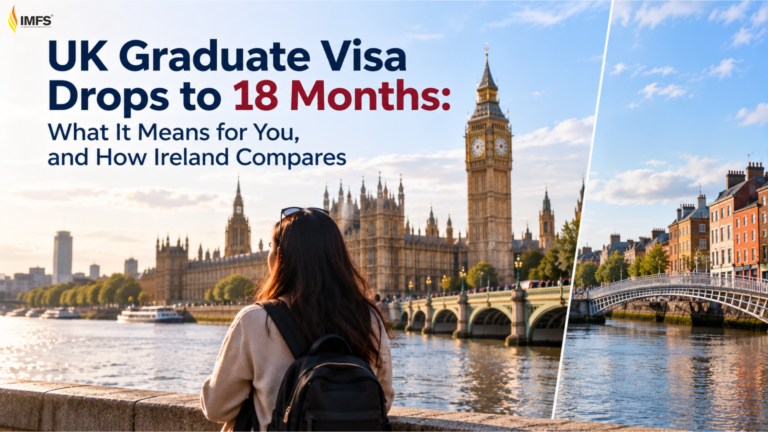
UK Graduate Visa Drops to 18 Months: What It Means for You, and How Ireland Compares
Updated 30 September 2026
Right now, one question keeps coming up in our counselling sessions: is the UK still worth it, now that the post-study visa is getting shorter? It's a fair thing to ask. The honest answer depends on what you plan to do after your degree, so this post goes through what the rules actually say, where Ireland fits as an alternative, and how you can work out which suits you.
What's actually changing in the UK
The change was announced in the government's May 2025 Immigration White Paper and has since gone into the rules. The Home Office guidance now says the Graduate route is 18 months for applications from 1 January 2027, and UKCISA, which advises UK universities and international students, says the same. If you apply before that date, you still get 2 years.
| You apply for the Graduate visa | Bachelor's or Master's | PhD |
|---|---|---|
| On or before 31 December 2026 | 2 years | 3 years |
| On or after 1 January 2027 | 18 months | 3 years |
The visa isn't going anywhere, and you still don't need a job offer or a sponsor to get it. What you lose is six months. You also can't extend it. When it ends, you either move onto another visa or you leave.
Which intakes does this hit?
| Where you are | What to expect |
|---|---|
| One-year master's, started September 2025, finishing this autumn | You can still apply before 31 December and get 2 years, as long as your university has reported your completion in time |
| One-year master's, started January 2026, finishing around January 2027 | You'll be applying after the cutoff, so 18 months |
| Any course starting September 2026 or later | 18 months |
| PhD | 3 years |
If your course ends near December, go and speak to your university's international office now. Ask them when they plan to report your completion to the Home Office. You can't apply until they have, and a delay of a few weeks can push you past the cutoff.
💡 Your next question is probably: "Is the UK still worth it with 18 months?"
It depends on whether you can land a sponsored job in that time. The Graduate visa lets you take almost any job without a sponsor, but to stay once it ends you'll usually need a Skilled Worker visa. That means a licensed employer, a graduate-level role, and a salary of at least £41,700 or the going rate for the job if that's higher. There's a lower threshold for new entrants, which includes people switching from a Graduate visa. Also worth knowing: time spent on the Graduate visa doesn't count towards settlement.
You can test your own numbers in the Study Abroad ROI Calculator. If you're still comparing countries, our post on Canada or the UK goes through it in more detail, and Post-Study Work Opportunities in Ireland shows the Irish side.
Applying: the bits people get wrong
You have to apply from inside the UK, and before your Student visa runs out. Students sometimes fly home for a break and assume they can apply from India. You can't.
Your university also has to tell the Home Office that you've completed your course before you can apply. That's why the intake table above matters so much.
If a government or an international scholarship agency paid both your fees and your living costs in the 12 months before you apply, you'll need written consent from that sponsor. Chevening and similar scholars should check this early.
Dependants are another surprise. Only people who are already in the UK as your dependant on your Student visa can extend under yours. Partners or children who weren't in the UK with you generally can't join you on the Graduate route.
Applications are made online on GOV.UK, and you pay the visa fee and the Immigration Health Surcharge up front. The surcharge for the Graduate visa is usually £1,035 for each year, and the total for your exact period is shown when you apply. Check the GOV.UK cost page for current amounts before you pay.
After the Graduate visa
Most graduates who want to stay switch to a Skilled Worker visa. Since July 2025 the job has to be at degree level (RQF 6), and since 8 January 2026 new applicants need English at B2. The lower new-entrant salary threshold is worth reading about on the official Skilled Worker pages, because it applies to a lot of recent graduates.
Some students look at Global Talent or the High Potential Individual visa instead, if they qualify. On settlement, the government is raising the English standard for indefinite leave to remain on various routes from 26 March 2027, and it's still considering whether to extend that further. Check the current position before you plan around it.
If you want the wider picture on universities, cities and jobs, start with our Study in the UK 2026 guide, then read Best Universities in the UK for International Students and UK Career Opportunities for Indian Students.
Ireland: Stamp 1G in plain English
Ireland calls its post-study route the Third Level Graduate Programme, and the permission you get is Stamp 1G. After an honours bachelor's (Level 8) you get 12 months. After a master's or PhD (Level 9 or 10) you get 12 months, and you can renew once for another 12, which makes 24 in total. Our guide to post-study work opportunities in Ireland covers the permit options in more detail.
The renewal isn't automatic. You have to show Irish immigration that you've been looking properly for graduate-level work: applications, interviews, agency sign-ups and so on. The whole point of Stamp 1G is to find a job and move onto an employment permit, either a General Employment Permit or a Critical Skills Employment Permit. If that doesn't happen before Stamp 1G ends, you're expected to leave.
A few rules to keep in mind. You must hold a current Stamp 2, and you must apply within six months of being told you've got your award. The time you spend on student permission plus Stamp 1G is capped at 7 years for Level 8 and 8 years for Level 9 or above. You can use the programme twice at most, for example after a bachelor's and again after a later master's. Your course also has to be on Ireland's Interim List of Eligible Programmes (ILEP), so check that before you accept an offer. And while Stamp 1G lets you work full-time, you can't run your own business or trade.
For the Critical Skills Employment Permit, the Department of Enterprise, Trade and Employment lists a minimum salary of €40,904 from 1 March 2026 for occupations on its Critical Skills list where a relevant degree is required. If you got your qualification in the 12 months before applying, a lower €36,848 applies. These thresholds are set to rise in stages up to 2030, so look at the DETE page when you're ready to apply. For typical graduate roles and pay, see High-Paying Jobs in Ireland for Graduates (Salary + Work Visa).
We've written more on Ireland in Studying in Ireland from India, Why Study in Ireland in 2026, Top STEM Universities in Ireland, Top 10 Mistakes Indian Students Make in Ireland and Getting an Irish Residence Permit.
The UK and Ireland side by side
| UK Graduate visa | Ireland Stamp 1G | |
|---|---|---|
| After a bachelor's | 18 months (2 years if you apply by 31 Dec 2026) | 12 months |
| After a master's | 18 months (2 years if you apply by 31 Dec 2026) | Up to 24 months, in two 12-month blocks |
| After a PhD | 3 years | Up to 24 months |
| Job offer needed to start | No | No |
| Where and when you apply | Inside the UK, before your Student visa expires | In Ireland on a current Stamp 2, within six months of your award notice |
| Self-employment | Allowed | Not allowed |
| Can it be extended? | No | One renewal for master's and above |
| Usual next step | Skilled Worker: £41,700 or the going rate, degree-level job, B2 English | Critical Skills: €40,904 (€36,848 for recent graduates), or a General Employment Permit |
| Counts towards settlement? | Graduate time doesn't count on work routes | Check ISD and DETE for current rules |
In practice, a one-year taught master's gets you 18 months after study in the UK from 2027, but up to 24 in Ireland, as long as your course is on the ILEP list and you can show your job search for the renewal. For a bachelor's it's 18 months against 12. The UK has the bigger employer market. Ireland has the longer master's window. Neither is the "safe" option.
What it costs
For the UK Student visa, applications from 11 November 2025 need proof of £1,529 a month for London courses and £1,171 a month elsewhere, for up to 9 months, plus any tuition you still owe. University visa pages, for example Westminster's, say the London figure goes up to £1,570 for applications from 30 November 2026. The money normally has to sit in the account for 28 days before you apply. The health surcharge is £776 a year on the Student visa and £1,035 a year on the Graduate visa. Confirm all of these on GOV.UK in the week you apply, since they do change.
For Ireland, fees and proof-of-funds amounts also change, so use the student FAQ from Immigration Service Delivery and its Third Level Graduate Programme page for the current numbers. For tuition by university and city, see Cost of Studying in Ireland, and for the step-by-step application, Ireland Student Visa: Requirements, Fees and Process.
To put your own budget together, try the Cost Calculator and the Education Loan EMI Calculator. If you're weighing up a loan, our page on education loans for studying abroad is a good place to start, and Top 10 Hidden Costs of Studying in the UK covers what tuition doesn't. For Ireland, Top 10 Hidden Costs of Studying in Ireland and Budget-Friendly Universities in Ireland do the same job.
Who should pick the UK, and who should pick Ireland?
There's no single right answer. It comes down to your profile, your budget and what you want to happen after graduation.
The UK probably suits you if you:
- ✅ Are aiming for a one-year master's and are fine with a tighter job search
- ✅ Want a sector with a big UK employer market, such as finance, consulting, tech or healthcare
- ✅ Can pay for the whole degree without leaning on a long post-study stay
- ✅ Will finish before 31 December 2026 and can apply quickly for the 2-year visa
- ❌ Not for you if: your plan depends on a long, guaranteed post-study stay or a quick route to settlement
Ireland probably suits you if you:
- ✅ Are doing a master's on the ILEP list and want up to 24 months after it
- ✅ Are heading for tech, pharma or another area where employers use the Critical Skills permit
- ✅ Are happy with a smaller job market in exchange for a longer master's window
- ✅ Can show proper job-search evidence when you renew Stamp 1G
- ❌ Not for you if: you're doing a bachelor's and need more than 12 months, or you want to be self-employed straight after graduating
How to decide, based on what matters most to you
If your primary constraint is cost... look at your total spend, not only tuition: proof of funds, health surcharge, living costs. Then be realistic about how many earning months you'll get. Start with the Cost Calculator and Top 5 Cheapest Universities in the UK. For Ireland, see Cost of Studying in Ireland and Budget-Friendly Universities in Ireland.
If your goal is permanent residency... be careful with both. Neither post-study visa is a settlement route by itself. In the UK, Graduate visa time doesn't count towards settlement on work routes and the English standard is going up. In Ireland, you go from Stamp 1G to an employment permit and build from there. Our post on New Zealand vs UK is worth reading before you decide.
If university ranking and starting salary are your top priorities... shortlist by your own profile first. The University Recommender is a decent starting point, and Best Universities in the UK for International Students goes deeper. For Ireland's tech and engineering route, see Top STEM Universities in Ireland.
If visa certainty and job market stability matter most to you... pay attention to dates. In the UK, it's whether you apply before or after 1 January 2027. In Ireland, it's the six-month window after your award notice and the expiry of your Stamp 2. Both are easy to miss, and our posts on UK Student Visa Made Simple, Top 10 UK Student Visa Mistakes and Ireland Student Visa: Requirements, Fees and Process cover the usual slips.
Questions we get asked
I finish my degree in 2026. Does the 18-month rule apply to me?
It depends on when you apply, not when you finish. Apply on or before 31 December 2026 and you get 2 years. Apply from 1 January 2027 and you get 18 months. You can only apply once your university has reported that you've completed your course.
Can I extend the UK Graduate visa?
No. If you want to stay longer you have to qualify for another route, such as Skilled Worker, or leave.
How long is Stamp 1G in Ireland after a master's?
Up to 24 months: 12 to start, then one 12-month renewal. For the renewal you need to show you've been actively looking for graduate-level work. There's also an overall 8-year cap on student permission plus Stamp 1G for Level 9 and above.
For a complete breakdown, see: Post-Study Work Opportunities in Ireland
Do I need a job offer for either visa?
No, for both the UK Graduate visa and Stamp 1G. But they're both time-limited, and you'll need a sponsored or employment-permit route if you want to stay longer.
I haven't picked a country yet. What should I read next?
Try Canada or the UK, New Zealand vs Ireland or The Truth About Studying in the UK and Ireland After 12th.
For the full UK picture, see: Study in the UK 2026 Complete Guide
I've chosen my country. What do I do now?
Shortlist universities and start your visa file. For the UK, begin with Best Universities in the UK and UK Student Visa Made Simple. For Ireland, begin with Studying in Ireland from India and Ireland Student Visa: Requirements, Fees and Process. For funding, see Financial Aid & Scholarships for Indian Students in Ireland.
💡 Your next question is probably: "Where do I even start with a shortlist?"
Start with your course level and your budget, then check that the course qualifies for the post-study route you're counting on. For Ireland, that means the ILEP list. For the UK, it means a course your university can confirm as eligible for the Graduate visa. Once those two things are settled, the rest gets a lot easier. Our UK university guide, Ireland guide and Ireland visa process are good places to begin.
Want to talk it through?
Bring your degree, your budget and your timeline, and we'll go through the options together.
Book a free counselling sessionYou can also look at Master's Counseling or find your nearest branch.
- UK Government: Graduate visa and how much it costs
- UK Government: Immigration Rules, Appendix Graduate
- UK Government: Skilled Worker visa and Student visa
- UKCISA: Student update: changes to the Student and Graduate rules
- House of Commons Library: Changes to UK visa and settlement rules after the 2025 immigration white paper
- Ireland ISD: Third Level Graduate Programme, Immigration permission and stamps and Student FAQ
- Ireland DETE: Critical Skills Employment Permit and salary threshold roadmap
- Citizens Information (Ireland): Critical Skills Employment Permit
Rules, fees and thresholds change, so confirm on the official page before you apply. This is general guidance, not legal or immigration advice.