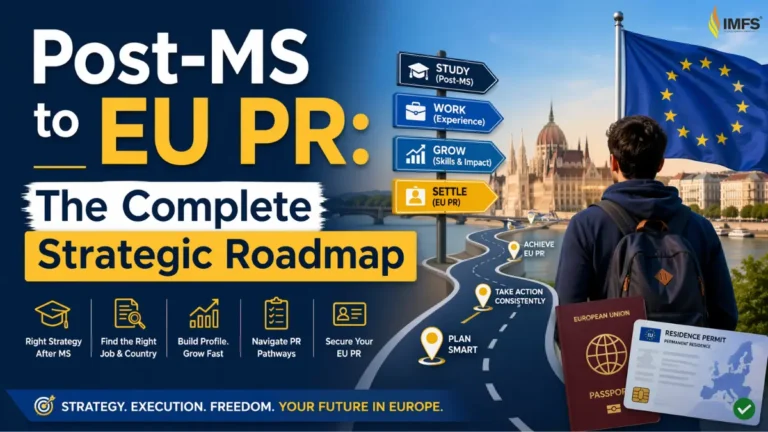
EU PR Playbook: Your Post-MS Roadmap to Permanent Residency in Europe (2026)
Choosing to study abroad in Europe is a significant investment for any Indian student – often ₹40-75 lakh. The journey doesn't end with a Master's degree. Your ultimate goal is often a stable career and Permanent Residency (PR).
| If You Want... | Choose These EU Countries |
|---|---|
| The Fastest PR Timeline | 🇩🇪 Germany (21-27 months with EU Blue Card) |
| To Keep Your Indian Passport (Dual Citizenship) | 🇩🇪 Germany (since June 2024), 🇫🇷 France, 🇩🇰 Denmark, 🇸🇪 Sweden, 🇵🇹 Portugal |
| Low English Language Barrier for Work | 🇳🇱 Netherlands, 🇵🇹 Portugal |
| Strongest Tech Job Market & Industry Presence | 🇩🇪 Germany (Munich, Berlin), 🇳🇱 Netherlands (Amsterdam, Eindhoven) |
| Lowest Salary Threshold for Entry | 🇵🇹 Portugal (Tech Visa – above minimum wage), 🇸🇪 Sweden (SEK 29,680/month) |
| Excellent Quality of Life & Work-Life Balance | 🇩🇰 Denmark, 🇸🇪 Sweden |
| Significant Tax Benefits for High Earners | 🇳🇱 Netherlands (30% ruling), 🇪🇸 Spain (Beckham Law) |
| Immediate Unrestricted Spouse Work Rights | 🇩🇪 Germany (Blue Card), 🇳🇱 Netherlands (HSM) |
| Future Mobility Across EU Countries | Any country offering EU Long-Term Resident status (after 5 years) |
| Fastest Route to EU Citizenship | 🇵🇹 Portugal (5 years total), 🇫🇷 France (5 years total) |
IMFS Recommendation: Based on 67,000+ students guided, we advise Indian students prioritise Germany for its rapid PR path for STEM graduates and new dual citizenship law. For those seeking faster processing and spouse work rights, the Netherlands is an excellent alternative. Portugal offers a lower entry threshold and cost of living. Your choice depends on aligning individual career, language skills, and life goals.
Table of Contents
- What is the EU Long-Term Resident Directive?
- How can Indian students get PR in Germany in 21 months?
- What are the PR requirements for the Netherlands for Indian graduates?
- What is the Talent Permit in France and its PR timeline?
- How can I get PR in Denmark, and what are the new changes?
- What are Sweden's PR and Citizenship timelines for Indian nationals?
- How accessible is Permanent Residency in Portugal for Indian tech graduates?
- What are the pathways to PR and citizenship in Spain for Indian professionals?
- Which EU country is right for my PR goals as an Indian student?
- What is the comparative PR and citizenship timeline across these EU countries?
- What are the key tips for securing EU PR post-MS for Indian students?
- Frequently Asked Questions about EU PR
- Counsellor's Note
- Related Topics
- References & Sources
- How IMFS Can Help
Europe is not just a study destination; it's a launchpad for a global career and a pathway to international residency. Indian students often aim beyond just a Master's degree, seeking a clear roadmap to Permanent Residency (PR). This guide presents a detailed 'EU PR Playbook' covering Germany, Netherlands, France, Denmark, Sweden, Portugal, and Spain, focusing on crucial aspects like visa types, salary thresholds, PR timelines, language requirements, and dual citizenship options as of 2026. Understanding these nuances is vital for making an informed decision that shapes your future.
IMFS: Your Trusted Guide to Global Futures since 1997
With 27+ years of experience and having guided over 67,000 students, IMFS stands as India's most trusted study abroad consultancy. We don't just help you get admitted; we help you plan your entire career trajectory, including post-study work and permanent residency pathways. Our expertise spans admissions to top universities and navigating complex immigration policies across the USA, UK, Canada, Ireland, Australia, Germany, and New Zealand.
What is the EU Long-Term Resident Directive and how does it benefit Indian students?
The EU Long-Term Resident (LTR) Directive 2003/109/EC is a significant benefit for non-EU nationals. After 5 years of legal residence in any EU member state, you can apply for EU LTR status. This status grants enhanced rights to move to and work in other EU countries with significantly fewer barriers, meaning you do not need to restart your residency clock in every country.
This directive gives you immense flexibility. For example, an EU LTR permit acquired in Germany would simplify your pathway to residing and working in France, the Netherlands, or Sweden. It's a cross-border superpower that ensures your first EU country is not necessarily your last, providing a safety net and long-term mobility option within the EU.
How can Indian students get PR in Germany in 21 months?
Germany stands out for offering one of the fastest paths to Permanent Residency (Niederlassungserlaubnis) in the entire European Union for Indian Master's graduates, especially those in STEM fields. With an EU Blue Card, PR is possible in as little as 21 months if you possess B1 level German language skills. If you have A1 German, this timeline extends to 27 months.
Germany's robust economy and active tech and engineering job market make it a prime destination. There is no lottery, no points system, and no cap for the EU Blue Card. If you have a recognised university degree and a qualifying job offer, you can apply.
What are the EU Blue Card (Germany) salary thresholds for 2026?
The salary thresholds for the EU Blue Card in Germany are adjusted annually. For 2026, the key thresholds are:
| Category | Annual Gross Salary (2026) | Notes |
|---|---|---|
| Standard (all professions) | €50,700 (₹55.77 lakh) | General threshold for any occupation. |
| Shortage occupations (IT, engineering, healthcare, teaching) | €45,934.20 (₹50.53 lakh) | No Federal Employment Agency (BA) approval needed. |
| New entrants/graduates (within 3 years of degree) | €45,934.20 (₹50.53 lakh) | Applies across all professions, offering a graduate discount. |
| IT specialists without a formal degree | €45,934.20 (₹50.53 lakh) | Requires 3 years of IT experience in the last 7 years; BA approval needed. |
Key Requirements for Germany EU Blue Card:
- Recognised university degree: Verify on the ANABIN database (anabin.kmk.org). Your institution should have an H+ status. If not, obtain a Statement of Comparability (ZAB) from the Central Office for Foreign Education.
- Valid employment contract: For at least 6 months, meeting the salary threshold.
- Health insurance: Valid statutory or private health insurance from entry.
- No labour market test: Not required for any Blue Card occupation in Germany.
Path to Permanent Residency (Niederlassungserlaubnis) in Germany:
- 21 months: With B1 German language proficiency (accepted certifications: TELC, Goethe-Institut, ÖSD).
- 27 months: With A1 German language skills.
- Both require continuous qualified employment, social security contributions, sufficient living space, and no serious criminal record. The 21/27-month clock starts from your Blue Card issuance date, so apply promptly upon arrival.
Citizenship in Germany:
- Standard route: 5 years of legal residence. This was reduced from 8 years by the June 2024 Nationality Act (StAG) reform. The 3-year fast-track, though introduced, was repealed effectively from October 2025.
- Dual citizenship: Permitted since June 2024 for all nationalities due to the StAG reform. You can keep your Indian passport.
- Language requirement: B1 German. You also need to pass a citizenship test (Einbürgerungstest) on German law, society, and history.
Insider Experience: From 20+ years of placing Indian students in Germany, we consistently see students who begin their German language learning in India and arrive with at least A2 German find suitable employment 4-6 months faster and integrate more smoothly.
Germany's Blue Card in 2026 is arguably the best entry point into the EU for Indian STEM graduates. The lack of a labour market test, clear PR timelines, and the new dual citizenship law make it an exceptionally appealing choice. The €45,934 threshold for IT and engineering is achievable for most entry-level roles with reputable German companies. Learn more about studying in Germany.
What are the PR requirements for the Netherlands for Indian graduates?
The Netherlands offers one of the fastest processing times for skilled worker permits in the EU, often just 2 weeks for employers recognised by the Immigration and Naturalisation Service (IND). Known for its thriving tech, finance, and logistics sectors, particularly in cities like Amsterdam and Rotterdam, the Netherlands also provides a unique financial incentive with its 30% tax ruling.
Highly Skilled Migrant Permit (Kennismigrant): Salary Thresholds (2026)
The Dutch Highly Skilled Migrant (HSM) scheme is processed by your employer, who must be an IND-recognised sponsor. Salary thresholds are adjusted annually, effective January 1st.
| Category | Monthly Gross (excl. 8% holiday allowance) | Notes |
|---|---|---|
| Age 30 and above | €5,942 (₹6.53 lakh) | Approx. €71,616/year + 8% holiday pay. |
| Under 30 years of age | €4,357 (₹4.79 lakh) | Approx. €52,548/year + 8% holiday pay. |
| Recent graduates, Orientation Year holders (within 3 years of graduation) | €3,122 (₹3.43 lakh) | Must be from a top-200 university (QS/THE/ARWU) in the last 3 years. |
| EU Blue Card (Netherlands) | €4,754 (₹5.22 lakh) | For graduates within 3 years of degree completion. |
Key Requirements for Highly Skilled Migrant Permit:
- Recognised IND sponsor: Your employer must be on the public IND register.
- No labour market test: The employer handles the entire application.
- Degree: While not a legal requirement, a Master's or equivalent experience is typically expected. Nuffic credential evaluation is recommended for non-Dutch degrees.
The 30% Tax Ruling:
This powerful financial benefit is available if you are hired from outside the Netherlands and meet the salary threshold. You can receive up to 30% of your gross salary tax-free for 5 years (for arrivals from January 1, 2024). This significantly boosts your net income, making the Netherlands very attractive for high earners. Ensure this is explicitly covered in your employment offer.
Path to Permanent Residency in the Netherlands:
- After 5 continuous years of legal residence with a qualifying permit (e.g., HSM).
- Requirements: Pass the civic integration exam (Inburgeringsexamen) at A2 Dutch language level. This exam has 6 components and typically requires 6-12 months of preparation.
- Strict on continuity: No significant gaps in residence or employment are permitted. A 3-month unemployment gap, for instance, can affect eligibility. If laid off, you have a 3-month grace period to find a new recognised-sponsor employer.
Citizenship in the Netherlands:
- After 5 years of legal residence, including time on an HSM permit.
- B1 Dutch language required and successful completion of the civic integration exam.
- Dual citizenship: Generally not permitted. Indian nationals usually must renounce Indian citizenship unless they qualify for specific exceptions (e.g., statelessness, marriage). Verify your personal situation with a Dutch immigration lawyer.
Orientation Year (Zoekjaar): The Netherlands offers a 1-year Orientation Year permit for recent graduates of Dutch universities or top-200 global universities. This allows you to search for an HSM-qualifying role. Once you secure a job with a recognised sponsor, you can switch to the Kennismigrant permit at a reduced threshold (€3,122/month), which is a significant advantage for fresh graduates.
What is the Talent Permit in France and its PR timeline?
France revised its immigration system in June 2025, streamlining the 'Passeport Talent' into a simpler 'Talent Permit.' For Indian MS graduates, the 'Talent – Qualified Employee' route is the primary pathway. France boasts a vibrant tech ecosystem, with Paris rapidly growing as a major European startup hub, and offers a relatively accessible PR route.
Talent Permit, Qualified Employee (Salarié Qualifié): Salary Thresholds (2025)
These categories are designed to attract skilled professionals and are exempt from standard labour market tests.
| Permit Category | Salary Threshold | Notes |
|---|---|---|
| Talent – Qualified Employee (new graduate / JEI employee) | €39,582/year gross (₹43.54 lakh) | Requires MS degree or equivalent. Reduced by 8% from 2024, good for entry-level. |
| Talent – EU Blue Card (France) | €59,373/year gross (₹65.31 lakh) | 1.5x average annual gross salary. Requires 3-year degree + 6-month contract. |
| Talent – Intra-company transferee/assignment | €39,582/year gross (₹43.54 lakh) | For staff transferred to a French entity of a multinational. |
Key Requirements for Talent Permit:
- Master's degree or equivalent (minimum 3 years of higher education).
- Employment contract: Permanent (CDI) or fixed-term of at least 3 months for Talent – Qualified Employee; at least 6 months for the EU Blue Card route.
- No labour market test: Talent permit holders are exempt.
Language Rules (Important 2026 Update):
- From January 2026, most multi-year residence permits require A2-level French. However, Talent Permit holders are explicitly exempt from this requirement, a significant advantage.
- For permanent residency (5-year card): B1 French is required.
- For citizenship: B2 French is required (potentially C1 from 2026, verify). The Republican Integration Contract must be signed.
Path to Permanent Residency in France:
- Long-Term Resident (carte de résident de longue durée – UE): After 5 years of continuous, legal, and uninterrupted residence in France.
- Alternatively: A 10-year resident card (carte de résident) after 5 years, which is renewable without employment conditions.
France PR Rule Change: Verify Before Applying. France's 2024 immigration law (Loi n° 2024-42) amended several timelines for permanent residence. While usually 5 years, some implementing decrees were still pending as of early 2026, with reports suggesting the timeline might extend to 7 years. Always consult current rules at service-public.fr or with a French immigration lawyer before relying on a timeline.
Citizenship in France:
- After 5 years of legal residence (can include Talent Permit time).
- B2 French language required, plus a civic integration exam.
- Dual citizenship: France permits dual citizenship; you can keep your Indian passport.
How can I get PR in Denmark, and what are the new changes?
Denmark boasts one of Europe's strongest markets for tech, life sciences, and engineering. A significant June 2025 political deal has specifically targeted India as one of 16 countries for a new streamlined collective-agreement-based work permit, indicating a clear opening for Indian talent.
Work Permit Schemes in Denmark:
| Scheme | Salary Threshold (2025) | Labour Market Test | Best For |
|---|---|---|---|
| Pay Limit Scheme | DKK 552,000/year (₹61.54 lakh) | No | High earners in any field. |
| Positive List (Higher Education) | Market rate (varies) | No | Occupations on SIRI's shortage list (updated twice yearly), including IT, engineers. |
| Fast-Track Scheme | DKK 552,000/year or Positive List rate | No | Employees of SIRI-certified companies; fastest processing (approx. 15 days). |
| New Collective Agreement Scheme (India eligible, pending implementation) | DKK 300,000/year (₹33.47 lakh) | Via collective agreement | Significant new route for India-specific talent; lower threshold (vs DKK 448k previously). Employers must be certified and covered by a collective agreement. |
Path to Permanent Residency in Denmark:
- Standard route: 8 years of legal residence.
- Fast-track route (4 years): Requires meeting 2 of 4 additional conditions:
- Pass the Danish 3 language test.
- At least 4 years in current job.
- Demonstrate active citizenship.
- Earn above DKK 286,525/year (₹32.00 lakh) on average.
- Denmark has strict enforcement of continuous residence; even short absences must be well-documented.
Citizenship in Denmark:
- 9 years of legal residence (including 8 years as a PR). Alternatively, 8 years with strong integration markers.
- Danish language at level 3 (Dansk 3 / PD3) required.
- Dual citizenship: Permitted since September 2015, allowing you to retain your Indian citizenship.
Denmark Positive List: Check it Before You Choose Your Job. SIRI publishes a Positive List of in-demand occupations twice a year (January and July) on nyidanmark.dk. If your job title is on this list, you are exempt from the DKK 552,000 Pay Limit threshold, needing only a market-rate salary. This is often the more accessible entry point for IT engineers and data scientists.
What are Sweden's PR and Citizenship timelines for Indian nationals?
Sweden maintains one of the most open work permit systems in the EU, where any registered employer can sponsor a non-EU worker without a labour market test. Cities like Stockholm, Gothenburg, and Malmö are hubs for tech and gaming industries. However, significant salary threshold changes are set for June 2026, and the citizenship timeline has recently increased.
Work Permit (Arbetstillstånd) in Sweden: Salary Thresholds
| Period | Monthly Gross Minimum | Notes |
|---|---|---|
| Current (as of June 2025) | SEK 29,680 (₹1.78 lakh) | 80% of the median wage. Approx. €2,650/month (₹2.92 lakh). |
| From June 2026 (proposed bill) | SEK 33,390 (₹2.00 lakh) | 90% of the median wage. Bill passed in December 2025. Healthcare/shortage exemptions possible. |
Key Requirements for Work Permit:
- Any registered Swedish employer can sponsor a work permit.
- No labour market test: Application processed by Migrationsverket in 15–45 days.
- Permit is employer-specific: Changing employers requires a new work permit application before starting the new job.
- No legal degree requirement, but the role and salary must align with 'skilled' industry norms.
Path to Permanent Residency in Sweden:
- After 4 years (48 months) of legal residence, with at least 44 months of actual employment within the last 7 years.
- Financial self-sufficiency: Required, typically SEK 29,680 net/month (after tax). Only stable base salary counts.
- Language requirement: From July 2027, A2 Swedish language and knowledge-of-society test will be required for PR. No language requirement currently.
Citizenship in Sweden:
- 8 years of legal residence. This is a significant increase from 5 years, effective in 2025.
- From July 2027, A2 Swedish language and society knowledge will be required for citizenship applications.
- Dual citizenship: Sweden permits dual citizenship, allowing you to retain your Indian passport.
Sweden Citizenship Timeline Doubled: Plan Accordingly. Effective in 2025, Sweden increased the citizenship residency requirement for non-EU nationals from 5 to 8 years. Combined with the 4-year PR timeline, the total path from arrival to citizenship is now approximately 8+ years. The 2026 salary threshold increase will also impact new applicants. Factor these changes into your long-term planning, especially when comparing against faster citizenship routes like Germany or Portugal.
How accessible is Permanent Residency in Portugal for Indian tech graduates?
Portugal has rapidly grown into a desirable destination for Indian tech graduates, particularly in Lisbon and Porto, which now host major tech hubs with companies like Google and Amazon. English is widely spoken in professional environments, and the cost of living is notably lower than in countries like Germany or the Netherlands.
Residence Permit for Highly Qualified Activity (EU Blue Card / Tech Visa) in Portugal:
Portugal offers both the EU Blue Card and a more accessible Tech Visa for skilled professionals.
| Permit Type | Salary Threshold | Notes |
|---|---|---|
| EU Blue Card Portugal | 1.5x average gross annual salary (~€33,000–€36,000/year, ₹36.3 – ₹39.6 lakh) | Check IEFP for current reference salary. |
| Tech Visa (Visto Tech) | Above minimum wage (€870/month, ₹95,700) | For employees of IAPMEI-certified tech companies. Highly accessible for graduates. |
| General Residence Permit for Employment | Above minimum wage (€870/month, ₹95,700) | Job must be in a skilled category; no strict minimum beyond national minimum wage. |
India–Portugal Bilateral Labour Agreement (2025):
In 2025, Portugal and India signed a bilateral labour agreement, aiming to simplify work permit processing for Indian nationals and recognise specific professional qualifications. This can be beneficial for streamlined permit pathways at some Portuguese consulates; verify implementation details with AIMA (formerly SEF) or the Portuguese Consulate in India.
Path to Permanent Residency in Portugal:
- After 5 years of legal residence with a qualifying permit.
- Requirements: A2 Portuguese language certificate (CAPLE exam), a clean criminal record, and proof of sufficient means of subsistence.
- Processing through AIMA (formerly SEF) can take 6–12 months for PR applications.
Citizenship in Portugal:
- After 5 years of legal residence, making it one of the fastest citizenship timelines in Europe.
- A2 Portuguese language required (CAPLE or equivalent).
- Dual citizenship: Portugal permits dual citizenship; you can keep your Indian passport.
Portugal Tech Visa: The Most Accessible Route for Indian Graduates. Portugal's Tech Visa, for employees of IAPMEI-certified companies, offers a significantly lower salary threshold (just above minimum wage) than the EU Blue Card. This makes it an incredibly accessible entry point into Portugal's rapidly growing tech sector. Always check the IAPMEI-certified employer list before accepting any job offer if utilising this pathway.
What are the pathways to PR and citizenship in Spain for Indian professionals?
Spain is increasingly attractive for Indian tech graduates, especially in Barcelona (Europe's 4th largest startup ecosystem) and Madrid. The 2022 Startup Law and the 'Beckham Law' tax regime enhance Spain's competitiveness. However, it's crucial to note that citizenship typically takes 10 years for most nationalities, including Indians.
EU Blue Card Spain / Highly Qualified Professional Permit:
Spain offers several pathways for skilled professionals, each with distinct advantages.
| Permit Type | Salary Threshold | Notes |
|---|---|---|
| EU Blue Card Spain | 1.5x average Spanish gross annual salary (~€40,000–€44,000/year, ₹44 – ₹48.4 lakh) | General route for highly skilled. |
| International Teleworking Visa (Digital Nomad Visa) | At least €2,646/month (₹2.91 lakh) (~200% minimum wage) | For remote workers; now allows work for Spanish employers. |
| Startup Nation Permit (Ley de Startups, 2022) | No minimum salary | For employees and founders of authorised startup companies (requires certification). |
Key Requirements for Permits in Spain:
- University degree: For regulated professions, a degree (Master's or Bachelor's) recognized in Spain may require homologation (convalidación) through the Ministry of Education.
- No labour market test: For EU Blue Card or Startup Permit routes.
- Social security affiliation: Required from the first day of employment.
Path to Permanent Residency in Spain:
- After 5 years of continuous legal residence with work permits.
- Requirements: No criminal record, sufficient economic means, and basic integration with local culture and language.
- Application through the Oficina de Extranjería, with processing times typically ranging from 3–6 months.
Citizenship in Spain:
- Standard route: 10 years of legal residence for most nationalities, making it the longest citizenship timeline among the countries in this guide.
- Spanish B1 language level required, plus nationality tests: CCSE (cultural and constitutional knowledge) and DELE Spanish language exam.
- Dual citizenship: Spain generally does not permit dual citizenship for Indians, meaning you would likely need to renounce your Indian citizenship. Verify carefully with an immigration lawyer.
Beckham Law: A Tax Advantage for New Arrivals. Spain's 'Beckham Law' (Régimen Especial para Trabajadores Impatriados) allows newly arrived workers to pay a flat 24% tax on income up to €600,000 for their first 6 years, instead of the higher progressive Spanish tax rates. For high-earning Indian MS graduates in tech roles in cities like Madrid or Barcelona, this can result in significant tax savings. Apply within 6 months of starting work.
Ready to Build Your European Career & Future?
Europe offers incredible post-MS opportunities. Don't navigate the complex visa and PR landscape alone. Our expert counselors can tailor a strategy just for you.
Get My EU PR Decision Plan — Free Find My Nearest IMFS BranchWhich EU country is right for my PR goals as an Indian student?
Choosing the right European country for your post-MS career and Permanent Residency is a highly personal and professional decision. Use this matrix to strategically match your priorities with the best-suited destinations.
| Your Priority | Recommended Country (and Why) |
|---|---|
| Fastest possible PR | 🇩🇪 Germany: 21 months with B1 German for EU Blue Card holders. Unmatched in the EU. |
| No language barrier (English workplace) | 🇳🇱 Netherlands or 🇵🇹 Portugal: Many tech employers and major cities operate effectively in English. |
| Lowest entry salary barrier | 🇵🇹 Portugal (Tech Visa: just above minimum wage, approx. €870/month or ₹95,700). 🇸🇪 Sweden (SEK 29,680/month or ₹1.78 lakh). |
| Dual citizenship (keep Indian passport) | 🇩🇪 Germany (since June 2024), 🇫🇷 France, 🇩🇰 Denmark, 🇸🇪 Sweden, 🇵🇹 Portugal. (Netherlands and Spain generally do not). |
| Strongest tech job market | 🇩🇪 Germany (Munich, Berlin, Hamburg) and 🇳🇱 Netherlands (Amsterdam, Eindhoven) have the largest employer bases for Indian STEM graduates. |
| Best quality of life / work-life balance | 🇩🇰 Denmark and 🇸🇪 Sweden consistently rank high globally for social benefits, worker protections, and overall well-being. |
| Fastest citizenship after PR | 🇵🇹 Portugal (5 years total residence to citizenship) or 🇫🇷 France (5 years total residence to citizenship). Germany's fast-track is 5 years with strong integration. |
| EU mobility (want to move countries later) | Any EU country: The EU Long-Term Residency status, obtainable after 5 years, significantly simplifies subsequent intra-EU mobility. |
| Spouse’s work rights from day one | 🇩🇪 Germany (spouses of Blue Card holders get immediate unrestricted work rights) and 🇳🇱 Netherlands (spouses get full work rights with HSM). |
| Lowest cost of living | 🇵🇹 Portugal is significantly more affordable than Germany, France, or the Netherlands. Lisbon's cost of living is approximately 40% lower than Amsterdam's. |
What is the comparative PR and citizenship timeline across these EU countries?
Understanding the full timeline from securing your first permit to gaining Permanent Residency and eventually citizenship is crucial for long-term planning. This table provides a snapshot of the key stages and requirements for each country:
| Country | Entry Permit (Processing Time) | Fastest PR Timeline | Language for PR | Citizenship Timeline | Dual Citizenship Allowed? |
|---|---|---|---|---|---|
| 🇩🇪 Germany | EU Blue Card (4–12 weeks visa) | 21 months (B1 German) | B1 German | 5 years (standard, 3-yr fast-track repealed Oct 2025) | ✅ Yes (since June 2024) |
| 🇳🇱 Netherlands | HSM (2 weeks with recog. sponsor) | 5 years | A2 Dutch (civic exam) | 5 years | ❌ Generally No |
| 🇫🇷 France | Talent Permit (4–8 weeks) | 5 years (verify new rules, could be 7) | B1 French | 5 years (B2 French) | ✅ Yes |
| 🇩🇰 Denmark | Pay Limit / Fast-Track | 4 years (with 2 extra conditions) | Danish 3 (DU3) | 9 years | ✅ Yes (since 2015) |
| 🇸🇪 Sweden | Work Permit (15–45 days) | 4 years | None until July 2027, then A2 | 8 years (increased from 5 in 2025) | ✅ Yes |
| 🇵🇹 Portugal | Tech Visa / EU Blue Card | 5 years | A2 Portuguese | 5 years | ✅ Yes |
| 🇪🇸 Spain | EU Blue Card / Startup Permit | 5 years | A2 Spanish (+ CCSE) | 10 years | ❌ Generally No |
What are the key tips for securing EU PR post-MS for Indian students?
Navigating the European immigration landscape requires strategic planning. Here are critical pieces of advice based on our extensive experience:
- Start German Language Learning Early: For Germany, B1 German unlocks the 21-month PR route. Begin language instruction in India with Goethe-Institut or IMFS classes even before getting a job offer. Certificates like Goethe/TELC are essential.
- Verify Employer Status for Netherlands: If targeting the Netherlands, always confirm your prospective employer's status as an IND-recognised sponsor on the official IND public register. A non-recognised sponsor cannot process your Highly Skilled Migrant application.
- Understand French Permit Categories: For France, the June 2025 Talent Permit reforms renamed categories but did not eliminate the nuances. Verify which specific sub-category (e.g., Qualified Employee, EU Blue Card) applies to your job, as each has different salary and contract requirements.
- Check German Degree Recognition (ANABIN): Before applying to Germany, ensure your Indian university and degree are listed with 'H+' status in the ANABIN database (anabin.kmk.org). If not, initiate a ZAB assessment (Statement of Comparability) as early as possible, as it can take 4–6 months.
- Leverage EU Long-Term Residency: Aim for EU Long-Term Resident status after 5 years in any EU country. This status is a strategic asset, providing significant cross-border mobility within the EU, even if your immediate plan is not to relocate.
- Prioritise Dual Citizenship Options: If retaining your Indian passport is important, prioritise countries that permit dual citizenship, such as Germany (since June 2024), France, Denmark, Sweden, and Portugal. The Netherlands and Spain generally do not.
- Meticulously Manage Permit Timelines: Never let your residence permit lapse. Gaps in legal residence will break the continuity required for both PR and citizenship applications. Set multiple reminders for renewal 3–4 months before expiry.
- Consider Spouse's Work Rights: For couples, Germany's Blue Card and the Netherlands' Highly Skilled Migrant permits immediately grant unrestricted work rights to spouses. A dual-income household from day one is a major financial and quality-of-life factor.
- Monitor Danish Collective Agreement Scheme: If targeting Denmark, closely monitor the implementation dates for the new June 2025 collective-agreement work permit scheme, which explicitly includes India with a significantly lower DKK 300,000 threshold. Check nyidanmark.dk for updates.
- Consult an Immigration Lawyer: European immigration law is complex, country-specific, and frequently changes. For your first application and for PR/citizenship, always work with a registered immigration lawyer in your target country to ensure compliance and avoid costly errors.
Frequently Asked Questions about EU PR
Counsellor's Note
As counselors who have guided thousands of Indian students to Europe over the decades, we understand that the decision extends far beyond just choosing a university. Your long-term vision—a stable career, excellent quality of life, and eventual permanent residency—is paramount. Europe offers a mosaic of opportunities, each with its unique advantages and challenges.
Germany’s commitment to attracting skilled talent, exemplified by its rapid PR timelines and recent acceptance of dual citizenship, positions it as a clear frontrunner for many. However, the linguistic barrier, while an investment, is often underestimated. Conversely, the Netherlands offers a highly professional environment with significant tax benefits and an English-speaking workplace, but without the option of dual citizenship for most Indians. Each country requires a tailored approach.
Our advice is always to look beyond the immediate. Consider where you truly want to build a life, what language you are willing to learn, and how your family's needs align with immigration policies. The EU Long-Term Resident Directive means your journey might involve several countries, but strategic planning from the outset can ensure a smoother, more successful transition to permanent residency. Remember, the right path is the one that best aligns with your individual career ambitions and personal values.
Related Topics


References & Sources
- BAMF Germany - The EU Blue Card
- BAMF Germany - New Nationality Act (2024)
- IND Netherlands - Highly Skilled Migrant
- IND Netherlands - Orientation Year Permit
- France Visas - Foreign Talents (Talent Permit)
- Service-Public France - Residence Permit "Talent"
- Nyidanmark Denmark - Pay Limit Scheme
- Nyidanmark Denmark - The Positive List
- Migrationsverket Sweden - Work Permit
- IAPMEI Portugal - Tech Visa
- AIMA Portugal - Working in Portugal (formerly SEF)
- Oficina de Extranjería Spain - Normativa de Extranjería
- European Commission - EU Long-Term Residents Directive
- ANABIN Database - Recognition of Foreign Qualifications
- Numbeo - Cost of Living Index (Q1 2026)
Find Your Nearest IMFS Centre
Talk to an IMFS Consultant — Free
27+ years of placing students in Germany, Netherlands, France, and across Europe. No fees. No pressure. Just honest, expert guidance for your EU PR journey.
- Personalised PR Roadmap
- Optimised University Selection
- Visa Application Support
- Scholarship Guidance
- Post-Study Work Permit Strategy
- Career Planning & Job Search Tips
Available in 13 branches: Dadar, Thane, Borivali, Vashi, Churchgate, Shivajinagar, Pimpri, Kukatpally, LB Nagar, Madhapur, Manipal, Nellore, Warangal.