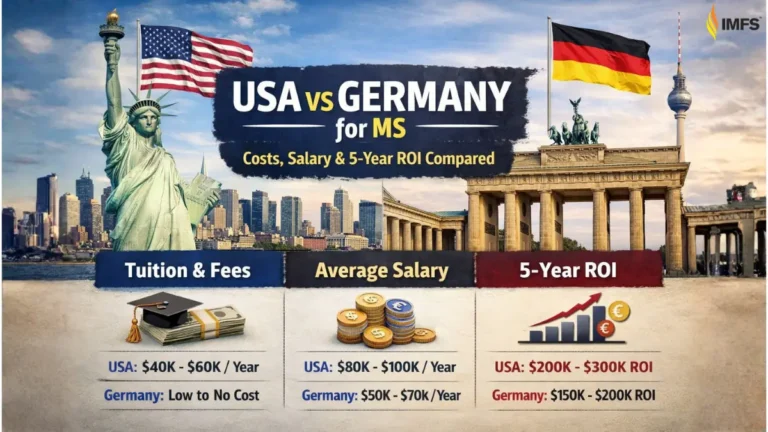
USA vs Germany for MS:
Costs, Salary & 5-Year ROI Compared
Which is better — USA or Germany for MS? | Real ₹ numbers | H-1B vs EU Blue Card | PR timeline
| If you want… | Choose |
|---|---|
| Highest salary potential | 🇺🇸 USA |
| Lowest total cost | 🇩🇪 Germany |
| PR certainty in 3–4 years | 🇩🇪 Germany |
| Tech career in AI / CS | 🇺🇸 USA |
| Low financial risk | 🇩🇪 Germany |
| Mechanical / Auto Engineering | 🇩🇪 Germany |
| FAANG / top startup career | 🇺🇸 USA |
| Budget under ₹32 lakh total | 🇩🇪 Germany |
Not sure which fits your profile? Get a personalised recommendation from IMFS →
📋 On This Page
- 2026 trends — H-1B, Germany hiring, AI salaries
- Total cost — USA vs Germany in ₹
- Salary after MS in USA vs Germany
- 5-year net wealth: the real ROI number
- Visa reality — H-1B lottery vs EU Blue Card
- Which profile suits USA and which suits Germany?
- Germany really free? Hidden costs explained
- IMFS Google ratings — verified
- Frequently asked questions
If you are an Indian student deciding between USA vs Germany for your MS degree, this is the most important page you will read before applying. This is not about rankings. It is about money, visa security, and where you want to be in five years. Both countries are excellent — but they suit completely different profiles. We give you real numbers from verified sources so the decision is based on facts, not fear.
💡 IMFS has placed students at Northeastern, UT Dallas, Arizona State, USC, and Columbia in the USA — and at TU Munich, RWTH Aachen, and KIT in Germany. This guide is built on 27+ years of real placement data, not guesswork.
H-1B cap is unchanged at 65,000 + 20,000 (Master's cap), but the number of applications has stayed above 700,000 per year — meaning approval odds hover at 25–30% per annual lottery. The 2025 rule changes added stricter employer compliance checks and specialty occupation requirements, making approvals harder even for STEM roles. Indian nationals also face the longest Green Card backlog of any country — 50–100+ years in EB-2/EB-3. For Indian students, USA offers the best salary ceiling but the least predictable path to staying permanently.
Germany officially has a shortage of 600,000+ skilled workers as of 2026 (Federal Employment Agency, BA). The Skilled Immigration Act (Fachkräfteeinwanderungsgesetz) 2024 reform opened new pathways for Indian engineers, IT professionals, and nursing graduates. The EU Blue Card salary threshold for shortage occupations (IT, engineering, healthcare) was set at €43,759 in 2026 — most MS graduates qualify immediately. BMW, Bosch, Siemens, SAP, and Volkswagen are actively hiring international graduates. Germany is not just tolerating international talent — it is structurally dependent on it.
After the 2022–2023 FAANG hiring freeze and mass layoffs (over 200,000 tech jobs cut across Meta, Amazon, Google, Microsoft in 2023–2024), AI/CS starting salaries in the USA have stabilised rather than grown. Median MS CS starting salary at non-FAANG companies is now $95,000–$110,000 — down from the $130,000–$150,000 peak of 2021–2022. Top-tier roles at AI labs (OpenAI, Anthropic, Google DeepMind) still command $160,000–$220,000, but these require exceptional profiles and published research. For average Indian MS CS graduates, the realistic USA salary range in 2026 is $95,000–$120,000 — closer to 1.5x Germany than the 2x premium of 3 years ago.
| Trend | Impact on USA | Impact on Germany | IMFS recommendation |
|---|---|---|---|
| H-1B tightening | Higher risk for staying post-MS. Only ~25–30% get H-1B each lottery. | No impact. EU Blue Card has no lottery or quota. | If you need visa certainty, Germany wins in 2026. |
| Germany hiring surge | — | 600,000+ job shortage. BMW, Bosch, Siemens, SAP actively hiring. PR easier than ever. | Engineering students: 2026 is Germany's best year in a decade. |
| AI/CS salary normalisation | Gap vs Germany narrowed to ~1.5x from ~2x in 2021. ROI advantage shrinking. | Germany AI/CS salaries steady at €52K–€68K. More predictable. | USA still wins for top AI roles. Mid-tier CS: Germany ROI now comparable. |
| Dual citizenship India–Germany | — | Since 2024 reform. Indian students can keep Indian passport + get German citizenship. | Major new reason to choose Germany for students planning long-term. |
How much does an MS degree actually cost — USA vs Germany for Indian students?
The total cost of studying in the USA vs Germany is the single biggest factor most Indian families underestimate. Here is every rupee, laid out clearly.
Tuition: $40,000–$80,000 total
Living: $18,000–$24,000/year × 2
At ₹95/USD · Source: published tuition 2025 · see rate note ↑
Tuition: €0 (free at all public universities)
Semester fees: €250–€350 × 4 = ~€1,200
Living: €700–€1,000/month × 24
At ₹110/EUR · Source: DAAD official 2025 · see rate note ↑
✅ Germany saves Indian students ₹52–₹92 lakh in upfront cost. That is the price of a 2BHK in a Mumbai suburb — before you earn your first salary abroad. Read our full breakdown: Cost of studying in the USA and Free education in Germany — the full truth.
| Cost component | 🇺🇸 USA | 🇩🇪 Germany |
|---|---|---|
| Tuition (2 years) | ₹38L–₹76L | ₹1L (semester fees only) |
| Living costs (24 months) | ₹34L–₹45L | ₹18.5L–₹26.4L |
| Health insurance (student) | ~₹2.5L–₹4L total | ₹2.4L–₹2.6L total |
| Blocked account | — | ₹13.1L (your money, returned monthly) |
| Language course | — | ₹0.7L–₹1.8L (optional, strongly recommended) |
| Total real cost | ₹72L–₹1.22 crore | ₹20L–₹30L |
📌 Sources: DAAD official figures 2025, published US university tuition 2025. Exchange rates: 1 USD = ₹95, 1 EUR = ₹110 (March 2026). All figures are estimates based on published data — actual costs vary by city, university, and lifestyle. Consult an IMFS counselor for a profile-specific cost estimate.
What salary can I expect after MS in USA vs Germany?
When students ask which is better USA or Germany for MS, salary is usually the first number they compare. Here is the honest picture — including what most blogs leave out.
FAANG / top tech: up to $180K
Mid-tier companies: $90K–$120K
Data Science / AI: $95K–$140K
Source: Glassdoor USA, Levels.fyi 2025
SAP, Siemens, BMW, Bosch, Airbus
Data Science / AI: €50K–€68K
Mechanical Engineering: €48K–€65K
Source: Destatis Germany, StepStone 2025
📊 USA salary is 1.7–2.2x Germany in absolute rupee terms. But Germany's lower education debt, lower taxes on middle incomes, and universal healthcare close this gap significantly. See the 5-year net wealth calculation below for the real difference. Also read: Top 10 high-paying jobs in USA for international students.
| Field | 🇺🇸 USA salary/yr | USA (₹L) | 🇩🇪 Germany salary/yr | Germany (₹L) |
|---|---|---|---|---|
| CS / Software Engg | $100K–$150K | ₹95L–₹1.42Cr | €52K–€75K | ₹57.2L–₹82.5L |
| Data Science / AI | $95K–$140K | ₹90L–₹1.14Cr | €50K–€68K | ₹55L–₹74.8L |
| Mechanical / Auto Engg | $75K–$110K | ₹71L–₹1.05Cr | €48K–€65K | ₹52.8L–₹71.5L |
| Finance / MBA | $90K–$130K | ₹85.5L–₹1.24Cr | €45K–€65K | ₹49.5L–₹71.5L |
🤔 Still confused between USA & Germany?
Your GRE score, CGPA, budget, and career goal all matter before choosing. Get a personalised recommendation from an IMFS counselor — free, no obligations.
Germany vs USA ROI: the 5-year net wealth number nobody shows you
The real Germany vs USA ROI is not just salary — it is what you have left after 5 years once you factor in education loan repayment. Here is an honest, transparent calculation for MS in Computer Science.
📌 Assumptions: MS CS. Education loan at 10.5% interest (SBI Scholar loan rate, early 2026). USA: $100,000 total cost, starting salary $120,000. Germany: €22,000 total cost, starting salary €60,000. Job secured within 3 months of graduation. H-1B approval assumed for USA — see next section for what happens when it is not approved.
| Year | 🇺🇸 USA net savings (₹L) | 🇩🇪 Germany net savings (₹L) |
|---|---|---|
| Year 1 post-MS | ₹21L | ₹17L |
| Year 2 | ₹25L | ₹20L |
| Year 3 | ₹29L | ₹23L |
| Year 4 | ₹33L | ₹26L |
| Year 5 | ₹37L | ₹29L |
| 5-year gross savings | ₹1.45 crore | ₹1.15 crore |
| Education loan repaid | −₹95L | −₹24L |
| 5-year net wealth | ₹50L | ₹91L ✅ |
📌 Model assumptions: MS CS, education loan at 10.5% SBI Scholar rate (early 2026), USA $100,000 total cost, starting salary $120,000; Germany €22,000 total cost, starting salary €60,000. Post-tax net savings estimated using US federal+state effective rate ~22% and Germany effective rate ~35%. Living costs: USA $2,500/month, Germany €1,100/month post-graduation. This is an illustrative model — not a financial guarantee. Individual outcomes vary. Source methodology: Glassdoor USA 2025, Destatis Germany 2025, SBI loan rates 2026.
⚠️ The H-1B risk factor that changes everything: If the USA student does not get H-1B and must leave after OPT ends — which happens to ~70–75% of applicants every year — net wealth can collapse below ₹25 lakh after repaying a ₹66 lakh loan. Germany has no equivalent risk. The EU Blue Card is not a lottery. Read more: The new H-1B mandate — opportunity lost for the USA?
Want to understand education loan options? Read: Education loans made simple — best banks and fastest approvals 2026. For Germany-specific funding, explore the DAAD Scholarship 2026 explained.
Visa reality — OPT, H-1B lottery, and EU Blue Card explained clearly
When comparing USA vs Germany study options, the visa path after graduation is often more important than the degree itself.
OPT: 12 months work authorization after graduation
STEM OPT: 24-month extension for STEM MS
Total: 36 months work authorization
H-1B lottery: ~25–30% approval per year. Must apply annually during OPT.
Green Card: EB-2/EB-3 backlog for Indian nationals: 50–100+ years. Not a realistic option.
Source: USCIS H-1B FY2025, NFAP Green Card report 2024
Job Seeker Visa: 18 months to find a job related to your degree. No lottery. No quota.
EU Blue Card: After job offer at ≥€43,759 (IT/engineering, 2026). Spouse gets immediate work rights.
PR: 21 months with B1 German, or 27 months with A1 German
Citizenship: 5 years. Dual citizenship with India permitted since 2024 Nationality Act.
Source: BAMF Germany 2025, EU Blue Card Directive 2024
Full F-1 visa guide: How to get your US student visa in 2026 | Top reasons F-1 visa applications get rejected | 2026 German student visa made simple | Germany Job Seeker Visa guide
Which profile suits USA and which suits Germany?
When students ask which is better USA or Germany for MS, the answer depends entirely on your field, budget, and risk appetite. IMFS counselors ask these exact questions in every free session.
🇺🇸 Choose USA if you are…
- In CS, Data Science, AI/ML, Finance/Quant
- GRE above 315, CGPA above 8.0
- Comfortable absorbing H-1B uncertainty
- Targeting FAANG, top hedge funds, or US startups
- Family can manage ₹60–80 lakh loan
- Want the highest salary ceiling in any country
🇩🇪 Choose Germany if you are…
- In Mechanical, Automotive, Civil, Electrical Engineering
- Budget is a real constraint — large loan not viable
- Want PR certainty in 3–4 years without a lottery
- Willing to learn German (adds 15–20% to salary)
- Targeting BMW, Bosch, Siemens, Volkswagen, SAP, Airbus
- Interested in Nursing or Ausbildung pathways
💡 IMFS strategy: Apply to both countries simultaneously. 3–5 US universities + 2–3 German universities. When actual admits and scholarships arrive, compare real numbers and decide. You are not committing to a country when you apply. Read: Which study destination is best in 2026–27? and Canada vs USA 2026.
Need exam guidance? GRE coaching at IMFS | IELTS coaching at IMFS | German language A1 to B2 at IMFS | GRE retake or apply now? 2026 playbook
Is Germany really free for Indian students — hidden costs explained
Germany's public universities charge zero tuition for international students as of 2026 — confirmed at TU Munich, RWTH Aachen, KIT, TU Berlin, Heidelberg. But there are real costs to plan for. We have detailed guides for each:
| Hidden cost | Amount (₹) | Notes + IMFS guide |
|---|---|---|
| Blocked account deposit | ₹13.1L (€11,904) | Mandatory for visa. Your own money, withdrawn monthly. Full blocked account guide → |
| Student health insurance | ₹2.4L–₹2.6L total | AOK/TK student tariff. €110–120/month. Excellent coverage included. |
| Semester fee | ~₹1.1L total | €250–350 × 4 semesters. Covers transit pass in many cities. |
| German language course | ₹0.7L–₹1.8L | Optional but strongly recommended for B2. IMFS German coaching → |
| Student housing | ₹6.3L–₹9L/year | €700–€1,000/month. Germany housing guide → |
| Flight + relocation | ₹70K–₹90K | One-way flight + German student visa fee. |
| Real Germany total (2 years) | ₹20L–₹30L | Full breakdown: Top 10 hidden costs of studying in Germany → |
Read: How to study in Germany for free in 2026 | Complete guide to studying in Germany for Indian students
What Students Say — IMFS Google Ratings
IMFS has a 4.7★ Google rating across 2,100+ verified reviews from students placed in universities in the USA, Germany, UK, Canada, Ireland, and Australia. Read real reviews from students at your nearest branch before booking your free counseling session.
⭐ Want to share your IMFS experience? If you are an IMFS student who studied in the USA or Germany, leave a Google review at your branch — it helps other students make this decision with confidence.
Data verified against: Glassdoor USA 2025, Destatis Germany 2025, StepStone 2025, exchange rates: 1 USD = ₹95, 1 EUR = ₹110 (March 2026), USCIS FY2025, BAMF Germany 2025, DAAD official 2025, SBI loan rates 2026
Published: March 2026
Related blogs from IMFS
Frequently Asked Questions — USA vs Germany for MS
Talk to an IMFS Consultant — It's Free
27+ years of placing students in USA and Germany. Our counselors will look at your actual GRE score, CGPA, budget, and career goal — and give you an honest, data-backed recommendation. No pressure. No fees. No spam.
13 branches across India · Thane · Borivali · Dadar · Churchgate · Vashi · Shivaji Nagar · Pimpri · Kukatpally · LB Nagar · Madhapur · Manipal · Nellore · Warangal
Pillar pages: Study in USA · Study in Germany · GRE Coaching · German Language · Education Loan