🇨🇦 Canada · Study Permit · 2026 Complete Guide
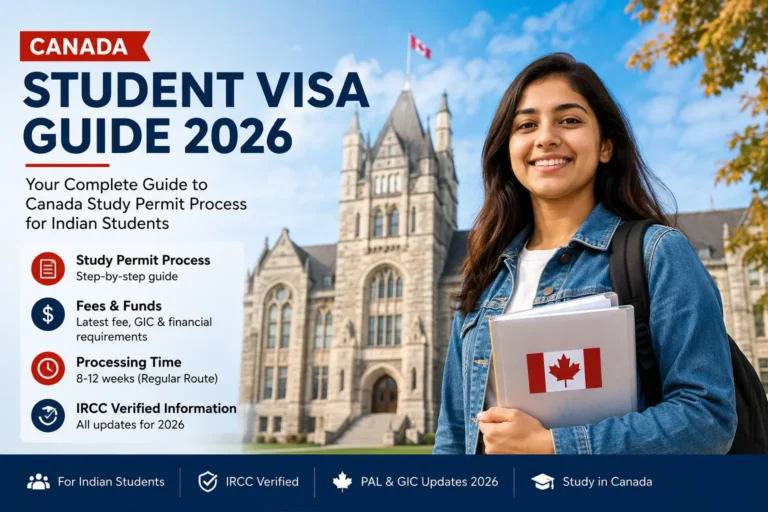
Canada Student Visa Guide 2026 — Study Permit Process for Indian Students
SDS discontinued. GCKey portal closed. PAL now required for undergraduates. This guide covers the complete 2026 study permit process — every fee, document, and step — verified from IRCC.
✍️ Sameer Jadhav, Content Strategist, IMFS | 👁 Reviewed by Reshma Bokaria, Admissions Reviewer (Canada & Australia), IMFS | 📅 July 30, 2026
📋 Key Takeaways — Before You Apply
- Study permit fee: CAD $150 + CAD $85 biometrics = CAD $235 minimum. 🟢 IRCC
- Proof of funds: CAD $22,895/year living + full tuition + return travel (from Sep 1, 2025). 🟢 IRCC
- SDS is gone — all Indian students apply through the regular route. Processing: 8–12 weeks. 🟢 IRCC
- PAL: Required for UG/diploma. Masters/PhD at eligible public institutions EXEMPT from Jan 2026. 🟢 IRCC
- Study permit ≠ student visa — two separate documents. Indian citizens need both. Apply together via IRCC Secure Account. 🟢 IRCC
- GCKey is closed — apply only via IRCC Secure Account at ircc.canada.ca (since March 25, 2025). 🟢 IRCC
- Co-op: Auto-included in your study permit from April 1, 2026. No separate application or fee. 🟢 IRCC
- Work during study: 24 hrs/week off-campus (permanent under Bill C-12). Full-time during academic breaks. 🟢 IRCC
What is a Canada Study Permit?
A Canada study permit is an official document issued by IRCC (Immigration, Refugees and Citizenship Canada) that authorises you to study at a Designated Learning Institution (DLI) in Canada. It is not the same as a student visa — Indian students typically need both. The study permit allows you to study; the student visa (Temporary Resident Visa) allows you to enter Canada. Both are applied for simultaneously via the IRCC Secure Account. You cannot study in Canada without a valid study permit for programs longer than 6 months. Source: IRCC. 🟢
Request official transcripts 2–3 months before you apply for your visa. Many Indian universities issue official transcripts only by registered post, taking 6–8 weeks with per-copy fees. Students who delay this miss their visa window after receiving their LOA. Start the transcript process the same week you submit your university applications — not after receiving an offer.
⚠️ Major 2026 changes — confirm you understand these before applying: (1) SDS is permanently discontinued — no fast track. (2) GCKey portal is closed — use IRCC Secure Account only. (3) Funds threshold raised to CAD $22,895/year (from Sep 1, 2025). (4) Masters/PhD students are PAL-exempt and cap-exempt from Jan 2026. (5) Co-op work permit eliminated — now auto-included in study permit from April 1, 2026. See full details: Canada Immigration Changes Guide →
Canada Study Permit — Step-by-Step Process 2026
Apply at least 3–4 months before your program start date. With SDS discontinued, regular processing takes 8–12 weeks. Each step below must be completed in sequence.
- 1Get accepted by a Designated Learning Institution (DLI)
Apply to a Canadian university or college. Verify it is on IRCC's official DLI list at canada.ca before accepting. Your Letter of Acceptance (LOA) must include the institution's DLI number. A non-DLI LOA = automatic refusal. Source: IRCC. 🟢
- 2Obtain PAL (if you are an undergraduate or diploma student)
Masters and PhD students at eligible public institutions are exempt from PAL from January 2026. Undergraduate and diploma students must obtain a Provincial Attestation Letter from their province. Your university's international office initiates this — contact them immediately after receiving your offer. Do not apply for PAL directly. Source: IRCC. 🟢
- 3Prepare proof of funds (GIC or bank statements)
You must show CAD $22,895/year for living costs plus full first-year tuition plus return travel costs (from Sep 1, 2025). GIC method: invest minimum CAD $10,000 with an IRCC-approved Canadian bank (Scotiabank, TD, CIBC, RBC, BMO). Bank statement method: 6 months of stable history — large deposits right before applying are the #1 red flag. GIC is refundable if refused. Source: IRCC. 🟢
- 4Complete biometrics at a VFS Global centre
Cost: CAD $85. Give fingerprints and photo at any VFS Global centre in India. Valid for 10 years once given — you won't need to repeat if your biometrics are still on file. Book early — slots in Mumbai, Delhi, and Bengaluru fill weeks in advance during peak months. Source: IRCC. 🟢
- 5Get medical examination done (if staying 6+ months)
Required for all study programs 6 months or longer. Must be done by an IRCC-approved panel physician only — results from any other doctor are not accepted. The panel physician uploads results directly to IRCC. Cost: approximately INR 4,500–6,500. Find approved physicians at canada.ca. Exam results are valid for 12 months. Source: IRCC. 🟢
- 6Submit application via IRCC Secure Account
Apply at ircc.canada.ca — use the IRCC Secure Account (GCKey closed March 25, 2025). Upload all documents. Pay CAD $150 (study permit) + CAD $85 (biometrics) online by credit card. Your student visa (TRV) and study permit are typically processed together for Indian applicants. Source: IRCC. 🟢
- 7Receive Port of Entry Letter and travel to Canada
If approved, you receive a Port of Entry (POE) Introductory Letter — print this and bring it to the airport. Your actual study permit is issued by a CBSA officer at the Canadian port of entry when you land. Apply for your Social Insurance Number (SIN) within your first week in Canada — you need it before starting any work. Source: IRCC. 🟢
Complete Document Checklist — Canada Study Permit 2026
| Document | Required? | Who Needs It | Notes |
|---|---|---|---|
| Valid passport | ✅ Yes | All | Valid for full study duration + 3 months. All blank pages matter. |
| Letter of Acceptance (LOA) | ✅ Yes | All | Must include DLI number. Conditional offers not accepted. |
| PAL (Provincial Attestation Letter) | UG/Diploma: ✅ Masters/PhD: Exempt | UG/Diploma only | University international office initiates. Do not apply directly. |
| Proof of funds | ✅ Yes | All | CAD $22,895/yr living + tuition + travel. GIC or bank statements (6-month history). |
| Biometrics confirmation | ✅ Yes (most) | Most applicants | CAD $85 at VFS Global India. Valid 10 years. |
| Medical examination | ✅ If 6+ months | Most applicants | Panel physician only. Valid 12 months. Results uploaded by physician to IRCC directly. |
| Statement of Purpose | ✅ Strongly recommended | All | Why Canada, why this program, why you'll return to India. Be specific. |
| IELTS / TOEFL / PTE score | ✅ Yes | All | Academic for university admission. General Training needed for PGWP CLB later. |
| Official transcripts | ✅ Yes | All | All degree and diploma certificates. Attested if required by university. |
| Police clearance | If required | Some | IRCC specifies based on countries lived in. India clearance if stayed 6+ months age 18+. |
| Custodianship declaration | If under 17 | Minor students | Notarized letter from parent or legal guardian. |
Canada Study Permit Fees 2026 — Full Breakdown
| Fee Item | Amount | Paid To | Refundable? |
|---|---|---|---|
| Study permit application | CAD $150 | IRCC (online) | ❌ No |
| Biometrics | CAD $85 | IRCC (online) | ❌ No (if given) |
| GIC investment | CAD $10,000 min | Approved Canadian bank | ✅ Yes — if visa refused |
| Medical examination | ~INR 4,500–6,500 | Panel physician (India) | ❌ No |
| VFS service charge | CAD $30–100 | VFS Global | ❌ No |
| Student visa (TRV) | Included in study permit fee | IRCC | — |
| Minimum total out-of-pocket | ~CAD $235 + INR 5,000 + VFS | — | — |
Book your VFS biometrics appointment the same day you submit your IRCC application — especially August through November. VFS Global slots in Mumbai, Pune, and Bengaluru fill 3–4 weeks ahead during the September–December peak. Waiting until your file is acknowledged can delay your entire application by a month.
All IRCC fees from ircc.canada.ca. Verify current fees before applying — fees change periodically. 🟢 IRCC
Provincial Attestation Letter (PAL) — Who Needs It and How to Get It
📌 PAL in one sentence: A PAL is a letter from a Canadian province confirming it has allocated a study permit slot to your specific application. It exists because IRCC capped total study permits at 408,000 for 2026 — provinces decide how to distribute their allocation. Source: IRCC. 🟢
| Student Type | PAL Required? | From Cap? | From Jan 2026 |
|---|---|---|---|
| Undergraduate (Bachelor's) | ✅ Yes | Yes (counts toward 408,000) | No change |
| College / PG Diploma | ✅ Yes | Yes (counts toward 408,000) | No change |
| Masters at eligible public university | ❌ No (exempt) | Exempt | Exempt from Jan 2026 |
| PhD / Doctoral | ❌ No (exempt) | Exempt | Exempt from Jan 2026 |
| Official exchange programs | ❌ No (exempt) | Exempt | Exempt |
How to Get Your PAL
- Accept your offer letter from the Canadian institution
- Contact the institution's International Student Office immediately and ask them to initiate your PAL request to the province
- The institution submits your details to the provincial government
- The province issues the PAL (timing varies — can take days to weeks depending on province)
- The institution sends you the PAL — include it in your study permit application
⚠️ Do not apply for a study permit without your PAL if you are an undergraduate or diploma student. IRCC will refuse your application and the CAD $150 fee is non-refundable. Contact your university's international office the same day you accept your offer. Source: IRCC. 🟢
GIC Explained — Proof of Funds for Canada Study Permit
✅ The GIC is your money — not a fee. You invest CAD $10,000 minimum with an IRCC-approved Canadian bank. This money is held in Canada and released to you in instalments after you arrive. It is fully refundable if your study permit is refused. Think of it as opening a Canadian bank account in advance. Source: IRCC. 🟢
IRCC-Approved GIC Providers (India)
| Bank | India Partner | GIC Amount |
|---|---|---|
| Scotiabank | Most widely used by Indian students | CAD $10,000+ |
| TD Bank | HDFC (select branches) | CAD $10,000+ |
| CIBC | Direct application online | CAD $10,000+ |
| BMO | Direct application online | CAD $10,000+ |
| RBC | Direct application online | CAD $10,000+ |
The GIC confirmation letter from your Canadian bank takes 2–4 weeks after you make the investment. Students who invest in a GIC on the same day they plan to submit their visa application consistently face delays. Invest as soon as you receive your unconditional LOA — build the bank's processing time into your application timeline.
Always verify current IRCC-approved GIC providers at canada.ca before investing. The approved list may change. 🟢 IRCC
The GIC covers part of the CAD $22,895 living funds requirement. You must also show first-year tuition and return travel funds separately — through bank statements or education loan documents.
Why Canada Study Permits Get Refused — Top 5 Reasons for Indian Students
IRCC refusal rates for Indian students increased significantly in 2024–2025. These are the most common reasons:
- Weak intent to return to India — IRCC must believe you will leave Canada when your permit expires. Lack of strong ties to India (employment, property, family) raises this concern. Your SOP must address this explicitly.
- Suspicious or insufficient funds — Meeting CAD $22,895 is necessary but not sufficient. Funds need 6 months of stable history. Sudden large transfers just before applying are the single biggest red flag IRCC officers watch for.
- Weak Statement of Purpose — Generic SOPs that could apply to any student at any university show lack of genuine intent. Be specific: why this program, why this university, why Canada, what is your career plan, and how does studying in Canada serve your goals in India.
- Missing or invalid PAL — Undergraduate and diploma students who submit without a PAL get automatic refusals. The cap cannot be overridden.
- Non-DLI institution or non-disclosure — Applying for a non-DLI institution, or failing to declare previous visa refusals (any country) are automatic grounds for refusal and can trigger longer bans.
📌 Reapplying after refusal: There is no mandatory waiting period. You can reapply immediately with a stronger application addressing the refusal reason. Read your refusal letter carefully — IRCC must state the reason. IMFS counsellors review refusal letters and help rebuild applications. Book a free session →
→ See: Canada Visa Interview Questions — How to Answer Them →
After Your Study Permit Arrives — First Steps in Canada
At the Port of Entry (Airport)
- Print your POE Introductory Letter — the CBSA officer issues your actual study permit stamp at the airport
- Have all documents accessible: passport, LOA, proof of funds, medical results
- Your study permit is valid for the duration of your program + 90 days
- Check your permit for errors immediately — request corrections at the airport if needed
Within Your First Week
- Apply for SIN (Social Insurance Number) at a Service Canada office. You need your study permit. Your SIN will start with 9 (temporary). You cannot work legally without a SIN. Source: Service Canada. 🟢
- Open a Canadian bank account — your GIC instalments will be deposited here
- Enrol in your university's health plan — check provincial health coverage (OHIP in Ontario has a 3-month wait)
- Enrol in classes and activate your student card
→ See: Student Banking in Canada — Complete Guide → | Top 10 Canada Study Tips for Indian Students →
5 Mistakes Indian Students Make With Canada Study Permits
These are the behaviour patterns behind refusals — IMFS counsellors see these consistently across applicants every cycle.
- 1Applying without checking DLI status
Every year students accept offers from institutions not on IRCC's DLI list — including some private colleges with impressive websites. A non-DLI LOA = automatic refusal and non-refundable CAD $150 fee. Takes 2 minutes to verify at canada.ca before accepting any offer.
- 2Depositing a large lump sum just before applying
IRCC officers specifically look for sudden large deposits. Bank statements showing a consistently low balance with a sudden CAD $23,000 injection just before applying raise flags about borrowed funds — a common refusal trigger regardless of the final balance. Build funds over 6 months.
- 3Uploading unofficial transcripts
IRCC requires official, university-sealed transcripts. Screenshots of grade portals, unofficial downloads, or email attachments from a registrar are not official documents. Confirm with your registrar exactly what format IRCC accepts for Indian credentials.
- 4Writing a SOP that mentions career goals in Canada
A study permit SOP must demonstrate intent to study and return to India — not to settle in Canada. The strongest SOPs explicitly describe post-study plans at home. Mentioning Canadian job prospects or long-term settlement creates intent flags that officers are trained to notice.
- 5Not declaring previous visa refusals
IRCC immigration history — including refusals from Canada, USA, UK, Australia, or any country — must be declared. Non-disclosure is a separate refusal ground and can trigger longer bans than the original refusal would have. Declare everything and address it in your SOP.
Canada Study Permit FAQs — 2026
How much is the Canada study permit fee in 2026?
CAD $150 (study permit) + CAD $85 (biometrics) = CAD $235 minimum. Additional: VFS service charge, medical exam cost (~INR 4,500–6,500). The GIC investment (CAD $10,000+) is not a fee — it's your money. Pay the IRCC fees online via the IRCC Secure Account. Source: IRCC. 🟢
How much money do I need to show for a Canada study permit?
From September 1, 2025: CAD $22,895/year for living expenses + full first-year tuition + return travel to India. These are separate requirements — all three must be shown. GIC covers part of the living funds. Bank statements must show 6 months of stable history. Source: IRCC. 🟢
Is SDS still available for Indian students?
No. SDS (Student Direct Stream) has been permanently discontinued. All Indian students apply through the regular study permit route with 8–12 weeks processing time. There is no current fast-track alternative. Source: IRCC. 🟢
Do I need a PAL for my Canada study permit?
Depends on your level. Undergraduate and diploma students must get a PAL from their province. Masters and PhD students at eligible public institutions are exempt from January 2026. Your university's international office handles the PAL process. Source: IRCC. 🟢
How long does Canada study permit processing take?
Approximately 8–12 weeks via the regular route for Indian applicants. Apply 3–4 months before your program start date. IRCC may request additional documents during processing — this pauses your timeline. Track your application in the IRCC Secure Account. Source: IRCC. 🟢
Is a study permit the same as a student visa for Canada?
No — two different documents. The student visa (TRV) lets you enter Canada. The study permit lets you study in Canada. Indian citizens need both. When you apply via the IRCC Secure Account, both are typically processed together. Source: IRCC. 🟢
Can I work while studying in Canada?
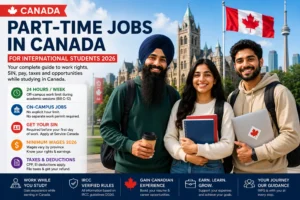
Yes. Up to 24 hours/week off-campus during academic sessions (Bill C-12 permanent cap). Full-time during scheduled breaks. On-campus work has no specific hour limit from IRCC. Co-op placements are now auto-included in your study permit from April 1, 2026. Source: IRCC. 🟢
What happens if my Canada study permit is refused?
You receive a refusal letter stating the reason. No mandatory waiting period — reapply immediately with a stronger application. The GIC investment is refundable if refused. Common reasons: insufficient funds, weak SOP, missing PAL, unclear ties to India. IMFS counsellors review refusal letters and help rebuild. Book a session →
What is a DLI and how do I check if my college is one?
DLI (Designated Learning Institution) is a Canadian school approved by a provincial government to host international students. Your study permit is refused if your institution is not on the DLI list. Verify at canada.ca/en/immigration-refugees-citizenship/services/study-canada/study-permit/prepare/designated-learning-institutions-list.html before accepting any offer. Source: IRCC. 🟢
Can I apply for a Canada study permit with a conditional offer letter?
No. IRCC requires an unconditional Letter of Acceptance. A conditional offer (pending language scores, final year results, or other requirements) is not accepted. Complete all conditions first, then apply for your study permit once you have an unconditional LOA. Source: IRCC. 🟢
Planning to Study in Canada? Start Here.
Free 30-minute session at all 10 IMFS branches. We check your DLI, PAL eligibility, GIC setup, and SOP — before you submit a single document.
Dadar · Thane · Borivali · Vashi · Shivaji Nagar Pune · Kukatpally · LB Nagar · Madhapur Hyderabad · Nellore · Warangal
🍁 Continue Your Canada Journey
About This Guide
Written by Sameer Jadhav, Content Strategist and International Education Research Specialist, IMFS. Reviewed by Reshma Bokaria, Admissions Reviewer (Canada & Australia), IMFS.
All policy facts verified against IRCC (ircc.canada.ca). Last reviewed: July 30, 2026. Next review: October 2026.
Related Guides — Canada Cluster