🇨🇦 Canada · Work While Studying · 2026 Guide
Part-Time Jobs in Canada for International Students 2026 — Work Rights, SIN & Pay Guide
You can work 24 hours/week off-campus and unlimited hours on-campus. This guide covers exactly how — from getting your SIN to understanding taxes, minimum wages, and the best jobs for Indian students in Canada.
✍️ Sameer Jadhav, Content Strategist, IMFS | 👁 Reviewed by Reshma Bokaria, Admissions Reviewer (Canada & Australia), IMFS | 📅 July 30, 2026
📋 What Indian Students Need to Know About Working in Canada
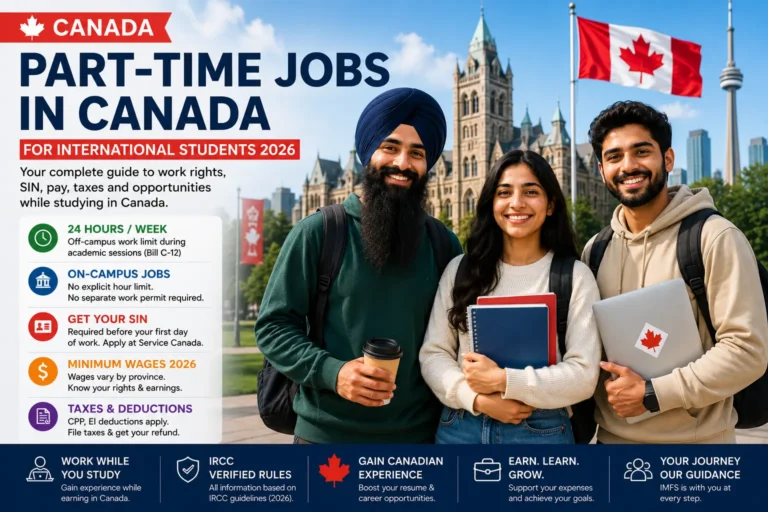
- Off-campus: 24 hrs/week during academic sessions — permanent under Bill C-12. Not 20 hrs, not unlimited. 24. 🟢 IRCC
- On-campus: no explicit limit from IRCC — but maintain full-time student status or you lose your work authorization. 🟢 IRCC
- Academic breaks: full-time — work as many hours as you want during summer and winter breaks. 🟢 IRCC
- SIN is mandatory before your first shift. Apply at Service Canada with your study permit. Takes 1 day. 🟢 Service Canada
- Co-op is now auto-included in your study permit from April 1, 2026 — no separate application. 🟢 IRCC
- CPP and EI deducted from every paycheck — not optional. You can claim EI benefits after graduating. 🟢 CRA
- File taxes by April 30 — many students get refunds due to low income and the Basic Personal Amount credit. 🟡 CRA — verify at cra.gc.ca
- Annual earnings estimate: approximately CAD $20,000–25,000 (24 hrs/week at term + full-time in breaks) — highly variable by province and sector.
Can International Students Work Part-Time in Canada?
Yes. If you have a valid Canadian study permit and your program is at a DLI (Designated Learning Institution), you are automatically authorised to work in Canada — both on and off campus. You do not need a separate work permit to work in Canada as a full-time student. The only requirement is a valid study permit and your SIN (Social Insurance Number). Off-campus work is capped at 24 hours/week during academic sessions under Bill C-12. On-campus work has no explicit hour cap from IRCC. Source: IRCC. 🟢
On-Campus vs Off-Campus Work — Key Differences
🏫 On-Campus Work
- No explicit hour limit from IRCC
- No separate work permit needed
- No off-campus 24-hr rule applies
- Positions within your institution or affiliated organisations
- Library, cafeteria, bookstore, IT support, research assistant, teaching assistant
- Most stable — institution knows your academic schedule
- Research/Teaching Assistant: best pay (CAD $18–25/hr typically)
🏙️ Off-Campus Work
- Maximum 24 hours/week during academic sessions (Bill C-12)
- Full-time during scheduled academic breaks
- No separate work permit needed (included in study permit)
- Retail, hospitality, food delivery, customer service, tutoring
- Co-op placements count as off-campus — now auto-included in study permit (April 2026)
- Gig work (DoorDash, UberEats): flexible but self-employed — different tax treatment
⚠️ The 24-hour rule is strictly enforced. IRCC officers can verify your work history through payroll records. Working more than 24 hours/week off-campus violates your study permit conditions and can affect future immigration applications including PGWP and PR. Always count your hours accurately. Source: IRCC. 🟢
How to Get Your SIN (Social Insurance Number)
You cannot work legally in Canada without a SIN. Apply within your first week of arriving. There is no cost to get a SIN.
- 1Locate your nearest Service Canada office
Search at servicecanada.gc.ca. Most major Canadian cities have walk-in centres. No appointment needed at most locations.
- 2Bring your study permit and passport
Both are required. Ensure your study permit is the stamped copy from the port of entry, not just the Port of Entry Letter. Source: Service Canada. 🟢
- 3Complete the application form
A Service Canada officer will process your application on the spot. You receive your SIN the same day or within a few days by mail.
- 4Your SIN starts with 9 — that's normal
International students receive a temporary SIN beginning with the digit 9. This is valid for work purposes. Keep your SIN private — do not share it unless required for payroll or tax purposes. Source: Service Canada. 🟢
Open your Canadian bank account and get your SIN on your first day in Canada — not your first week. Your GIC instalments cannot be deposited until your account is active. Most major Canadian banks (Scotiabank, TD, RBC) offer newcomer packages with free banking for the first year. Bring your study permit and passport. Takes 45 minutes. Do not leave this for later.
Minimum Wages by Province — What You'll Earn
💡 These are indicative rates. Provincial minimum wages change at different times during the year. Always verify the current rate at your provincial government's employment standards website before accepting a job offer. 🟡 Indicative
| Province | Approx. Min. Wage (2025–26) | Major City | Verify At |
|---|---|---|---|
| British Columbia | ~CAD $17.40/hr | Vancouver | gov.bc.ca |
| Ontario | ~CAD $17.20/hr | Toronto, Ottawa, Hamilton | ontario.ca |
| Alberta | ~CAD $15.00/hr | Calgary, Edmonton | alberta.ca |
| Quebec | ~CAD $15.75/hr | Montreal | cnt.gouv.qc.ca |
| Saskatchewan | ~CAD $15.00/hr | Saskatoon, Regina | saskatchewan.ca |
| Manitoba | ~CAD $15.80/hr | Winnipeg | gov.mb.ca |
| Nova Scotia | ~CAD $15.70/hr | Halifax | novascotia.ca |
All rates are approximate and indicative for 2025–26. Verify at your provincial employment standards website. Many employers — especially on-campus and in tech — pay above minimum wage. 🟡
Calculate Your Part-Time Earnings
Use the IMFS Part-Time Earnings Calculator — input your province, hourly rate, and hours per week to see annual take-home estimates.
Open Calculator →Best Part-Time Jobs for Indian International Students in Canada
| Job Type | Typical Pay | Hours Flexibility | Best For | Where to Find |
|---|---|---|---|---|
| Research/Teaching Assistant | CAD $18–25/hr | Medium | All students (especially Masters/PhD) | University department notice boards, email professors directly |
| Campus positions (library, IT, admin) | CAD $16–19/hr | High | All students | University careers portal, student union |
| Retail / Grocery store | Min wage–CAD $18/hr | High | All students | Walmart, Loblaws, Tim Hortons, TD stores |
| Coffee shops / Food service | Min wage–CAD $18/hr | Very high | All students | Tim Hortons, Starbucks, local cafes |
| Customer service / Call centre | CAD $16–20/hr | High | Strong English speakers | Indeed, LinkedIn, company websites |
| Tutoring / Online teaching | CAD $20–35/hr | Very high | Strong subject knowledge | Superprof, Varsity Tutors, personal ads |
| Food delivery (DoorDash, UberEats) | CAD $15–25/hr (variable) | Maximum | Students with flexible schedules | App-based signup |
| IT / Tech support | CAD $18–28/hr | Medium | CS, IT, Engineering students | University IT department, Geek Squad, local firms |
Pay rates are indicative. Gig economy jobs (DoorDash, UberEats) classify you as self-employed — no CPP/EI contributions, but also no employer benefits. Research/Teaching Assistantships are the highest-value positions for Masters/PhD students. 🟡
→ See: Best Jobs for International Students in Canada (post-graduation focus) →
Tax Basics for International Students Working in Canada
📌 This section is a general overview only — not tax advice. Tax rules for international students in Canada are complex and vary by your specific situation. Verify everything at cra.gc.ca or consult a Canadian tax professional. 🟡
What Happens on Your First Paycheck
- CPP (Canada Pension Plan) — deducted automatically. You contribute to CPP on all employment income. As an international student, you may not receive the full benefit later, but the contributions are non-negotiable. Source: CRA. 🟢
- EI (Employment Insurance) — deducted automatically. Useful: if you lose your job after graduation, you may be eligible for EI benefits using contributions made during your study period. Source: CRA. 🟢
- Federal and provincial income tax — withheld based on your TD1 form (which you fill out when hired). Most students at low income levels get much of this back as a refund.
Filing Your Tax Return
- Tax year: January 1 – December 31
- Filing deadline: April 30 of the following year
- You will receive a T4 slip from each employer showing total income and deductions
- International students who spend 183+ days in a tax year in Canada are typically taxed as Canadian residents — meaning access to credits and deductions that reduce or eliminate tax owed
- Basic Personal Amount: First ~CAD $15,700 of income is tax-free federally (verify exact amount at cra.gc.ca)
- Many students working part-time earn below or near the basic personal amount — resulting in a full or partial refund of income tax withheld
- File for free using Wealthsimple Tax (free for students), UFILE, or TurboTax Canada
✅ Most Indian students working part-time get a tax refund when they file — because more tax is withheld during the year than they actually owe at their income level. File your return even if you think you owe nothing — the refund won't come unless you file. 🟡 indicative — verify at cra.gc.ca
Keep a written log of your weekly work hours across all employers. If you work 16 hours at retail and 10 hours on DoorDash the same week, you have exceeded the 24-hour off-campus limit — even though each job individually looks fine. IRCC can request employment records during PGWP and Express Entry applications. Students who cannot account for their work history have had PGWP applications complicated as a result.
File your Canadian tax return even if you earned nothing in your first year. Filing establishes your Canadian tax history, which IRCC checks during Express Entry and PR applications. Students who skipped their first return because they "didn't earn enough" sometimes face complications proving residency history years later. Filing takes 20 minutes using Wealthsimple Tax (free for students). 🟡 — verify tax obligations at cra.gc.ca
6 Common Mistakes Indian Students Make When Working in Canada
- Not getting a SIN before starting work — working without a SIN is illegal and puts your immigration status at risk. Apply the day you arrive. Takes 1–2 hours at Service Canada.
- Exceeding 24 hrs/week off-campus — IRCC can verify through payroll records. This violates your study permit conditions and affects future PGWP and PR applications.
- Treating gig work as "not real work" — driving for Uber/DoorDash counts toward your 24 hrs/week. It's employment income and is taxable. Keep track of your hours across all jobs.
- Not filing a tax return — even if you owe nothing. Refunds are common. IRCC may also check tax compliance history during immigration applications.
- Not telling your bank about your income — if you open a GIC or student account, some banks restrict certain transactions. Inform your bank when you start receiving a salary.
- Taking a part-time job during exam season — dropping below full-time student status (or failing courses due to work pressure) can affect your study permit and PGWP eligibility. Academic standing comes first.
Can Your Spouse Work in Canada While You Study?
📌 Since November 2024: Spousal open work permits are available to spouses/common-law partners of students enrolled in Masters, PhD, and certain professional degree programs. Spouses of undergraduate and diploma students are generally no longer eligible for a spousal open work permit. This policy changed in 2024 and may be subject to further review under the Strong Borders Act. Always verify current eligibility at canada.ca before your spouse applies. Source: IRCC. 🟢
Part-Time Jobs in Canada — FAQs
How many hours can international students work in Canada?
24 hours/week off-campus during academic sessions (Bill C-12 permanent). Full-time during academic breaks. On-campus: no explicit IRCC limit — maintain full-time student status. Source: IRCC. 🟢
Do international students need a work permit to work in Canada?
No separate work permit is needed. Work authorization (both on and off campus) is built into your study permit. You need a valid study permit and a SIN (Social Insurance Number). That's it. Source: IRCC. 🟢
What is a SIN and how do I get one?
SIN (Social Insurance Number) is the unique identifier used for all employment and tax purposes in Canada. International students get a SIN starting with 9 (temporary). Apply at any Service Canada office with your study permit and passport. Free, same-day or within a few days. Source: Service Canada. 🟢
What is the minimum wage in Canada for students?
Minimum wages vary by province. Approximate 2025–26 rates: Ontario ~CAD $17.20/hr, BC ~CAD $17.40/hr, Alberta ~CAD $15.00/hr, Quebec ~CAD $15.75/hr. These are indicative — verify at your provincial government website. 🟡
Do international students pay tax on part-time income in Canada?
Yes. Students spending 183+ days in Canada are typically taxed as Canadian residents. CPP and EI are deducted from every paycheck. File a T4 return by April 30. Many students at part-time income levels get refunds. Verify at cra.gc.ca. 🟡 CRA
Can I do food delivery (DoorDash, UberEats) as an international student?
Yes — but food delivery is gig (self-employed) work, which counts toward your 24 hrs/week off-campus limit. As self-employed, you won't have CPP/EI deducted automatically — you report this income in your tax return and pay any tax owed. Keep track of your hours across all jobs. 🟡 CRA
What jobs pay the best for international students on campus?
Research Assistant (RA) and Teaching Assistant (TA) positions typically pay CAD $18–25/hr — the highest on-campus rates. Apply directly to department professors by emailing your CV and expressing interest. Competition is high but the pay and CV value are unmatched.
Can my spouse work in Canada while I study?
Since November 2024: yes, for spouses/partners of Masters, PhD, and certain professional degree students. Generally no longer available to spouses of undergraduate or diploma students. Policy may change — verify current rules at canada.ca. Source: IRCC. 🟢
Planning Your Canada Budget? Talk to IMFS.
Our counsellors map your total Canada cost — tuition, living, part-time earnings offset, PGWP — so you arrive with a real financial plan, not a guess.
Dadar · Thane · Borivali · Vashi · Shivaji Nagar Pune · Kukatpally · LB Nagar · Madhapur Hyderabad · Nellore · Warangal
🍁 Continue Your Canada Journey
About This Guide
Written by Sameer Jadhav, Content Strategist and International Education Research Specialist, IMFS. Reviewed by Reshma Bokaria, Admissions Reviewer (Canada & Australia), IMFS.
Work rights facts verified against IRCC (ircc.canada.ca). Wage rates are indicative — verify at provincial employment standards websites. Tax overview verified against CRA (cra.gc.ca). Last reviewed: July 30, 2026.
Related Canada Guides