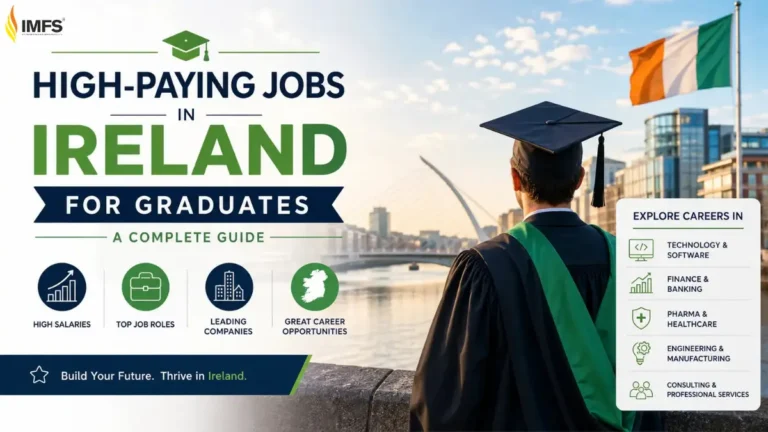
Top 10 Highest Paying Jobs
in Ireland for Graduates in 2026
Ireland's economy in 2026 is one of the strongest in Europe — driven by technology, pharmaceuticals, finance, and a growing professional services sector. For Indian graduates weighing their study abroad options, Ireland offers something rare: a genuinely accessible graduate job market, a post-study work pathway that requires no employer sponsorship, and salaries that compare favourably with the cost of living outside Dublin.
This guide covers the top 10 highest paying jobs in Ireland for graduates in 2026 — with verified salary ranges, required skills, and a clear pathway for international students to access them through the Third Level Graduate Scheme.
Ireland Graduate Salary Overview — All 10 Roles at a Glance
| # | Role | Entry–Mid Salary | Best Degree Fit | Key Sector |
|---|---|---|---|---|
| 1 | Software Engineering | €45,000–€75,000+ | CS, IT, Engineering | Tech |
| 2 | Pharma & Biotech | €40,000–€70,000 | Pharmacy, Life Sciences | Pharma |
| 3 | Finance & Investment Banking | €40,000–€65,000 | Finance, Economics | Financial Services |
| 4 | Data Science & Analytics | €45,000–€75,000 | Data Science, Statistics | Cross-sector |
| 5 | Medicine & Specialist Roles | €80,000–€200,000+ | Medicine (+ specialisation) | Healthcare |
| 6 | Corporate Law | €60,000–€100,000+ | Law (corporate track) | Legal |
| 7 | IT & Project Management | €50,000–€80,000 | IT, Systems Eng, MBA | Tech/Enterprise |
| 8 | Senior Sales & Marketing | €50,000–€90,000 | Marketing, Business, Comms | Tech/FMCG/SaaS |
| 9 | Specialised Engineering | €45,000–€80,000 | Biomed, Energy, Mechanical | Industry |
| 10 | Management Consulting | €55,000–€90,000 | Business, Economics, MBA | Professional Services |
📌 Cost of living context: A comfortable single-person budget in Dublin runs approximately €2,000–€2,500/month (rent, food, transport, utilities). In Cork, Galway, or Limerick, €1,400–€1,800/month is realistic. At the salary ranges above, most roles deliver a strong net-positive after living costs — particularly outside Dublin. See the full breakdown at IMFS Ireland Cost Guide.
The Top 10 Highest Paying Jobs in Ireland in 2026
1 Software Engineering & Development
With the European headquarters of Google, Meta, Apple, Microsoft, and Amazon all based in Ireland, skilled software developers are in continuous high demand. Roles span full-stack development, DevOps engineering, AI/ML specialist positions, and cloud architecture.
2 Pharmaceutical & Biotech Careers
Ireland is home to 9 of the world's top 10 pharmaceutical companies, including Pfizer, Johnson & Johnson, Novartis, and Eli Lilly. Roles in R&D, regulatory affairs, quality assurance, and manufacturing are consistently well-compensated and in high demand.
3 Finance & Investment Banking
Dublin is one of Europe's primary financial centres, hosting the European operations of Citibank, JPMorgan, Bank of America, and numerous asset management firms. Investment analysis, asset management, risk consultancy, and fund administration roles are all well-paid entry points for finance graduates.
4 Data Science & Analytics
Every major sector in Ireland — tech, finance, healthcare, e-commerce, and pharma — needs professionals who can extract insight from data. Data scientists, business analysts, and machine learning engineers are among the fastest-growing roles in the Irish job market in 2026.
5 Medicine & Specialist Roles
Specialist doctors — cardiologists, radiologists, surgeons, and anaesthesiologists — command the highest salaries in the Irish healthcare system. Note: foreign-trained doctors must register with the Medical Council of Ireland and may need additional assessments before practising.
6 Corporate Law & Legal Advisory
Growing international business operations in Ireland — particularly post-Brexit corporate relocations — have significantly increased demand for corporate and M&A lawyers, compliance specialists, and in-house counsel.
7 IT & Project Management
Technology project managers and IT leads overseeing digital transformation, cloud migration, and enterprise system implementations are highly valued across Ireland's multinational and financial services sectors.
8 Senior Sales & Marketing
Senior B2B marketing and enterprise sales professionals — particularly in tech, SaaS, and FMCG companies — earn significantly in Ireland. Roles with regional responsibility across EMEA are particularly well-paid.
9 Specialised Engineering
Biomedical engineers, renewable energy specialists, and process engineers in pharmaceutical manufacturing are in high demand due to Ireland's concentrated pharma industry and growing clean energy sector.
10 Management Consulting
Consultants advising on business strategy, operations, or technology transformation at major consulting firms (Deloitte, PwC, Accenture, McKinsey) in Ireland earn strongly, particularly those with an MBA or deep niche expertise.
Which Jobs Are in High Demand in Ireland in 2026?
Beyond the highest-paid roles, these sectors are experiencing acute talent shortages — meaning strong job security alongside competitive pay:
High Demand — Tech & Data
- Cybersecurity Analysts and Architects
- Cloud Engineers (AWS, Azure, GCP)
- Data Scientists and ML Engineers
- DevOps and Site Reliability Engineers
High Demand — Non-Tech
- Registered Nurses and Allied Health Professionals
- Project Managers (IT, Construction, Healthcare)
- Skilled Trades (Electricians, Plumbers, Carpenters)
- Pharmaceutical Manufacturing Technicians
🎓 Studying in Ireland? Plan Your Career Path Now
IMFS counselors specialise in aligning your degree choice with Ireland's actual job market demand — before you apply, not after.
How Indian Graduates Can Access High-Paying Jobs in Ireland
Ireland actively welcomes international graduates. The pathway is structured and clear — but it requires preparation that starts before you even apply to a university.
1. Understand the Third Level Graduate Scheme
The Third Level Graduate Scheme is Ireland's post-study work pathway for international graduates — and it requires no employer sponsorship. The durations are:
- Level 8 (Bachelor's degree): 12 months to stay and seek employment
- Level 9 (Master's degree): 24 months to stay and seek employment
- Level 10 (PhD): 24 months to stay and seek employment
After securing employment, you can transition to a Critical Skills Employment Permit (for roles on Ireland's Critical Skills list — tech, engineering, pharma, finance) or a General Employment Permit for other roles. The Critical Skills permit also provides a faster route to long-term residence.
💡 Strategy tip: A Master's degree gives you 24 months of post-study job searching vs 12 months for a Bachelor's — twice the runway. If you are targeting competitive sectors like investment banking or tech consulting, the extra time to network, build local experience, and interview is highly valuable. See IMFS Master's Counseling for program shortlisting.
2. Choose the Right Degree for Ireland's Job Market
The programs in highest demand from Irish employers are in computer science, data science, pharmaceutical sciences, biomedical engineering, and finance. Start with the top courses to study in Ireland before finalising your application. Choosing a program without checking graduate employment rates is the single most common mistake Indian students make — see mistakes Indian students make in Ireland for the full list.
3. Prepare Your English Proficiency Score
All Irish universities require IELTS or equivalent for admission. Most programs require IELTS 6.5 overall; postgraduate programs in medicine and law typically require 7.0 or above. IMFS's IELTS coaching program is structured specifically to hit the scores Irish universities require — not just the general passing band.
4. Build a CV to Irish Standards
Irish CVs follow a specific format — typically 2 pages maximum, results-focused bullet points, no photograph, no date of birth. A CV built for Indian job applications will not perform well in Ireland without adaptation.
5. Network Before You Arrive
LinkedIn is the primary professional networking platform in Ireland. Building a strong profile before arrival — connecting with alumni at your target companies, joining Irish industry groups — gives you a significant advantage over graduates who only start networking after landing.
6. Register the Irish Residence Permit (IRP) on Arrival
After arriving in Ireland on your study visa, you must register with the Irish Immigration Service and obtain your Irish Residence Permit (IRP) within 90 days. This card is what your employer will need to verify your right to work — get it done immediately after arrival, not just before your job starts.
📋 Funding your Ireland studies: See financial aid and scholarships for Indian students in Ireland and IMFS Ireland cost guide to plan your full budget before applying.
Frequently Asked Questions
Software Engineering (€45,000–€75,000+), Data Science (€45,000–€75,000), Pharma and Biotech (€40,000–€70,000), Finance and Investment Banking (€40,000–€65,000), and Corporate Law (€60,000–€100,000+) are the strongest-paying entry points. Medicine tops the range at €80,000–€200,000+ for specialists. Ireland hosts the European HQs of Google, Meta, Microsoft, and 9 of the world's top 10 pharmaceutical companies — creating consistent demand across all these sectors.
Yes. Ireland's Third Level Graduate Scheme allows international graduates to stay and seek employment without employer sponsorship — 12 months for Bachelor's graduates, 24 months for Master's and PhD graduates. After securing a role in a high-demand sector, graduates can apply for a Critical Skills Employment Permit which also provides a faster route to long-term Irish residence.
It is Ireland's post-study work pathway for international students. Level 8 (Bachelor's) graduates can stay 12 months; Level 9 (Master's) and Level 10 (PhD) graduates can stay 24 months. No employer sponsorship is required during this period. It allows you to network, build local experience, and apply for a Critical Skills or General Employment Permit to stay long-term.
Entry-level software engineers earn €45,000–€75,000+ depending on specialisation and employer. Entry developers typically start at €45,000; those with AI/ML, DevOps, or cybersecurity skills command more. Dublin and Cork have the highest concentration of tech employers, with Google, Meta, Apple, and Microsoft all actively hiring graduates.
Yes. Pharma and Biotech (€40,000–€70,000), Finance and Investment Banking (€40,000–€65,000), Corporate Law (€60,000–€100,000+), Medicine (€80,000–€200,000+), Management Consulting (€55,000–€90,000), and Senior Sales and Marketing (€50,000–€90,000) are all strong options for non-IT graduates. Ireland's economy is diverse — it is not only a tech hub.
Dublin has the highest concentration of opportunities — tech, finance, and pharma HQs are all there. Cork is strong in pharma and tech (Apple, Pfizer). Galway has a growing med-tech sector. Limerick offers engineering and IT roles. Dublin has higher salaries but also significantly higher living costs — Cork, Galway, and Limerick offer better net purchasing power for graduates at similar career stages.
No. English is the primary business language across all professional sectors. Irish (Gaelic) is not required in the private sector. However, knowing an additional European language — French, German, or Spanish — can be advantageous for roles in sales, marketing, customer success, and international-facing positions at multinational companies.
Most Irish universities require IELTS 6.5 overall for admission to undergraduate and taught postgraduate programs. Medicine and Law programs typically require 7.0 or above. For employment, no specific IELTS score is required — strong spoken English is what employers assess in interviews. Achieve a strong admission score and the workplace score looks after itself. IMFS's IELTS coaching is calibrated to Irish university admission thresholds.
The Critical Skills Employment Permit (CSEP) is Ireland's work permit for roles on the government's Critical Skills Occupations list — which includes most technology, engineering, pharmaceutical, and finance roles. It requires a job offer with a minimum annual salary of €32,000 for eligible roles. The CSEP has a faster route to long-term residence than a General Employment Permit and allows the holder's family to join them in Ireland.
Ready to Plan Your Career in Ireland?
Choosing the right course, university, and career track for Ireland's job market is a decision that has long-term consequences. IMFS has placed 67,000+ students globally since 1997 — and our Ireland counseling team knows exactly which programs lead to the best graduate outcomes.