Home › Study in Germany › Best Universities in Germany for International Students
Best Universities in Germany for Indian Students 2026 — Master's Across All Disciplines
TU Munich, RWTH Aachen, LMU, Heidelberg, Mannheim, KIT, TU Berlin, Stuttgart — ranked by field, with APS, dMAT, ECTS, fees, and a complete application roadmap from India.
From Summer Semester 2027, Indian students applying for master's programmes in Engineering, CS, Business, Commerce, Finance, Economics, or Management must submit a dMAT certificate with their APS application. First exam: 26 September 2026. Fee: €150. Next dMAT exam: Q1 2027
✓ Check your dMAT eligibility in 2 minutes → IMFS dMAT coaching → Register for the next dMAT orientation & batch →
- Engineering/CS/STEM: TU Munich, RWTH Aachen, KIT Karlsruhe, TU Berlin, University of Stuttgart
- Business/Economics: University of Mannheim, WHU (private), LMU Munich
- Medicine/Life Sciences: Heidelberg University, LMU Munich
- All require: APS certificate (6–12 weeks) + dMAT (if eligible) + ECTS conversion
- No tuition at public universities — semester contribution €150–€430 only
- Blocked account €11,904 required before visa application
- 1,500+ programmes fully available in English — German not mandatory for all
- 18-month post-study job search visa; EU Blue Card pathway to PR in 21 months
- Why Germany for a Master's?
- Choose Your University by Field of Study
- Top 8 Universities — Profiles and Data
- 2026 Entry Requirements (APS, dMAT, ECTS)
- Language Requirements
- Fees, Blocked Account and Living Costs
- Visa and Post-Study Work
- Professional Qualification Holders (CA, CFA, ACCA, CMA)
- How to Apply from India — 8-Stage Roadmap
- What IMFS Students Say — dMAT Reviews
- FAQ
Germany has been among the top three destinations for Indian master's students for over a decade — and the reasons are structural, not just aspirational. Most public universities charge no tuition fees, the post-study work visa gives graduates 18 months to find employment, and German engineering employers are globally respected. In 2026, the process has become more standardised with mandatory APS certificates, the new dMAT exam, and ECTS credit conversion for every Indian applicant. This guide covers all disciplines — not just STEM — so you can identify the right university for your specific field and profile.
Why Germany for a Master's Degree in 2026?
| Factor | Germany advantage | More detail |
|---|---|---|
| Tuition | €0 at most public universities | Free education guide |
| Duration | 2-year master's — thorough but longer than UK 1-year | USA vs Germany comparison |
| Post-study visa | 18-month job search visa after graduation | Job seeker visa guide |
| PR pathway | EU Blue Card → PR in 21 months | EU Blue Card guide |
| English programmes | 1,500+ master's in English — German not mandatory | English-taught programmes |
| Industry ties | BMW, Siemens, SAP, Bosch, Bayer, BASF on campus | Jobs after graduation |
| Living cost | €650–€1,200/month — lower than UK/USA | Hidden costs guide |
| Scholarships | DAAD, Deutschlandstipendium, university awards | DAAD scholarships guide |
Not sure Germany is right for your profile? Use the IMFS Germany Admission Readiness Checker — a free 2-minute tool that assesses your APS status, ECTS grade, dMAT eligibility, language, and financial readiness before you start applications. If you are weighing Germany against the USA, read the USA vs Germany STEM comparison and the full MS comparison guide.
Choose Your University by Field of Study
This is the most important table in this guide. Germany's best universities are highly specialised — the right choice depends entirely on your field, not just global rankings.
| Field | Top choice | Also consider | English MSc? |
|---|---|---|---|
| Computer Science / AI | TU Munich | TU Berlin, RWTH Aachen, KIT | Yes |
| Mechanical Engineering | RWTH Aachen | TU Munich, Stuttgart, KIT | Partial |
| Data Science / Analytics | TU Munich | RWTH Aachen, TU Berlin, LMU | Yes |
| Electrical Engineering | RWTH Aachen | TU Darmstadt, KIT, TU Munich | Partial |
| Business Administration / MBA | Mannheim | LMU, WHU, Frankfurt School | Yes |
| Finance / Economics | Mannheim | Goethe Frankfurt, LMU, Humboldt | Yes |
| Medicine / Life Sciences | Heidelberg | LMU Munich, Charité Berlin | Partial |
| Renewable Energy | KIT Karlsruhe | RWTH Aachen, TU Berlin | Yes |
| Automotive / Aerospace | Stuttgart | TU Munich, RWTH Aachen | Partial |
| Humanities / Social Sciences | LMU Munich | Humboldt Berlin, Heidelberg | Partial |
For a deep dive into the best courses to study in Germany for high-paying careers, or to check which English-taught programmes are available, IMFS has dedicated guides for both. If engineering or CS is your target, also read the detailed IMFS STEM universities in Germany guide.
Top 8 Universities in Germany — Profiles and 2026 Data
1. Technical University of Munich (TUM)
QS #37 globally (2026) Best for: CS, AI, Data Science, Aerospace, BiomedicalTUM is Germany's highest-ranked technical university and a globally recognised institution for STEM master's programmes. Its partnerships with BMW, Siemens, MAN, Airbus, and Google are not cosmetic — students get direct access to research projects, industry-sponsored theses, and recruitment pipelines. TUM's startup ecosystem (TUM Entrepreneurship Centre) is one of Europe's most active. Munich's economy — Germany's most dynamic — means graduate job opportunities are exceptional.
| Programme | Language | IELTS | GRE role | Tuition |
|---|---|---|---|---|
| MSc Computer Science | English | 6.5 | 160+ Quant positively evaluated | Semester contribution only* |
| MSc Data Engineering & Analytics | English | 6.5 | Positively evaluated | Semester contribution only* |
| MSc Aerospace Engineering | English/German | 6.5 | Not required | Semester contribution only* |
| MSc Biomedical Engineering | English | 6.5 | Not required | Semester contribution only* |
| MSc Management (TUM SOM) | English | 6.5 | GMAT preferred | Varies by programme |
*Some TUM programmes in the School of Management and select faculties charge international student fees. Verify per programme at tum.de.
📍 Munich — best city for Indian students in Germany guide covers cost, community, transport.
2. RWTH Aachen University
QS #106 globally (2026) Best for: Mechanical, Electrical, Chemical, Civil, Data Science, RoboticsRWTH Aachen is Germany's largest technical university and arguably the strongest for engineering across all disciplines. Ford, Toyota R&D, Thyssenkrupp, and E.ON maintain research labs on campus. RWTH's Mechanical Engineering and Electrical Engineering programmes are the most applied-to by Indian students — IMFS applicant data shows competitive profiles typically have CGPA 7.5+/10 and GRE 318+ for RWTH programmes. RWTH also uses dMAT scores as an additional selection indicator beyond the APS requirement.
3. Karlsruhe Institute of Technology (KIT)
QS #116 globally (2026) Best for: Renewable Energy, Mechanical, Electrical, CS, AutomationKIT is simultaneously a state university and a Helmholtz national research centre — giving students access to research infrastructure and funding that ordinary universities cannot match. Its Mechanical Engineering and Renewable Energy programmes are particularly strong. Karlsruhe is a smaller city with significantly lower living costs than Munich or Berlin, making KIT excellent value. See the cheapest universities in Germany guide for a full cost comparison.
4. Technical University of Berlin (TU Berlin)
QS #154 globally (2026) Best for: CS, AI, Industrial Engineering, Applied MathematicsTU Berlin's location in Germany's capital puts students at the heart of Europe's second-largest tech startup ecosystem after London. Berlin's multicultural environment is the most welcoming in Germany for international students. TU Berlin is particularly strong for Computer Science, AI, and Industrial Engineering. The affordable student housing guide notes that Berlin is cheaper than Munich despite being the capital — a key advantage for Indian students managing budgets.
5. Ludwig Maximilian University of Munich (LMU)
QS #63 globally (2026) Best for: Business, Medicine, Life Sciences, Humanities, Natural SciencesLMU is Germany's strongest broad-discipline university — it covers what TUM does not. Where TUM focuses entirely on STEM, LMU's strengths span medicine, economics, law, humanities, and natural sciences. For Indian students targeting MSc programmes in Business Analytics, Life Sciences, or Physics, LMU Munich is the top choice. LMU and TUM are located within 3km of each other, sharing Munich's exceptional job market. Many Indian students apply to both simultaneously.
6. Heidelberg University
QS #87 globally (2026) Best for: Medicine, Life Sciences, Biomedical Research, Natural SciencesGermany's oldest university (founded 1386) and consistently its highest-ranked for medical and life science research. Heidelberg's Cancer Research Centre (DKFZ) is one of the world's leading oncology institutions — MSc students in Biomedical Sciences and Molecular Medicine can access research at a level simply unavailable elsewhere in Germany. For Indian students from biology, pharmacy, or biomedical backgrounds targeting research-led MS programmes, Heidelberg is in a different class. Note that most Heidelberg programmes are in German — verify the programme page before applying.
7. University of Mannheim
QS #801–1000 globally (2026) Best for: Business Administration, Finance, Economics, Data ScienceMannheim's location between Frankfurt (finance) and Stuttgart (automotive, engineering industry) gives MSc Finance and Economics graduates exceptional placement opportunities. English-taught programmes are available. GMAT is preferred for business programmes — IMFS offers GMAT coaching at all branches. Also check GRE prep if your target programme accepts it.
8. University of Stuttgart
QS #318 globally (2026) Best for: Automotive, Aerospace, INFOTECH, Mechanical EngineeringStuttgart is the global capital of automotive engineering — Porsche, Mercedes-Benz, and Bosch are all headquartered nearby. The University of Stuttgart's INFOTECH programme (MSc in Information Technology, fully in English) is designed specifically for international students and is highly regarded. Automotive and Aerospace Engineering graduates from Stuttgart have an almost direct pipeline to the country's largest automotive employers. Stuttgart is also featured in our Germany STEM universities guide with full programme and GRE data.
2026 Entry Requirements — APS, dMAT, and ECTS
These three requirements are new or significantly updated in 2026. Every Indian student applying for a German master's must address all three before submitting university applications.
APS Certificate — Mandatory for All
The APS certificate is issued by APS India and verifies that your Indian academic credentials are authentic. Without it, no German university processes your application and no German embassy issues a student visa. The process takes 6–12 weeks — start at least 10 months before your target intake. If your APS is delayed, read the APS delay guide. For the full three-part process covering APS + ECTS + dMAT together, see the complete Germany MS guide for Indian students.
dMAT Exam — New from June 2026
| Detail | Information |
|---|---|
| Who needs it | Indian applicants for MS from Summer 2027 with bachelor's in Engineering, CS, Business, Commerce, Finance, Economics, Accounting, or Management |
| Next exam date | Q1 2027 |
| Fee | €150 (~₹16,300) |
| Duration | 3.5 hours (digital) |
| Score scale | 0–200 with percentile ranking |
| Tests | Figure sequences, mathematical equations, Latin squares — aptitude not subject knowledge |
| Exemption | APS application submitted before 29 June 2026 |
| Does it replace APS? | No — submitted alongside APS documents |
| Does low score fail APS? | No — low score does not automatically fail APS certificate |
Read the full dMAT for Germany MS guide, the dMAT exam preparation guide 2026, and the new dMAT requirement explained. IMFS dMAT coaching is available at all 10 branches — view new batch details →
ECTS Credit Conversion
German universities evaluate your Indian degree using ECTS (European Credit Transfer System). Your CGPA must be converted to a German-equivalent grade (Notendurchschnitt) using the modified Bavarian formula or the institution's own conversion table. A strong CGPA in Indian terms can convert to a weaker German grade — and if the converted grade does not meet a programme's minimum, your application is rejected regardless of your actual marks. The IMFS German Grade Calculator tells you your converted grade instantly. For the full guide, read ECTS credits explained 2026. IMFS also offers dedicated ECTS preparation coaching to help you identify programmes where your converted grade is competitive.
Language Requirements
| Programme type | Test required | Minimum score | Prepare with IMFS |
|---|---|---|---|
| English-taught master's | IELTS Academic or TOEFL iBT | IELTS 6.0–6.5 / TOEFL 80–90 | IELTS coaching / TOEFL coaching |
| German-taught master's | TestDaF or DSH | TestDaF Level 4 / DSH-2 (B2/C1) | German language coaching |
| Business programmes (some) | GMAT or GRE | GMAT 620+ / GRE 315+ | GMAT coaching / GRE coaching |
| German (for post-study) | Goethe-Zertifikat | A1–B1 for daily life; B1 for PR | German A1–B2 at IMFS |
Fees, Blocked Account and Living Costs
| Cost item | Amount (2026) | Notes |
|---|---|---|
| Tuition — public universities | €0 at most | Baden-Württemberg and some TUM programmes charge extra for non-EU; verify per university |
| Semester contribution | €150–€430 per semester | Often includes city public transport pass — significant saving |
| Blocked account (Sperrkonto) | €11,904 lump sum | Required for student visa; bank releases €992/month. How to open one → |
| Monthly living — Munich | €950–€1,220 | Rent, food, transport, phone. Rent guide |
| Monthly living — other cities | €650–€900 | Aachen, Karlsruhe, Mannheim significantly cheaper than Munich/Berlin |
| Health insurance | ~€110/month | Mandatory for student visa; public insurance available under 30 |
| APS certificate fee | ~€200 | One-time |
| dMAT exam fee | €150 | One-time; if eligible |
Use the IMFS Study Abroad Cost Calculator to model your Germany budget, the Education Loan EMI Calculator to plan repayments, and the Study Abroad ROI Calculator to evaluate the long-term return. Education loans from SBI, HDFC Credila, Axis, and Avanse cover Germany MS programmes — see the full education loan guide. For scholarship options, read the DAAD scholarships guide and the complete scholarships guide for studying abroad. Once in Germany, you'll also need a German bank account — set it up as soon as you arrive.
Visa and Post-Study Work Rights
| Stage | Visa/permit | Duration | Guide |
|---|---|---|---|
| During study | Student visa → Residence permit | Duration of programme + 1 year | Visa requirements · Residence permit |
| After graduation | Job seeker visa | 18 months | Job seeker visa guide |
| After job offer | Work permit / EU Blue Card | 4 years (Blue Card) | EU Blue Card guide |
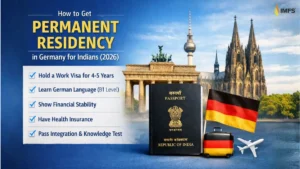
| Long term | Permanent residency (Niederlassungserlaubnis) | 21 months (Blue Card) / 5 years (standard) | Germany PR guide |
Read the 2026 German student visa guide for the full document checklist. After arrival, you must register your address (Anmeldung guide) and open a bank account. Once in Germany, the best apps for international students in Germany guide covers everything you need on your phone. Also avoid the common pitfalls in the top 10 mistakes Indian students make in Germany. For long-term planning, the post-MS to EU PR roadmap lays out the full pathway from graduation to permanent residency.
Professional Qualification Holders — CA, CFA, ACCA, CMA
| Qualification | Germany-relevant pathway | IMFS guide |
|---|---|---|
| ACCA | MSc Accounting/Finance — up to 9 ACCA exam exemptions at UK universities; Germany options for finance-focused MS | ACCA → Master's abroad |
| CFA | MSc Finance at Mannheim, Frankfurt School — CFA progress strengthens application | CFA → MSc Finance abroad |
| CA (ICAI) | MSc Finance, MS Business Analytics, MBA abroad — CA background valued | CA → Master's abroad |
| CMA | MSc Management Accounting, Finance, or Business programmes | CMA → Master's abroad |
| Any professional course | Overview of all pathways from professional qualifications to master's degrees | Master's after professional qualification |
| Commerce background | All commerce + professional course routes to global master's | Commerce → Master's abroad |
How to Apply for German Universities from India — 8-Stage Roadmap
| Stage | When (for Sep/Oct 2027 intake) | What to do | IMFS support |
|---|---|---|---|
| 1. Profile + ECTS assessment | Now — Oct 2026 | Convert CGPA → German grade. Identify competitive programmes. Use German Grade Calculator and CGPA converter. | Free profile session at IMFS Masters Counselling |
| 2. dMAT eligibility check | Now — immediately | Check if your degree field requires dMAT. Register for next exam date. Use dMAT eligibility checker. | IMFS dMAT coaching |
| 3. APS application | Oct–Dec 2026 | Register on APS India portal. Submit degree, mark sheets, ID documents. Submit dMAT certificate when received. Read APS step-by-step guide. | IMFS APS document review |
| 4. Language test | Oct 2026–Feb 2027 | IELTS 6.0–6.5 for English programmes. GRE/GMAT for relevant programmes. German B2/C1 for German-taught programmes. Use IELTS predictor. | IMFS test prep |
| 5. University shortlist | Nov–Dec 2026 | 5–8 universities. IMFS counsellors build the shortlist against ECTS converted grade, field, and career goal. Check readiness checker. | Shortlisting session |
| 6. SOP + applications | Nov 2026–Jan 2027 | Apply via uni-assist (most universities) or directly. Motivation letter (SOP) required. IMFS drafts and reviews SOPs. | SOP drafting + review |
| 7. Blocked account + accommodation | Mar–May 2027 | Open blocked account with €11,904. Read blocked account guide. Book student housing. Read rent guide. | Pre-departure checklist |
| 8. Visa + departure | May–Jul 2027 | German embassy student visa application. Documents: APS certificate, admission letter, blocked account, health insurance, passport photos. Read 2026 visa guide. | Visa document review |
On arrival, set up your address registration (Anmeldung), bank account, and residence permit. The IMFS student essential services page covers insurance, accommodation support, and post-arrival help. For a broader look at study abroad tools, visit IMFS calculators and tools.
What IMFS Students Say — dMAT Coaching Reviews
IMFS launched dMAT coaching immediately after the APS India announcement in June 2026. Here is what students who have trained with IMFS are saying on Google:
"The dMAT coaching at IMFS was incredibly structured. I had no idea what the exam even looked like when I walked in — after 3 weeks of preparation I felt completely ready. The logical reasoning and figure sequence modules were exactly what appeared in the actual exam. Highly recommend to any Germany MS aspirant."
"I was really confused about whether I needed the dMAT — my degree is in Commerce. IMFS confirmed I was eligible, explained the exam pattern clearly, and within 2 weeks I had a clear prep plan. The eligibility checker on their website is very helpful too. The coaching quality is genuinely excellent."
"What I appreciated most was that IMFS handled everything — APS documents, ECTS conversion, dMAT coaching, and my university shortlist — all under one roof. I didn't have to figure out what to do next at any stage. They know the Germany MS process inside out. My TUM application is already submitted."
Frequently Asked Questions
All Germany Guides on IMFS
Last reviewed: September 2026. University rankings, APS procedures, dMAT requirements, tuition policies, and visa rules are subject to change — always verify with the university, APS India (aps-india.de), g.a.s.t. (d-mat.de), and the German embassy before applying. This article is for informational purposes only and does not constitute immigration or legal advice.
Ready to Apply for a Master's in Germany?
IMFS provides the complete Germany MS pathway — ECTS assessment, APS guidance, dMAT coaching, university shortlisting, SOP, and visa preparation. 67,000+ students guided since 1997.