Home › Study in Germany › dMAT Exam Preparation Guide 2027
dMAT Exam Preparation Guide 2027 — Syllabus, Pattern, Scoring and Study Plan
Every question type, the 0–400 scoring, the 16 January and 13 March 2027 test dates, exam rules and how to prepare.
- The dMAT has two compulsory modules that are the same for everyone: the Core Module and the General Academic Module.
- The Core Module has three subtests — Figure Sequences, Mathematical Equations and Latin Squares — with 20 tasks in 25 minutes each.
- The General Academic Module has about 60 single-choice questions in 90 minutes, each based on a short academic text.
- Each module is scored 0–200 (mean 100) with a percentile rank; the total is the sum, so the maximum is 400.
- 2027 test dates: 16 January (register by 4 January, results 8 February) and 13 March (register by 1 March, results 5 April).
- There is no negative marking and no note-taking. Only a passport is accepted as ID.
- The dMAT is not a pass/fail test for APS; universities decide independently how to use the score.
- Your dMAT certificate is generally valid indefinitely (a university can set its own limit if you submit it directly), and you can take the test as many times as you like.
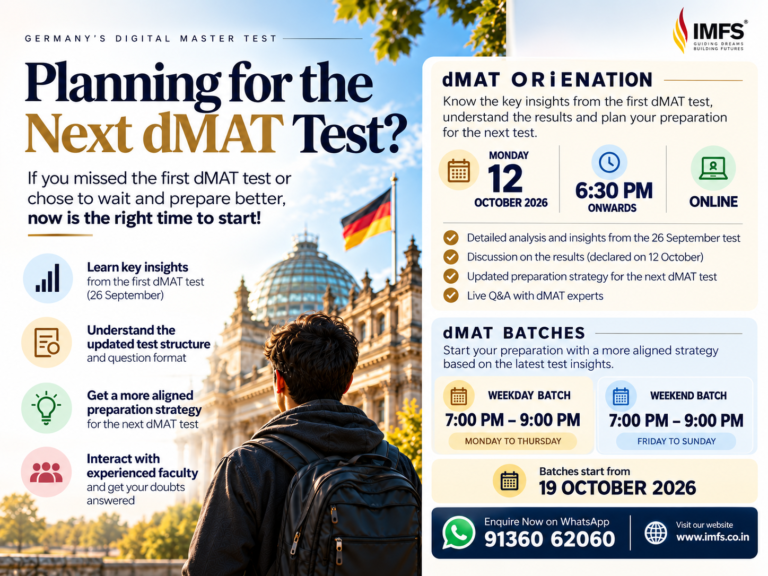
- IMFS runs continuous online dMAT batches: Evening (Mon–Thu, 7–9 PM) and Weekend (Fri–Sun, 7–9 PM).
- Check if it applies to you with the dMAT Eligibility Checker, then take the free dMAT mock test below.
- IMFS Students Shine in the First dMAT
- What Is the dMAT Syllabus?
- Who Needs to Prepare for dMAT?
- Who Develops and Administers the dMAT?
- The dMAT Core Module — Three Question Types Explained
- dMAT Time Breakdown
- The General Academic Module — What It Actually Tests
- Exam Day Rules
- IMFS dMAT Coaching — Online Batches
- What Does Your dMAT Score Actually Mean?
- dMAT 2027 — Registration, Test Centres and Key Dates
- dMAT vs GRE vs GMAT vs TestAS
- Frequently Asked Questions
- Related Guides
Quick answer: the dMAT (Digital Master Test) is the aptitude test that Indian Master's applicants in Engineering, Commerce, Economics and Business must take as part of the APS process for Germany from Summer Semester 2027. It has a Core Module (Figure Sequences, Mathematical Equations, Latin Squares) and a General Academic Module, each scored out of 200. The next tests are on 16 January and 13 March 2027.
This guide explains each question type with worked examples, how the score is calculated, the 2027 dates and exam rules, and how to prepare. It is part of our Study in Germany guidance. If you are still planning your application, start with Germany's new dMAT requirement explained and our Master's counselling team.
IMFS Students Shine in the First dMAT
Results of the first dMAT were declared on 12 October 2026. Highlights from IMFS students across the full test and individual modules:
| Score | Student | Result |
|---|---|---|
| 400/400 | Amey Parab | Full Test |
| 195/200 | Siddharth Jadhav | General Academic Module (GAM) |
| 197/200 | Vishit | Core Module |
| 197/200 | Nidhi Bamhane | Core Module |
| 190/200 | Pranjali Sawant | Core Module |
Individual scores are as shared by the students with IMFS and have not been independently verified.
What Is the dMAT Syllabus?
The dMAT syllabus has two parts, and every test taker gets the same tasks. The Core Module measures general cognitive and analytical skills through three subtests: Figure Sequences, Mathematical Equations and Latin Squares. The General Academic Module tests how well you apply those skills to academic problems: you read a short text and answer single-choice questions about it. You do not need memorised subject knowledge for either module, but you do need practice with the exact formats. See how these formats played out in our analysis of the first dMAT.
Sources: d-mat.de FAQ for India and dMAT preparatory materials (02.09.2026), checked November 2026.
Who Needs to Prepare for dMAT?
You need the dMAT if you are an Indian applicant for a Master's programme in Germany, your intake is Summer Semester 2027 or later, and your undergraduate degree falls in one of the fields below. APS India lists:
- Engineering and Technology: all B.Tech and B.Eng degrees, whatever the specialisation.
- Commerce and Economics: all undergraduate degrees in Commerce, Accounting, Finance or Economics.
- Business and Management: all undergraduate degrees in Business Administration or Management Studies.
- Mixed degrees are covered if the core curriculum or major is in Commerce, Economics, Business or Management.
| Your situation | dMAT required? |
|---|---|
| B.Tech / B.E. student applying for Summer 2027 or later | Yes |
| B.Com / BBA / BMS / Economics graduate applying for Summer 2027 or later | Yes |
| Bachelor's or PhD applicant to Germany | No |
| Official exchange, double-degree or university partnership programme | No |
| Completed APS online registration, or shipped complete documents, before 29 June 2026 | No (transitional exemption) |
| Already holds an APS certificate | No |
| Degree outside the listed fields | No |
Source: aps-india.de/dmat (updated 29 October 2026). The wording on your degree decides — check APS India before registering.
Not sure? Answer six quick questions in the dMAT Eligibility Checker, check your overall profile with the Germany Admission Readiness tool, and confirm your credits with our ECTS credits guide.
Who Develops and Administers the dMAT?
The dMAT is a registered trademark of g.a.s.t. (Gesellschaft für Akademische Studienvorbereitung und Testentwicklung), which registers candidates, runs the test and issues the certificate. Its development was sponsored by the German Academic Exchange Service (DAAD) and the German Rectors' Conference (HRK), and the format was developed with the psychology departments of the University of Ulm and the University of Kassel. The test is taken digitally at designated test centres, administered in English, and evaluated centrally at g.a.s.t. in Bochum. The certificate is issued electronically and can be verified online.
Sources: dMAT certificate, dMAT preparatory materials, d-mat.de FAQ, checked November 2026.
The dMAT Core Module — Three Question Types Explained
The Core Module is the same for every test taker and tests how you reason, not what you know. Each subtest has 20 tasks and 25 minutes, which is about 75 seconds per task. You can try all three formats in the free dMAT mock test after this section.
Figure Sequences
You see a series of matrices in which figures change their position, colour or orientation according to rules. Your task is to work out the pattern and determine the next two matrices. The official rules are:
- Figures can change colour and rotate around their own axis.
- Figures can move vertically, horizontally or diagonally, but a figure cannot switch from a diagonal movement to another type of movement.
- Changes can grow by x + 1: a figure that moves one step from matrix 1 to matrix 2 moves two steps from matrix 2 to matrix 3, then three steps, and so on.
- Figures cannot disappear, overlap or leave the matrix. At an outer boundary they either bounce off or move along the boundary.
How to approach it: track one figure at a time across all matrices, note its movement, colour and rotation separately, check whether the step count is increasing, and check how it behaves at the edge before predicting the next two matrices.
Mathematical Equations
Each task is a system of several equations with letters. Every letter is an integer between 1 and 20, and there is always only one solution in which all equations are correct. Treat each task as a logic puzzle: find the one set of whole numbers that makes every equation true.
| Difficulty | System | Solution |
|---|---|---|
| Low | 7 + A = 14 B − 3 = A | A = 7, B = 10 |
| Medium | 3 × C = A A + C = 8 2 × A + 2 × C = B | C = 2, A = 6, B = 16 |
| High | A − B + C − D = 2 10 × B = C 5 × B = A 11 + B = D | Substituting: 5B − B + 10B − (B + 11) = 2, so 13B = 13 and B = 1. A = 5, C = 10, D = 12 |
Worked examples written by IMFS in the official format.
How to approach it: read every equation first, solve the one with a single unknown to anchor a value, substitute into the rest, and check that the final values satisfy every equation.
Latin Squares
You see a 5×5 grid in which some fields contain letters. Each letter can appear only once in each row and each column, and only the letters shown as response options can appear in the grid. You decide which letter belongs in the box marked with a question mark — sometimes after filling other fields in your head first.
| C1 | C2 | C3 | C4 | C5 | |
|---|---|---|---|---|---|
| R1 | A | B | C | D | E |
| R2 | B | C | D | E | A |
| R3 | C | D | ? | A | B |
| R4 | D | E | A | B | C |
| R5 | E | ? | B | C | D |
Solution: row 3 already has C, D, A and B, so the missing letter is E. Row 5 has E, B, C and D, so its missing letter is A. Check the columns: column 3 now reads C, D, E, A, B and column 2 reads B, C, D, E, A, with no repeats.
| C1 | C2 | C3 | C4 | C5 | |
|---|---|---|---|---|---|
| R1 | A | B | C | D | E |
| R2 | B | C | D | E | A |
| R3 | C | D | E | A | B |
| R4 | D | E | A | B | C |
| R5 | E | A | B | C | D |
Rules quoted from the dMAT preparatory materials (02.09.2026); examples by IMFS.
Practise all three Core Module subtests and the General Academic Module in the official single-choice format. Enter your details to start instantly.
Click below to start. The test opens in a new tab. An IMFS counsellor will also contact you with preparation tips and coaching details.
Open dMAT Mock TestFree · No payment · Instant access after submission
dMAT Time Breakdown
g.a.s.t. describes the exam as about three hours, with a 30-minute break between the two parts. The published section times are:
| Section | Tasks | Time |
|---|---|---|
| Figure Sequences | 20 | 25 minutes |
| Mathematical Equations | 20 | 25 minutes |
| Latin Squares | 20 | 25 minutes |
| Core Module total | 60 | 75 minutes |
| Break | — | 30 minutes |
| General Academic Module | About 60 (may be higher or lower) | 90 minutes |
Sources: dMAT preparatory materials (02.09.2026) and d-mat.de FAQ, checked November 2026.
About 75 seconds per Core Module task leaves little room to stall. Practise under timed conditions so that pacing becomes automatic.
The General Academic Module — What It Actually Tests
The General Academic Module taken for APS is the same for all applicants, whatever their bachelor's subject. Each task is a text about a problem or concept, followed by single-choice questions with four options and exactly one correct answer. Texts, questions and options can include figures, tables or formulas. The questions test whether you can apply what the text explains, not whether you have memorised facts.
Possible topic areas listed by g.a.s.t. are mathematics, computational sciences, natural sciences, engineering, business administration, economics, social sciences and humanities. The official preparatory materials include four sample exercises:
| Sample exercise | Questions |
|---|---|
| Vector Calculations | 8 |
| Hydrostatics | 6 |
| Optimal Order Quantity | 7 |
| Research Strategies in Social Sciences | 6 |
Source: dMAT preparatory materials (02.09.2026). g.a.s.t. notes that sample tasks may not reflect the difficulty of the real test and cover only some topics.
Exam Day Rules
Three rules decide how you prepare and what you carry on test day:
- No negative marking. Wrong answers cost nothing, so answer every question — guess if you have to.
- No notes. You may not take notes at any point in the exam, so practise Mathematical Equations and Latin Squares without writing.
- Passport only. A valid passport is the only accepted ID, and the name you register with must match it.
Source for notes and ID rules: dMAT preparatory materials and d-mat.de FAQ, checked November 2026.
IMFS dMAT Coaching — Online Batches
IMFS runs live online dMAT coaching covering both the Core Module and the General Academic Module, so you can join from anywhere in India. Batches run continuously, which means you can join at any time rather than waiting for a fixed start date.
| Batch | Days | Time |
|---|---|---|
| Evening (online) | Monday to Thursday | 7–9 PM |
| Weekend (online) | Friday to Sunday | 7–9 PM |
Register for a batch using the form below, or message us on WhatsApp. Reviews, results and full programme details are on our IMFS dMAT coaching page. For other entrance tests, see IMFS test prep.
Live online classes for the Core Module and General Academic Module. Batches run continuously, so you can join any time. Leave your details and an IMFS counsellor will call you with the next batch.
An IMFS counsellor will call you shortly with the next online batch and timings. You can also try the free dMAT mock test while you wait.
No payment needed to register · Online classes
What Does Your dMAT Score Actually Mean?
Your certificate shows two separate results, one for the Core Module and one for the subject module (the General Academic Module), plus a total.
- Module score (0–200): the dMAT score converts your number of correct answers to a scale from 0 to 200 with a mean of 100.
- Percentile rank (0–100): the proportion of other participants who achieved a lower or equal result.
- Total score (0–400): the sum of your two module scores.
Source: d-mat.de FAQ and the dMAT certificate format, checked November 2026.
How APS, visas and universities use the score
- APS: the dMAT is not a stand-alone pass/fail test, and a low score does not automatically lead to refusal of the APS certificate. Your APS certificate will indicate that you have taken the dMAT.
- Student visa: g.a.s.t. states that taking the dMAT is sufficient; no minimum score is required.
- Universities: each German university decides independently how it assesses the result. The dMAT does not replace the GRE or GATE.
- Validity and retakes: the certificate is generally valid indefinitely, though a university can set its own rules, and you may take the dMAT as many times as you wish.
Sources: aps-india.de/dmat, d-mat.de FAQ, RWTH and Göttingen programme pages, checked November 2026.
dMAT 2027 — Registration, Test Centres and Key Dates
Registration for both 2027 tests opened on 28 October 2026 on the g.a.s.t. portal.
| Test date | Registration window | Results |
|---|---|---|
| 16 January 2027 | 28 October 2026 – 4 January 2027 | 8 February 2027 |
| 13 March 2027 | 28 October 2026 – 1 March 2027 | 5 April 2027 |
| 26 September 2026 (first test, held) | 29 June – 15 September 2026 | 12 October 2026 |
Sources: g.a.s.t. dMAT registration portal and aps-india.de/dmat, checked November 2026.
| Item | Details |
|---|---|
| Fee | €150, payable during registration (APS India). Payment by PayPal or a Mastercard/Visa credit card with 3D Secure; debit cards are not accepted. |
| Test centres | Ahmedabad, Bengaluru, Bhopal, Chandigarh, Chennai, Kolkata, Mananthavady, Mumbai, New Delhi and Pune, plus Berlin (Germany) and Kathmandu (Nepal). Seats are first come, first served. |
| Changes and refunds | You can change your test centre in the portal until the registration deadline if seats are available. After the deadline there is no refund, including if you do not attend. |
| Format | Digital, at designated test centres, in English; single-choice questions throughout. |
| Contact | dMAT registration, payment and results: kontakt@gast.de. APS questions: info@aps-india.de. |
Sources: aps-india.de/dmat, d-mat.de FAQ, checked November 2026.
How big is the dMAT? At the first test on 26 September 2026, 12,026 of the 12,155 registered candidates sat the dMAT at 23 test centres in 12 cities — 21 in India, plus Kathmandu and Berlin. Bengaluru had the highest demand, with about 3,100 seats.
Source: g.a.s.t. news, 28 September 2026.
dMAT vs GRE vs GMAT vs TestAS
Students preparing for the GRE or GMAT often ask whether that preparation transfers. The tests serve different purposes and use different formats:
| dMAT | GRE General | GMAT | Digital TestAS | |
|---|---|---|---|---|
| Purpose | Part of APS documentation for listed Indian Master's applicants (Summer 2027 onwards) | Graduate admissions test | Business school admissions test | Aptitude test for international applicants who want to study in Germany |
| Length | About three hours with a 30-minute break | About 1 hour 58 minutes | 2 hours 15 minutes | Core Module about 90 minutes, 30-minute break, subject module 90 minutes |
| Structure | Core Module (3 subtests) + General Academic Module | Verbal, Quantitative, Analytical Writing | Quantitative, Verbal, Data Insights | Core Module (3 subtests) + one of six subject modules |
| Scores | 0–200 per module, total 0–400, plus percentile ranks | Verbal and Quant 130–170 each; Writing 0–6 | Total 205–805; each section 60–90 | See testas.de |
Sources: dMAT preparatory materials, d-mat.de FAQ, ETS (GRE), mba.com (GMAT), testas.de, checked November 2026.
A useful link: the digital TestAS Core Module uses the same three subtests as the dMAT Core Module — Figure Sequences, Mathematical Equations and Latin Squares, with 20 tasks in 25 minutes each — so official TestAS core practice material also trains the dMAT formats.
IMFS view: GRE Quant practice builds general number sense, but the dMAT formats — equation systems with integers from 1 to 20, 5×5 Latin Squares and x + 1 figure rules — need their own practice. If you are taking both tests, see our GRE preparation and GRE for Germany MS guides, or read whether you can do a Germany MS without the GRE.
Need help with the full application? See Master's counselling and Germany student visa requirements, or plan your budget with our study abroad calculators.
Frequently Asked Questions
What is the dMAT syllabus?
The dMAT has two compulsory modules that are the same for every test taker. The Core Module has three subtests: Figure Sequences, Mathematical Equations and Latin Squares, each with 20 tasks in 25 minutes. The General Academic Module has about 60 single-choice questions in 90 minutes, each based on a short text about mathematics, sciences, engineering, business, economics, social sciences or humanities.
When are the dMAT 2027 test dates?
g.a.s.t. has scheduled two dMAT tests for Indian applicants in 2027. The 16 January 2027 test has a registration deadline of 4 January 2027 and results on 8 February 2027. The 13 March 2027 test has a registration deadline of 1 March 2027 and results on 5 April 2027. Registration for both opened on 28 October 2026 on the g.a.s.t. portal.
How is the dMAT scored?
Each module is scored separately. The dMAT score converts the number of correct answers to a scale from 0 to 200, with a mean of 100, for the Core Module and for the General Academic Module. The total score is the sum of the two, so the maximum is 400. Your certificate also shows a percentile rank for each module.
How long is the dMAT and how many questions does it have?
g.a.s.t. describes the exam as about three hours, with a 30-minute break between the two parts. The Core Module has 60 tasks: 20 Figure Sequences, 20 Mathematical Equations and 20 Latin Squares, with 25 minutes for each subtest. The General Academic Module has approximately 60 questions in 90 minutes; the exact number can be slightly higher or lower.
Is there negative marking in the dMAT, and can I take notes?
There is no negative marking in the dMAT, so you should answer every question, even if you have to guess. Note-taking is not allowed at any point in the exam. This matters most for Mathematical Equations and Latin Squares, which you must practise solving in your head.
Is the dMAT a pass or fail test for APS?
No. APS India states that the dMAT is not a stand-alone pass/fail test for the APS certificate, and a low dMAT score does not automatically lead to refusal of the APS certificate. For the student visa, g.a.s.t. states that taking the dMAT is sufficient. Each German university decides independently how it uses the result in admissions.
Which universities use the dMAT score?
Two programmes currently use a dMAT in their own selection: RWTH Aachen's M.Sc. Battery Science and Technology in Engineering, where the test counts for 80% of the admission result, and the University of Göttingen's M.Sc. Applied Data Science. Göttingen accepts only the dMAT with the Data Science subject module, not the General Academic Module version taken for APS.
Who needs to take the dMAT?
Indian Master's applicants who apply for intakes from Summer Semester 2027 onwards and whose undergraduate degree is in Engineering or Technology (all B.Tech and B.Eng), Commerce, Accounting, Finance, Economics, Business Administration or Management Studies. Bachelor's and PhD applicants, official exchange and double-degree students, and some applicants covered by transitional rules are exempt.
Where are the dMAT test centres and what ID do I need?
Indian test centres are in Ahmedabad, Bengaluru, Bhopal, Chandigarh, Chennai, Kolkata, Mananthavady, Mumbai, New Delhi and Pune; the test is also offered in Berlin and Kathmandu. Seats are allotted first come, first served. Only a valid passport is accepted as identification, and you cannot take the test without it.
Where can I get dMAT coaching?
IMFS runs online dMAT coaching that covers both the Core Module and the General Academic Module. Batches run continuously, so you can join at any time, with an Evening batch (Monday to Thursday, 7 to 9 PM) and a Weekend batch (Friday to Sunday, 7 to 9 PM). Contact IMFS or message us on WhatsApp for the next batch.
How long is the dMAT result valid, and can I retake it?
The dMAT certificate is generally valid indefinitely. If you submit it directly to a university as part of your application, that university can apply its own validity rules. You can take the dMAT as many times as you wish. Source: d-mat.de.
Related Guides
Last reviewed: 2 November 2026. Sources: aps-india.de/dmat (updated 29 October 2026), d-mat.de FAQ for India, g.a.s.t. registration portal, g.a.s.t. news (28 September 2026), dMAT preparatory materials (02.09.2026), RWTH Aachen and University of Göttingen programme pages, ets.org, mba.com and testas.de. Dates, fees and rules can change; confirm on the official sites before registering. This guide is for information only.
Prepare for the 2027 dMAT with IMFS
Online dMAT coaching for the Core Module and General Academic Module. Join any time. No fees for counselling. No pressure.
For Germany counselling, walk in at any of our 10 IMFS branches: Matunga, Thane, Borivali, Vashi, Pune (Shivaji Nagar), Kukatpally, LB Nagar, Madhapur, Nellore, Warangal.