Home › Study in Germany › Ausbildung Stipend Comparison 2026
Ausbildung Stipend (Monthly Pay) Comparison Table 2026 for Indian Students
1. "A blocked account is always required." It is not, if your stipend is at least €1,048 gross a month. 2. "Health insurance is an extra cost." For apprentices it is already deducted from the stipend. 3. "Germany allows dual citizenship, so I keep my Indian passport." India does not allow it.
Book free Germany counselling WhatsApp +91 93225 09674
- Every company-based Ausbildung pays a monthly training allowance (Ausbildungsvergütung) that rises each year.
- Under collective agreements in West Germany, first-year pay in 21 popular trades ranges from €1,094 to €1,333, and €1,491 for nurses in public-sector hospitals.
- The legal minimum for training starting in 2026 is €724 a month in year 1; companies without a collective agreement may pay up to 20% below the agreed rate.
- About 21% goes to social insurance, including health insurance, so €1,213 gross is roughly €955 net.
- The visa needs no blocked account if your allowance is at least €1,048 gross (€822 net) a month in 2026.
- You may work up to 20 hours a week in a second job and stay up to 18 months after training to find work.
- A settlement permit is typically possible after two years of qualified work following a German Ausbildung.
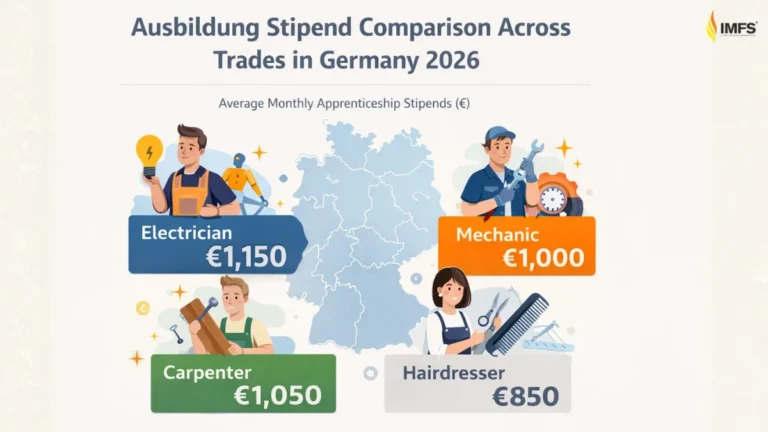
An Ausbildung in Germany pays a monthly training allowance from the first day. Under collective agreements in West Germany, first-year pay in popular trades ranges from about €1,094 to €1,333 a month, and nurses in public-sector hospitals earn €1,491. Pay rises every training year, and the legal minimum for training starting in 2026 is €724 a month.
This guide compares official stipends for 21 trades in euros and rupees, explains what you actually keep after deductions, and shows when your stipend replaces the blocked account for the visa. New to the system? Start with our overview of Ausbildung in Germany for Indians and everything you need to know about Ausbildung, or compare routes in our Study in Germany guide.
Quick Decision Guide: Your Ausbildung Stipend
Use this table to match your priorities to the right kind of trade. It is an orientation guide; your profile, German level and region decide the real outcome.
| If you want… | Look at… | Why |
|---|---|---|
| The highest stipend | Nursing, banking, plant mechanics | €1,268–€1,491 in year 1 under collective agreements |
| A high salary after training | IT, electrical, mechatronics | Median skilled pay of €4,100–€4,600 a month (Entgeltatlas 2025) |
| The shortest training | 2-year trades | For example, sales assistant (Verkäufer/-in) |
| To avoid a blocked account | Any collectively agreed trade | All 21 trades in our table pay more than €1,048 in year 1 |
| Lower living costs | Smaller cities | Rent takes far less of your stipend than in Munich or Frankfurt |
| A faster route to permanent residence | Any Ausbildung + B1 German | Settlement permit typically after 2 years of qualified work |
| A low-paid craft or school-based programme | Check carefully | Pay may be below €1,048, so you would need to top up for the visa |
Sources: BIBB table, West Germany, 1 October 2025; Make it in Germany, vocational training visa; Section 18c Residence Act. Checked October 2026.
Ausbildung Stipend Comparison Table 2026: 21 Popular Trades
These are the collectively agreed monthly training allowances in West Germany as of 1 October 2025, published by the Federal Institute for Vocational Education and Training (BIBB). Nursing pay is the public-sector rate from 1 May 2026. All figures are gross; rupee values at 1 EUR = ₹108 (October 2026).
| Trade | Duration | Year 1 | Year 2 | Year 3 | Year 4* | Year 1 in ₹ |
|---|---|---|---|---|---|---|
| IT & electrical | ||||||
| IT Specialist Fachinformatiker/-in (all specialisations) | 3 yrs | €1,213 | €1,280 | €1,358 | — | ₹1,31,004 |
| IT Systems Electronics Technician IT-System-Elektroniker/-in | 3 yrs | €1,220 | €1,290 | €1,375 | — | ₹1,31,760 |
| Electronics Technician, Industrial Elektroniker/-in für Betriebstechnik | 3.5 yrs | €1,230 | €1,312 | €1,403 | €1,501 | ₹1,32,840 |
| Mechatronics Technician Mechatroniker/-in | 3.5 yrs | €1,227 | €1,299 | €1,391 | €1,475 | ₹1,32,516 |
| Metal, automotive & process | ||||||
| Plant Mechanic (plumbing, heating, air-con) Anlagenmechaniker/-in | 3.5 yrs | €1,268 | €1,345 | €1,443 | €1,536 | ₹1,36,944 |
| Industrial Mechanic Industriemechaniker/-in | 3.5 yrs | €1,224 | €1,290 | €1,378 | €1,457 | ₹1,32,192 |
| Cutting Machine Operator (CNC) Zerspanungsmechaniker/-in | 3.5 yrs | €1,225 | €1,285 | €1,373 | €1,452 | ₹1,32,300 |
| Automotive Mechatronics Technician Kraftfahrzeugmechatroniker/-in | 3.5 yrs | €1,209 | €1,283 | €1,391 | €1,468 | ₹1,30,572 |
| Chemical Production Technician Chemikant/-in | 3.5 yrs | €1,184 | €1,276 | €1,350 | €1,458 | ₹1,27,872 |
| Healthcare | ||||||
| Nurse (public-sector hospitals) Pflegefachmann/-frau (TVAöD) | 3 yrs | €1,491 | €1,552 | €1,653 | — | ₹1,61,028 |
| Business & office | ||||||
| Bank Clerk Bankkaufmann/-frau | 3 yrs | €1,333 | €1,387 | €1,456 | — | ₹1,43,964 |
| Digitalisation Management Assistant Kaufmann/-frau für Digitalisierungsmanagement | 3 yrs | €1,241 | €1,293 | €1,393 | — | ₹1,34,028 |
| Industrial Business Management Assistant Industriekaufmann/-frau | 3 yrs | €1,196 | €1,268 | €1,363 | — | ₹1,29,168 |
| Office Management Assistant Kaufmann/-frau für Büromanagement | 3 yrs | €1,161 | €1,246 | €1,345 | — | ₹1,25,388 |
| Retail & logistics | ||||||
| Warehouse Logistics Specialist Fachkraft für Lagerlogistik | 3 yrs | €1,177 | €1,253 | €1,336 | — | ₹1,27,116 |
| Freight Forwarding & Logistics Assistant Kaufmann/-frau für Spedition und Logistikdienstleistung | 3 yrs | €1,125 | €1,211 | €1,290 | — | ₹1,21,500 |
| Retail Sales Assistant Kaufmann/-frau im Einzelhandel | 3 yrs | €1,096 | €1,206 | €1,339 | — | ₹1,18,368 |
| Sales Assistant (2-year) Verkäufer/-in | 2 yrs | €1,094 | €1,207 | — | — | ₹1,18,152 |
| Hospitality | ||||||
| Hotel Specialist Hotelfachmann/-frau | 3 yrs | €1,117 | €1,235 | €1,353 | — | ₹1,20,636 |
| Chef / Cook Koch/Köchin | 3 yrs | €1,125 | €1,237 | €1,352 | — | ₹1,21,500 |
| Restaurant & Events Specialist Fachmann/-frau für Restaurants und Veranstaltungsgastronomie | 3 yrs | €1,107 | €1,228 | €1,344 | — | ₹1,19,556 |
*Year 4 applies only to 3.5-year trades (final six months). Sources: BIBB table, West Germany, 1 October 2025; BIBB, tariff training allowances 2025; TVAöD Pflege pay table (public sector), from 1 May 2026. Companies in East Germany or without a collective agreement may pay less. Non-tariff companies may pay up to 20% below the agreed rate (Section 17 Vocational Training Act (BBiG)), and never below the legal minimum of €724, €854, €977 and €1,014 for years 1–4 of training starting in 2026 (BIBB, minimum training allowance 2026). Exchange rate 1 EUR = ₹108 (October 2026); rates change daily. Illustrative figures, not a financial guarantee.
Want the full picture for a specific trade? Read our in-depth guides to the Fachinformatiker (IT) Ausbildung, Mechatronics and Electronics Ausbildung, Nursing Ausbildung and Hospitality Ausbildung, or see the best Ausbildung programs for Indians.
Also see: Find your nearest IMFS branch · Counselling services
Why This Matters: Understanding Your Earning Potential
Your stipend decides three things: whether you need a blocked account for the visa, how comfortably you live during training, and how much you depend on money from home. Knowing the real figure, not an average from a blog, is the basis of a sound plan.
Visa and finances
For company-based training, the German Missions accept your training allowance as proof of funds if it is at least €1,048 gross or €822 net a month in 2026. Above that, you do not need to deposit ₹12.86 lakh in a blocked account, the amount required for student visas. Below it, you top up only the shortfall. Source: Make it in Germany, vocational training visa.
Career impact
Trades with higher stipends are often those with skills shortages and better pay after qualifying. In 2024, 79% of apprentices in Germany were kept on by their training company (IAB Kurzbericht 14/2025), so your Ausbildung is usually also your first job.
For parents
The stipend means your child is employed, insured and earning from day one, with no tuition fees. Your main investment is the 12–18 months of German preparation, the visa and travel, plus a buffer for the first weeks before the first payslip.
Key Decision Framework: Choosing the Right Ausbildung
Stipend is only one factor. Weigh these five before you apply:
- Demand in Germany: shortage occupations offer better job security and pay after training.
- Your aptitude: you will spend three to four days a week at the company, so pick work you enjoy.
- Stipend vs. city costs: €1,200 goes much further in a small industrial town than in Munich.
- Career progression: look at further qualifications such as Meister or Techniker, or a later degree.
- German requirements: customer-facing and healthcare trades usually expect stronger German.
| Factor | Technical, IT & healthcare | Business & office | Retail & hospitality |
|---|---|---|---|
| Year 1 stipend (tariff, West) | €1,184–€1,491 | €1,161–€1,333 | €1,094–€1,125 |
| Year 3 stipend | €1,350–€1,653 | €1,345–€1,456 | €1,339–€1,353 |
| Demand | Very high in many fields | Medium to high | High, but lower pay after training |
| Core skills | Maths, technical aptitude, care | Organisation, communication | Service, teamwork, stamina |
| German demands | B1–B2; healthcare often B2 | B2 for office work | B1–B2, daily customer contact |
Source: BIBB table, West Germany, 1 October 2025; TVAöD Pflege pay table (public sector), from 1 May 2026. Ranges cover the trades in our comparison table only.
Eligibility & Requirements for Ausbildung in Germany
Each company sets its own entry requirements, and the visa adds a few more. Here is the 2026 overview for Indian applicants:
| Requirement | Details (2026) |
|---|---|
| School education | Class 10 or 12; companies decide. Class 12 with good marks, or a relevant diploma, makes you more competitive. Check how your marks convert with our German grade calculator. |
| Age | No legal upper limit for the Ausbildung itself. The job-search permit for a training place (Section 17) is for applicants under 35. |
| German | B1 is normally required for the visa; most employers expect B1–B2 in interviews. |
| Visa type | National visa for vocational training (Section 16a Residence Act); the Federal Employment Agency must approve. |
| Proof of funds | Training allowance of at least €1,048 gross / €822 net a month, or a top-up via blocked account, scholarship or sponsorship. School-based training: €959 net a month. |
| Health insurance | Statutory health insurance starts with your employment; the contribution is deducted from your stipend. |
| Training contract | A signed contract with a German company, registered with the chamber (IHK or HWK). |
| APS certificate | Generally not required; APS is for university study (APS India FAQs). |
Sources: Make it in Germany, vocational training visa; Make it in Germany visa overview, January 2026; Section 17 Residence Act. Visa fee €75. Checked October 2026; verify with the German Missions in India before applying.
Document checklist
- Valid passport and visa application form with photos
- Signed training contract and, if applicable, the Federal Employment Agency approval
- German certificate at B1 or higher (Goethe-Institut, telc or ÖSD)
- Class 10 and 12 mark sheets and any diploma, with certified translations
- German-style CV (Lebenslauf) and motivation letter
- Proof of funds: training allowance in the contract, plus top-up evidence if it is below €1,048 gross
All test prep · IMFS branches
Timeline for Ausbildung Application (2027 Intake)
Most Ausbildung programmes start in August or September, and large companies recruit about a year ahead. If you are starting from zero German, plan 12–18 months.
| Phase | When (for an August/September 2027 start) | Key tasks |
|---|---|---|
| 1. German and research | Now – early 2027 | Reach B1, aim for B2. Shortlist trades and companies. |
| 2. Applications | October 2026 – March 2027 | German CV and cover letters; apply widely; video interviews and aptitude tests. |
| 3. Contract | February – May 2027 | Sign the training contract; check the exact allowance against the €1,048 threshold. |
| 4. Visa | April – July 2027 | Book your appointment early; processing can take several weeks after approval by the Federal Employment Agency. |
| 5. Arrival | August – September 2027 | Register your address, open a bank account and start training. |
IMFS planning guide based on typical recruitment cycles; individual companies and missions vary.
Cost of Living & What You Actually Keep
Your stipend is paid gross. Social insurance takes about 21% of it, and that includes your health insurance, so you do not pay for health cover separately.
From gross to net: three examples
| Trade (year 1) | Gross | Approx. net | Approx. net in ₹ |
|---|---|---|---|
| Sales assistant (lowest in our table) | €1,094 | €865 | ₹93,420 |
| IT specialist (Fachinformatiker) | €1,213 | €960 | ₹1,03,680 |
| Nurse, public sector (from May 2026) | €1,491 | €1,180 | ₹1,27,440 |
IMFS estimate assuming about 21% social insurance and no income tax at this level. Your payslip may differ slightly. Exchange rate 1 EUR = ₹108 (October 2026).
Typical monthly costs outside the most expensive cities
| Expense | Per month (€) | Per month (₹) |
|---|---|---|
| Rent (shared flat or room, including utilities) | €350 – €550 | ₹37,800 – ₹59,400 |
| Food and groceries | €200 – €280 | ₹21,600 – ₹30,240 |
| Public transport (Deutschlandticket, €63) | €63 | ₹6,804 |
| Phone and internet | €20 – €40 | ₹2,160 – ₹4,320 |
| Personal and leisure | €60 – €120 | ₹6,480 – ₹12,960 |
| Total | €693 – €1,053 | ₹74,844 – ₹1,13,724 |
IMFS estimate for smaller and mid-sized cities, October 2026. Rents in Munich, Frankfurt, Hamburg and Stuttgart are often €600–€900 for a room. Health insurance is not listed because it is deducted from your stipend. Illustrative only — not a financial guarantee. Plan your own budget with our cost calculator and read our guide to renting in Germany and the best cities for Indian students.
Salary after the Ausbildung
Once qualified, pay rises sharply. The Federal Employment Agency's Entgeltatlas shows these median gross monthly salaries for skilled workers in 2025:
| Occupational group (skilled worker) | Median gross per month | Approx. in ₹ |
|---|---|---|
| Mechatronics and automation | €4,105 | ₹4.43 lakh |
| Electrical operating technology | €4,440 | ₹4.80 lakh |
| Software development (IT specialist) | €4,612 | ₹4.98 lakh |
Source: Bundesagentur für Arbeit, Entgeltatlas (reference year 2025), full-time employees, all ages. Starting pay right after qualifying is usually lower; hospitality and retail pay less than technical trades. Illustrative — not a financial guarantee. See our guide to high-paying jobs in Germany.
Check your Germany admission readiness · Bachelor's counselling · Master's counselling · Scholarships
Tips for Success in Your Ausbildung Journey
For students
- Read the contract figure, not the average: your visa depends on the allowance written in your training contract.
- Target collectively agreed employers: larger companies and the public sector usually pay the tariff rates in our table.
- Reach B2 if you can: it opens better companies and makes vocational school and exams far easier.
- Apply widely and early: German-language CV and cover letter for each company; many places are filled a year ahead.
- Pick your city wisely: the same stipend buys a much better life outside the most expensive cities.
- Use the 20-hour rule carefully: a second job is allowed, but your training and Berufsschule come first.
For parents
- Budget for preparation, not tuition: German classes, certificates, translations, visa and flights are the main costs.
- Keep a starting buffer: one to two months of living costs until the first payslip.
- Plan long term: PR typically comes two years after qualifying; India does not allow dual citizenship, so German citizenship means giving up Indian citizenship (OCI is available).
Avoid the usual traps with our list of common mistakes Indian students make in Germany, and read about the German residence permit and health insurance.
Key Takeaways & Best Strategy
- First-year stipends in 21 popular collectively agreed trades range from €1,094 to €1,333, and €1,491 for public-sector nursing; they rise every year.
- All 21 trades in our table clear the €1,048 visa threshold in year 1, so no blocked account is needed if your company pays the agreed rate.
- Non-tariff and craft employers can pay less; check your contract and top up only the shortfall.
- Expect to keep about 79% of your gross stipend; health insurance is already included.
- After training you can stay up to 18 months to find work, and PR typically follows after two years of qualified employment.
If you hold or are completing a Bachelor's degree, a Master's in Germany may be the better route. Plan the university requirements early with ECTS credits explained and our complete APS, ECTS and dMAT guide, or compare costs in free education in Germany.
Check if you need the dMAT · dMAT exam guide · dMAT preparation guide · APS certificate guide
Exchange rate used throughout: 1 EUR = ₹108 (October 2026), based on the weekly average EUR/INR rate. Rates change daily — consult IMFS for a current estimate.
Frequently Asked Questions
What is the average monthly stipend for an Ausbildung in Germany?
Is the Ausbildung stipend enough to cover living costs in Germany?
Which Ausbildung trades offer the highest stipends in Germany?
Do I need a blocked account for an Ausbildung visa?
Can I work a part-time job during my Ausbildung?
What is the difference between a school-based and a company-based Ausbildung stipend?
How does the stipend increase over the years of Ausbildung?
Are there any deductions from the Ausbildung stipend?
Can I get PR in Germany after completing an Ausbildung?
What is the salary after completing an Ausbildung?
Do I need the APS certificate for an Ausbildung visa?
Related Germany Guides
Last reviewed: October 2026. Figures are from BIBB, the public-sector TVAöD pay table, the IAB, the Federal Employment Agency, Make it in Germany and German federal law, checked October 2026. Allowances, visa rules and thresholds change; verify with the official sources and the German Missions in India before applying. For informational purposes only — not legal or financial advice.
Talk to an IMFS Consultant — Free
Trade selection, German coaching from A1 to B2, application documents and visa guidance for your Ausbildung in Germany. No fees. No pressure.
Or walk in at any of our 10 IMFS branches — Matunga, Thane, Borivali, Vashi, Shivaji Nagar (Pune), Kukatpally, LB Nagar, Madhapur, Nellore and Warangal.