Home › Study in Germany › Mechatronics & Electronics Ausbildung
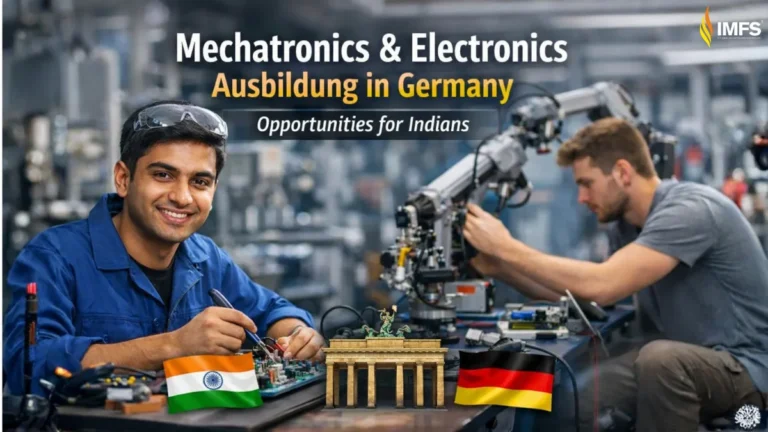
Ausbildung in Mechatronics & Electronics in Germany: The Complete 2026 Guide for Indian Students
1. The visa usually needs B1 German, not B2 — but most employers still expect B1–B2 in interviews. 2. You skip the blocked account only if your training allowance is at least €1,048 gross a month. 3. India does not allow dual citizenship, so plan your long-term status carefully.
Book free Germany counselling WhatsApp +91 93225 09674
- An Ausbildung is a paid, 3.5-year dual training: you work at a company and attend a vocational school (Berufsschule).
- Under collective agreements in West Germany, apprentices earn €1,227–€1,501 gross a month, from year 1 to year 4 (BIBB, October 2025).
- The visa usually needs B1 German, a signed training contract and approval from the Federal Employment Agency.
- A blocked account is not needed if your allowance is at least €1,048 gross a month in 2026; otherwise you must top up.
- The APS certificate is for university study and is generally not part of the Ausbildung visa process.
- In 2024, 79% of apprentices were kept on by their training company (IAB).
- After a German Ausbildung, a settlement permit is typically possible after two years of skilled work.
- Choose a Bachelor's instead if you want R&D, design or a Master's — but expect a Studienkolleg and a blocked account.
- Quick Decision Guide
- What is an Ausbildung?
- Mechatroniker vs. Elektroniker
- Curriculum, stipend and what you earn
- Salary and career prospects
- Step-by-step application guide
- Visa and the blocked account
- Staying in Germany: jobs, PR and citizenship
- Ausbildung vs. Bachelor of Engineering
- Who should choose which path?
- FAQ
An Ausbildung in Mechatronics or Electronics is a paid, 3.5-year apprenticeship in Germany that Indian students can join after Class 12. You train at a company such as a machine builder, automation firm or manufacturer, attend a vocational school one to two days a week, and earn about €1,230 a month from the first year under collective agreements. The visa usually needs B1 German and a signed training contract.
This guide covers what you learn, what you earn in euros and rupees, how to apply from India, the visa rules that actually apply in 2026, and how the route compares with a Bachelor's degree. If you are still choosing between routes, start with our Study in Germany guide and our overview of Ausbildung in Germany for Indians. Comparing countries as well? Our Study in Europe guide and study abroad hub cover the other options.
Quick Decision Guide
Use this table to see quickly whether an Ausbildung fits your goals. It is an orientation guide; your profile, German level and the region decide the real outcome.
| If you want… | Ausbildung is… | Why |
|---|---|---|
| To earn from the first month | Ideal | Monthly training allowance; no tuition fees at the Berufsschule |
| To avoid a large education loan | Ideal | No blocked account if the allowance is at least €1,048 gross a month |
| Hands-on industrial work | Ideal | Most of your time is spent at the training company |
| A route to permanent residence | Strong | Settlement permit typically after 2 years of skilled work |
| To work for large industrial employers | Direct route | Large manufacturers and the Mittelstand train thousands of apprentices |
| Research, design engineering or R&D | Not ideal | A Bachelor of Engineering suits these roles better |
| A Master's or PhD later | Not direct | Possible via Meister or Techniker, but it takes longer |
| You have Class 12 PCM | Eligible | A relevant diploma makes you more competitive |
| You will learn German | Required | B1 for the visa; B1–B2 expected by most employers |
| Mainly classroom learning | Reconsider | The Ausbildung is predominantly practical |
Sources: Make it in Germany visa overview, January 2026; Section 18c Residence Act. Checked October 2026.
What Is an Ausbildung — and Why Does It Beat a Regular Degree?
An Ausbildung is Germany's dual vocational training: you are employed by a company and also attend a state vocational school. You usually spend three to four days a week at the company and one to two days at the Berufsschule, or the school days come in blocks. Both parts are compulsory, and the company pays you a monthly training allowance throughout.
For Indian students, the key difference from a degree is that you are an employee from day one, not a student. For a broader introduction, read everything you need to know about Ausbildung in Germany. You sign a training contract, pay into German social insurance and gain work experience that employers value. Whether it "beats" a degree depends on your goal: it is faster and cheaper for hands-on technical careers, while a degree from one of the best universities in Germany is better for research and design.
The Two Professions: Mechatroniker vs. Elektroniker
Mechatroniker and Elektroniker are two separate, nationally recognised occupations, each with its own training regulation. Both take 3.5 years, but they focus on different work.
| Mechatroniker (Mechatronics Technician) | Elektroniker für Betriebstechnik (Electronics Technician, Industrial) | |
|---|---|---|
| Focus | Combines mechanical, electrical and software systems | Electrical and electronic systems in plants and buildings |
| Typical work | Assembling, programming and maintaining automated machines and production lines | Installing power supply, control cabinets and automation systems; fault-finding |
| Core skill | PLC programming and system integration | Electrical installation, measurement and safety (VDE standards) |
| Duration | 3.5 years | 3.5 years |
Source: BIBB occupational profiles; BIBB table, West Germany, 1 October 2025. Checked October 2026.
Curriculum, Stipend & What You Earn — 2026 Figures
Both occupations run for 3.5 years under a national training regulation, and you are paid every month from the start. The figures below are the collectively agreed allowances most large employers follow.
What You Learn at the Berufsschule (Mechatronics)
- Mechanical assembly and fabrication of machine components
- Electrical wiring, installation and component testing
- PLC programming to automate industrial processes
- Reading and creating technical drawings and circuit diagrams
- Hydraulic and pneumatic systems
- Quality assurance and measurement technology
What You Learn at the Berufsschule (Electronics — Industrial Technology)
- Installing and commissioning power supply systems and control cabinets
- Programming and configuring automation systems
- VDE safety standards and legally required safety procedures
- Measuring and analysing electrical and electronic systems
- Troubleshooting circuits and programmable controllers
- Energy-efficient building and plant technology
Monthly Stipend — 2026 Figures
Training allowances rise each year. These are the collectively agreed rates in West Germany from 1 October 2025, with rupee values at 1 EUR = ₹108 (October 2026).
| Mechatroniker | Gross per month | Approx. in ₹ |
|---|---|---|
| Year 1 | €1,227 | ₹1,32,516 |
| Year 2 | €1,299 | ₹1,40,292 |
| Year 3 | €1,391 | ₹1,50,228 |
| Year 4 (final 6 months) | €1,475 | ₹1,59,300 |
| Elektroniker für Betriebstechnik | Gross per month | Approx. in ₹ |
|---|---|---|
| Year 1 | €1,230 | ₹1,32,840 |
| Year 2 | €1,312 | ₹1,41,696 |
| Year 3 | €1,403 | ₹1,51,524 |
| Year 4 (final 6 months) | €1,501 | ₹1,62,108 |
Sources: BIBB table, West Germany, 1 October 2025; BIBB, tariff training allowances 2025. Companies in East Germany or without a collective agreement may pay less, but not below the legal minimum for training starting in 2026: €724, €854, €977 and €1,014 for years 1–4 (BIBB, minimum training allowance 2026). Exchange rate 1 EUR = ₹108 (October 2026); rates change daily — consult IMFS for a current estimate. Illustrative figures, not a financial guarantee.
Also see: German language coaching (A1–B2) · Find your nearest IMFS branch
Salary & Career Prospects After Ausbildung
After qualifying you become a Facharbeiter (skilled worker), the backbone of German industry. Pay depends heavily on region, company size and collective agreement.
Starting Salary — Newly Qualified (2025–2026)
| Level | Gross per month | Approx. in ₹ | Basis |
|---|---|---|---|
| Newly qualified Mechatroniker or Elektroniker | €3,000 – €3,800 | ₹3.24 lakh – ₹4.10 lakh | Estimated; varies by region and collective agreement |
| Skilled worker, mechatronics and automation (all experience levels) | €4,219 (median) | ₹4.56 lakh | Measured — Entgeltatlas 2025 |
| Specialist level, e.g. Meister or Techniker | €5,260 (median) | ₹5.68 lakh | Measured — Entgeltatlas 2025 |
Source: Bundesagentur für Arbeit, Entgeltatlas (reference year 2025), occupational group mechatronics and automation technology, full-time gross median. Starting range is an IMFS estimate. Net pay is typically 60–70% of gross depending on tax class. Exchange rate 1 EUR = ₹108 (October 2026). Illustrative — not a financial guarantee.
Job Roles After Qualification
| Role | What you do |
|---|---|
| Automation technician | Programs and maintains robots and automated assembly lines |
| Industrial maintenance specialist | Keeps machinery running; diagnoses mechanical, electrical and software faults |
| PLC programmer | Develops and maintains the controllers that run production processes |
| High-voltage and e-mobility technician | Works on battery systems and charging infrastructure (extra certification required) |
| Quality control technician | Uses precision measurement to keep production within standards |
| Field service technician | Installs and services equipment at customer sites, often with travel |
The Long-Term Career Ladder: Meister & Techniker
The Ausbildung is the foundation, not the ceiling. With work experience you can take further qualifications:
- Industriemeister: an IHK qualification in advanced technical and leadership skills. It allows you to train apprentices and lead teams.
- Staatlich geprüfter Techniker: a two-year full-time (or four-year part-time) state programme between skilled worker and engineer. Both qualifications can also open access to university study in Germany, for example at one of the top STEM universities in Germany.
Step-by-Step Application Guide for Indian Students (2026)
Applying from India takes 12 to 18 months from your first German lesson to your visa. Large companies recruit about a year before training starts, usually for an August or September start.
| Step | What to do |
|---|---|
| 1. Check eligibility | Class 12 with good Physics and Maths. A relevant 3-year diploma strengthens your application and may shorten training. See how your marks convert with our German grade calculator. |
| 2. Learn German | Reach at least B1 (Goethe-Institut or telc); aim for B2 for interviews. Allow 12–18 months from zero. IMFS German coaching |
| 3. Prepare documents | German-style CV (Lebenslauf), a cover letter (Anschreiben) for each company, certified translations of Class 10 and 12 mark sheets and diploma, and your language certificate. |
| 4. Find positions | Search ausbildung.de, azubiyo.de, the Federal Employment Agency job portal and Make it in Germany, plus company career pages. Apply to large firms and Mittelstand companies. |
| 5. Interview and tests | Usually a video interview in German, with reasoning tests, spatial tasks and basic physics and electronics questions. |
| 6. Sign the contract | The company registers your training contract with the chamber (IHK or HWK). |
| 7. Apply for the visa | Apply at the German Missions in India with your contract and German certificate; the Federal Employment Agency must approve. |
Visa: When You Do NOT Need a Blocked Account
You do not need a blocked account for the vocational training visa if your training allowance is high enough to cover your living costs. In 2026 the threshold is €1,048 gross (€822 net) a month, according to Make it in Germany.
| Visa type | Purpose | Blocked account? | Proof of funds |
|---|---|---|---|
| Student visa | University degree | Yes — €11,904 (2026) | Blocked account, scholarship or sponsorship |
| Vocational training visa (dual) | Company-based Ausbildung | Usually no | Training allowance of at least €1,048 gross / €822 net a month |
| Vocational training visa (dual), low allowance | Allowance below the threshold | Top-up needed | Blocked account, scholarship or formal sponsorship for the shortfall |
Sources: Make it in Germany visa overview, January 2026; Make it in Germany, vocational training visa. Checked October 2026. Visa fee €75. Requirements can change — verify with the German Missions in India before applying.
Staying in Germany: Jobs, PR and Citizenship
After a German Ausbildung you can stay and work as a skilled worker, and permanent residence typically follows after two years of qualified employment. Our guide to the German residence permit explains how the permit itself works.
| Stage | Typical rule (2026) |
|---|---|
| After qualifying | Work as a skilled worker; if you need time, a permit of up to 12 months to look for a job is available |
| Settlement permit (PR) | Typically after 2 years of qualified work, with 24 months of pension contributions and B1 German |
| German citizenship | After 5 years of residence (the 3-year fast track was abolished in October 2025) |
| Dual citizenship | Germany allows it, but India does not — you would give up Indian citizenship and can apply for OCI |
When you arrive, three tasks come first: register your address (Anmeldung), open a German bank account for your allowance, and confirm your health insurance. Our list of common mistakes Indian students make in Germany helps you avoid the usual traps.
Sources: Section 18c Residence Act; The Local, 31 October 2025 (citizenship). Timelines are typical, not guaranteed. Checked October 2026. More: Germany job seeker visa · EU Blue Card and PR.
Check your Germany admission readiness · Bachelor's counselling · Master's counselling · Scholarships
Ausbildung vs. Bachelor of Engineering in Germany
An Ausbildung is the faster, paid route into a technical job; a Bachelor's is the academic route into engineering design, research and further study. The table compares them for Indian students in 2026.
| Factor | Ausbildung | Bachelor of Engineering |
|---|---|---|
| Duration | 3.5 years | 3–3.5 years (plus about 1 year Studienkolleg for most Class 12 graduates) |
| Entry from India | Class 12; company decides | Class 12 plus Studienkolleg, or JEE Advanced, or a year of university study in India |
| Fees | None | No tuition at most public universities; semester contribution about €150–€430 |
| Income during training | €1,227–€1,501 a month (tariff, West) | Part-time work up to 140 full days or 280 half days a year |
| Proof of funds for visa | Training allowance (if at least €1,048 gross) | €11,904 blocked account (2026) |
| Language | German B1 for the visa; B1–B2 in practice | German C1 for German-taught; IELTS/TOEFL for the few English-taught programmes |
| Work focus | Hands-on, production and maintenance | Theory, design and laboratory work |
| Career path | Skilled worker → Meister/Techniker → team lead | Engineer → R&D, design, Master's or PhD |
| After completion | 79% kept on by training company (all occupations, 2024) | Job search; up to 18 months post-study permit |
Sources: IAB Kurzbericht 14/2025; Make it in Germany visa overview, January 2026; DAAD; checked October 2026. Illustrative comparison, not a career guarantee. Compare costs with our free education in Germany guide and best STEM universities in Germany.
If the academic route suits you better, plan the university requirements early. Master's applicants need enough credits — read ECTS credits explained and our complete APS, ECTS and dMAT guide. Still comparing destinations? See USA vs Germany for an MS and our data study Germany vs Canada, or how Germany grew among Indian students in Germany's rise 2016–2026. Students can estimate part-time income with our part-time earnings calculator.
Check if you need the dMAT · dMAT exam guide · dMAT preparation guide · Analysis of the first dMAT
Who Should Choose Which Path?
Choose the occupation that matches what you enjoy doing every day; both lead to secure skilled jobs.
| Choose Mechatronics if… | Choose Electronics if… |
|---|---|
| You like how robots and automated machines work | You like circuits, power systems and control electronics |
| You enjoy combining mechanical, electrical and software parts | You want to specialise in automation, energy or building technology |
| You see yourself on production lines in machine building or manufacturing | You see yourself in plant engineering, utilities or electrical contracting |
| A Mechanical or Electrical diploma strengthens your case | An Electrical or Electronics diploma may shorten your training |
Not sure? Our counsellors combine your marks, interests and German plan into a recommendation, and our guide to the best cities in Germany for Indian students helps you compare where to train. Explore other routes too: Fachinformatiker (IT) Ausbildung and Nursing Ausbildung.
German language coaching · All test prep · ECTS guidance · Free study abroad tools
Exchange rate used throughout: 1 EUR = ₹108 (October 2026), based on the weekly average EUR/INR rate. Rates change daily — consult IMFS for a current estimate.
Frequently Asked Questions
Is Indian Class 12 PCM enough for a Mechatronics or Electronics Ausbildung in Germany?
What German language level do I need for an Ausbildung?
How much do Mechatronics and Electronics apprentices earn in Germany?
Do I need a blocked account for an Ausbildung visa?
Is the APS certificate required for an Ausbildung visa?
Can I go to Germany to search for an Ausbildung place?
Can the 3.5-year Ausbildung be shortened for diploma holders?
What is the job prospect after a Mechatronics or Electronics Ausbildung?
How long does it take to get permanent residence after an Ausbildung?
Ausbildung or Bachelor of Engineering in Germany — which is better for Indian students?
More Germany Guides from IMFS
Last reviewed: October 2026. Figures are from BIBB, the IAB, the Federal Employment Agency, Make it in Germany and German federal law, checked October 2026. Allowances, visa rules and thresholds change; verify with the official sources and the German Missions in India before applying. For informational purposes only — not legal or financial advice.
Talk to an IMFS Consultant — Free
Personalised guidance for Ausbildung, German language and university routes in Germany. No fees. No pressure.
Or walk in at any of our 10 IMFS branches — Matunga, Thane, Borivali, Vashi, Shivaji Nagar (Pune), Kukatpally, LB Nagar, Madhapur, Nellore and Warangal.